September 19, 2026 · 9 min read
Athens Acropolis and Plaka Walk
A self-guided Athens walking tour through the old lanes of Plaka and Anafiotika, around the ancient Agora, and up to the Acropolis itself.
548
September 19, 2026 · 9 min read
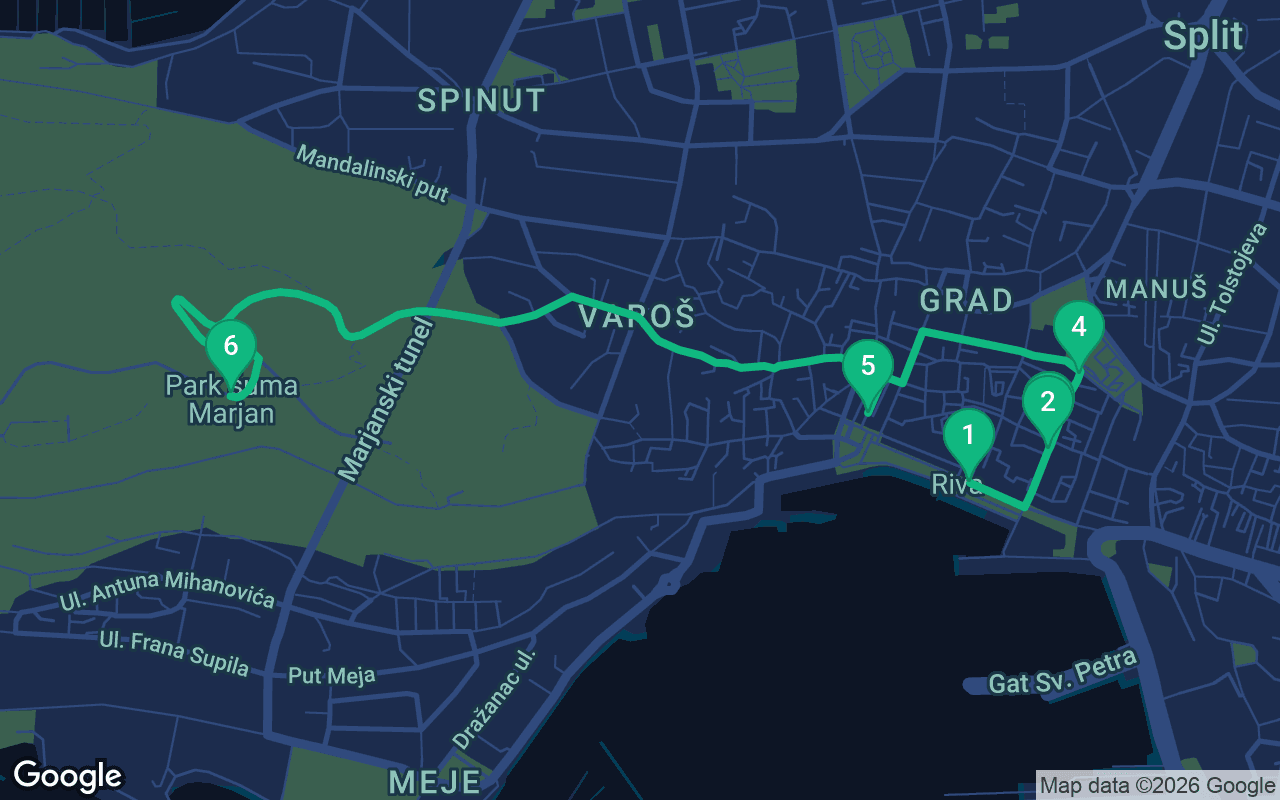
Przejdź tę trasę z innymi podczas najbliższej zaplanowanej wycieczki.
Około 2,6 km, około 41 minut spokojnym tempem · 6 przystanków
Split is a city that lives inside a Roman palace. Seventeen centuries ago a retired emperor built himself a vast stone retirement home by the Adriatic, and instead of crumbling into a ruin, it filled up with people, shops, homes, and churches, and never emptied out again. This self-guided Split walking tour takes you through that living palace and out to the green hill that shelters it, and it is one of the more remarkable self-guided walking tours you can do, since the ancient walls here are not a museum you look at but streets you walk down. It is a short loop, under three kilometers, but it packs in a Roman cellar, an emperor's mausoleum, a bustling square, and a viewpoint over the whole red-roofed old town and the islands beyond. Wear comfortable shoes for the marble and the climb, and give it a slow half day.
Set aside three or four hours, more if you climb the bell tower or the hill at the end or stop for a long seafood lunch, which by the water you should. The old town of Split is tiny and dense, a warren of marble lanes polished smooth by centuries of feet, so wear shoes with a bit of grip and expect to get pleasantly lost, since the palace is a maze and that is part of the fun. Summers here are hot and the stone holds the heat, so start early, carry water, and use the shade of the narrow lanes. Almost everything on this route is packed into a few hundred meters, until the final stretch out to the hill, so you can wander freely and always find your way back to the seafront to reorient. The one longer leg is the walk up to Marjan at the end, a gentle climb that earns its view. And do stop as you go for a coffee on the Riva or a snack in a hidden courtyard, because Split is a city that takes its leisure seriously.
Start on the Riva, the wide, palm-lined promenade that runs along the seafront in front of the palace, the living room of the whole city. This is where Split comes to stroll, meet, and drink coffee, a broad marble esplanade of cafe terraces facing the harbor, with the old palace wall rising directly behind it and the boats and islands out in front. Take a seat for a few minutes, order a coffee, and watch the town go by, because the slow seafront stroll is a genuine local ritual, especially in the golden hour before dinner. The southern wall of Diocletian's Palace looms right behind the cafes, and hidden in it is a small doorway, the old sea gate, that leads straight into the heart of the ancient complex. Once, before the land in front was reclaimed, the sea came right up to this wall and boats could sail in through that gate. Get a feel for the scale of the palace front from out here, the long line of Roman stone with the modern cafe life bustling at its foot, then step through the Bronze Gate in the middle of the wall and into the cool shadows of the palace cellars.
 Through the sea gate you enter the substructures of the palace, the podrumi, a vast complex of vaulted stone cellars that once formed the foundations of the emperor's private apartments above. For centuries these halls were filled with rubbish and forgotten, which is exactly why they survived so intact, and clearing them out revealed a near-perfect map in stone of the grand imperial rooms that once stood overhead. Walking through the cool, dim, echoing chambers is like stepping straight back into the fourth century, the bare Roman stonework rising into shadowy arches above you. Part of the complex is free to pass through, the central corridor that links the seafront to the square above, usually lined with market stalls selling crafts and souvenirs, and a larger ticketed section opens off it if you want to explore the full extent of the cellars. Fans of a certain television show about dragons may recognize these halls, which have stood in for more than one throne room. Take a slow walk through the vaults, feel the temperature drop and the centuries fall away, then climb the stairs at the far end, which lift you up into the bright ceremonial center of the palace.
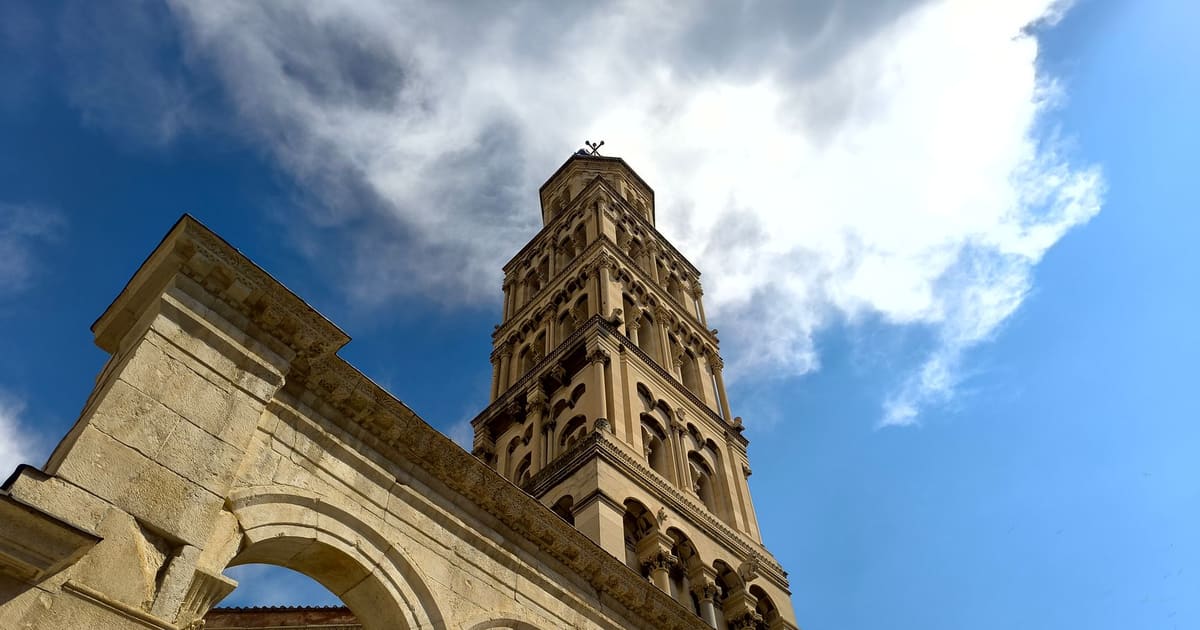
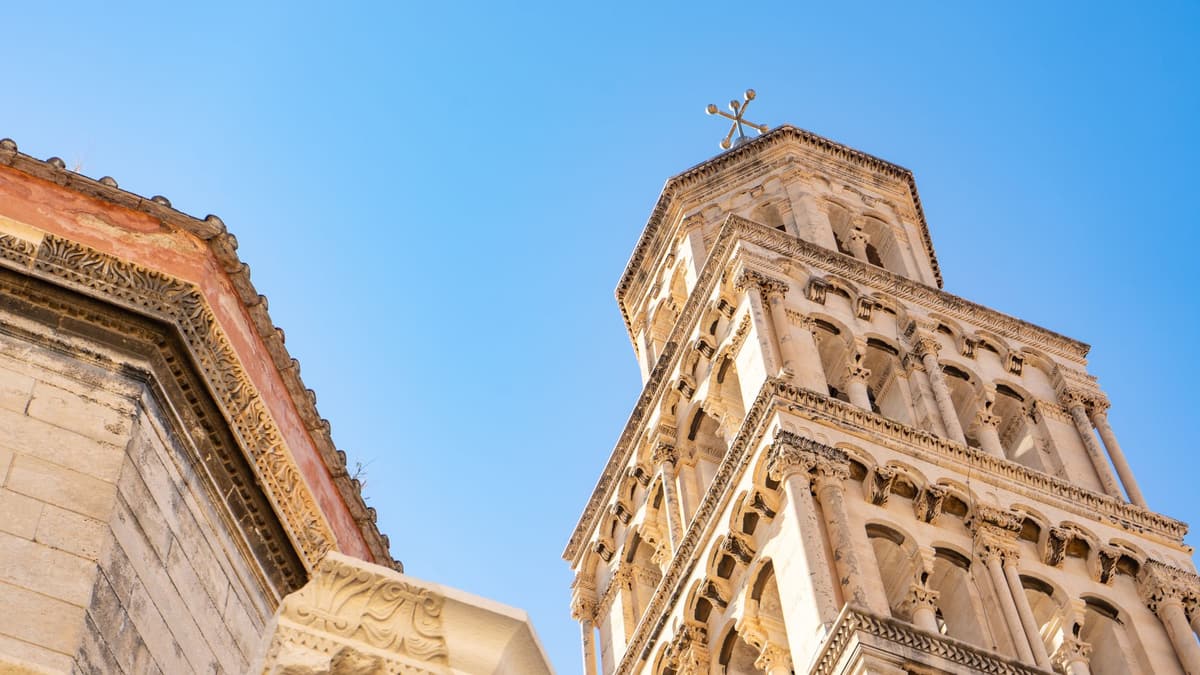
You emerge into the Peristyle, the monumental colonnaded courtyard at the very center of the palace, and it is the showpiece of the whole old town. This was the emperor's ceremonial square, ringed by columns and arches of imported stone, where subjects would gather to greet Diocletian as a living god descending the steps from his apartments. Today its steps are an open-air stage where people sit with a drink and listen to a singer in the evenings, the same stones serving as a theater seventeen centuries on. On one side rises the Cathedral of Saint Domnius, which began life as Diocletian's own mausoleum, a strange twist since the emperor was a famous persecutor of Christians, and the very tomb built for him became a church dedicated to one of his victims. Its slender medieval bell tower is the symbol of Split, and if you have the legs, the steep climb up its open stairways gives a wonderful view over the rooftops. Directly opposite, down a tiny lane, stands the little Temple of Jupiter, remarkably intact, once dedicated to the king of the gods and later turned into a baptistery, guarded now by a headless black sphinx carried here from Egypt long ago. Linger in this dense knot of monuments, the beating heart of the palace, then head north up the main street toward the old landward gate.
 The main street of the palace leads you to the Golden Gate, once the grand landward entrance and the most ornate of the four Roman gates, facing the road to the emperor's birthplace inland. It is a handsome, weathered arch of Roman stonework, and passing through it you leave the old palace walls behind for a moment. Just outside stands the giant bronze statue of Gregory of Nin, a medieval Croatian bishop who famously fought for the right to worship in the Croatian language rather than Latin, sculpted by the great Croatian artist Ivan Mestrovic. The statue is enormous, all robes and beard and raised finger, and there is a well-loved local tradition that rubbing his big toe, worn golden and shiny by countless hands, brings good luck and a return to Split, so give it a rub as everyone does. Around here you can see stretches of the old walls from the outside and get a real sense of the palace as a fortress. Have a look at the gate and the statue, then turn back toward the medieval squares that grew up just beside the Roman core.
West of the palace lie the two great squares of medieval Split, where the town spilled out beyond the Roman walls in the Middle Ages. The first is the Pjaca, properly the People's Square, the old civic heart just outside the western gate, a bright open space of pale stone ringed by cafes, a Venetian-Gothic old town hall, and handsome old buildings, and it hums with life all day. It has been the meeting place of the townsfolk for centuries, and its terraces are a perfect spot to sit with a coffee and watch Split go about its business. A short walk south brings you to the Prokurative, more formally the Republic Square, a striking and unusual space open on one side to the sea and framed on the other three by matching arcaded buildings in a deep Venetian red, modeled on the great square of Venice itself. It is grand and theatrical, and often hosts concerts and events under the arches. These two squares show you the Split that grew up around the palace, the medieval and Venetian town that wrapped itself around the Roman bones. From the Prokurative, head west along the seafront, leaving the old town behind, and begin the gentle climb toward the green hill that watches over it all.
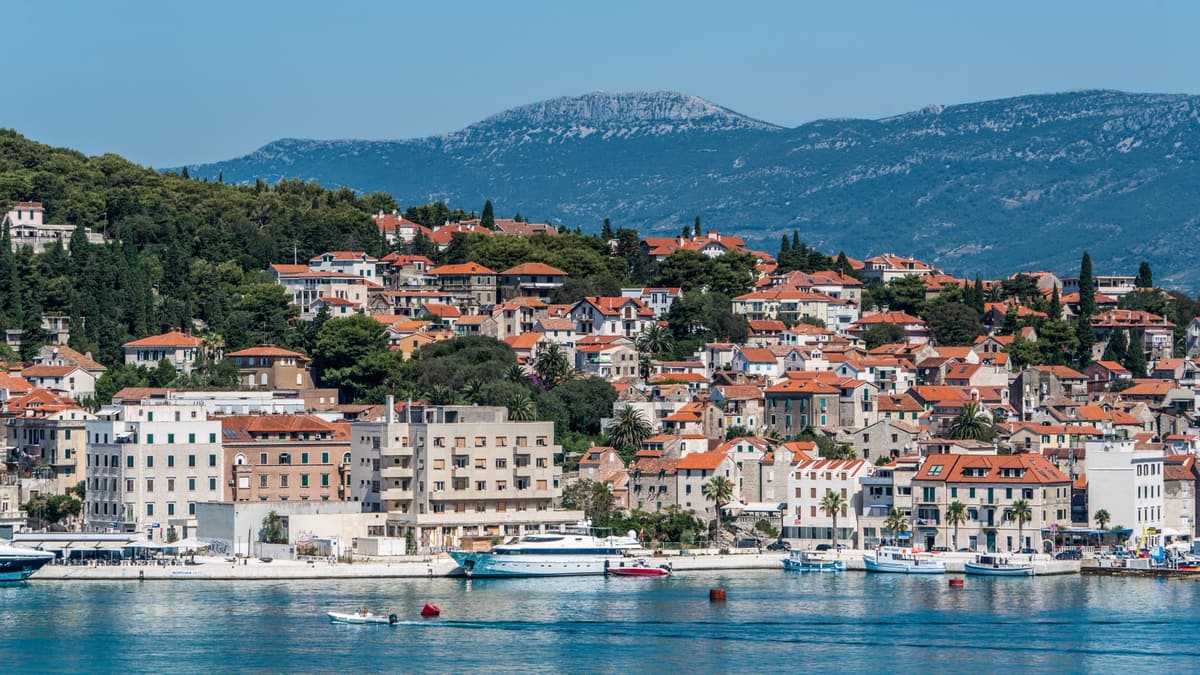
 The walk ends with a climb into Forest Park Marjan, the great pine-covered hill that rises straight out of the sea at the western edge of the old town, the green lung and beloved playground of the whole city. A path and a series of stone steps lead up through the old fishermen's quarter of Varos and on into the fragrant pine woods, and the effort is repaid quickly, because the first viewpoint terrace opens a wonderful panorama back over the whole of Split, the red roofs and the bell tower of the palace, the harbor full of boats, and the islands scattered across the blue Adriatic beyond. There is usually a cafe near the top where you can catch your breath with a cold drink and the view. Marjan is laced with trails, chapels, and lookouts, and you can go as far up as you like, but even the first terrace is a fitting, uplifting place to end, the entire route you have just walked laid out below you in miniature. Sit for a while and pick out the palace you explored, the squares, the seafront, then wander back down whenever you are ready. From a Roman cellar by the sea to a hilltop over the islands, it is a short walk that holds an astonishing amount of the world.
Split is a city you can only really understand on foot, because its wonders are woven into a maze of marble lanes far too narrow and tangled for anything on wheels. Walking is how you feel the strange, wonderful truth of the place, that people live and shop and sleep inside a Roman emperor's palace, hanging their laundry between seventeen-hundred-year-old columns. The old town is tiny, so getting lost costs you nothing and usually turns up the best corners, and the seafront is always there to set you straight. Go early to beat the heat and the cruise-ship crowds, save the hill for last, and let yourself wander off the route into any lane that looks inviting. If you would rather not walk it alone, open the Walk With Me live map to see who else is out walking Split, and share a coffee on the Riva or the view from Marjan with a little company.
Wszystkie przystanki tego spaceru po Split, Croatia, po kolei.
Około 2,6 km, mniej więcej 41 minut w spokojnym tempie.
Działa z Garmin, Komoot, Strava, OS Maps i dowolną aplikacją GPX.
September 19, 2026 · 9 min read
A self-guided Athens walking tour through the old lanes of Plaka and Anafiotika, around the ancient Agora, and up to the Acropolis itself.
September 19, 2026 · 8 min read
A self-guided barcelona walking tour from Placa de Catalunya down the Ramblas into the Gothic Quarter and El Born to Santa Maria del Mar.
September 19, 2026 · 8 min read
A self-guided bruges walking tour from the Markt and its belfry through the squares and along the canals to the Beguinage and the Lake of Love.