September 2, 2026 · 9 min read
エディンバラ・ロイヤル・マイル散策ルート
エディンバラのロイヤル・マイルを巡る究極の散策ルートをご紹介します。火山岩の丘にそびえる城から宮殿の門へと下る、歴史の魅力が詰まったセルフガイドの旅を、自分のペースでじっくりと楽しんでみませんか。歩くたびに新しい発見が待っています。
507
August 27, 2026 · 9 min read
次回予定されているツアーで、他の人と一緒にこのウォークをしましょう。
約2.4 km、ゆったりしたペースで約33分 · 8停留所
オーディオツアー ・ 音声ガイド 11 分$4.99(1回のみの購入)
Florence is a city you can hold in the palm of your hand, its Renaissance treasures clustered so tightly that a single walk carries you past more masterpieces than most cities own in total. If you are dreaming up a walking tour in Italy, this Florence self guided walking tour threads the essential heart of the old city, starting under the great tiled dome of the cathedral, crossing the theatrical main square with its open-air sculptures, stepping onto the jewelers' bridge over the river, and ending at the vast church where the geniuses of the Renaissance lie buried. It is short in distance but immense in what it holds.
Before you set off, a word on logistics. This walk is only about four to five kilometers, so the distance is easy, but Florence rewards slowness, and you could stretch it across a whole day of gazing upward. The center is paved in stone and largely flat, though the streets are narrow and often crowded, so wear shoes you can walk and stand in comfortably. Early morning is magical here, before the tour groups arrive, when the light is soft and the squares are nearly empty. If you are listening as you walk, remember to look up from the screen often, because in this city the ceilings and rooftops are half the show, and step aside into a doorway whenever you want to pause and simply stare.
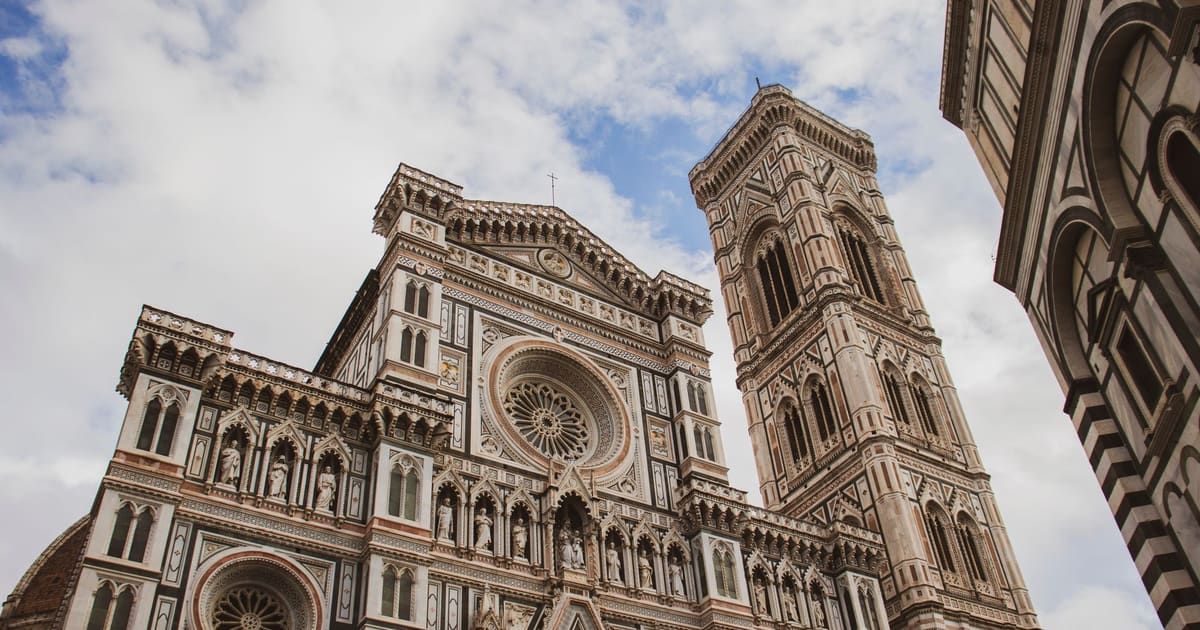
You begin where Florence itself seems to begin, in the square beneath the cathedral, known as the Duomo. Nothing quite prepares you for the scale of it, the walls sheathed in pink, white and green marble arranged in intricate geometric patterns, and above them the enormous terracotta dome that has defined the skyline for six centuries. It was an engineering miracle in its day, raised without the wooden framework everyone thought was necessary, and it still astonishes engineers. Walk slowly around the base and let your eye climb the marble. Facing the cathedral stands the octagonal Baptistery, older and smaller, famous for its bronze doors so beautiful they were called the Gates of Paradise. Trace the golden panels with your gaze. The square is a swirl of visitors and artists sketching the facade. When you are ready, leave the cathedral behind and head south into the shopping streets, aiming for a grand open square a few minutes away.
Piazza della Repubblica is a wide, bright square that feels different from the medieval lanes around it, more open and more nineteenth-century, marked by a triumphal arch along one side. This was once the Roman forum and later the old market of the city, and a single tall column in the square remembers that ancient marketplace. Today it is a lively social hub, ringed by grand historic cafes whose tables spill under the arcades, where waiters in white jackets carry trays of espresso. On one corner an antique carousel turns slowly, its painted horses and mirrors delighting children and adults alike, its music drifting across the stone. Musicians often play here in the evenings, and the square fills with the sound of a piano or a saxophone. Take a slow lap and enjoy the openness after the density of the center. Then slip out of a southern corner into a narrow street and look for a tall, boxy church that rises straight from the pavement ahead.
Orsanmichele is one of the strangest and most wonderful buildings in Florence, a tall square church that began life as a grain market and does not look like a church at all from the outside. As you approach, study the exterior at street level, where a series of niches hold statues of saints commissioned by the city's powerful trade guilds, the wool merchants, the bankers, the armorers, each competing to sponsor the finest sculpture. These figures, by the greatest sculptors of the age, turned the building into an open-air gallery of early Renaissance art. Walk slowly around all four sides, looking up into each niche at the saints who have watched over this street for centuries. The building feels solid and secretive, its lower windows bricked in from its market days. When you have circled it, continue south down the narrow lane, and within a minute the street opens dramatically into the grandest square in the city.
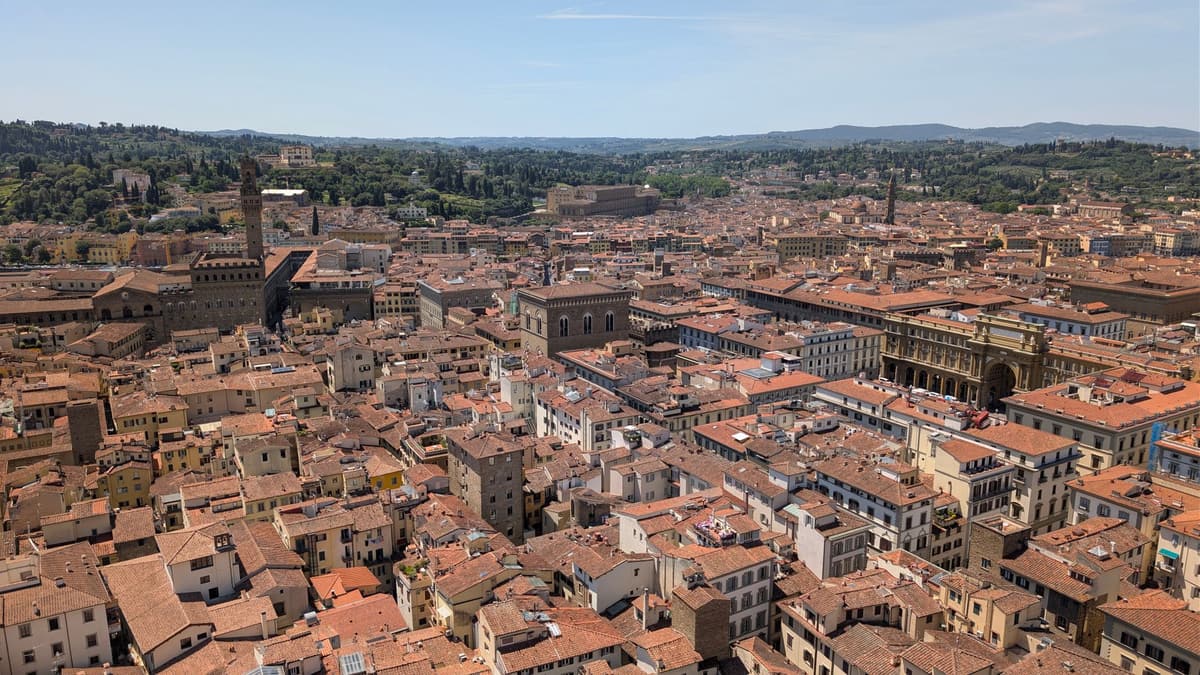
Piazza della Signoria is the political heart of Florence and one of the most theatrical public spaces in the world, an open-air sculpture gallery watched over by a fortress-like town hall with a soaring bell tower. As you step in, the space unfolds around you, dominated by the towering crenellated Palazzo Vecchio and the great fountain of Neptune with its sea gods and horses. A copy of Michelangelo's David stands guard at the palace door, marking the spot where the original once stood. Along one side runs a graceful open loggia crowded with ancient and Renaissance statues, a permanent free exhibition you can walk right up to. Wander among the marble and bronze figures, some depicting violent myths, all rendered with astonishing skill. This is a place to linger and turn in circles. When you are ready, drift toward the far corner of the square, where an elegant arcaded building funnels you toward the river.
The Uffizi Loggia is the long, U-shaped corridor of the great gallery, and even without stepping inside the museum you can walk its dramatic outdoor arcade for free. The building was designed as government offices, which is what uffizi means, and its two long wings run down toward the river, framing a narrow courtyard like a stone canyon. Walk into that courtyard and look up at the row of statues set into niches along the piers, portraits of the famous Florentines who shaped the Renaissance and the wider world, artists, scientists, explorers and statesmen. The perspective here is stunning, the two arcades drawing your eye straight toward a glimpse of the hills across the river at the far end. Street artists often perform beneath the arches, sometimes posing motionless as living statues. Follow the courtyard all the way to the river, then turn right along the water, where the most famous bridge in Florence waits just ahead.
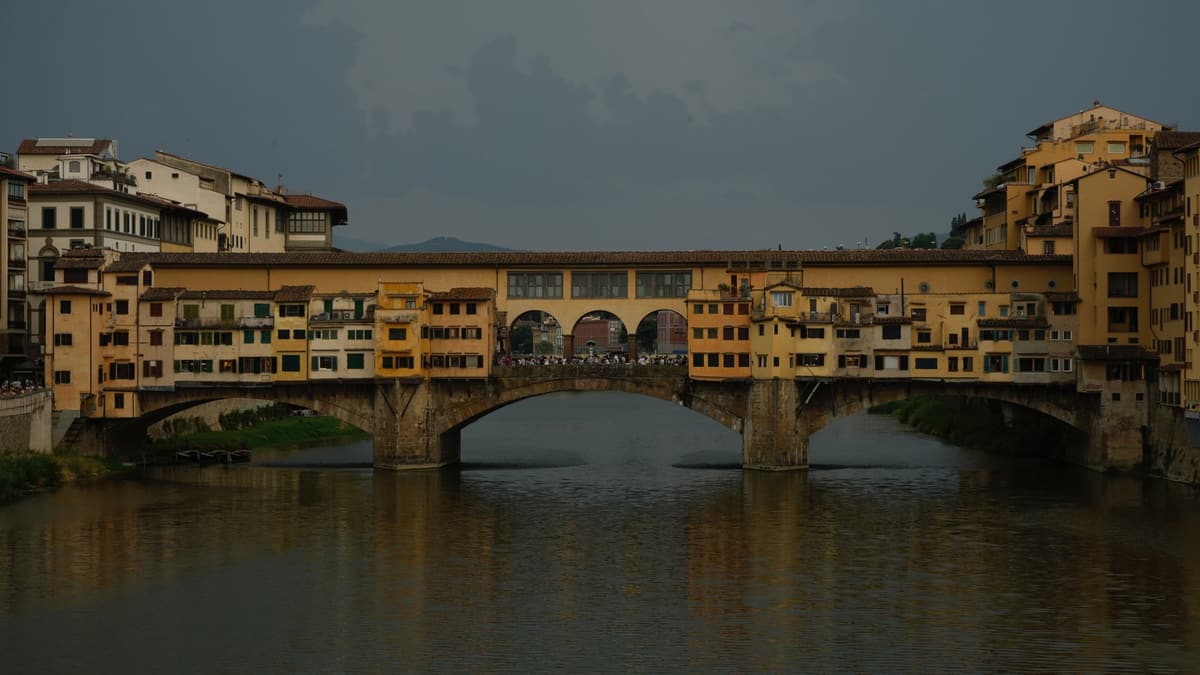
The Ponte Vecchio is the oldest bridge in Florence and one of the most beloved in the world, a stone crossing lined on both sides with tiny shops that seem to hang out over the river. As you step onto it, you are hemmed in by jewelers' windows glittering with gold, for this has been the goldsmiths' bridge for centuries, ever since the butchers who once traded here were ordered off for the smell. Halfway across, the shops break open to reveal terraces with sweeping views up and down the river, where crowds gather to watch the water slide past under the arches. Look up above the shops on one side and you can trace the line of an enclosed elevated corridor, a private passage the rulers once used to cross the city unseen. Take your time in the crush, then continue over the bridge, but instead of climbing the far bank, turn back downstream along the river toward an elegant square and its slender bridge.
Santa Trinita gives its name to both a quiet church and the graceful bridge beside it, and together they offer one of the loveliest river views in Florence. Stand on the Ponte Santa Trinita, an elegant span of three low arches decorated with statues of the four seasons at its corners, and look back upstream. From here you get the classic postcard of the Ponte Vecchio, its shops piled up in a jumble of ochre and cream, reflected in the water below, with the hills rising behind. This bridge was rebuilt stone by stone after wartime destruction, its original design so admired that engineers refused to change it. Nearby stands the plain-faced church of Santa Trinita, which hides rich frescoes within. Pause on the bridge to watch the light on the river, then head back into the streets on the north bank and make your way east, toward a great church square that anchors the far side of the old city.
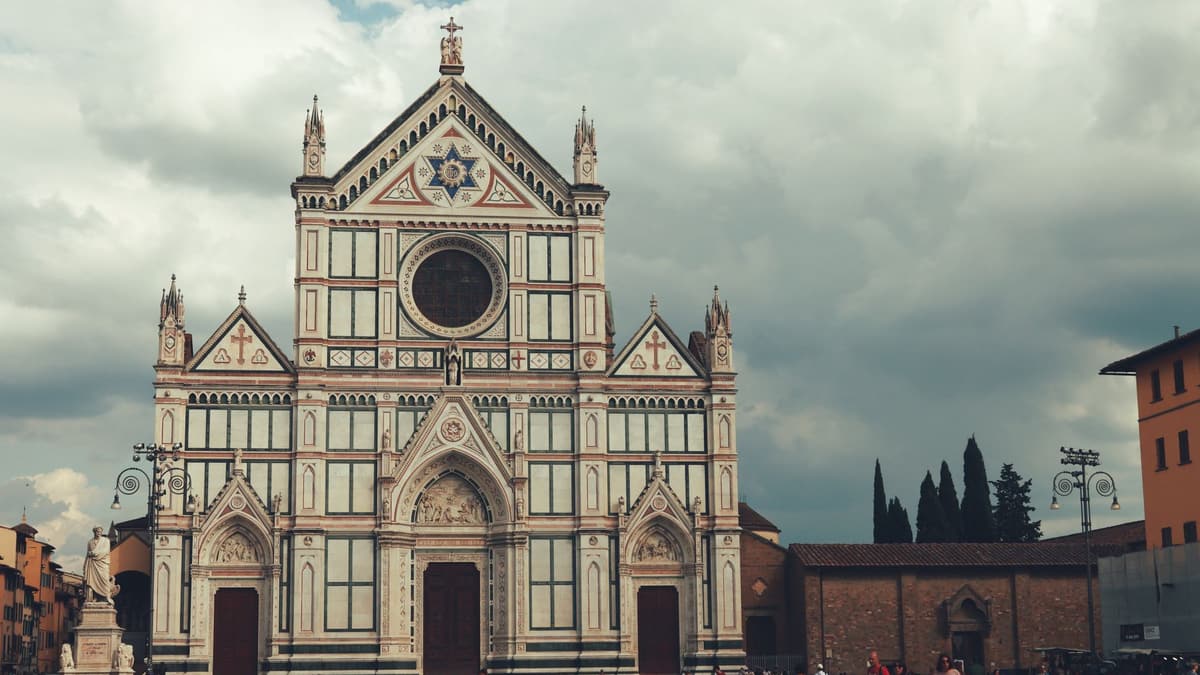
You finish at the Basilica of Santa Croce, a vast Franciscan church fronting a wide square, and it is a fitting and moving place to end. The facade is faced in the same green and white marble as the cathedral, and it presides over a broad piazza that has hosted festivals, markets and a raucous historic football game for centuries. Step back to take in the scale of the front, then consider what lies within, for this is the burial place of the Florentine greats, among them Michelangelo, Galileo and Machiavelli, which has earned it the name the temple of Italian glories. A statue of the poet Dante broods to one side of the square, exiled in life but honored in stone. The piazza is lively and human, ringed with cafes and leather workshops. Find a spot on the steps or a bench and let the day settle around you here at the resting place of genius.
Reaching Santa Croce, you have walked the entire arc of the Renaissance in an afternoon, from the dome that crowned it to the bridge that survived it to the tombs that hold its makers. Florence is a city that only fully makes sense on foot, because its wonders are not spread across a metropolis but packed into a few close-knit streets, one masterpiece leading around a corner to the next. Walking it, you feel how compact the world of these artists and thinkers really was, how they passed one another in these same narrow lanes. You notice the details that a bus or a rushed visit would erase, a carved saint in a niche, a reflection in the river, the worn steps of a great church. If you would like a companion for the next walk, open the Walk With Me map to find others out exploring, because a city this rich is even better shared.
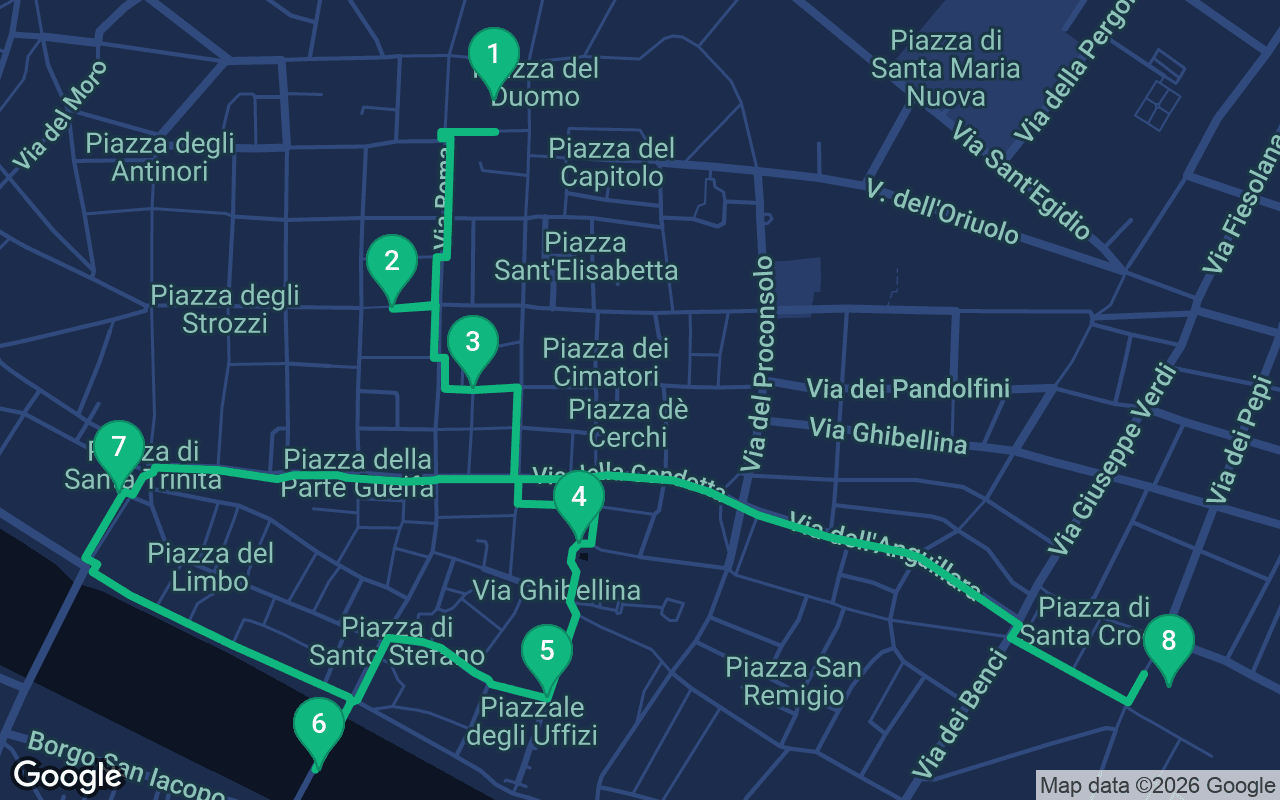
Florence, Italyを通るこのウォークのすべての停留所を順番に。
約2.4 km、ゆったりしたペースで約33分。
音声ガイド付きツアー
アプリを使って歩くと、目的地に到着するたびに音声ガイドが自動的にストーリーを語り始めます。イントロと最初の3スポットは無料でお試しいただけます。$4.99の1回限りの購入で、ツアー全体の音声ガイドをアンロックでき、期限なしでいつでもご利用いただけます。
Garmin、Komoot、Strava、OS Maps、その他あらゆるGPXアプリに対応しています。
September 2, 2026 · 9 min read
エディンバラのロイヤル・マイルを巡る究極の散策ルートをご紹介します。火山岩の丘にそびえる城から宮殿の門へと下る、歴史の魅力が詰まったセルフガイドの旅を、自分のペースでじっくりと楽しんでみませんか。歩くたびに新しい発見が待っています。
August 29, 2026 · 10 min read
息をのむような美しい城の絶景、歴史ある大聖堂、そして迷路のように隠れたファドの路地裏など、魅力あふれる見どころを巡るセルフガイドのリスボン・アルファマ徒歩ツアーで、この街の真の魂を肌で体験してみましょう。
August 28, 2026 · 9 min read
アムステルダムのヨルダーン地区を巡るセルフガイドウォーキングツアー。美しい西教会や歴史的なアンネ・フランクの家、花に彩られた運河、隠れた中庭、そして個性的なショップが並び地元の人々にも愛される九つの小路など、魅力あふれる旧市街の見どころをのんびりと歩いて巡ります。