
October 11, 2026 · 9 min read
Amsterdam Anne Frank Walking Tour
From the Hollandsche Schouwburg through the old Jewish Quarter, past the Dockworker and the Dam, to the Anne Frank House on the Prinsengracht.
589

October 11, 2026 · 10 min read

 Gli amici camminano gratis
Ogni tour funziona anche come camminata di gruppo programmata a cui puoi unirti nell'app.
Altri tour audio a Krakow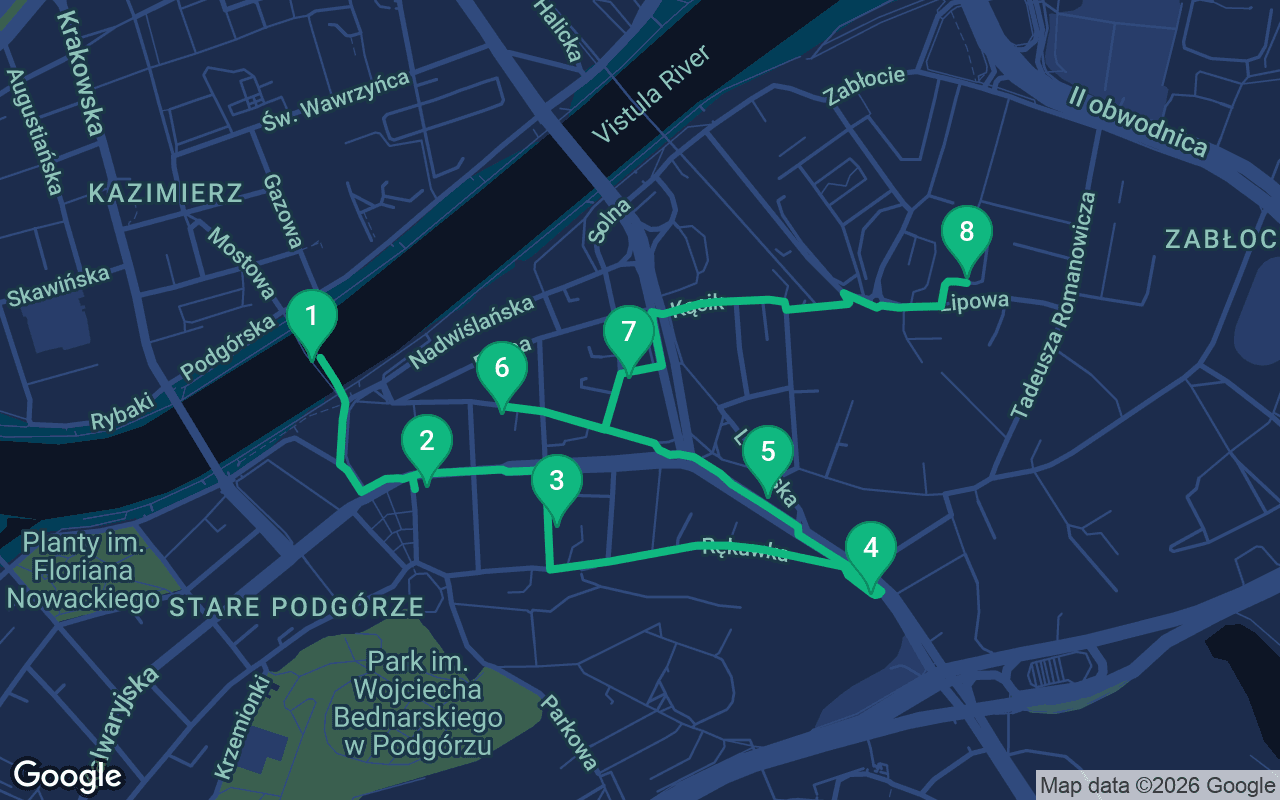
Circa 2,9 km, più o meno 40 minuti a passo tranquillo.
Questo tour è narrato
Premi play sulle prime 3 tappe per ascoltare una demo di 30 secondi della narrazione. Nell'app, l'introduzione e queste 3 tappe sono gratis e complete, e ogni tappa ti avvisa con un segnale acustico al tuo arrivo. L'intero tour narrato sarà tuo a $14.99, un acquisto unico che conservi per sempre.
Funziona con Garmin, Komoot, Strava, OS Maps e qualsiasi app GPX.
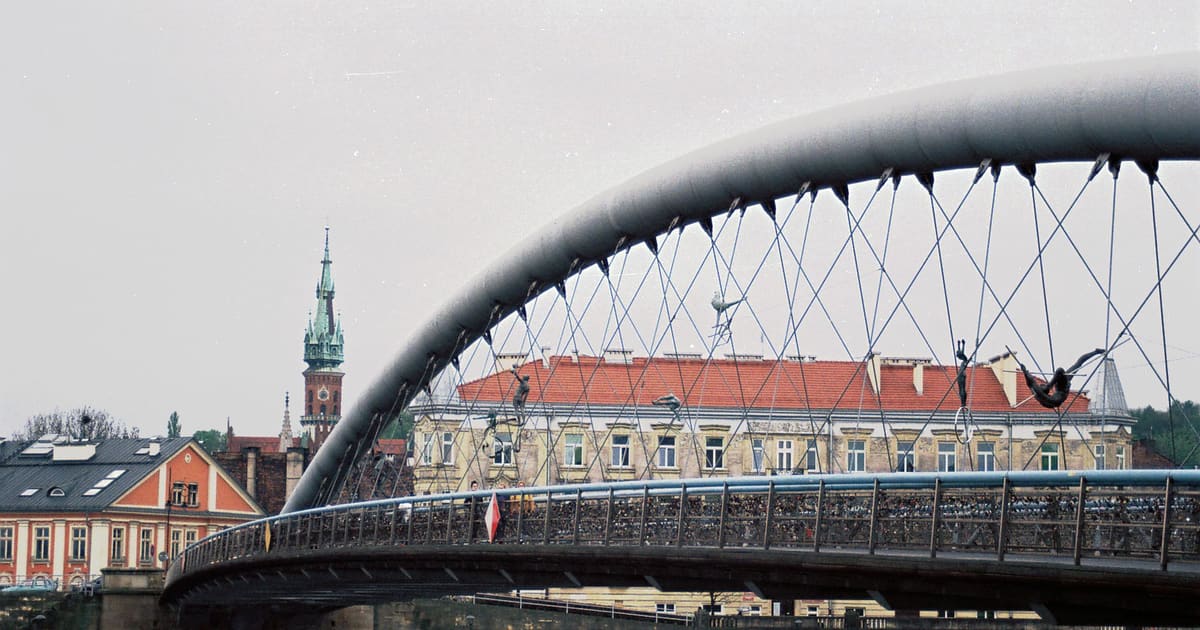
In March 1941 the German occupiers forced the Jews still living in Kraków across the Vistula into a walled ghetto in Podgórze. Two years later the ghetto was gone, its people deported to death camps, shot in its streets, or marched to a labor camp. This walk follows them, from the footbridge at the end of Mostowa Street in Kazimierz, past the gate, the walls and the deportation square, to Oskar Schindler's enamel factory, about three kilometers in all. Of all our self-guided walking tours, this is one to take slowly: these streets are a memorial, not a film set. At the end you will hear where the film Schindler's List and the history part ways.
The walking takes about 40 minutes; with the stories, allow two hours, all on flat pavement. Trams on Starowiślna Street bring you to the start, and at the end a tram stop and a small railway halt are a few minutes from Lipowa Street; check times on the day. The museum inside Schindler's factory sells timed tickets that often sell out, so book online ahead if you want to go in. The Eagle Pharmacy museum is closed on some weekdays, so check before you go.
You're crossing the Vistula. Behind you is Kazimierz, for centuries the Jewish quarter of Kraków. Ahead is Podgórze. This footbridge only opened in 2010, so hold in mind the river they crossed, not the bridge.
German troops took Kraków in September 1939. Within weeks Jews were ordered into forced labor, and by December they had to wear a white armband with a blue Star of David. From May 1940 to March 1941, more than 55,000 Jews were expelled from the city. About 15,000 were allowed to stay. Then, in early March 1941, a ghetto was ordered. Not in Kazimierz, the old Jewish quarter, but over the water in Podgórze. By the twenty-first of March, between 15,000 and 20,000 people had been packed into a few streets on the far bank.
In those same months a German businessman was getting rich here. Oskar Schindler, born in 1908 in Zwittau, had spied for German military intelligence, had been jailed by the Czechoslovak police, and had become a Nazi Party member in 1939. He came to Kraków to make money. In autumn 1939, through the German seizure of Jewish property, he took over Rekord, a Jewish-owned enamelware maker, and renamed it Deutsche Emailwarenfabrik. Everyone called it Emalia.
Step off the bridge and follow your map southeast, away from the river, to the market square, about four minutes.
You're at Rynek Podgórski, the old market square of Podgórze, where Limanowskiego Street runs off to the southeast. Look for the city's Ghetto Memory Trail plaque at number 1. Nothing of the gate survives.
Across the mouth of Limanowskiego stood the ghetto's main gate: a wall with an archway over the roadway and a passage for pedestrians on either side. On top was a Star of David and a large sign in Yiddish announcing a Jewish residential quarter.
Life inside ran on permission. German police in the old Podgórze town hall, right beside the gate, issued the passes. The number 3 tram still ran straight through the ghetto along Limanowskiego and Lwowska streets, but it made no stops inside. At number 3 on this square, Julius Madritsch ran tailoring workshops from 1942, a prized workplace because the rations were better.
The next stop jumps forward in time, to June 1942. You'll hear how the ghetto came to that point a few stops later. Follow your map east for about four minutes to the old Optima factory on Krakusa Street.
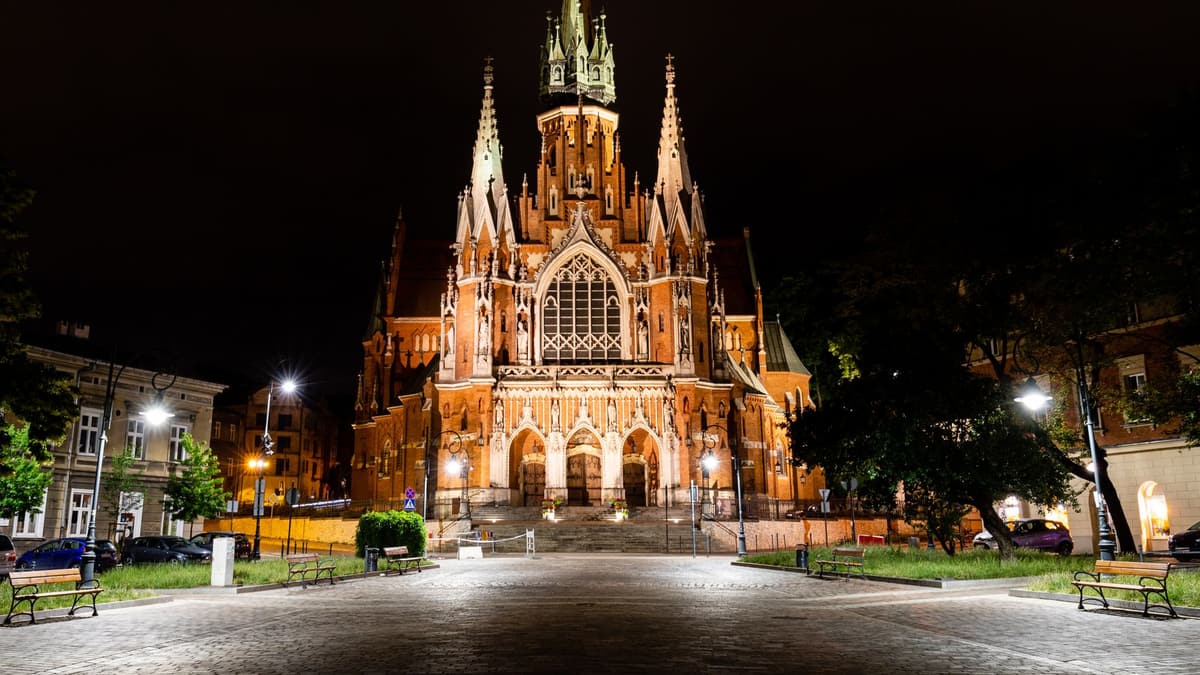 You're outside the former Optima chocolate factory at Krakusa 7.
It is now June 1942. In the ghetto years these halls held Jewish craft workshops, but that June the yard became the second assembly point after the ghetto's main square. From the sixth to the eighth of June, people refused permission to stay were held here for two days, in the open sun, with no food and no water.
Then they were marched to the station at Prokocim and put on trains to the Bełżec death camp. In the deportations of the first and sixth of June, up to 7,000 Jews from this ghetto were sent there.
The people held here left the ghetto through a second gate on Limanowskiego Street, and you're about to pass where it stood. Continue east along Limanowskiego for about nine minutes. Around numbers 31 and 50 you pass the site of that gate; its police guardhouse was in number 50. Carry on to the school at number 62.
Cosa è incluso
I nostri tour sono pensati per essere meditativi e immersivi: ti muovi e semplicemente ascolti. Sono sempre più belli in compagnia, e l'app riproduce la narrazione in sincronia, così tu, il tuo partner e i tuoi amici sentite ogni tappa nello stesso momento.
You're on the street outside the school at Limanowskiego 62. Behind the school building stands one of the two surviving stretches of the ghetto wall.
Il resto di questa tappa è nel tour audio completo.
This is the piece of the wall most people know. It runs about twelve meters along the street, with the same arched top, and you can stand right beside it.
Il resto di questa tappa è nel tour audio completo.
You're outside a large building from 1910, built as a savings bank, with a trail plaque by the door.
Il resto di questa tappa è nel tour audio completo.
You're on Plac Bohaterów Getta, Ghetto Heroes Square. Look at the chairs: 70 of them in bronze, by Karol Badyna, from the square's 2005 redesign.
Il resto di questa tappa è nel tour audio completo.
You're at Lipowa 4, facing the gate of Oskar Schindler's factory. Since 2010 its old administration building has held a museum of Kraków under Nazi occupation.
Il resto di questa tappa è nel tour audio completo.
Fai questa camminata in compagnia alla prossima uscita in programma.
Circa 2,9 km, circa 40 minuti a passo lento · 8 tappe
Gli amici camminano gratisOctober 11, 2026 · 9 min read
From the Hollandsche Schouwburg through the old Jewish Quarter, past the Dockworker and the Dam, to the Anne Frank House on the Prinsengracht.
October 11, 2026 · 11 min read
From Van Houten's street by the Vondelpark past Leidseplein, the Rijksmuseum passage and the famous canal bench to the Anne Frank House.

October 11, 2026 · 10 min read
Follow the last days of April and May 1945 from the Anhalter Bahnhof ruin past the Gestapo site and Brandenburg Gate to the Moltke Bridge and the Reichstag.
