
October 11, 2026 · 9 min read
Amsterdam Anne Frank Walking Tour
From the Hollandsche Schouwburg through the old Jewish Quarter, past the Dockworker and the Dam, to the Anne Frank House on the Prinsengracht.
589

October 8, 2026 · 12 min read

 A barátaid ingyen sétálnak
Minden túra ütemezett csoportos sétaként is fut, amelyhez csatlakozhatsz az appban.
További hangos túrák itt: Boston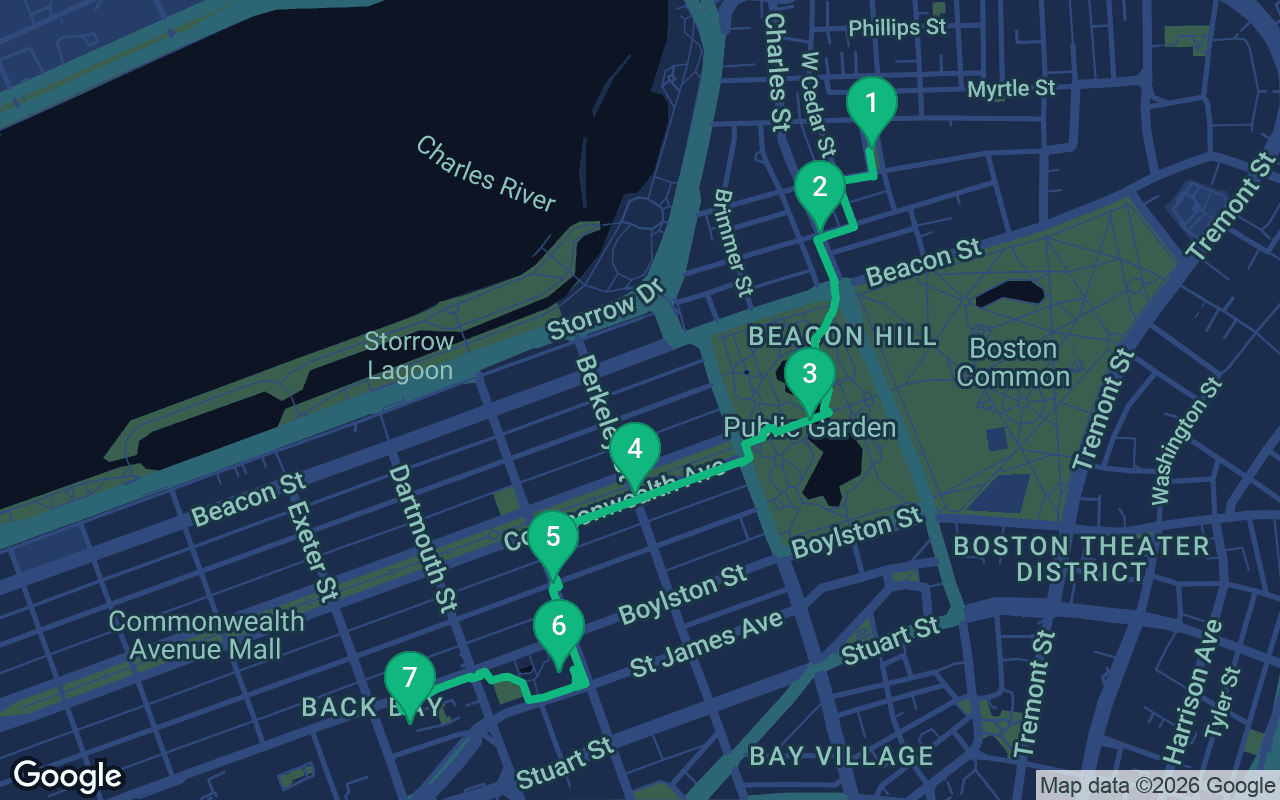
Nagyjából 2 km, körülbelül 28 perc kényelmes tempóban.
Ez a séta hangosvezetéssel is elérhető
Nyomj a lejátszásra az első 3 megállónál, és itt helyben meghallgathatsz egy 30 másodperces részletet a narrációból. Az alkalmazásban a bevezető és ez a 3 megálló teljes hosszában ingyenes, és mindegyik hangjelzéssel szól, amint megérkezel. A teljes narrált túra mindössze $6.99 összegért a tiéd lehet, ami egy egyszeri, örökre szóló vásárlás.
Működik Garmin, Komoot, Strava, OS Maps és bármilyen GPX alkalmazással.
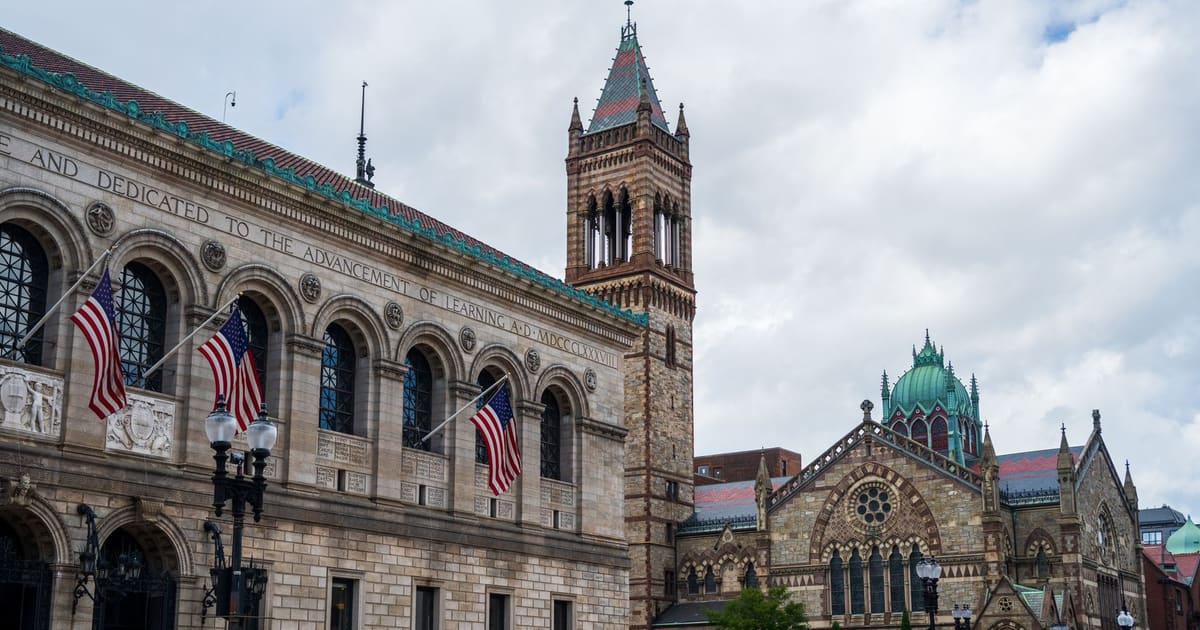
Boston's two handsomest neighborhoods sit side by side, and this walk takes you through both in one easy line. You start among the gas lamps and brick sidewalks of Beacon Hill, drop down to its little main street, cross the Public Garden past the swan boats and the famous bronze ducklings, then follow the grand boulevard of Back Bay to Newbury Street and Copley Square, where the walk finishes at the Boston Public Library. It is about two kilometers, a mile and a quarter, mostly downhill or flat, and it pairs well with the Freedom Trail on the same day, since the two share no stops. If you like your self-guided walking tours heavy on architecture and gardens and light on crowds, this is the Boston walk for you. Along the way you will also see how the city literally built itself new ground, because almost everything after the first stop stands on land that was once river or tidal mud.
Give yourself an hour and a half to two hours at a stroll, more if you go inside Trinity Church or spend time in the library, which you should. Getting up to Louisburg Square is the only real climb, since Beacon Hill's streets are steep in places, and its brick sidewalks are narrow and uneven, buckled by tree roots, so wear sturdy shoes and watch your step, especially in rain or ice. After that it is downhill and then flat. Mornings are lovely on the Hill, when the streets are quiet and the light catches the brick; late afternoon flatters Copley Square. Spring is the showpiece season, when the magnolias bloom along Commonwealth Avenue and the tulips fill the Public Garden, and autumn is a close second. The swan boats run only in the warmer months, and Trinity Church and the library keep their own hours, so check before you go. The Commonwealth Avenue Mall is well shaded by its trees, but Copley Square is wide open to sun and wind. Beacon Hill is a residential neighborhood, so keep your voice down and stay off the stoops.
You are standing in the most exclusive address in Boston, and it is wonderfully hushed. Louisburg Square is a long, narrow private garden behind a black iron fence, lined on both sides by tall brick bowfront houses built in the 1830s and 1840s. The garden belongs to the people who live around it, who look after it themselves, and the residents have long guarded the square as their own. At either end of the garden stands a small marble statue, Christopher Columbus at one end and the ancient Greek statesman Aristides the Just at the other, presented by a resident in 1850. The square takes its name from Louisbourg, the French fortress in Nova Scotia that New England troops captured in 1745, though the spelling drifted along the way. Louisa May Alcott, author of Little Women, lived at number 10 in her later years, and over the generations these houses have passed among old Boston families, writers and politicians. Look at the details as you turn around: the black shutters, the window boxes, the gas lamps that burn along these streets day and night. Beacon Hill is not only grand houses, either. Its north slope, a few minutes away, was home to Boston's free Black community in the nineteenth century, and the African Meeting House on Joy Street, built in 1806, is the oldest surviving Black church building in the country. Leave the square by the Mount Vernon Street end, cross over and walk straight down Willow Street. A few steps on, turn right into Acorn Street, the steep cobbled lane that appears on half the postcards in Boston, then follow West Cedar Street down to Chestnut Street and turn right. Charles Street is at the bottom, about five minutes away.
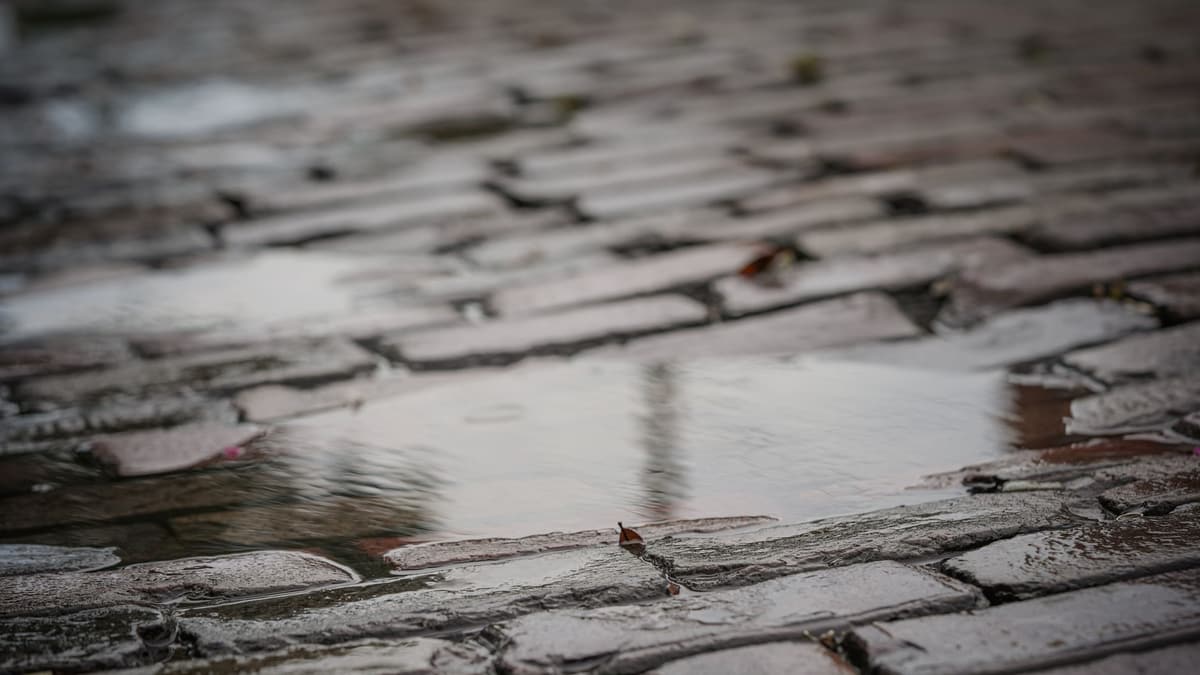 Charles Street is Beacon Hill's village high street, a short, gently curving run of brick buildings with antique dealers, cafes, florists, small grocers and a hardware store at street level and apartments above. Beacon Hill is a protected historic district, which is why the shopfronts stay modest, the signs hang discreetly, and the black iron lamps look the way they did generations ago. Here is the surprising part: around two hundred years ago, much of the ground under your feet did not exist. The edge of the Charles River ran close to here, and the street was laid out in the early 1800s on new land made by filling in the riverbank. Some of that fill came from the hill itself. Beacon Hill was once much taller, named for the tall pole with a fire basket on top that stood on its summit to warn the town of danger, and developers cut dozens of feet off the top to build houses and carted the earth downhill. Over the following century the riverbank was pushed farther and farther west, which is why the water now sits several blocks away behind the Esplanade. At the corner of Mount Vernon Street stands the Charles Street Meeting House, a church from 1807 whose Baptist congregation, the story goes, used the river at its doorstep for baptisms. It is a good street to browse or to grab a coffee before the next stretch. When you are ready, walk south along Charles Street to Beacon Street, about three minutes. The Common will be on your left; the gates of the Public Garden are on your right, across Beacon.
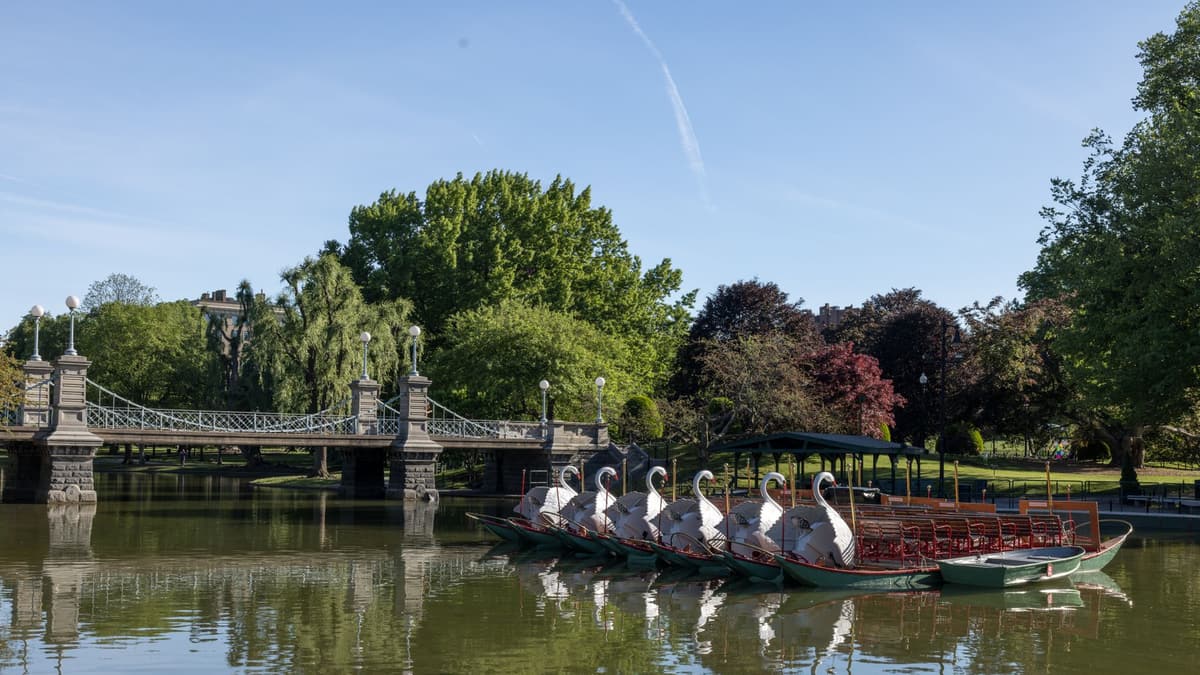
Just inside the gate at the corner of Charles and Beacon, a line of bronze ducks waddles across the cobbles. They are Mrs. Mallard and her eight ducklings from Robert McCloskey's 1941 picture book Make Way for Ducklings, in which a duck family braves the Boston traffic to reach this very garden, and the sculptor Nancy Schön cast them in 1987. Generations of children have ridden them, and locals dress them up for holidays and big games. The garden itself, founded in 1837, was the first public botanical garden in the United States, laid out on what had been salt marsh beside the Common. Where the Common is old, rough grazing land, this is its formal Victorian neighbor, with flowerbeds that change with the seasons, weeping willows trailing into the lagoon, and a little footbridge across the water. On the lagoon glide the swan boats, pedaled from inside a giant swan by a driver sitting behind the passengers. Robert Paget launched them in 1877, inspired by the opera Lohengrin, in which a knight crosses a river in a boat drawn by a swan, and his family still runs them. Look for the Ether Monument too, which honors the first public demonstration of ether as a surgical anesthetic at Massachusetts General Hospital in 1846. To move on, cross the footbridge and head west to the Arlington Street gate, where George Washington sits on horseback. Cross Arlington Street at the lights, and the long green strip of Commonwealth Avenue begins straight ahead, about five minutes from the ducklings.
Mit tartalmaz
Túráink meditatívnak és magával ragadónak készültek: mozogsz, és egyszerűen hallgatod. Együtt mindig jobbak, és az alkalmazás szinkronban játssza le a narrációt, így te, a párod és a barátaid ugyanabban a pillanatban hallhatjátok az egyes megállókat.
Stand on the central path and look west down the Mall, a long promenade of trees and lawns running down the middle of the avenue between rows of grand brownstone and brick houses.
A megálló folytatása a teljes hangos túrában hallható.
Newbury Street runs eight blocks from the Public Garden to Massachusetts Avenue, and it is Boston's favorite street for window shopping and people watching.
A megálló folytatása a teljes hangos túrában hallható.
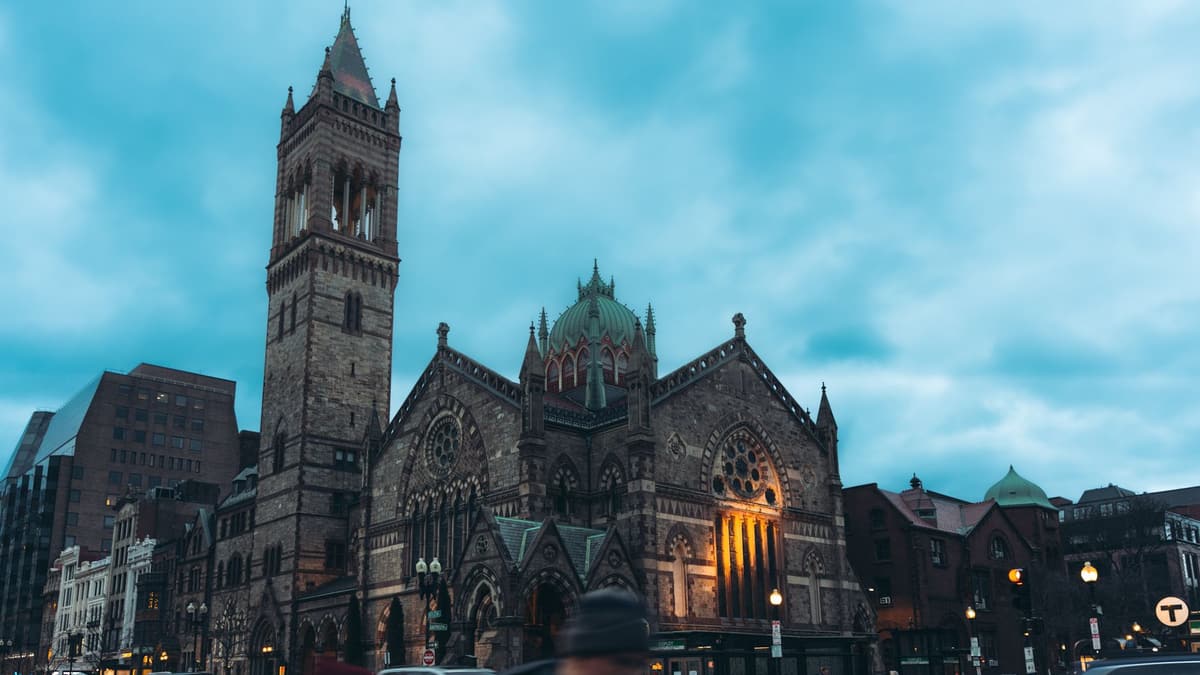
Across the street rises Trinity Church, a great pile of rough granite and red sandstone with a massive central tower, and one of the most admired buildings in America. An 1885 poll of architects ranked it the finest building in the country.
A megálló folytatása a teljes hangos túrában hallható.
The walk ends at the Boston Public Library, and the words carved above its entrance say it all: Free to All.
A megálló folytatása a teljes hangos túrában hallható.
Tedd meg ezt a sétát másokkal a következő tervezett túrán.
Körülbelül 2 km, nagyjából 28 perc kényelmes tempóban · 7 megálló
A barátaid ingyen sétálnakOctober 11, 2026 · 9 min read
From the Hollandsche Schouwburg through the old Jewish Quarter, past the Dockworker and the Dam, to the Anne Frank House on the Prinsengracht.
October 11, 2026 · 11 min read
From Van Houten's street by the Vondelpark past Leidseplein, the Rijksmuseum passage and the famous canal bench to the Anne Frank House.

October 11, 2026 · 10 min read
Follow the last days of April and May 1945 from the Anhalter Bahnhof ruin past the Gestapo site and Brandenburg Gate to the Moltke Bridge and the Reichstag.
