
October 11, 2026 · 9 min read
Amsterdam Anne Frank Walking Tour
From the Hollandsche Schouwburg through the old Jewish Quarter, past the Dockworker and the Dam, to the Anne Frank House on the Prinsengracht.
589

October 11, 2026 · 12 min read

 Друзья гуляют бесплатно
Каждую экскурсию можно пройти в составе запланированной группы, к которой легко присоединиться в приложении.
Ещё аудиоэкскурсии в Budapest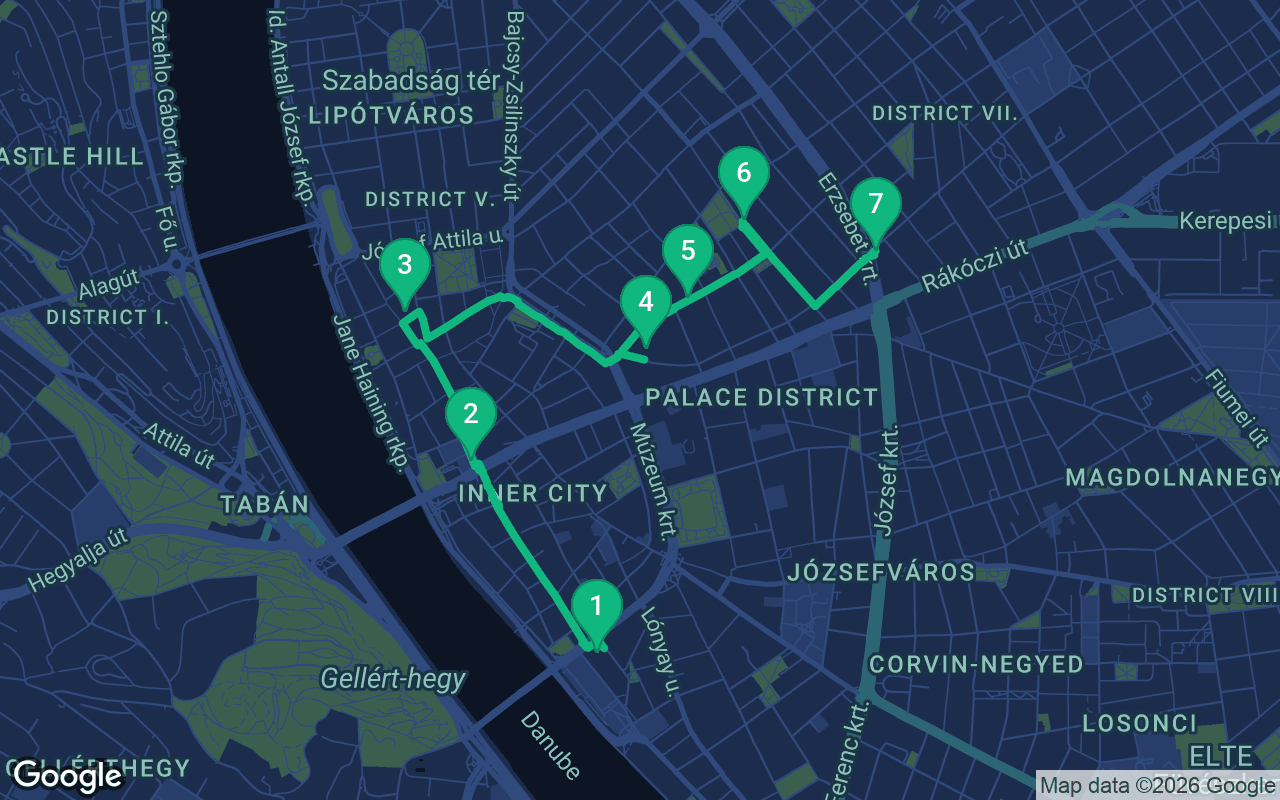
Примерно 3,7 км, около 51 минут в спокойном темпе.
Эта экскурсия озвучена
Нажмите «Воспроизвести» на первых 3 остановках, чтобы послушать 30-секундный фрагмент озвучки. В приложении вступление и эти остановки звучат полностью и бесплатно, а о каждой из них вас оповестит звуковой сигнал, когда вы до неё дойдёте. Вся экскурсия будет вашей за $15.99, это разовая покупка навсегда.
Совместимо с Garmin, Komoot, Strava, OS Maps и любыми приложениями для GPX.
Pest learned how to eat in the nineteenth century, and this walk follows that story from the market floor to the coffee house. You start inside the Great Market Hall on Fővám tér, where paprika fills the stalls downstairs and lángos comes out of the fryers upstairs. Then you walk up Váci utca for a Transylvanian chimney cake, sit down at Gerbeaud with the cake that a Budapest confectioner showed off to the whole country in 1885, and cross into the old Jewish quarter. There, a vanished pastry shop, a lesson in what goulash really is, and a lunch room from 1957 that came back to life in 2025 each tell part of the city's story. You finish under the gilding of the New York Café, a few minutes from Blaha Lujza tér. It's about 3.7 kilometers of walking, roughly 50 minutes on foot, though with the eating it fills a long lunchtime. Like all our self-guided walking tours, the pace is yours. By the end, you'll know why a Hungarian looks puzzled when you order goulash and expect a stew.
The walking itself is about 3.7 kilometers and 50 minutes, flat and paved the whole way, and much of Váci utca is pedestrian. With six tastings and a sit-down or two, plan on three hours or more.
Any day of the week can work, apart from public holidays, when the market hall is closed. On Sunday the market keeps short hours, from 10 in the morning to 4 in the afternoon, so don't start too early. Gettó Gulyás opens at noon and recommends booking, so a late-morning start at the market brings you into the Jewish quarter right at lunchtime. The synagogue is a working house of worship with its own visiting rules, but you only see it from the street, so that stop works any day.
You pay for your own food along the way. Share as you go: one lángos between two, one slice of cake for two, small portions at lunch. That keeps room for the last stop. If you have allergies, ask at every counter, because gluten, nuts, dairy and eggs turn up almost everywhere on this route. Hours change, so check before you go.
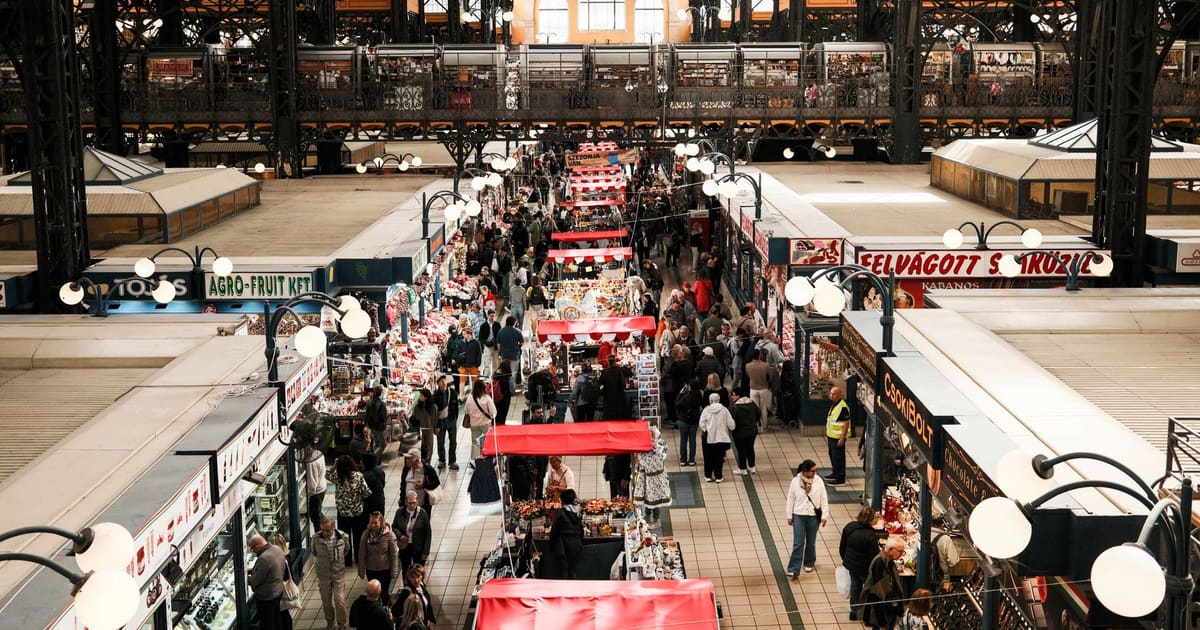
You're standing in front of the Great Market Hall, on Fővám tér, at the Pest end of Liberty Bridge. Look up at the roof. The glazed ceramic roof tiles came from the Zsolnay company.
This hall is where the story starts, and it nearly ended before it began. Samu Pecz's design was approved in February 1894. Two years later, on 30 July 1896, with the building almost finished, a fire badly damaged it. The city pressed on. Traders were allowed to sell here from 1 February 1897, and the official opening came two weeks later, on 15 February. You'll sometimes read that it opened in March. The hall's own history says February. The building was restored between 1991 and 1994, and it still does what it was built for.
Walk in and look at the ground floor. Those stalls hung with strings and stacked with bags are selling paprika, and its story is a strange one. According to the paprika museum in Kalocsa, the first record of the plant in Hungary is from 1570, in Margit Széchy's garden, where it was called "red Turkish pepper." It was grown first as an ornamental plant, something pretty to look at. Over the centuries it became the national spice. The town of Szeged was, and still is, one of its great growing centers, and Szeged has its own place in the history of science: Albert Szent-Györgyi worked there and won the 1937 Nobel Prize in Medicine for work that included vitamin C.
Now head upstairs to the food stalls. The dish to find is lángos, and the name comes from láng, the Hungarian word for flame. On bread-baking day, a piece of leftover dough was baked at the front of the oven, close to the fire. Today it's deep-fried and topped with sour cream, cheese and garlic.
What to order here: one lángos with sour cream and cheese, garlic if you like, split between two. Then take one more look at the paprika stalls on your way out.
Up ahead is a pastry with a written history older than this hall by a century. Step back onto Fővám tér, find the start of Váci utca, the pedestrian street running north from the square, and follow it north for about 12 minutes to number 31.
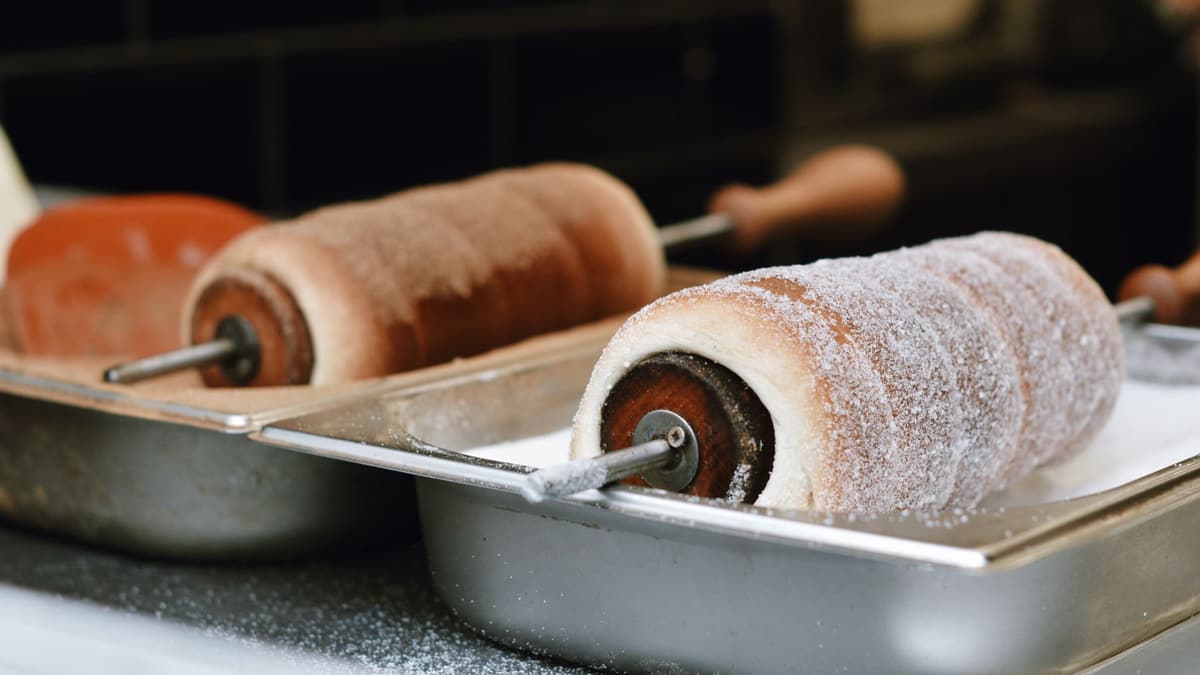 You're at Váci utca 31. Look in the window. Strips of dough are wound around spits, turning slowly over the heat, and that's the whole trick of this pastry.
This is kürtőskalács, and it comes from Transylvania, where the Székely Hungarians made it. Kürtő means stovepipe, which is why English speakers call it chimney cake.
Its paper trail is long, and a little tangled. There's a written mention from 1679. After that, the sources disagree about which recipe came first. Some point to a manuscript dated 1781. Others give the honor to the cookbook of Countess Mária Mikes, from 1784, which holds one of the earliest surviving recipes for it. Here's the detail that surprises people: the sweet, caramelized sugar crust came later. It's nineteenth-century cookbooks that tell you to roll the dough in sugar before baking. So what you're about to eat is an old Transylvanian pastry wearing a newer coat.
What to order here: one classic kürtőskalács, cinnamon or walnut, to share.
Next comes a café that lost its name for 36 years. Keep walking north on Váci utca for about 8 minutes. The street opens out into Vörösmarty tér, and Gerbeaud is on the square at numbers 7 and 8.
You're on Vörösmarty tér, in front of Gerbeaud. It doesn't take reservations, so you can simply walk in and wait for a table, or order at the counter.
The name over the door belongs to the second man in this story, not the first. Henrik Kugler founded the business in 1858 and moved it to this square in 1870. In 1884, a man born in Geneva joined him. His name was Emil Gerbeaud, and it's his name the café carries. Then history intervened. After the business was nationalized in 1948, it was renamed Vörösmarty, after the square, and it kept that name until March 1984. For 36 years, the cake shop on this square went by another name.
Now to the cake. In 1884, a Budapest confectioner named József C. Dobos, born in 1847, created a new torte, and the next year he presented it at the 1885 National General Exhibition in Budapest. Its clever part was the top: a hard caramel layer that kept the cake from drying out. The Dobos torte became famous, and in 1906 Dobos did something generous. He gave his recipe to the confectioners' guild, handing his best-known cake to his whole trade.
The Esterházy torte has a vaguer history. It's named after Prince Pál Antal Esterházy, who lived from 1786 to 1866, and it appeared in Budapest pastry shops in the late nineteenth century. Who first baked it, nobody knows.
What to order here: one slice to share. Choose the Dobos, the Esterházy, or the house's own Gerbeaud slice, with layers of walnut and jam under chocolate. All three are on Gerbeaud's list.
From here, the walk changes tone. The next stop is a house of worship and a place of memory, not a place to eat. Leave the square on its east side and walk to Deák Ferenc tér, then follow Károly körút southeast. After about 13 minutes, the Dohány Street Synagogue appears on your left, at the corner of Dohány utca.
Что входит
Наши экскурсии задуманы как медитативные и захватывающие: вы идёте и просто слушаете. Вместе всегда лучше, и приложение воспроизводит озвучку синхронно, так что вы, ваш партнёр и ваши друзья слышите каждую остановку одновременно.
You're standing in front of the Dohány Street Synagogue, at Dohány utca 2. This is a working synagogue.
Продолжение этой остановки есть в полной аудиоэкскурсии.
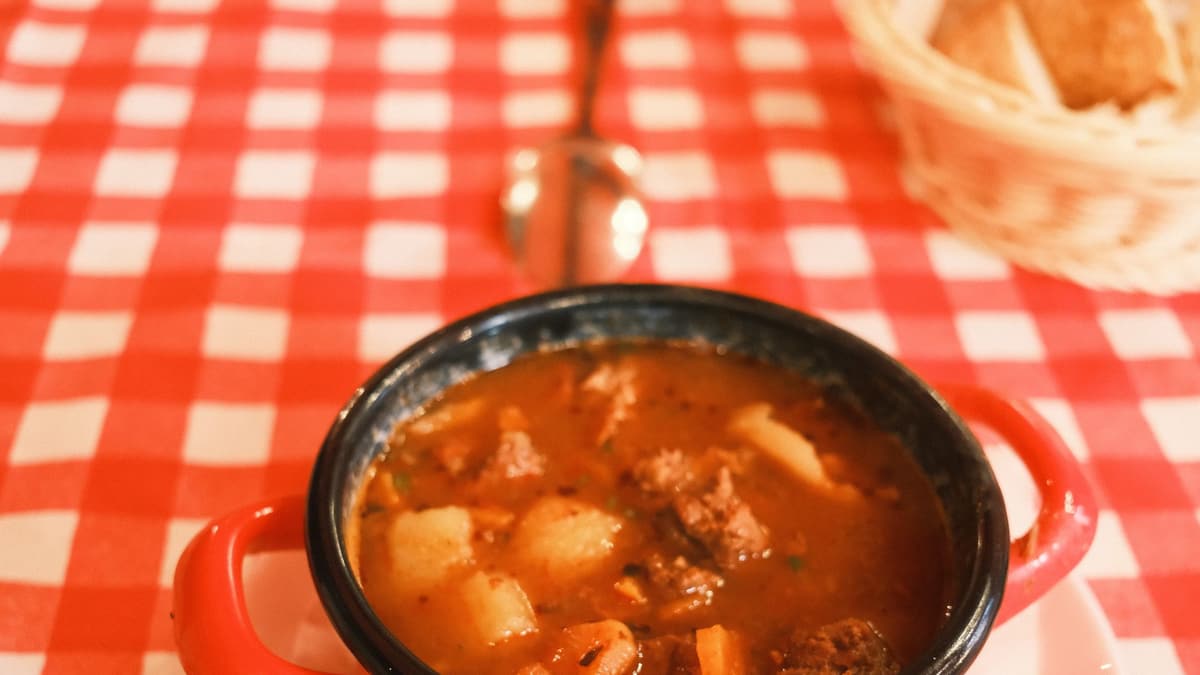
You're at Wesselényi utca 18, outside Gettó Gulyás. It opens at noon, and booking is a good idea.
Продолжение этой остановки есть в полной аудиоэкскурсии.
You're on Klauzál tér, at number 9, outside the Kádár lunch room. Inside, people share tables, and you still pay at the door as you leave.
Продолжение этой остановки есть в полной аудиоэкскурсии.
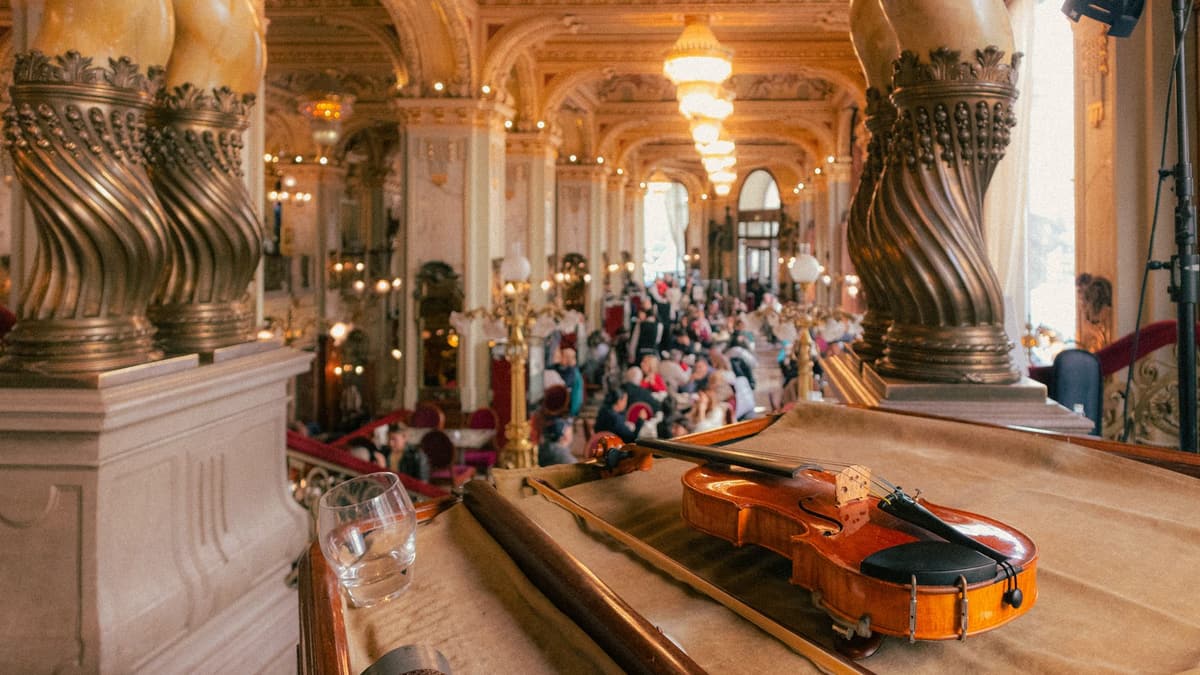
You're at Erzsébet körút 9 to 11, at the New York Café. Tables are first come, first served, so walk in and wait to be seated.
Продолжение этой остановки есть в полной аудиоэкскурсии.
Пройдите этот маршрут вместе с другими во время следующей запланированной прогулки.
Около 3,7 км, примерно 51 мин в спокойном темпе · 7 остановок
Друзья гуляют бесплатноOctober 11, 2026 · 9 min read
From the Hollandsche Schouwburg through the old Jewish Quarter, past the Dockworker and the Dam, to the Anne Frank House on the Prinsengracht.
October 11, 2026 · 11 min read
From Van Houten's street by the Vondelpark past Leidseplein, the Rijksmuseum passage and the famous canal bench to the Anne Frank House.

October 11, 2026 · 10 min read
Follow the last days of April and May 1945 from the Anhalter Bahnhof ruin past the Gestapo site and Brandenburg Gate to the Moltke Bridge and the Reichstag.
