
October 11, 2026 · 9 min read
Amsterdam Anne Frank Walking Tour
From the Hollandsche Schouwburg through the old Jewish Quarter, past the Dockworker and the Dam, to the Anne Frank House on the Prinsengracht.
589

October 11, 2026 · 14 min read

 Друзья гуляют бесплатно
Каждую экскурсию можно пройти в составе запланированной группы, к которой легко присоединиться в приложении.
Ещё аудиоэкскурсии в Paris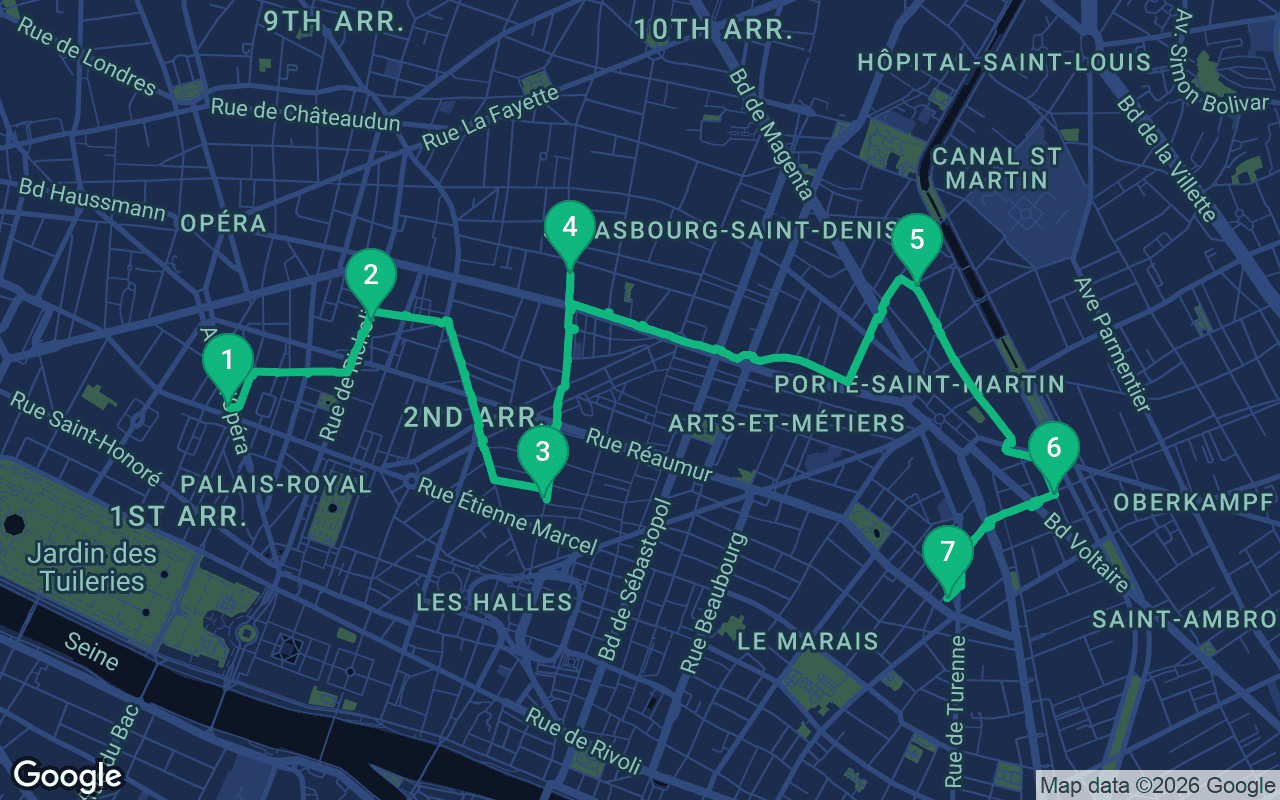
Примерно 5,2 км, около 73 минут в спокойном темпе.
Эта экскурсия озвучена
Нажмите «Воспроизвести» на первых 3 остановках, чтобы послушать 30-секундный фрагмент озвучки. В приложении вступление и эти остановки звучат полностью и бесплатно, а о каждой из них вас оповестит звуковой сигнал, когда вы до неё дойдёте. Вся экскурсия будет вашей за $16.99, это разовая покупка навсегда.
Совместимо с Garmin, Komoot, Strava, OS Maps и любыми приложениями для GPX.
Paris tells its history in flour, butter and salt, and this walk lets you taste it one counter at a time. You'll start near the Opéra with a croissant, and find out why the famous story of its birth is a myth. Then you'll stand at the address where an Austrian really did bring the crescent roll to Paris, eat a rum baba in a pastry house founded in 1730, and buy the two baguettes that won the city's best-baguette prize in 2025 and 2024. Along the way you'll hear about the 1993 law that decides what a "tradition" baguette may contain, and why UNESCO listed the baguette's know-how in 2022. You'll finish in the Marais at Poilâne, the family that made its name with a big round sourdough loaf and never sold baguettes at all. It's one of our self-guided walking tours, about 5.2 kilometers from Cédric Grolet's bakery on avenue de l'Opéra to Poilâne on rue Debelleyme, with seven stops and something to order at six of them.
The walking alone takes about 73 minutes for 5.2 kilometers, all on city pavements. With queues and tastings, give it a full morning. The nearest Metro stations to the start are Pyramides, on lines 7 and 14, and Opéra, on lines 3, 7 and 8, a few minutes up the avenue. You finish near Filles du Calvaire or Saint-Sébastien Froissart, both on line 8.
Pick your day with care, because this walk only works from Wednesday to Friday. Cédric Grolet is closed on Monday and Tuesday. Utopie and Poilâne's Marais shop are closed on Monday. Du Pain et des Idées is closed on Saturday and Sunday. Go in the morning. The first stop opens at nine, bakes in limited quantities and sells out, and you can pre-order on its website.
You pay for your own food at every stop. Seven bakeries is a lot of bread and butter, so share, split pastries, or buy to take away and eat later. Nearly everything on this walk contains gluten, and nuts, especially pistachio and almond, turn up often, so if you have an allergy, ask before you order. Hours change, so check each shop before you go.
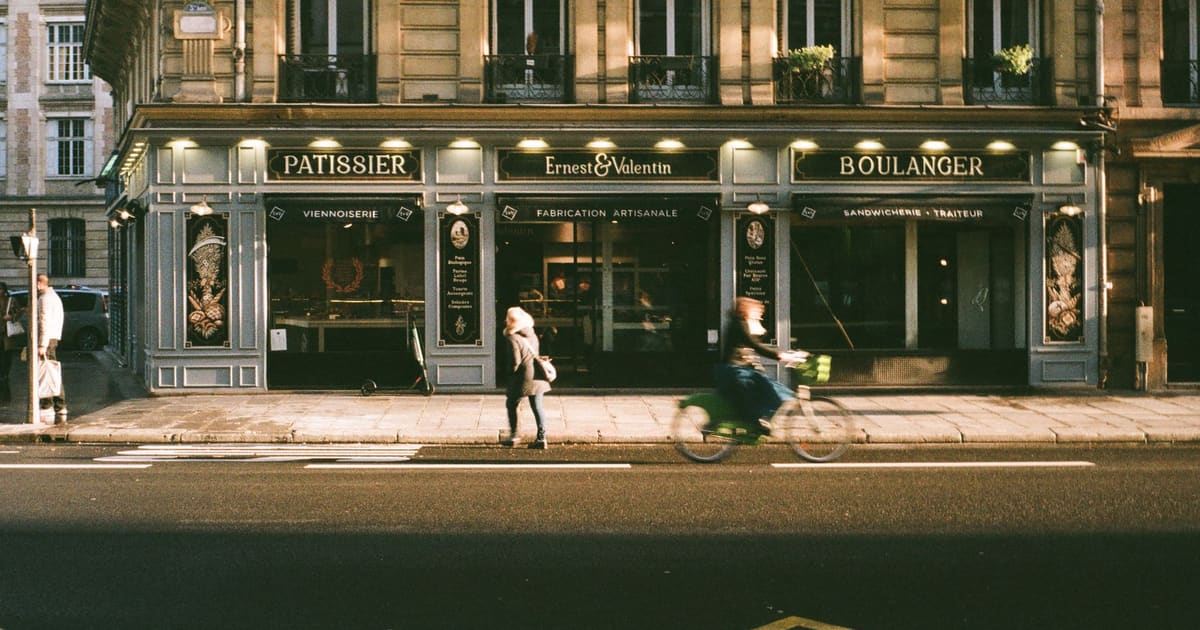
You're on avenue de l'Opéra, outside number 35, the bakery of the pastry chef Cédric Grolet. If there's a line, you're in good company. When this shop opened on the 22nd of November 2019, people queued for more than two hours on the first day.
Grolet made his name as the pastry chef of Le Meurice, and the guide Les Grandes Tables du Monde named him the best restaurant pastry chef. He's famous for pastries shaped like fruit and flowers, assembled to order. But this counter also sells the classics: the butter croissant, the pain au chocolat, the apple chausson, a tradition loaf and a baba.
What to order here: a butter croissant. It's the first line of today's story.
Look at the word French bakeries use for this whole family of pastries: viennoiserie. Vienna is hiding right inside it. So how did a Viennese pastry become the breakfast of Paris? You may have heard the famous answer. In 1683 the Ottoman army besieged Vienna, and when the siege failed, a baker shaped a pastry like a crescent to mock the defeated enemy. Some versions move the story to Budapest in 1686. It's a wonderful tale, and there's no contemporary evidence for any of it. Alan Davidson's Oxford Companion to Food treats it as legend, and it spread through the 1938 edition of the Larousse Gastronomique, the great French food encyclopedia. While we're clearing things up, there's no evidence that Marie-Antoinette brought the croissant to France either.
The true story is quieter, more Parisian, and it begins a few streets from here, with a former Austrian army officer and a shop on rue de Richelieu.
Take your croissant and head east, away from the avenue, to rue de Richelieu. Turn left and follow it north to number 92. About nine minutes.
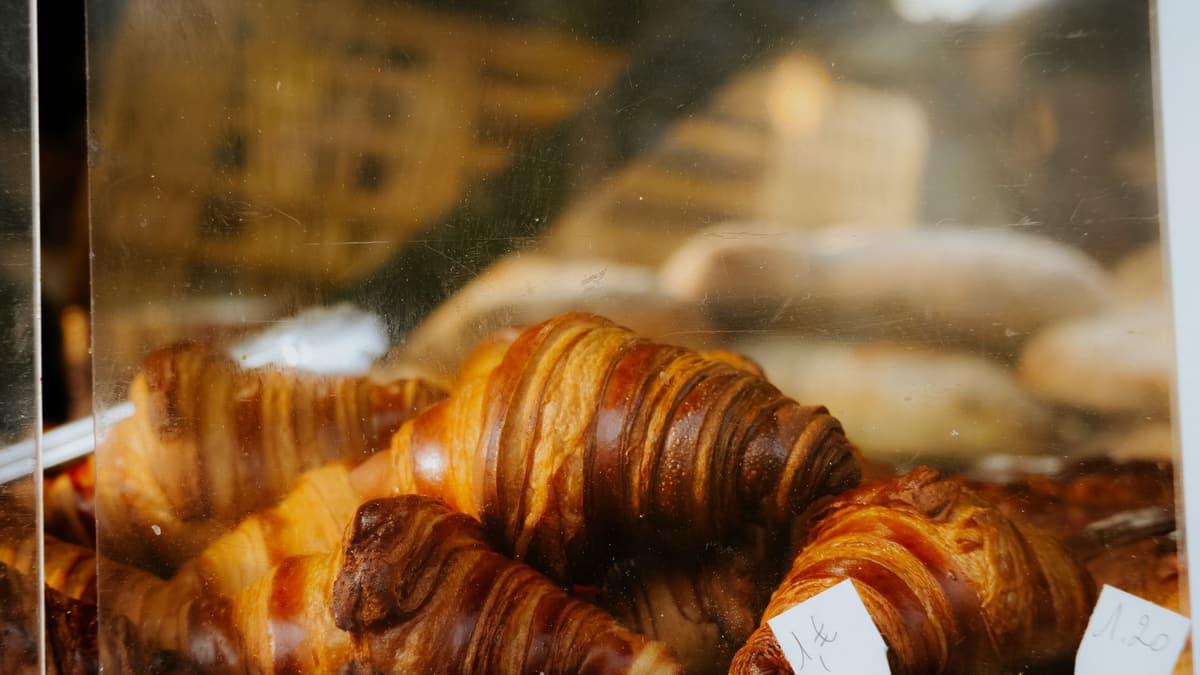
You're outside 92 rue de Richelieu. There's no bakery here now, and no plaque that we know of. It's an ordinary Paris building, so stand back and picture a shopfront with a new kind of sign: Boulangerie Viennoise, the Viennese bakery.
It was opened here by August Zang, an Austrian and a former artillery officer. Sources disagree on the year. Some say 1838, others 1839, and Jim Chevallier, who has written about Zang, puts the opening late in 1839. Zang sold the specialities of home, and among them was a crescent-shaped roll the Austrians called a kipfel, or kipferl. French bakers did what good bakers do. They copied it, and their version took a French name for its shape: croissant, the crescent.
So Zang didn't invent the croissant you just ate. He brought its ancestor. The flaky, laminated croissant came later, after Zang. The earliest laminated recipes appear in the early 1900s. Between his kipfel and Grolet's counter lie decades of French bakers reworking an Austrian idea, and the croissant still carries its passport in that word, viennoiserie.
Zang's own story takes a turn you won't see coming. In 1848 he went back to Austria, and there he founded a newspaper in Vienna, Die Presse. The man who brought the croissant's ancestor to Paris is remembered at home for a newspaper, not for bread. Paris kept the crescent. Vienna got the newspaper.
Now go back further, a full century before Zang, to a pastry cook who followed a royal bride to France. From here, take rue Saint-Marc east to rue Montmartre, turn right and follow rue Montmartre south, then turn left along rue Tiquetonne to rue Montorgueil and left again. Stohrer is at number 51. About fourteen minutes.
You're at 51 rue Montorgueil, in front of Stohrer. Look at the old shopfront, then step inside and look at the walls. Those are painted panels, set under glass. In 1984 the shopfront, the street facade and the interior decor were all listed as a historic monument.
Who painted them is a small puzzle. The house says the decor is the work of a student of the painter Paul Baudry. The official heritage notice names a decorator called Thivot du Mur. You'll read in many places that Baudry painted it himself, and that isn't what either of those sources says.
The house's story begins with a royal marriage. Nicolas Stohrer was the pastry cook of Stanislas Leszczyński, the former king of Poland. Stanislas's daughter, Marie, married Louis XV, the king of France, and in 1725 Stohrer came to Versailles with her. In 1730 he founded his own house in Paris, and it has been making pastry ever since. Since 2017 it has been owned by the Dolfi family.
What to order here: the baba au rhum. Here's the story the house tells about it, and it's a legend, so enjoy it as one. Old King Stanislas found his kugelhopf too dry. So Stohrer soaked it in wine. Which wine depends on who's telling it: the house itself admits the accounts diverge between Tokay and Malaga. Later the wine became rum, and the baba as we know it was born. Nobody can prove it, but you're eating it in the shop that tells the tale.
If rum isn't your thing, the house is also known for its puits d'amour, which means wells of love, and for its religieuse.
Now from royal pastry to the most everyday loaf in Paris, and the law that defines it. Walk north up rue Montorgueil. It becomes rue des Petits-Carreaux, then rue Poissonnière. Cross the wide Grands Boulevards and keep straight on into rue du Faubourg-Poissonnière. La Parisienne is at number 12. About twelve minutes.
Что входит
Наши экскурсии задуманы как медитативные и захватывающие: вы идёте и просто слушаете. Вместе всегда лучше, и приложение воспроизводит озвучку синхронно, так что вы, ваш партнёр и ваши друзья слышите каждую остановку одновременно.
You're at 12 rue du Faubourg-Poissonnière, outside La Parisienne. It's part of a small local group, seven bakeries in Paris, and this one is home to the best baguette in Paris for 2025.
Продолжение этой остановки есть в полной аудиоэкскурсии.
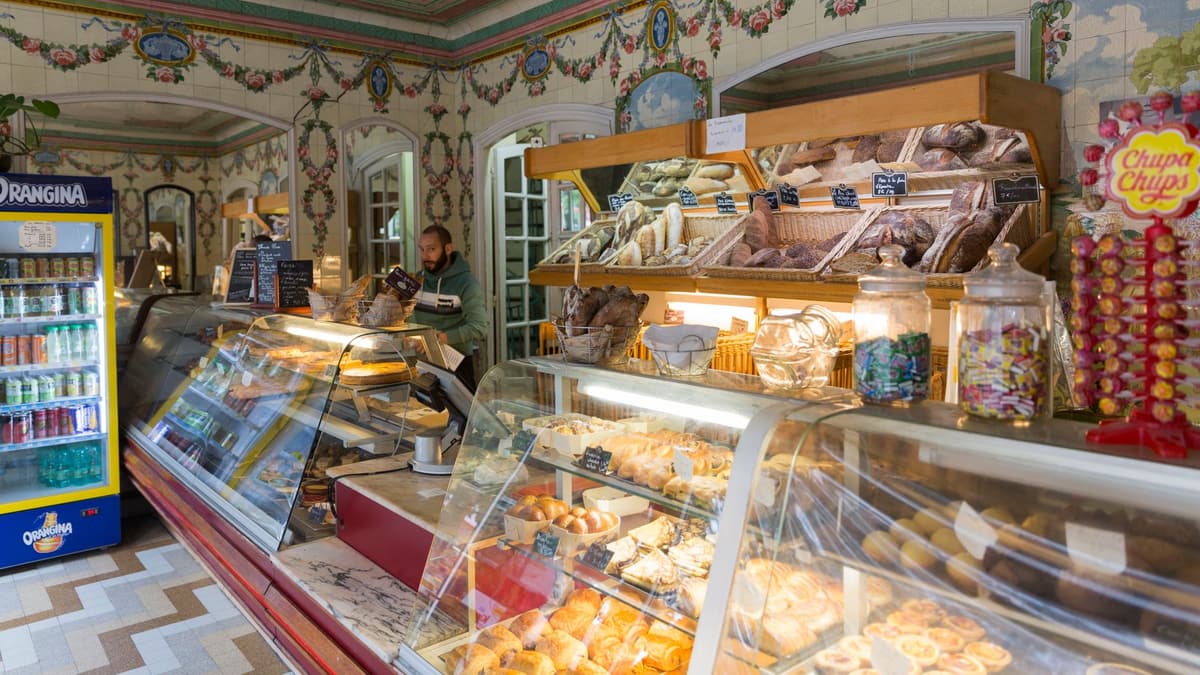
You're at 34 rue Yves-Toudic, outside Du Pain et des Idées, which means bread and ideas. Look through the window and up.
Продолжение этой остановки есть в полной аудиоэкскурсии.
You're on rue Jean-Pierre-Timbaud, at the grey shopfront on the corner of rue du Grand-Prieuré. This is Boulangerie Utopie, founded in the 2010s by Erwan Blanche and Sébastien Bruno.
Продолжение этой остановки есть в полной аудиоэкскурсии.
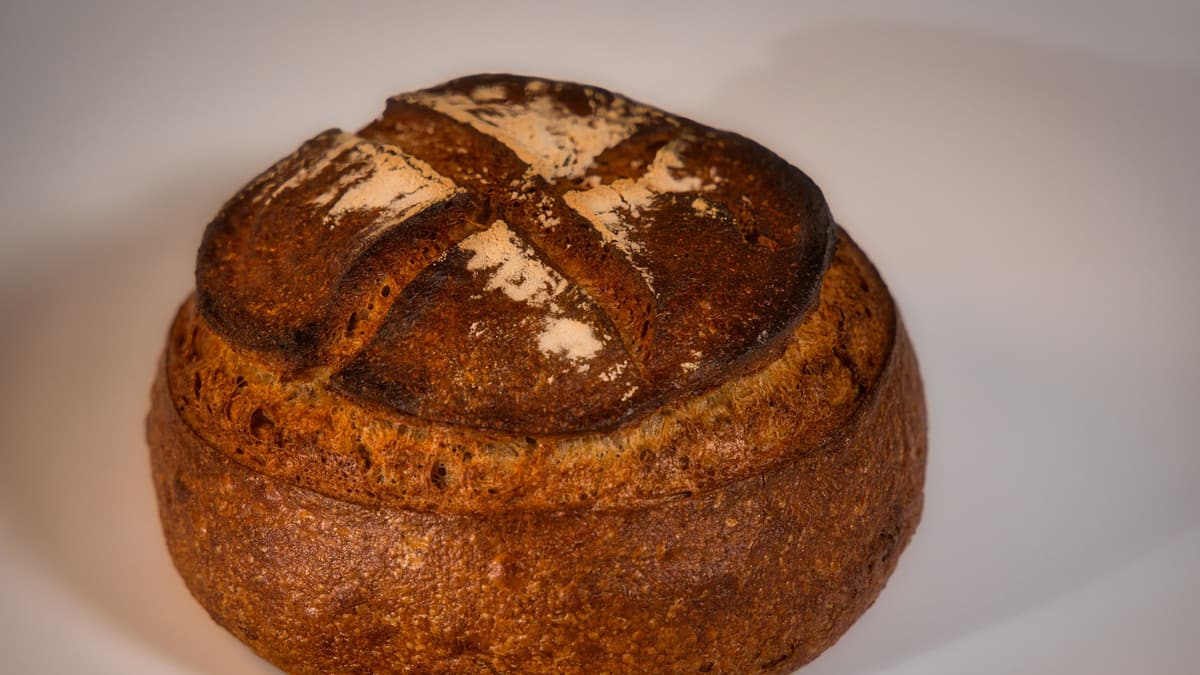
You're at 38 rue Debelleyme, in the Marais, outside Poilâne. Look at the bread in the window.
Продолжение этой остановки есть в полной аудиоэкскурсии.
Пройдите этот маршрут вместе с другими во время следующей запланированной прогулки.
Около 5,2 км, примерно 73 мин в спокойном темпе · 7 остановок
Друзья гуляют бесплатноOctober 11, 2026 · 9 min read
From the Hollandsche Schouwburg through the old Jewish Quarter, past the Dockworker and the Dam, to the Anne Frank House on the Prinsengracht.
October 11, 2026 · 11 min read
From Van Houten's street by the Vondelpark past Leidseplein, the Rijksmuseum passage and the famous canal bench to the Anne Frank House.

October 11, 2026 · 10 min read
Follow the last days of April and May 1945 from the Anhalter Bahnhof ruin past the Gestapo site and Brandenburg Gate to the Moltke Bridge and the Reichstag.
