
October 11, 2026 · 9 min read
Amsterdam Anne Frank Walking Tour
From the Hollandsche Schouwburg through the old Jewish Quarter, past the Dockworker and the Dam, to the Anne Frank House on the Prinsengracht.
589

October 11, 2026 · 13 min read

 Freunde laufen kostenlos mit
Jede Tour wird in der App auch als geplante Gruppenrunde angeboten, der du dich anschließen kannst.
Zur Audiotour-Seite für Dallas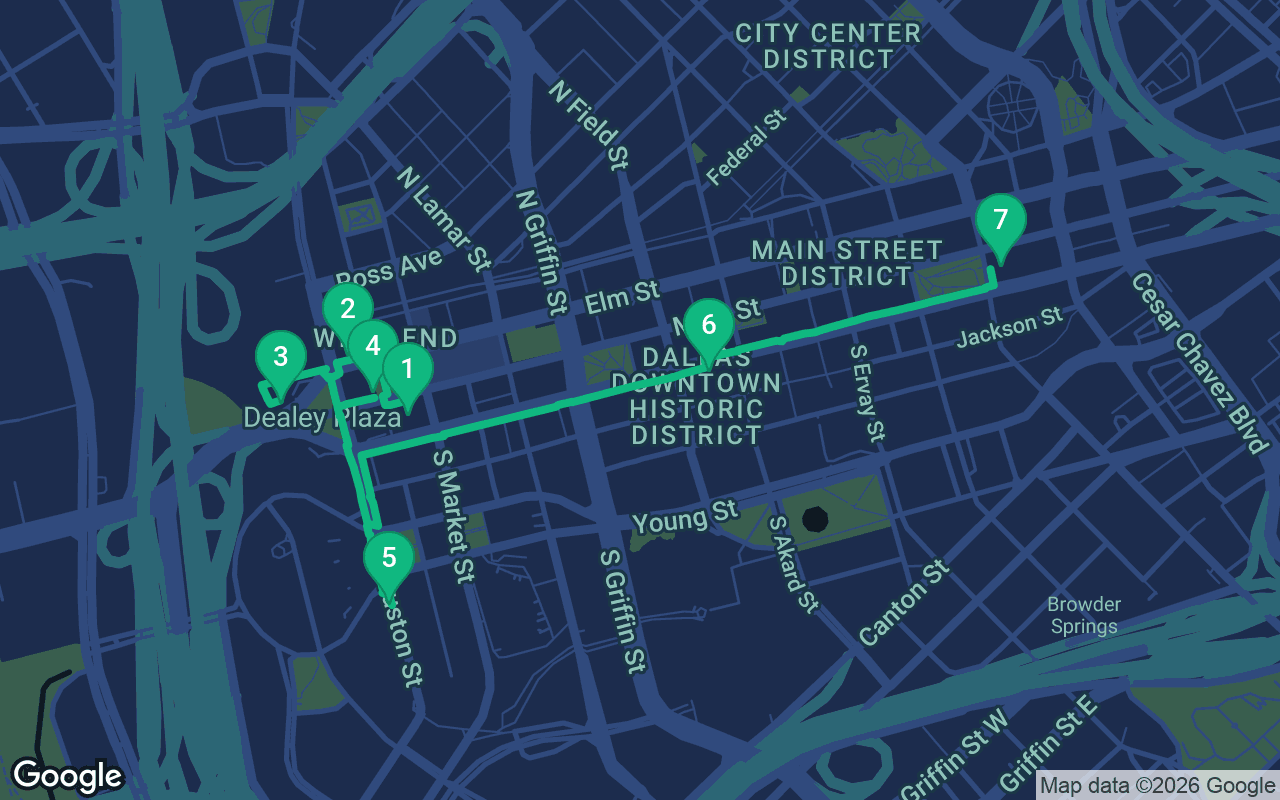
Etwa 2,9 km, ungefähr 43 Minuten in gemütlichem Tempo.
Diese Tour ist vertont
Klicke bei den ersten 3 Stationen auf Wiedergabe für eine 30-Sekunden-Vorschau der Erzählung. In der App hörst du die Einleitung und diese 3 Stationen kostenlos in voller Länge, und jede meldet sich mit einem Signalton, sobald du ankommst. Die gesamte geführte Tour gehört für einmalig $14.99 dauerhaft dir.
Funktioniert mit Garmin, Komoot, Strava, OS Maps und jeder GPX-App.
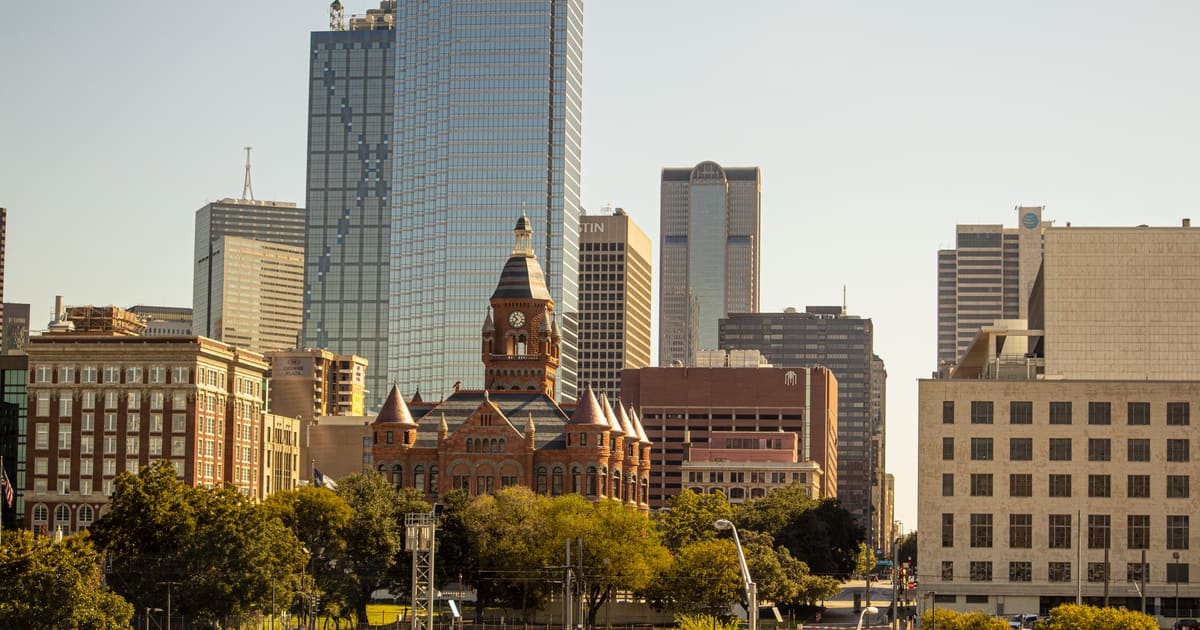
On Friday, November 22, 1963, President John F. Kennedy rode through downtown Dallas in an open car, past big crowds. At 12:30 pm, as the car passed the Texas School Book Depository on Elm Street, shots were fired. Within three days, two more men were dead: a Dallas police officer, and the man accused of killing the president, shot on live television in a police basement. This walk follows those three days in downtown Dallas, in order: the motorcade's last block of Main Street, the window, the grassy knoll and what the official investigations concluded, and then the path of a nightclub owner named Jack Ruby to the police basement. It's one of our self-guided walking tours, about 2.9 kilometers, from the JFK Memorial to the old police headquarters on Harwood Street. This is a walk about real deaths, so it keeps a quiet, factual tone, and it takes no side in any theory.
The walking takes about 43 minutes. With time at each stop, allow about two hours, and longer if you visit the Sixth Floor Museum; check its hours and ticket prices before you go. The route is flat apart from the gentle slope of the grassy knoll, and it's all on city sidewalks. Start at the JFK Memorial at Main and Market Streets, about 300 meters from West End DART station. You finish at Main and Harwood, about 500 meters from St. Paul DART station. On a hot day, carry water. One safety rule for Dealey Plaza: Elm Street is a live road with fast traffic. View everything from the sidewalk or the grass, and never step into the street. And one note on order: the fourth stop jumps ahead to Sunday, and the fifth steps back to Friday at 12:30. The streets set the order, and the narration will tell you when you're moving in time.
You're standing at the JFK Memorial. Walk inside if you like. It's a roofless square room, 50 feet on each side and 30 feet high, open to the sky. In the center is a low granite block with John F. Kennedy's name in gold. The architect Philip Johnson designed it as a cenotaph, an empty tomb, and it was dedicated on June 24, 1970.
Now step out to Main Street, at the edge of the plaza. Look west, toward the building Dallas calls Old Red. That is the way the motorcade went.
That morning, Air Force One landed at Love Field at 11:40. The motorcade's route through downtown is set out plainly in the Warren Commission's report: "Harwood to Main, Main to Houston, Houston to Elm." It was heading to a lunch at the Trade Mart. The President and Mrs. Kennedy rode in the open limousine with the Governor of Texas, John Connally, and his wife, Nellie.
The crowds along Main Street were huge. The report calls it "a tremendous reception." The car came down this street, past this block. Beside Old Red, at Houston Street, it turned right.
Keep that last corner of the walk in mind too. The motorcade had come into Main from Harwood Street. The walk ends there, at the place where this story closes two days later.
Now walk west on Main Street to Houston Street, and turn right. Stop on Houston, across from the seven-story building at the end of the block. About three minutes.
Stand on Houston Street and look across at the seven-story building. This is the Texas School Book Depository, at 411 Elm Street. It was built in 1901, after lightning burned down an earlier building on the same spot. Now find the sixth floor, and the window at the southeast corner, the corner nearest you where Houston meets Elm. That is the window.
Right here on Houston, just before the turn onto Elm, Nellie Connally said to the president, "Mr. President, you can't say Dallas doesn't love you." Kennedy answered, "That is very obvious." The car then turned left onto Elm and passed beneath this building.
Lee Harvey Oswald worked inside. He had been hired on October 15 as an order filler. That morning, according to the Warren Commission, he arrived carrying "a long and bulky brown paper package."
At 12:30 pm, shots were fired. In 1964 the Warren Commission concluded that the shots that killed the president and wounded Governor Connally came from that sixth-floor window at the southeast corner. Most witnesses heard three shots. Some heard two, others four or more.
One witness was a steamfitter named Howard Brennan. He was sitting on a low wall across Elm Street, about 120 feet from the window, and you can see him in a home movie that you'll hear about at the next stop. A deputy later found the sniper's position by the window and three empty shells. A rifle, a Mannlicher-Carcano with the serial number C2766, was found on the sixth floor.
Oswald did not stay. Roughly a minute and a half after the shots, Patrolman M. L. Baker, a Dallas police officer, confronted him in the second-floor lunchroom. When Baker was told that Oswald worked there, he let him go. By about 12:33, Oswald was out of the building. According to the Commission, he probably walked east on Elm Street for about seven blocks, boarded a bus at Elm and Murphy, and then took a taxi driven by William Whaley to Oak Cliff, the neighborhood where he rented a room.
Dallas County bought the building between 1977 and 1981. Today it holds county offices and the Sixth Floor Museum, which opened on February 20, 1989.
Now walk west along the sidewalk on the north side of Elm Street, going downhill, to the white concrete structure on the grassy slope. About three or four minutes.
You're at the white concrete pergola on the north side of Elm Street. The grassy slope in front of it is the grassy knoll. Behind you is a wooden fence, and beyond that, the rail yard. All of Dealey Plaza is a National Historic Landmark District, named in 1993.
Look for the small concrete pedestal near the pergola. A man named Abraham Zapruder stood on it with his home movie camera and filmed the motorcade as it came down Elm. His film became the key visual record of the assassination.
The car was moving at about 11 miles an hour. The fatal shot struck the president when the car was about 230 feet down Elm from the corner of Houston, below you on the road. Governor Connally was gravely wounded. The limousine reached Parkland Hospital at about 12:35.
You may see an X painted in the roadway of Elm Street. It is unofficial, painted by unknown hands, and not an exact survey mark. Please look at it only from the sidewalk or the grass. Do not step into the road for a photo. Traffic does not stop for it.
This hill is the center of most theories about the day. Here is what the official investigations found, in order.
In 1964 the Warren Commission concluded that there were three shots, all fired from the Depository window, and it found no credible evidence of shots from the overpass or the rail yards. It also found no evidence that Oswald, or Jack Ruby, was part of any conspiracy.
In 1979 the House Select Committee on Assassinations agreed that Oswald fired three shots. But it concluded that Kennedy was "probably assassinated as a result of a conspiracy." That rested on acoustic evidence, a police radio recording that it said showed "a high probability that two gunmen fired." The committee could not identify the other gunman, and it found that the Soviet and Cuban governments and organized crime, as groups, were not involved.
In 1982 a panel of the National Academy of Sciences studied that recording. It found that the sounds on the recording were made about one minute after the assassination, so the acoustic case for a second gunman did not hold.
Those are the findings. This walk leaves it there.
Now walk back east up Elm Street to Houston Street, turn right, and walk one block south to Main Street. The building on your left, at Houston and Main, is the next stop. About four or five minutes.
Was enthalten ist
Unsere Touren sind meditativ und immersiv gedacht: Du bleibst in Bewegung und hörst einfach zu. Gemeinsam sind sie immer schöner, und die App spielt die Erzählung synchron ab, sodass du, dein Partner und deine Freunde jede Station im selben Moment hören.
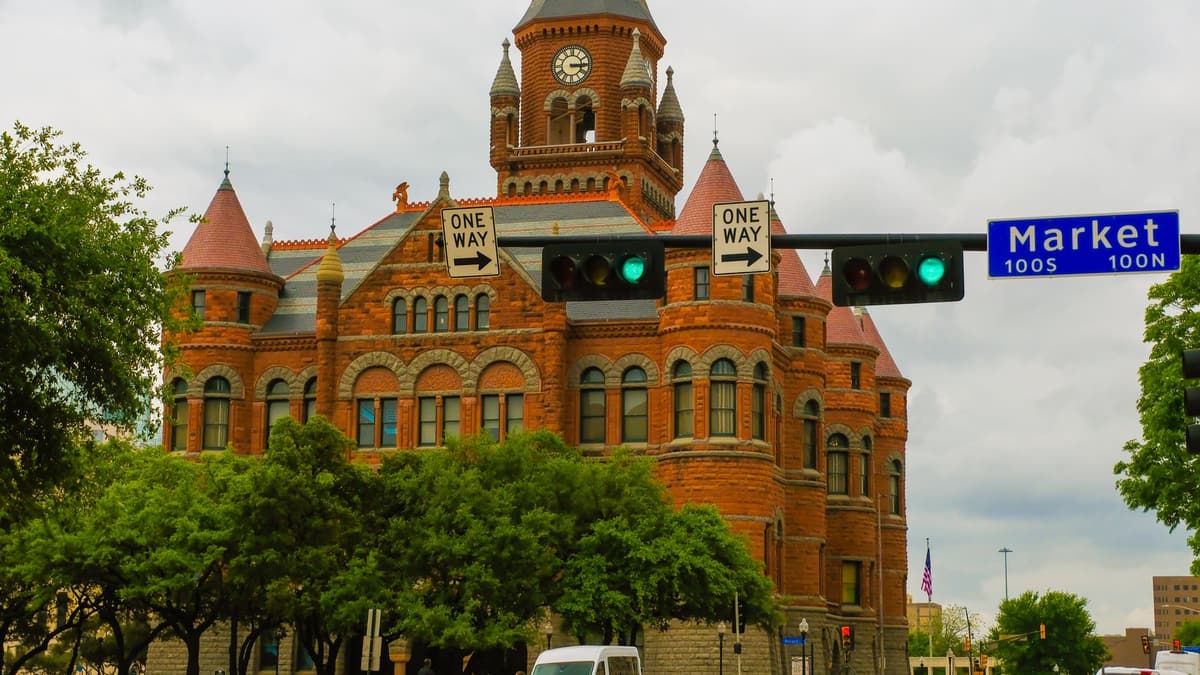
You're at the corner of Houston and Main. The building on the corner is the Dallas County Criminal Courts Building, from 1915. It faces Old Red across Main Street.
Der Rest dieser Station steckt in der vollständigen Audiotour.
We're back to Friday, November 22, a little before 12:30. Look at the building on Young Street with the carved facade known as the Rock of Truth.
Der Rest dieser Station steckt in der vollständigen Audiotour.
Stop on Commerce Street, across from the Adolphus Hotel at 1321 Commerce, which is still standing. Look at the south side of the street.
Der Rest dieser Station steckt in der vollständigen Audiotour.
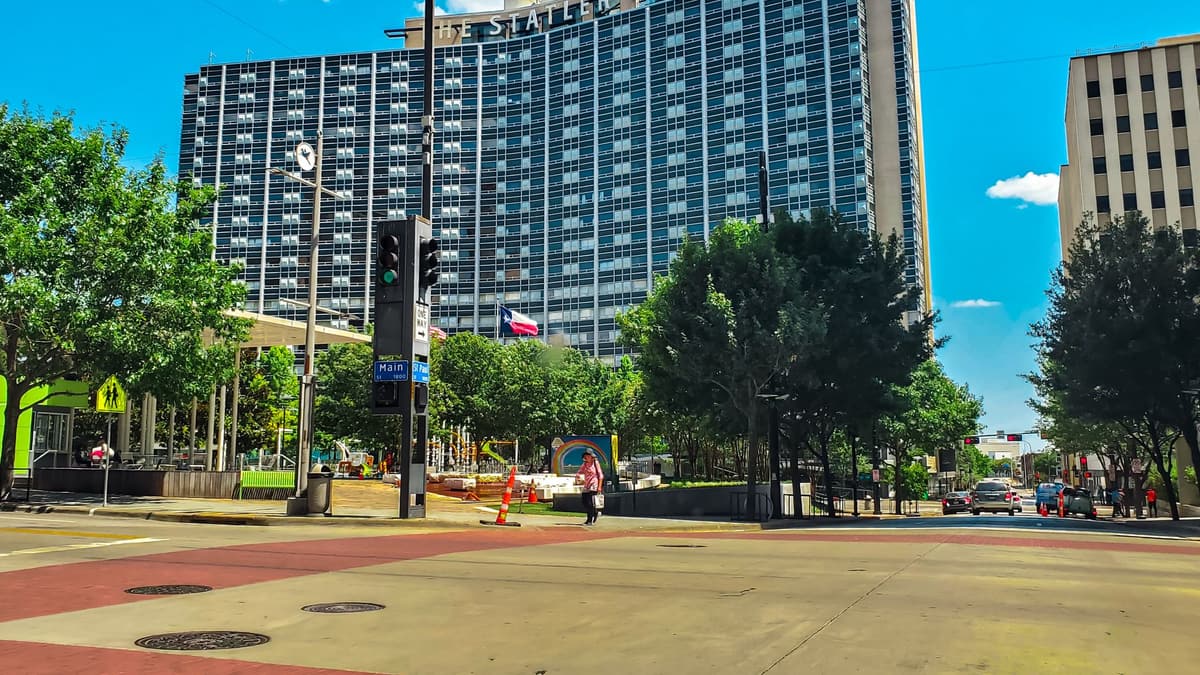
You're at Main and Harwood. The 1914 building on the corner, at 106 South Harwood, was the Dallas Municipal Building.
Der Rest dieser Station steckt in der vollständigen Audiotour.
Mach diesen Spaziergang zusammen mit anderen bei der nächsten geplanten Tour.
Ca. 2,9 km, etwa 43 Minuten bei gemütlichem Tempo · 7 Stopps
Freunde laufen kostenlos mitOctober 11, 2026 · 9 min read
From the Hollandsche Schouwburg through the old Jewish Quarter, past the Dockworker and the Dam, to the Anne Frank House on the Prinsengracht.
October 11, 2026 · 11 min read
From Van Houten's street by the Vondelpark past Leidseplein, the Rijksmuseum passage and the famous canal bench to the Anne Frank House.

October 11, 2026 · 10 min read
Follow the last days of April and May 1945 from the Anhalter Bahnhof ruin past the Gestapo site and Brandenburg Gate to the Moltke Bridge and the Reichstag.
