
October 11, 2026 · 9 min read
Amsterdam Anne Frank Walking Tour
From the Hollandsche Schouwburg through the old Jewish Quarter, past the Dockworker and the Dam, to the Anne Frank House on the Prinsengracht.
589

October 8, 2026 · 12 min read

 A barátaid ingyen sétálnak
Minden túra ütemezett csoportos sétaként is fut, amelyhez csatlakozhatsz az appban.
További hangos túrák itt: Chicago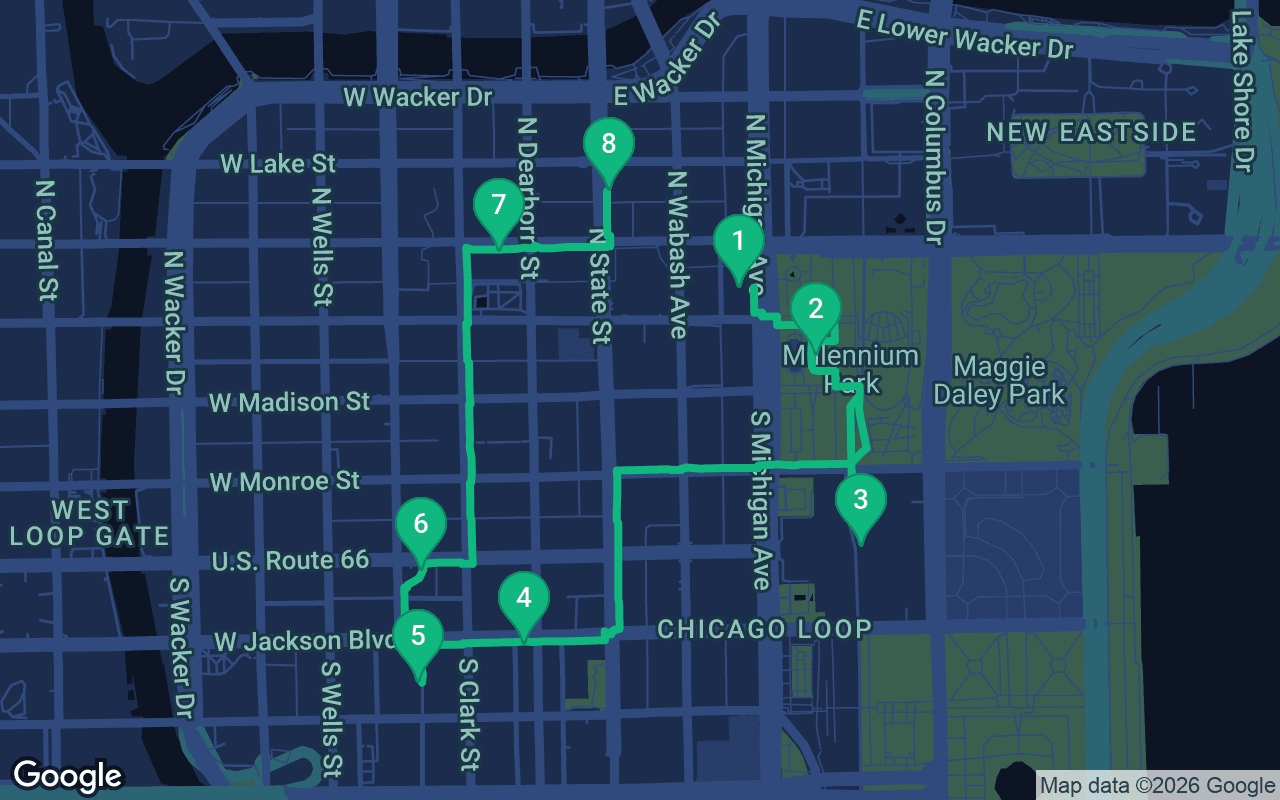
Nagyjából 3,4 km, körülbelül 51 perc kényelmes tempóban.
Ez a séta hangosvezetéssel is elérhető
Nyomj a lejátszásra az első 3 megállónál, és itt helyben meghallgathatsz egy 30 másodperces részletet a narrációból. Az alkalmazásban a bevezető és ez a 3 megálló teljes hosszában ingyenes, és mindegyik hangjelzéssel szól, amint megérkezel. A teljes narrált túra mindössze $9.99 összegért a tiéd lehet, ami egy egyszeri, örökre szóló vásárlás.
Működik Garmin, Komoot, Strava, OS Maps és bármilyen GPX alkalmazással.
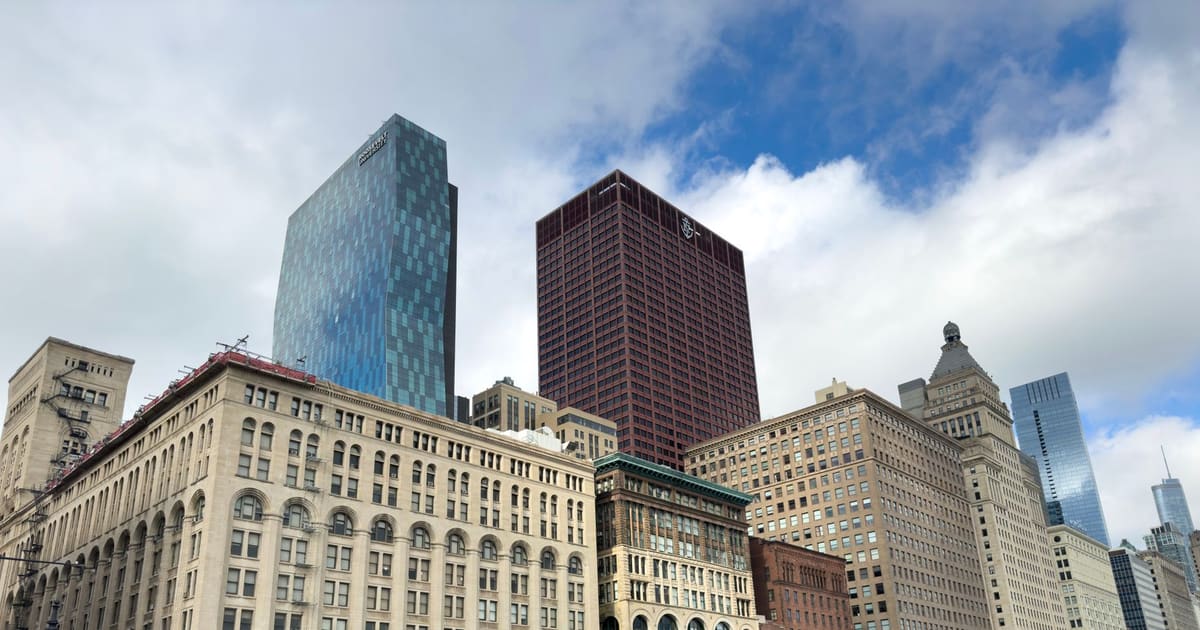
After the Great Fire of 1871 burned the heart of Chicago to the ground, the city rebuilt itself taller, faster and bolder than anywhere else in the world, and in the process it gave the world the skyscraper. This walk tells that story in the Loop, the downtown ringed by the elevated train tracks. It starts under a Tiffany glass dome at the Chicago Cultural Center, crosses Millennium Park to the Bean and the Art Institute, then heads into the canyons of the financial district for the buildings that changed how cities are built, before finishing beneath the lights of the Chicago Theatre on State Street. It runs about 3.4 kilometers, a little over two miles, and it is the best of our self-guided walking tours for anyone who wants to understand why Chicago looks the way it does.
Give it two to three hours at an easy pace, longer if you get lost in the Art Institute, which is very easy to do. The route is completely flat and paved, but the streets are busy, so expect lots of crossings and crowds at lunchtime. A weekday is best, because several stops are working office lobbies that are open during business hours and quieter or closed at weekends, so check before you go. Chicago weather is famously changeable. The wind funnels between the towers and can be bitter in winter, so bring a warm layer even on a mild day, and in summer the open plazas get hot while the narrow streets stay in shade. You will spend much of this walk looking up, which is the point, but watch the curbs. For most of the way you will hear the elevated trains rattling overhead on their tracks around the Loop, which have circled downtown since the 1890s and are part of the soundtrack. The Art Institute charges admission, and the rest of the route is free.
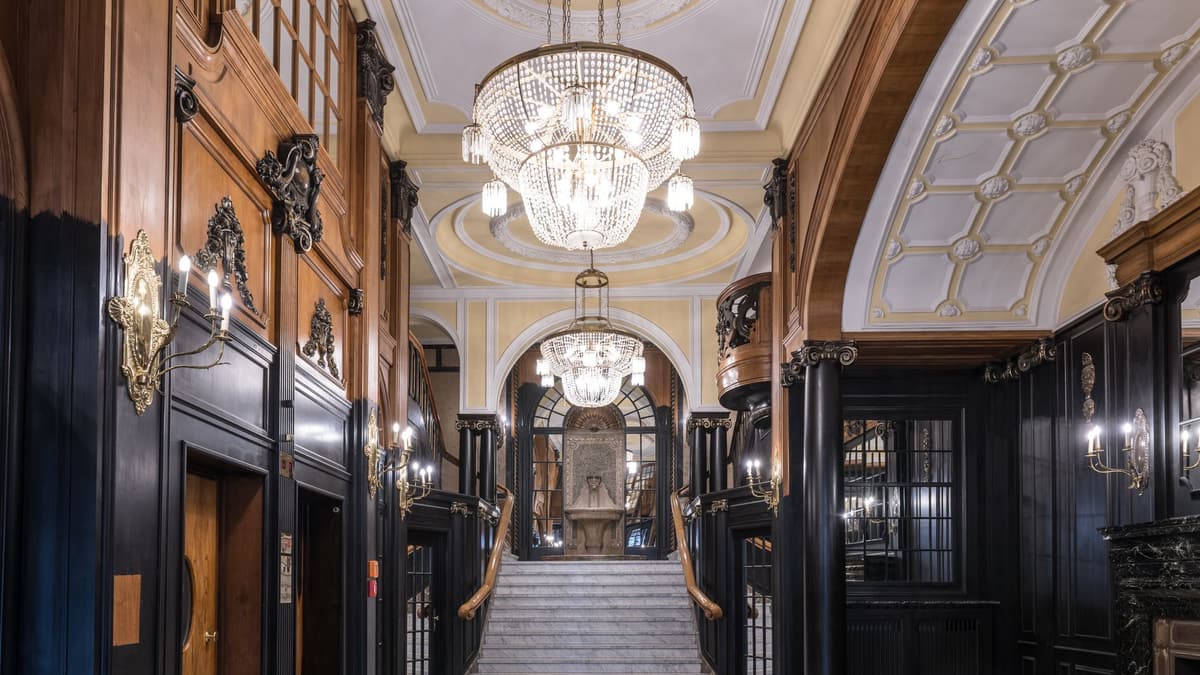
Step inside and climb the grand staircase to Preston Bradley Hall, then stand in the middle of the room and look straight up. Above you is a dome of Tiffany glass, thirty-eight feet across and made of some thirty thousand pieces, and it is said to be the largest Tiffany glass dome in the world. This building opened in 1897 as the city's first central public library, and the library itself was born out of disaster. When the Great Fire destroyed Chicago in 1871, people in Britain decided to help the city rebuild its mind as well as its streets. The author Thomas Hughes and others gathered thousands of donated books and shipped them across the Atlantic, reportedly with Queen Victoria herself among the donors, and those gifts became the seed of the Chicago Public Library. Look at the walls of the staircases and you will see mosaics of glass and marble spelling out quotations about books in several languages. The library moved out decades ago and the building now hosts free exhibitions, concerts and events, with a second, Renaissance-style glass dome over the hall at the north end. When you are ready, leave by the Michigan Avenue doors, cross the avenue at Washington Street into Millennium Park, and in about four minutes you will see a giant silver shape on the plaza ahead.
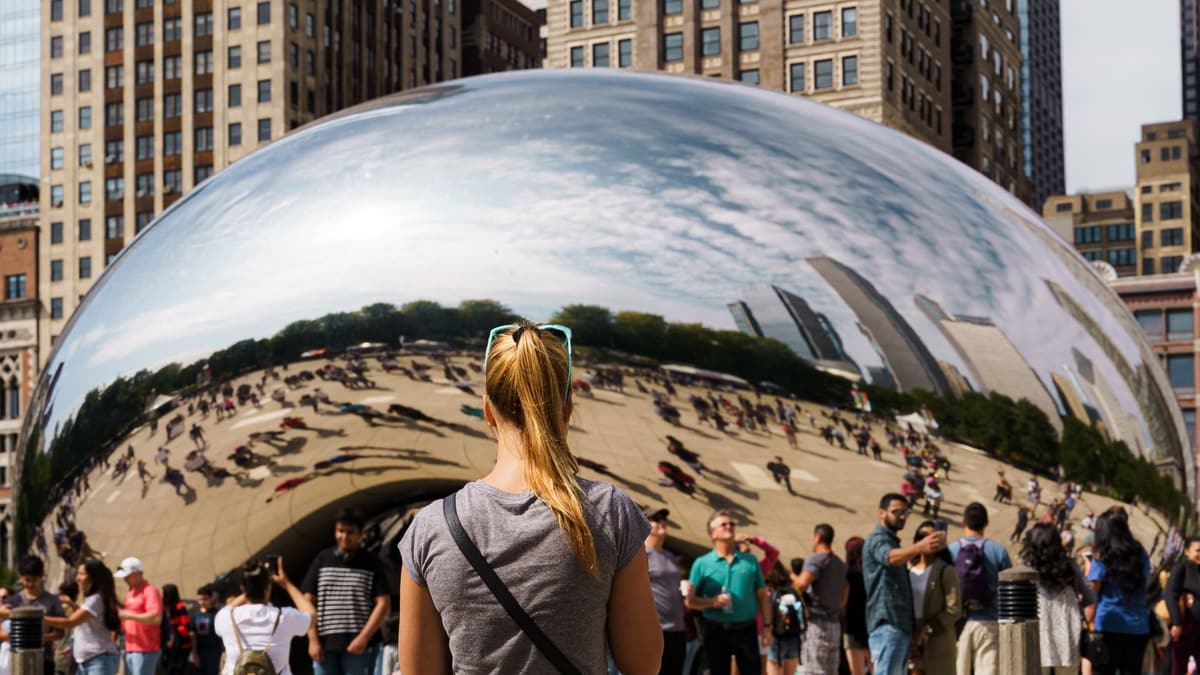
Walk all the way around it, then underneath it. Cloud Gate, which everyone in Chicago calls the Bean, was designed by the British artist Anish Kapoor, who has said he was inspired by liquid mercury. It is made of 168 stainless steel plates, welded together and polished until the seams vanished, so the whole thing looks like one drop of silver that has landed on the plaza. It weighs about 110 tons. Stand back and see how it bends the skyline of Michigan Avenue into a curve, then walk under the arch, into the hollow the artist calls the omphalos, the navel, where your reflection multiplies and twists above your head. Kapoor reportedly was not fond of the nickname, but the city never listened. Millennium Park itself is a small marvel of engineering. Until the late 1990s, this corner was an ugly stretch of railway tracks and parking lots, and the park was built over the top of them, opening in 2004, years behind schedule and well over budget. Today it is one of the most popular places in the city, with Frank Gehry's steel band shell just to the north. Head south through the park, past the two glass towers of the Crown Fountain, where faces of Chicagoans appear on giant screens and spit water. Cross Monroe Street and keep south along Michigan Avenue for about five minutes to a pair of bronze lions.
 Stand at the bottom of the steps between the two bronze lions. Sculpted by Edward Kemeys, they have guarded this door since 1894, and the city treats them like family: at Christmas they wear wreaths, and when the Blackhawks won the Stanley Cup they got giant hockey helmets. The building behind them was put up for the World's Columbian Exposition of 1893, the great fair that showed off the rebuilt city to the world, and was designed by the same firm as the Cultural Center you just left. Inside is one of the great art collections on earth. Two of the most famous American paintings hang here. One is Grant Wood's American Gothic, the stern farmer with a pitchfork and the woman beside him, for which Wood's sister and his dentist posed. The other is Edward Hopper's Nighthawks, with its lonely figures in an all-night diner, painted in 1942 and bought by the museum that same year. Seurat's huge dotted painting of Parisians in a park, A Sunday on La Grande Jatte, is here too, and it is even more astonishing in person. If you plan to come back for a proper visit, carry on for now. Go one block south to Jackson Boulevard, turn right and walk west, under the elevated tracks on Wabash Avenue and across State Street. In about eight minutes, at Dearborn Street, look for a dark, plain building on the left.
Mit tartalmaz
Túráink meditatívnak és magával ragadónak készültek: mozogsz, és egyszerűen hallgatod. Együtt mindig jobbak, és az alkalmazás szinkronban játssza le a narrációt, így te, a párod és a barátaid ugyanabban a pillanatban hallhatjátok az egyes megállókat.
Cross to the corner and look up at the brick wall in front of you.
A megálló folytatása a teljes hangos túrában hallható.
Stand on the corner of Jackson and LaSalle and look north up LaSalle Street. You are looking along the canyon of Chicago's financial district, and the tower behind you closes the end of it like a stage set.
A megálló folytatása a teljes hangos túrában hallható.
Look first at the entrance arch and find the carved birds tucked into the stonework. They are rooks, and they explain the name.
A megálló folytatása a teljes hangos túrában hallható.
In the middle of the plaza stands a fifty-foot sculpture of rusty brown steel with a long face and what might be wings, or hair, or ears. Nobody has ever agreed on what it is.
A megálló folytatása a teljes hangos túrában hallható.
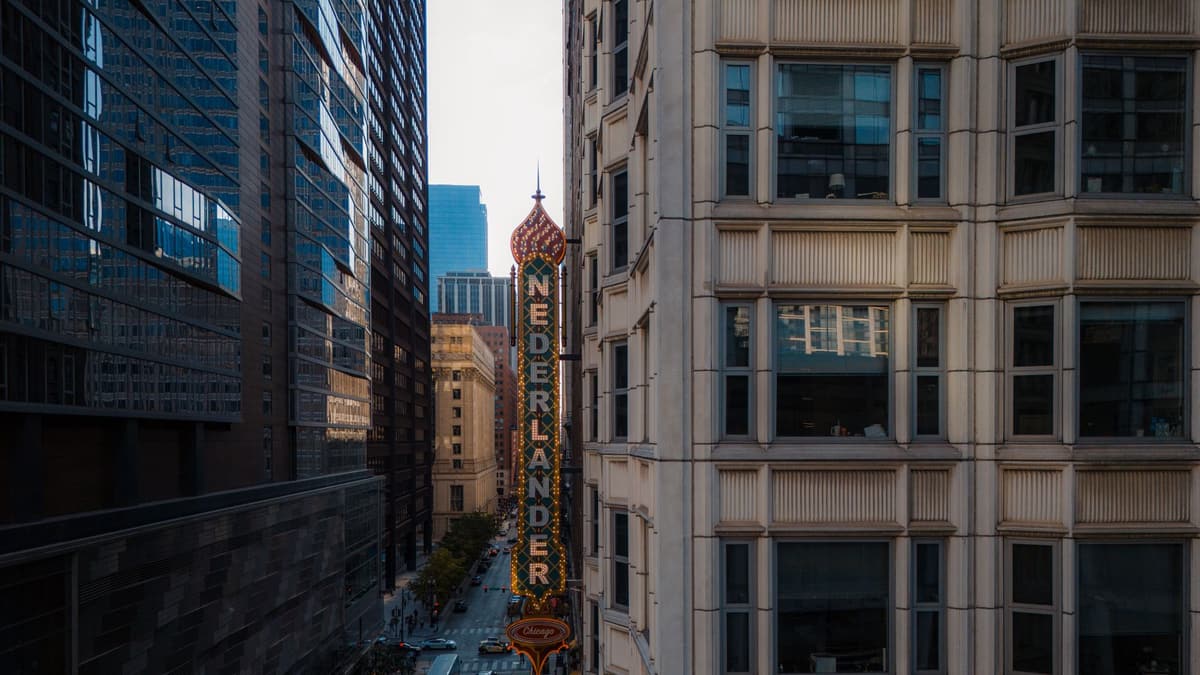
The walk ends under the most famous sign in Chicago, six stories of red letters spelling the city's name, flashing above the theater's marquee.
A megálló folytatása a teljes hangos túrában hallható.
Tedd meg ezt a sétát másokkal a következő tervezett túrán.
Körülbelül 3,4 km, nagyjából 51 perc kényelmes tempóban · 8 megálló
A barátaid ingyen sétálnakOctober 11, 2026 · 9 min read
From the Hollandsche Schouwburg through the old Jewish Quarter, past the Dockworker and the Dam, to the Anne Frank House on the Prinsengracht.
October 11, 2026 · 11 min read
From Van Houten's street by the Vondelpark past Leidseplein, the Rijksmuseum passage and the famous canal bench to the Anne Frank House.

October 11, 2026 · 10 min read
Follow the last days of April and May 1945 from the Anhalter Bahnhof ruin past the Gestapo site and Brandenburg Gate to the Moltke Bridge and the Reichstag.
