
October 11, 2026 · 9 min read
Amsterdam Anne Frank Walking Tour
From the Hollandsche Schouwburg through the old Jewish Quarter, past the Dockworker and the Dam, to the Anne Frank House on the Prinsengracht.
589

October 11, 2026 · 10 min read

 Prietenii merg gratis
Fiecare tur funcționează și ca o plimbare de grup programată la care te poți înscrie în aplicație.
Mai multe tururi audio în Warsaw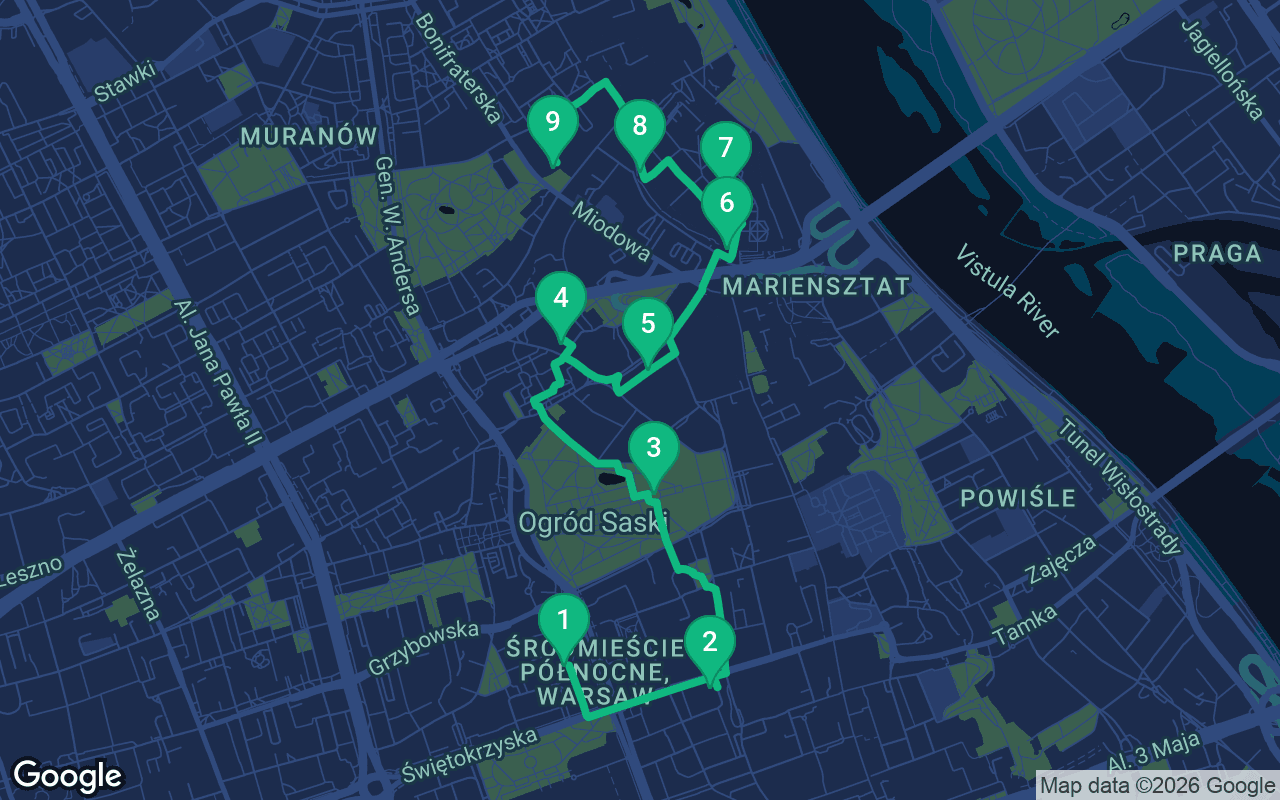
Aproximativ 4,2 km, aproximativ 57 minute într-un ritm ușor.
Acest tur este narat
Apasă pe redare la primele 3 opriri pentru o demonstrație de 30 de secunde a narațiunii. În aplicație, introducerea și aceste 3 opriri se aud integral și gratuit, iar fiecare te anunță printr-un semnal sonor când ajungi. Întregul tur ghidat este al tău pentru $15.99, o achiziție unică pe care o păstrezi pentru totdeauna.
Funcționează cu Garmin, Komoot, Strava, OS Maps și orice aplicație GPX.
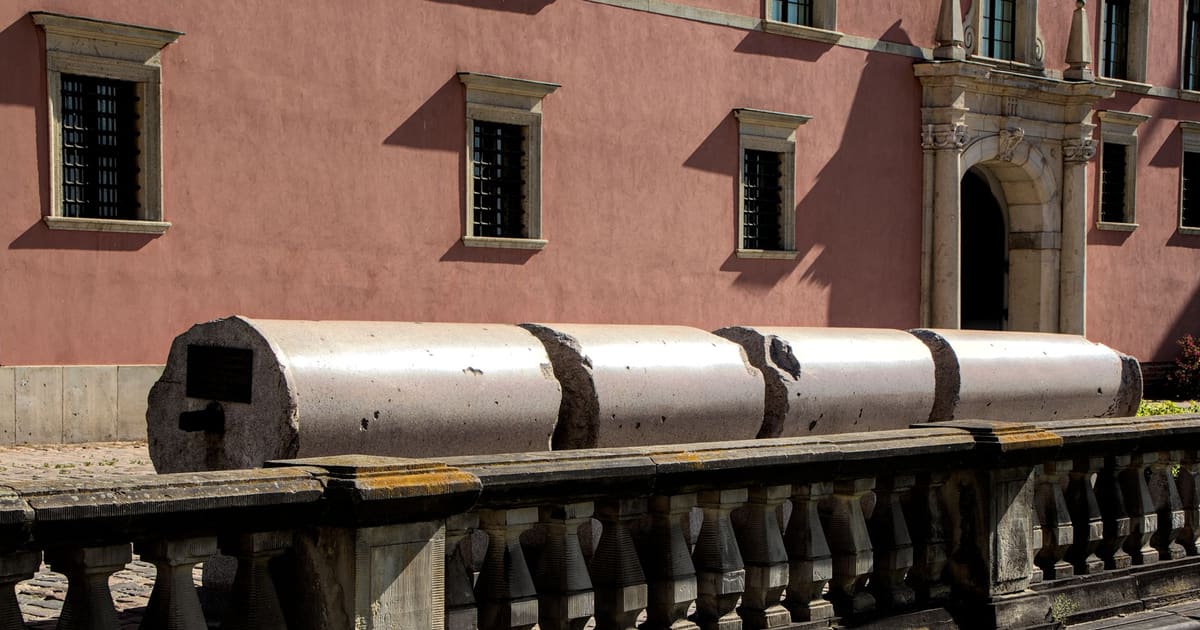
At five in the afternoon on August 1, 1944, between about 25,000 and 30,000 soldiers of the Polish Home Army rose against the German garrison of Warsaw. Only about one in ten had a weapon. They planned to fight for a few days, until the Red Army arrived. They fought for 63. This is not the Warsaw Ghetto Uprising, the revolt of Jewish fighters inside the ghetto in 1943. It is the Home Army's rising, a year later. The walk runs from the old telephone tower on Zielna Street to the Warsaw Uprising Monument on Krasiński Square, about four kilometers, from the center that held to the Old Town that fell. It is one of our self-guided walking tours built around a single story.
The walking takes about an hour; with the stories, allow two. Start from Świętokrzyska metro, about 250 meters from the tower. The walk ends about 600 meters from Ratusz-Arsenał metro. It is city pavement with no long climbs, and every stop can be seen from outside. Go in daylight, because much of this story is written on small stone plaques. The Warsaw Rising Museum, two kilometers west of the start, deserves its own visit.
You're on Zielna Street, below a tall tower. Look up at the roof. That symbol is the Kotwica, the anchor of Fighting Poland. This was the PAST building, the telephone company's tower, built like a castle keep. Under the occupation it was a German military telephone exchange.
The insurgents attacked it from the first hour, and failed. Four assaults in early August broke against it. For twenty days a German fortress stood in the middle of a Polish-held district. Then, in the small hours of August 20, the Kiliński battalion came back under Henryk Roycewicz, "Leliwa", with sappers, flamethrowers and a fire-brigade crew. Charges blew holes in the walls. A fire-engine pump sprayed a petrol mixture inside, and it was set alight. By mid-afternoon the tower was theirs. About three dozen Germans were dead, more than a hundred walked out as prisoners, and at least 17 Poles had died. It counts among the Uprising's greatest victories.
The same battalion had already flown a flag from the tallest building in the city. Walk east along Świętokrzyska Street for about six minutes; the hotel tower stands on the wide square to your right.
Face the tall hotel, today the Hotel Warszawa, and look up to the top floors. In 1944 this was the Prudential insurance tower, sixteen stories and 66 meters, the tallest building in Warsaw.
On August 1, Cadet Corporal Jerzy Frymus, "Garbaty", and Cadet Eugeniusz Lubieński, "Pająk", ran up 392 steps to the sixteenth floor and hung out the white-and-red flag. The tower became a constant German artillery target.
On August 28 came the biggest shell of all, nearly two tonnes, from a German Karl siege mortar. About 300 meters east, on his roof on Kopernika Street, Sylwester Braun, a Home Army photographer, was ready. As he later recalled, "over a period of three seconds I took six photographs." The sound reached him only by the third frame, and the blast made him grab the chimney. The building did not fall; its steel frame held.
Now step back to the first week, when the Old Town was cut off. Head north up Mazowiecka Street, cross Królewska, and walk into the Saxon Garden to the great fountain, about eight minutes.
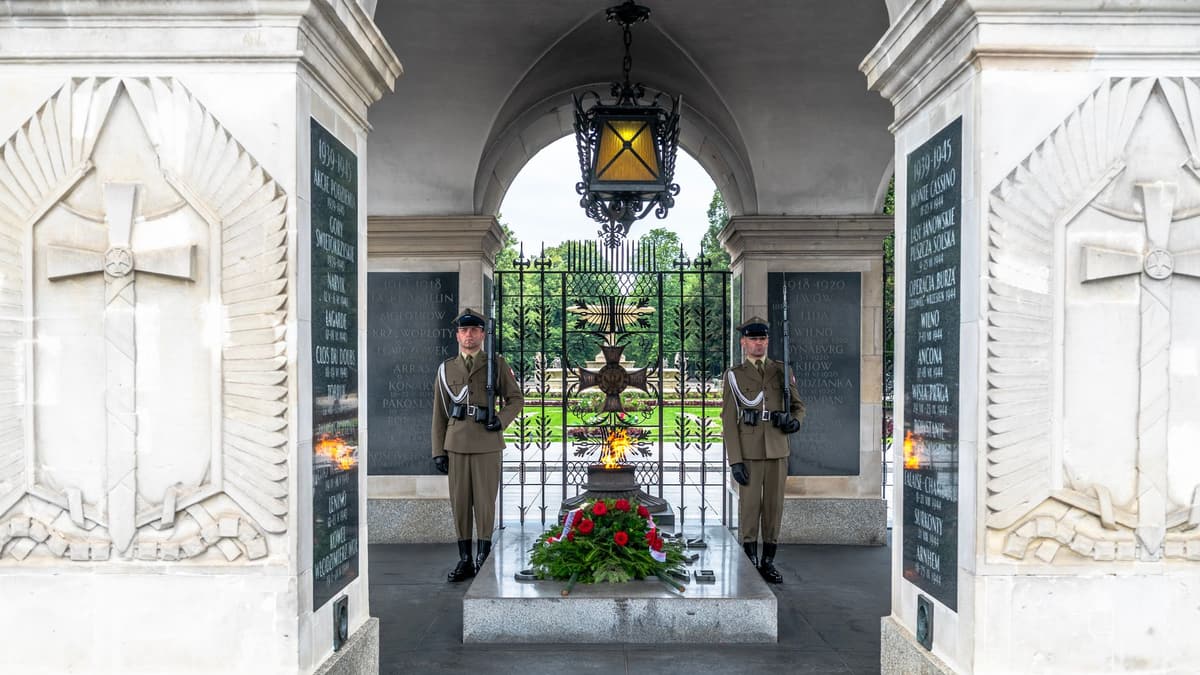 You're by the fountain in the Saxon Garden, which in August 1944 was the point of a German wedge.
On August 5, units under SS General Heinz Reinefarth, among them the Dirlewanger brigade, attacked through the western district of Wola, aiming for this park and the road to the Vistula bridge. As they advanced, they began the mass murder of Wola's people. The museum puts the dead at about 40,000.
That same day, the Zośka battalion used a captured Panther tank to take the German camp on Gęsia Street, in the ruins of the former ghetto, and freed 348 Jewish prisoners. Some of them joined the fight. It is the one true link between the two uprisings.
By August 7 the Germans held the line from Wola to this park, and the Old Town was cut off from the center. They drove Polish civilians ahead of their tanks as living shields, some herded from this garden toward the barricades. People were executed here too; a plaque on the north edge calls it a place sanctified by Polish blood.
Leave the park on its north side and follow your map north-west, across Senatorska Street to Bielańska Street, about seven minutes.
Ce este inclus
Tururile noastre sunt gândite să fie meditative și captivante: te miști și pur și simplu asculți. Sunt mereu mai frumoase împreună, iar aplicația redă narațiunea sincronizat, astfel încât tu, partenerul tău și prietenii tăi auziți fiecare oprire în același moment.
Find the fragment of an old façade, pitted with bullet marks, with the Fighting Poland anchor on its plaques. It is nearly all that is left of the bank.
Restul acestei opriri este în turul audio complet.
On the south side of the square stands the rebuilt Grand Theatre, home of the National Opera. Find the plaque on its wall.
Restul acestei opriri este în turul audio complet.
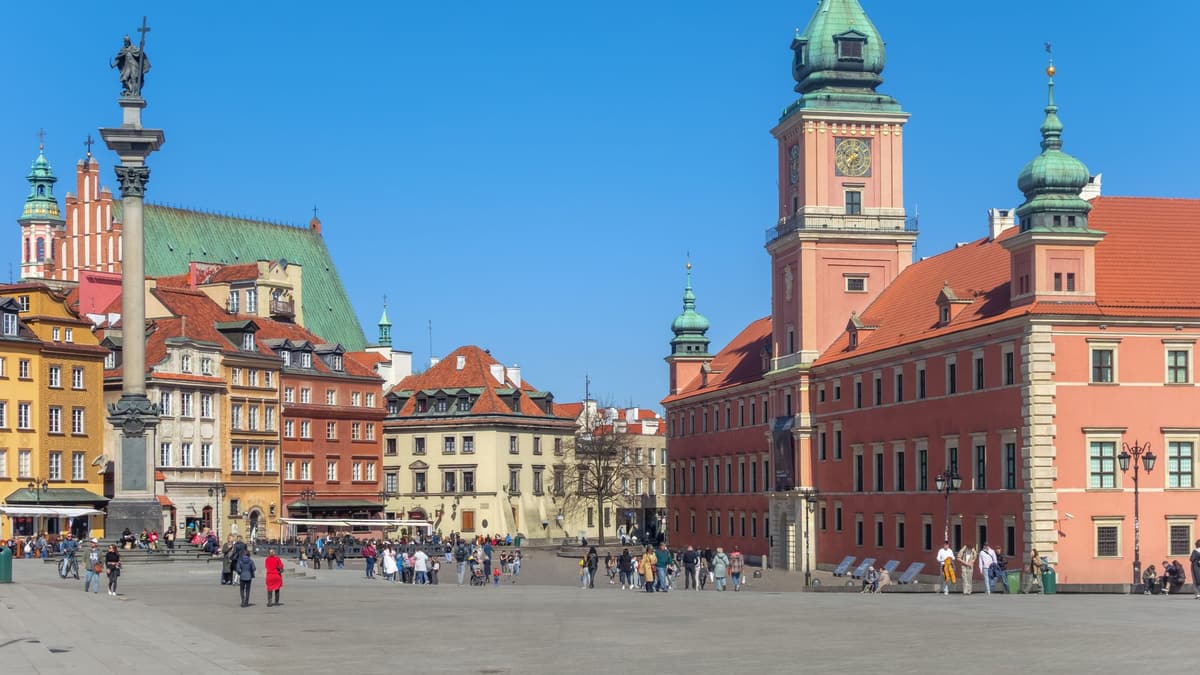
You're at the gateway to the Old Town: the Royal Castle, and the column with King Sigismund on top. Both are reconstructions, and so is the Old Town around them.
Restul acestei opriri este în turul audio complet.
Step into the lane and look at the cathedral's south wall, about 40 meters from the front. Set into it is a length of heavy track, with a plaque.
Restul acestei opriri este în turul audio complet.
Here, between the old town walls, stands a small bronze boy in a German helmet far too big for him, with a submachine gun and a white-and-red armband. He is no one in particular.
Restul acestei opriri este în turul audio complet.
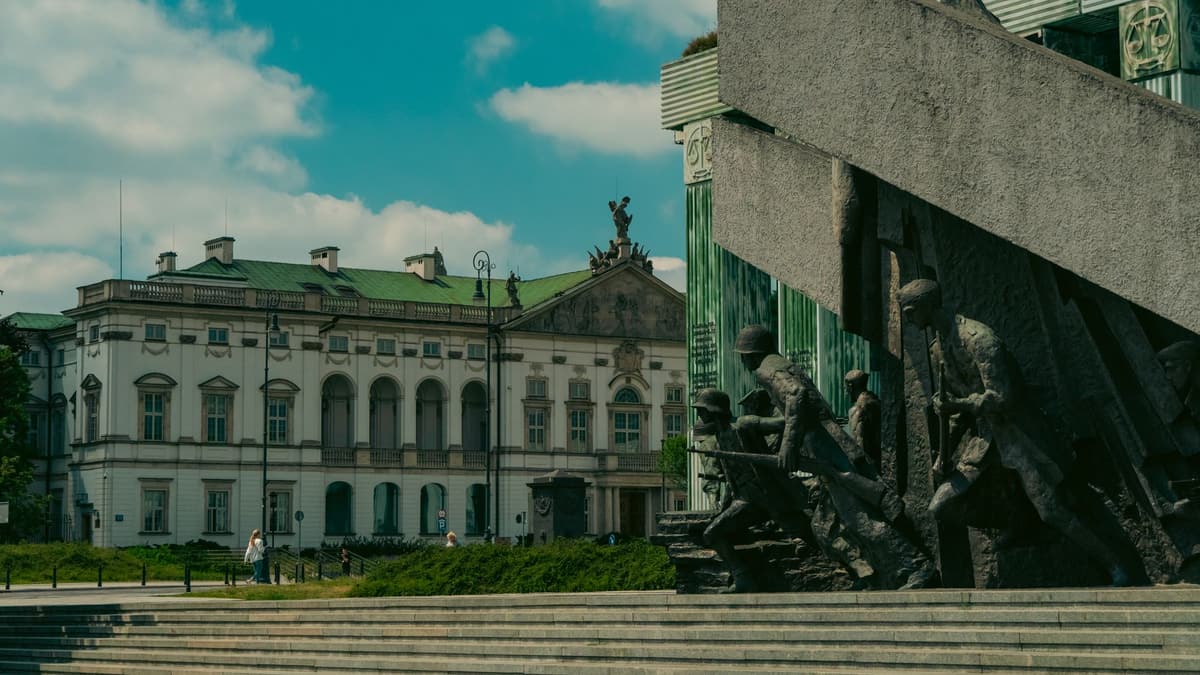
Face the great bronze on the corner of Długa and Miodowa. On the large part, insurgents burst out of collapsing walls.
Restul acestei opriri este în turul audio complet.
Fă această plimbare alături de alți oameni la următorul tur programat.
Aproximativ 4,2 km, aproximativ 57 minute într-un ritm ușor · 9 opriri
Prietenii merg gratisOctober 11, 2026 · 9 min read
From the Hollandsche Schouwburg through the old Jewish Quarter, past the Dockworker and the Dam, to the Anne Frank House on the Prinsengracht.
October 11, 2026 · 11 min read
From Van Houten's street by the Vondelpark past Leidseplein, the Rijksmuseum passage and the famous canal bench to the Anne Frank House.

October 11, 2026 · 10 min read
Follow the last days of April and May 1945 from the Anhalter Bahnhof ruin past the Gestapo site and Brandenburg Gate to the Moltke Bridge and the Reichstag.
