
October 11, 2026 · 9 min read
Amsterdam Anne Frank Walking Tour
From the Hollandsche Schouwburg through the old Jewish Quarter, past the Dockworker and the Dam, to the Anne Frank House on the Prinsengracht.
589

October 11, 2026 · 10 min read

 친구는 무료로 함께 걸어요
모든 투어는 앱에서 참여할 수 있는 정기 그룹 걷기 모임으로도 운영됩니다.
Berlin의 오디오 투어 더 보기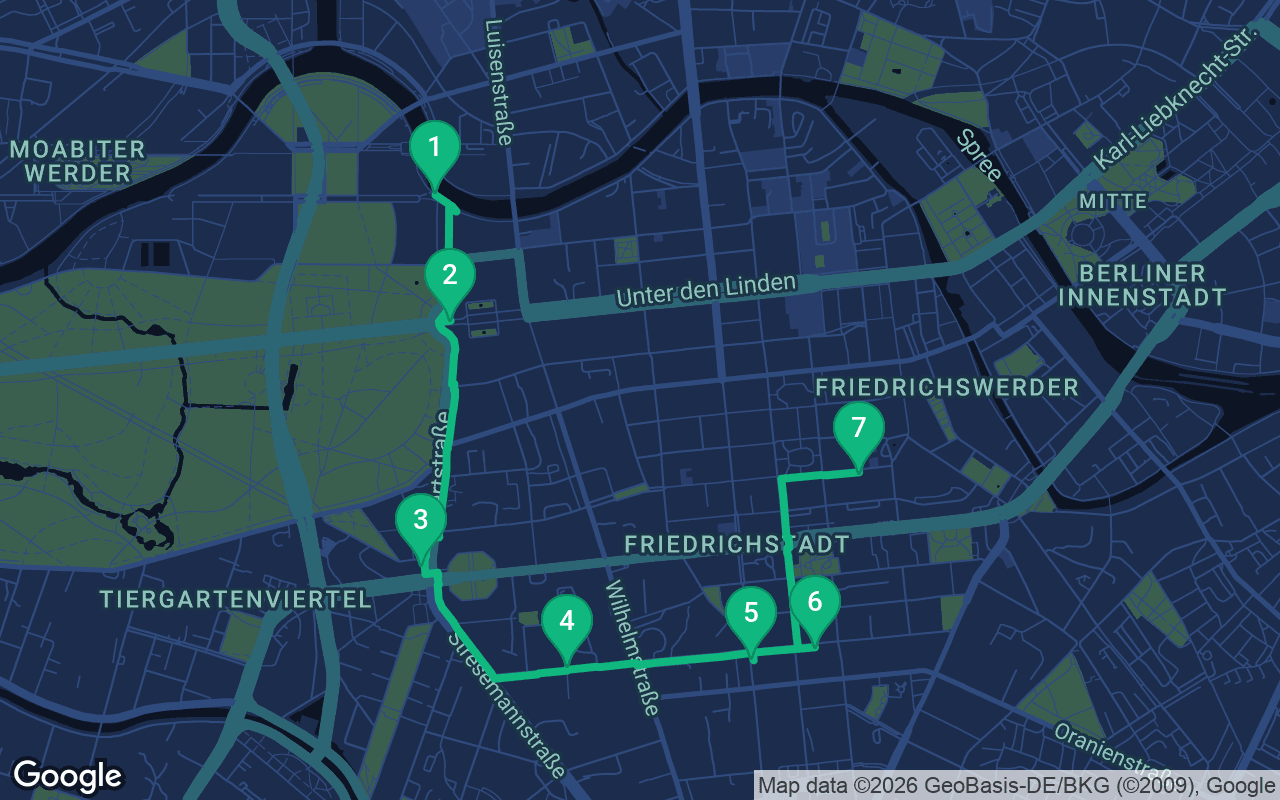
약 3.5km, 여유로운 페이스로 대략 49분 소요.
음성 가이드가 포함된 투어입니다
처음 3개 스톱에서 재생을 누르면 여기에서 나레이션을 30초 데모로 들을 수 있습니다. 앱에서는 인트로와 이 스톱들을 무료로 끝까지 들으실 수 있으며, 각 스톱에 도착하면 알림음이 울립니다. 전체 오디오 투어는 $15.99에 한 번만 구매하시면 평생 소장하실 수 있습니다.
Garmin, Komoot, Strava, OS Maps 및 모든 GPX 앱과 호환됩니다.
For twenty-eight years a wall ran through the middle of Berlin. This walk follows its line through the city center, from the August night in 1961 when the border was sealed to the November evening in 1989 when a fumbled answer at a press conference set off the night it opened. You start on the river behind the Reichstag, pass the Brandenburg Gate, Potsdamer Platz and a real stretch of the Wall, stop at Checkpoint Charlie and at the place where Peter Fechter died, and finish outside the building where Günter Schabowski read out his note. It is about three and a half kilometers, one of our self-guided walking tours that you can do in an afternoon. Two stops are memorials to people who were killed. Go gently there.
The walking takes about fifty minutes; with the stories, allow two hours. It is flat and paved all the way. The nearest stations to the start are Brandenburger Tor and Bundestag, both a few minutes away. The walk ends right by the U2 station Anton-Wilhelm-Amo-Straße, with Stadtmitte nearby. Checkpoint Charlie has costumed actors posing for photos; you don't need them for this story. The Wall remnant on Niederkirchnerstraße is fenced, so you see it from the pavement.
You're on the bank of the Spree, behind the east side of the Reichstag building. In front of you is a row of seven white crosses, each with a name and a date of death.
Look at the water. During the division, this bank belonged to West Berlin. The river itself was East Berlin. The front wall of the border ran to the riverbank right here, and it stayed until 1990.
The crosses were first put up in 1971, on the tenth anniversary of the Wall, by a private association of West Berlin citizens. Since June 2003 they have stood here on the riverbank again. Read the names. Günter Litfin, the twenty-fourth of August 1961, eleven days after the border closed. Chris Gueffroy, the fifth of February 1989, nine months before it opened. And one cross for the victims nobody could name.
The Berlin Wall Foundation counts at least 140 people who were killed or died at the Wall between 1961 and 1989. One hundred and one of them were trying to escape. Thirty were not fleeing at all, one was a Soviet soldier, and eight were East German border soldiers killed on duty.
These seven crosses stand for all of them. Keep them in mind; this walk ends with the night the border opened.
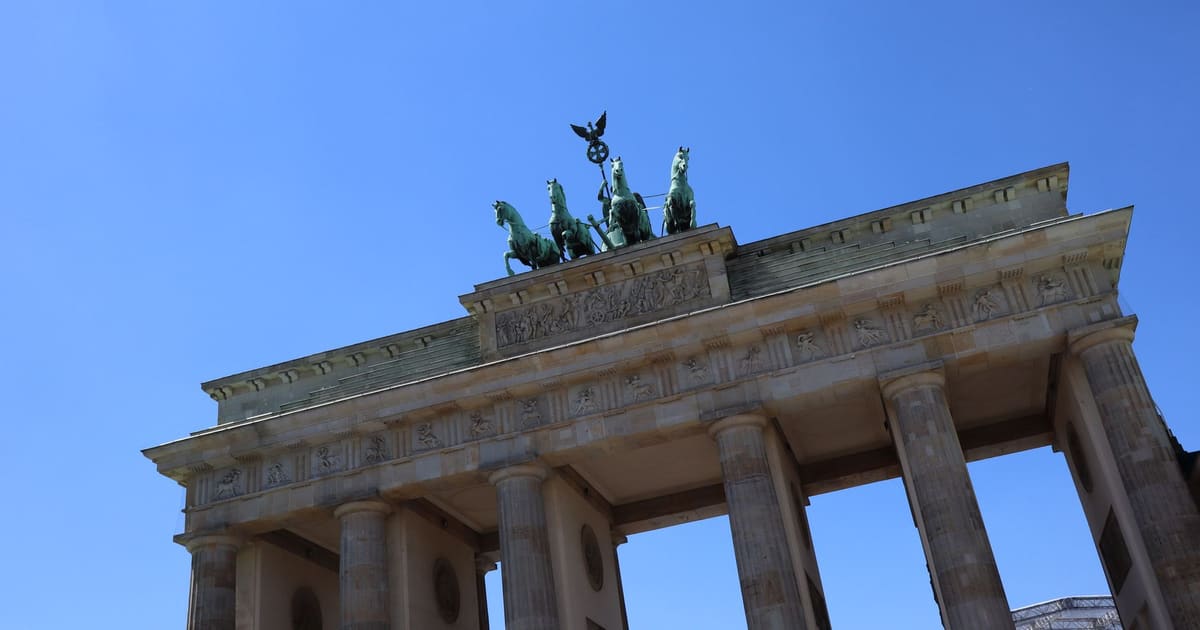
Walk south along the side of the Reichstag and follow Ebertstraße to the Brandenburg Gate, about five minutes. Stand on its western side, on the square called Platz des 18. März.
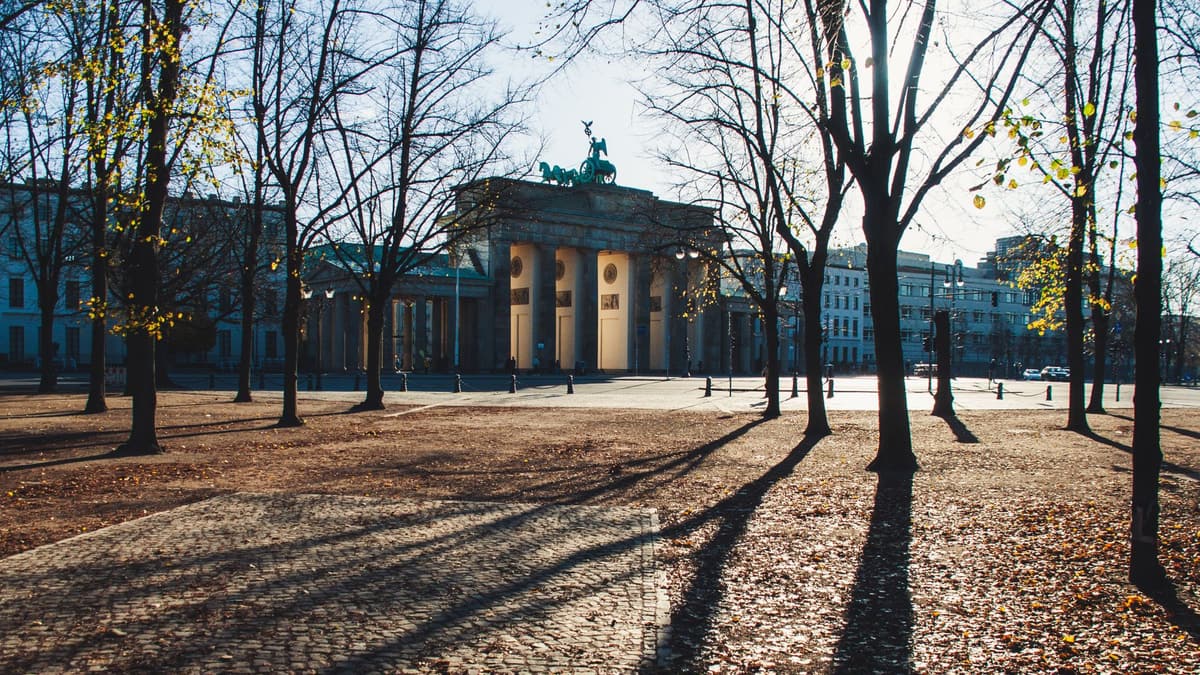 You're on the western side of the Brandenburg Gate. Look down: the line of the Wall is marked in the ground nearby.
On the thirteenth of August 1961, East German combat groups closed off the Gate. For one day it was still a crossing. From the fourteenth of August it was blocked completely, and for the next twenty-eight years it stood shut inside the heavily guarded East German border zone, a gate that no one could walk through.
Two months before that, a journalist had asked East Germany's leader whether the border would be fixed right here, at the Brandenburg Gate. His answer is waiting for you at the fourth stop.
Now jump forward with me, to the twelfth of June 1987. On this side of the Gate, the American president Ronald Reagan gave a speech. "Mr. Gorbachev, open this gate! Mr. Gorbachev, tear down this wall!" But be careful with the story that the speech brought the Wall down. When the Wall opened, two and a half years later, it happened for other reasons, and in a way nobody planned. You'll hear how at the last stop.
The Gate itself did not become a crossing the night the Wall fell. On the twenty-second of December 1989, Helmut Kohl and Hans Modrow opened a crossing here before more than 100,000 people.
Follow Ebertstraße south for about ten minutes to Potsdamer Platz. Look for the Wall slabs by the entrance to the S-Bahn station.
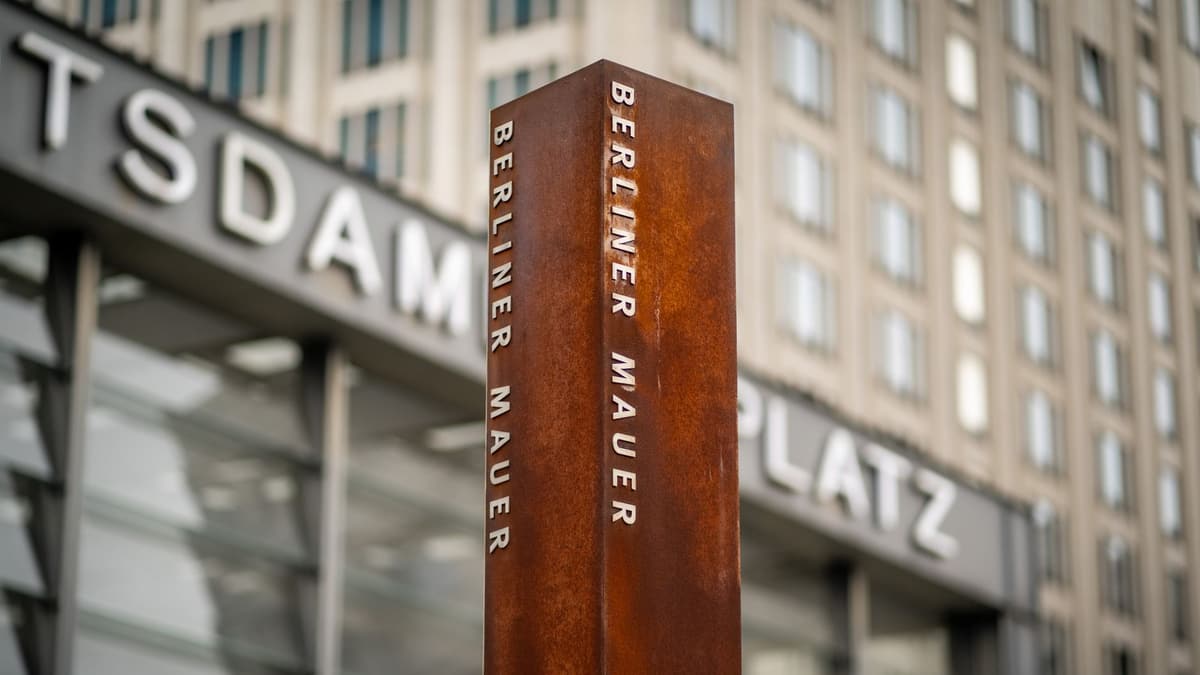
You're at Potsdamer Platz, beside a row of original Wall sections at the station entrance, covered in graffiti. Look down at the pavement: a line traces where the Wall ran straight across this square.
Before the Second World War, this was one of the busiest places in Berlin. War damage hit it first. Then the Wall cut through it, and for nearly three decades the square was an empty no man's land.
Let's jump ahead again, to three days after the Wall opened. By then the crowds at the Brandenburg Gate were so large that a new crossing was needed. At eight in the morning on the twelfth of November 1989, the mayors of East and West Berlin opened one here. That same day, a million East German citizens visited West Berlin. And at one in the afternoon, East Germany's defense minister announced on television that the order to shoot was abolished.
So the Wall did not fall in one night. Crossings opened one by one, this square on the twelfth of November, the Gate in December, and the concrete took months to come down.
Now we step back to the very beginning, two months before the Wall went up. Follow your map southeast along Stresemannstraße and turn left into Niederkirchnerstraße, about nine minutes.
포함 사항
저희 투어는 명상하듯 몰입할 수 있도록 만들어졌습니다. 걸으며 그저 귀 기울이시면 됩니다. 함께하면 언제나 더 좋고, 앱이 나레이션을 동기화해 재생하므로 당신과 파트너, 친구들이 모든 스톱을 같은 순간에 들을 수 있습니다.
You're beside about 200 meters of the real Wall. Until 1989 it marked the border between Mitte in the East and Kreuzberg in the West.
이 스톱의 나머지 내용은 전체 오디오 투어에 있습니다.
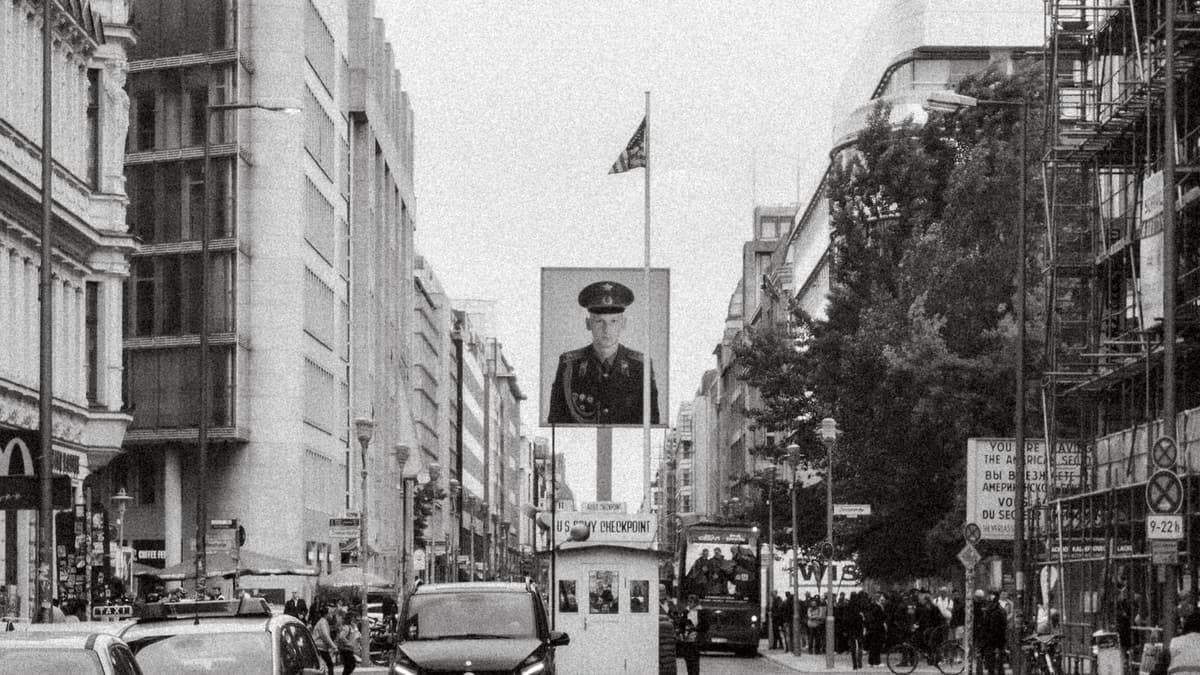
You're at Checkpoint Charlie, the Allied crossing on Friedrichstraße. The booth and the sign in the street are copies.
이 스톱의 나머지 내용은 전체 오디오 투어에 있습니다.
You're at the memorial to Peter Fechter: a steel column, about two and a half meters tall, unveiled on the thirteenth of August 1999. Its inscription ends with words that mean "he only wanted freedom."
이 스톱의 나머지 내용은 전체 오디오 투어에 있습니다.
You're on Anton-Wilhelm-Amo-Straße. Until the twenty-third of August 2025 it was called Mohrenstraße; it was renamed after Anton Wilhelm Amo, a change that was debated.
이 스톱의 나머지 내용은 전체 오디오 투어에 있습니다.
다음 예정된 투어에서 다른 사람들과 함께 이 산책을 해보세요.
약 3.5km, 여유로운 페이스로 대략 49분 소요 · 7 정류장
친구는 무료로 함께 걸어요October 11, 2026 · 9 min read
From the Hollandsche Schouwburg through the old Jewish Quarter, past the Dockworker and the Dam, to the Anne Frank House on the Prinsengracht.
October 11, 2026 · 11 min read
From Van Houten's street by the Vondelpark past Leidseplein, the Rijksmuseum passage and the famous canal bench to the Anne Frank House.

October 11, 2026 · 10 min read
Follow the last days of April and May 1945 from the Anhalter Bahnhof ruin past the Gestapo site and Brandenburg Gate to the Moltke Bridge and the Reichstag.
