
October 11, 2026 · 9 min read
Amsterdam Anne Frank Walking Tour
From the Hollandsche Schouwburg through the old Jewish Quarter, past the Dockworker and the Dam, to the Anne Frank House on the Prinsengracht.
589

October 11, 2026 · 14 min read

 친구는 무료로 함께 걸어요
모든 투어는 앱에서 참여할 수 있는 정기 그룹 걷기 모임으로도 운영됩니다.
Edinburgh의 오디오 투어 더 보기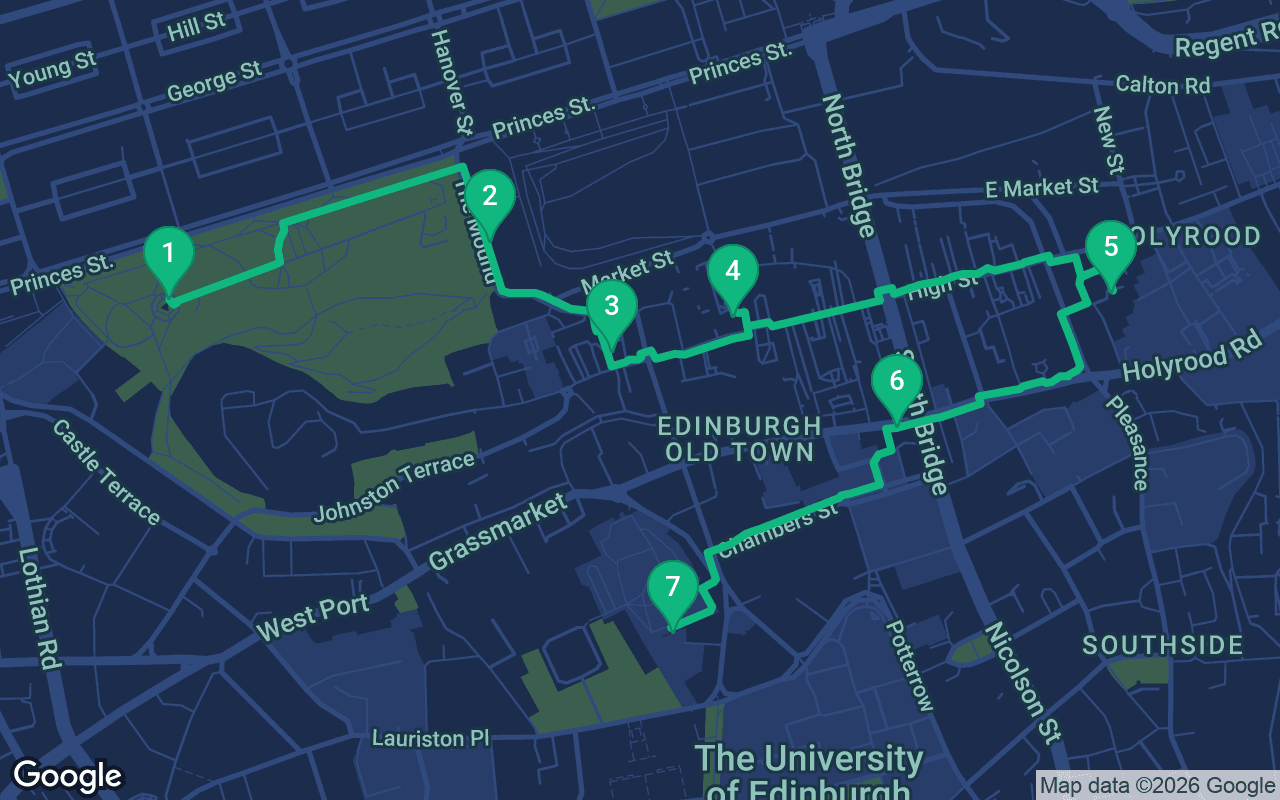
약 2.7km, 여유로운 페이스로 대략 39분 소요.
음성 가이드가 포함된 투어입니다
처음 3개 스톱에서 재생을 누르면 여기에서 나레이션을 30초 데모로 들을 수 있습니다. 앱에서는 인트로와 이 스톱들을 무료로 끝까지 들으실 수 있으며, 각 스톱에 도착하면 알림음이 울립니다. 전체 오디오 투어는 $14.99에 한 번만 구매하시면 평생 소장하실 수 있습니다.
Garmin, Komoot, Strava, OS Maps 및 모든 GPX 앱과 호환됩니다.
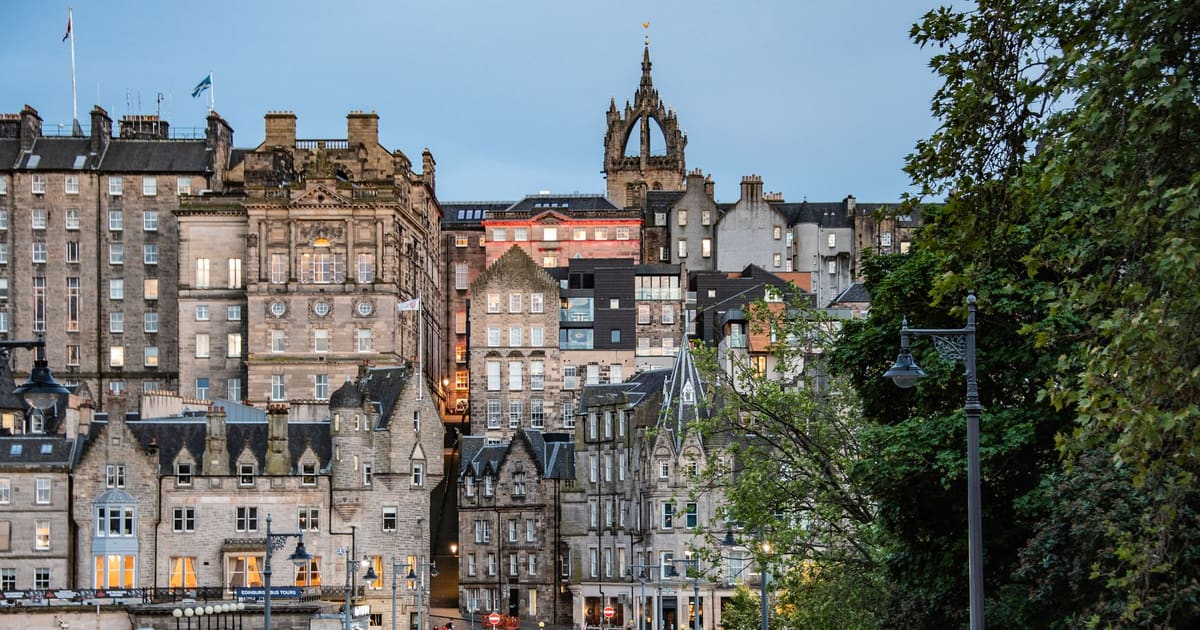
Edinburgh's Old Town is a city with floors you can't see. It was squeezed onto a narrow ridge, so it grew upward, and over the centuries whole streets were built over, buried and bridged. This walk goes looking for that hidden city. You start on the bed of a vanished loch, climb a hill made from building spoil, and slip into the closes where a respected cabinetmaker lived a double life. You pass a street sealed under the City Chambers, the courtyard of a bungled robbery and a bridge with eighteen arches nobody sees. The walk ends in Greyfriars Kirkyard, with a famous dog, a field prison and a tomb with a ghost story. The rule throughout is simple: true history first, and every ghost story labeled as a legend. The route runs about 2.7 kilometers from the Ross Fountain in West Princes Street Gardens to Greyfriars Kirkyard, one of our story-driven self-guided walking tours.
The walking takes about forty minutes. With the stories, allow around an hour and a half. There is one proper climb, up the Mound from the gardens to the Royal Mile, and a shorter one up Candlemaker Row at the very end. In between, the streets are cobbled in places and run downhill toward the Canongate and the Cowgate. Start in West Princes Street Gardens, reached from Princes Street. The gardens are gated and keep seasonal hours, so if they are closed, walk along the Princes Street pavement to the foot of the Mound and start the story there. Three places on the route can be visited inside: the Writers' Museum, which is free, and the paid underground tours of Mary King's Close and the South Bridge vaults. Check hours and book before you go if you want to go in. The walk works from the street either way.
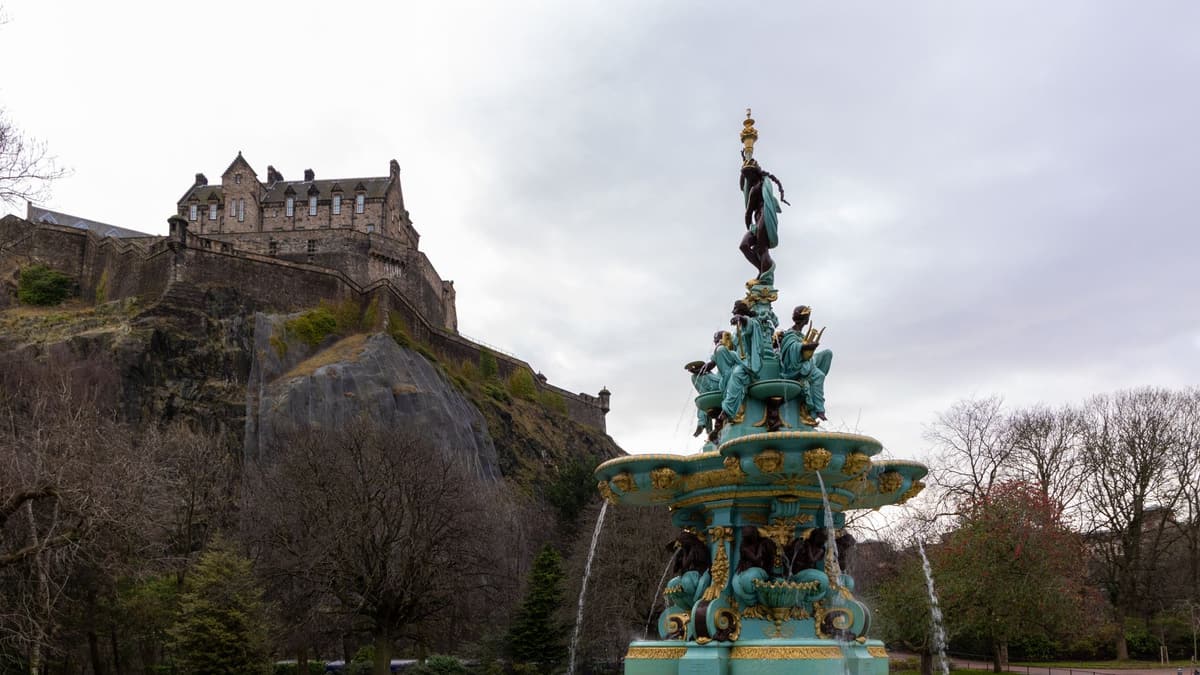
You're standing beside the Ross Fountain, the cast-iron fountain in West Princes Street Gardens. It was installed here in 1872 and restored in 2018. Now look up. Above you is the Castle Rock, with the Castle on top. Down here, the railway runs along the bottom of the valley.
Here's the first hidden thing on this walk: you're standing on the bed of a loch. In 1460, under King James the Third, this valley was flooded as a defence for the town on the ridge above. It was called the Nor Loch, the north loch.
It was not a pretty lake for long. For centuries the people of the Old Town threw their sewage and household waste down the hillside, and the loch filled with it. It also boxed the town in. With the Castle at one end and the loch along the north side, Edinburgh could not spread north. It could only grow upward, into tall tenements on the ridge, reached by steep, narrow alleys called closes. That squeeze is the reason for almost everything you'll see today.
In the eighteenth century the city finally decided to break out. Drainage began at the east end of the loch from around 1760. In July 1767 the council agreed James Craig's plan for a New Town on the open ground to the north. This western end, where you're standing, was the last part to go, drained between 1813 and 1820.
So the gardens around you are the old loch bed. To see how the city crossed it, walk east through the gardens toward the foot of the Mound, the road that climbs from Princes Street up to the Old Town. That's about six minutes.
 You're at the foot of the Mound. The road climbs from Princes Street past the National Galleries toward the Old Town on the ridge. It looks like a natural slope. It isn't. The whole thing is artificial.
When the New Town went up across the valley, its builders had to dig foundations, and that left mountains of earth. They dumped it here, into the old loch bed. Work began in the early 1780s. The dumping went on for decades, and the Mound was formally completed in the 1820s and 1830s. Nobody agrees on exactly how much earth went in. Estimates run from about 1.3 million to 2 million cartloads, so the safe answer is well over a million.
Think about what that means. Each of those cartloads was dug out for a house in the New Town and tipped here, and you're about to walk up it. The hill under your feet is made of earth from the New Town's foundations.
At the top of this hill, the city changes completely. Up there, in the Old Town, people lived stacked on top of each other in the closes, and one of those closes was home to a man who would become Edinburgh's most famous double life. Walk up the Mound, following the road as it curves into Bank Street, and keep climbing to the Royal Mile. Turn right at the top, and in a few steps look for the narrow entrance of Lady Stair's Close on your right. That's about six minutes, uphill.
You're at the mouth of Lady Stair's Close, off the Lawnmarket, the top stretch of the Royal Mile. This is a close: a narrow passage leading off the main street, between tall buildings, down the steep side of the ridge. Through it is Lady Stair's House, now the Writers' Museum. Now turn around and look across the street. At number 304 Lawnmarket is the entrance to Brodie's Close.
By 1741 a wright and cabinetmaker named Francis Brodie had moved his workshop and his home into that close. It had been called Cullen's Close, and it took the family's name. His son William was born there in 1741.
William Brodie did everything a respectable Edinburgh tradesman was meant to do. He became a burgess of the city in 1763. From 1781 he was elected Deacon of the Incorporated Wrights, the head of his trade, several times over, and that office gave him a seat on the town council. By daylight, Deacon Brodie was a pillar of the town.
The family house is gone. It was pulled down around 1835. But a piece of Brodie's work may still survive just behind you. Inside the Writers' Museum is a cabinet said to be by Brodie. It once stood in the childhood home of Robert Louis Stevenson, in Heriot Row in the New Town. Hold on to that detail. If the attribution is right, Stevenson grew up with Brodie's handiwork in his house, and Brodie would stay with him.
What did the respectable deacon do after dark? Before we find out, we step back more than a century, to a street that disappeared. Walk east down the Lawnmarket and the High Street, past St Giles' Cathedral on your right. Facing the cathedral on your left is the arched screen of the City Chambers. That's about three minutes.
포함 사항
저희 투어는 명상하듯 몰입할 수 있도록 만들어졌습니다. 걸으며 그저 귀 기울이시면 됩니다. 함께하면 언제나 더 좋고, 앱이 나레이션을 동기화해 재생하므로 당신과 파트너, 친구들이 모든 스톱을 같은 순간에 들을 수 있습니다.
You're facing the City Chambers, Edinburgh's council headquarters, behind its arched screen on the High Street. Under this building is a street.
이 스톱의 나머지 내용은 전체 오디오 투어에 있습니다.
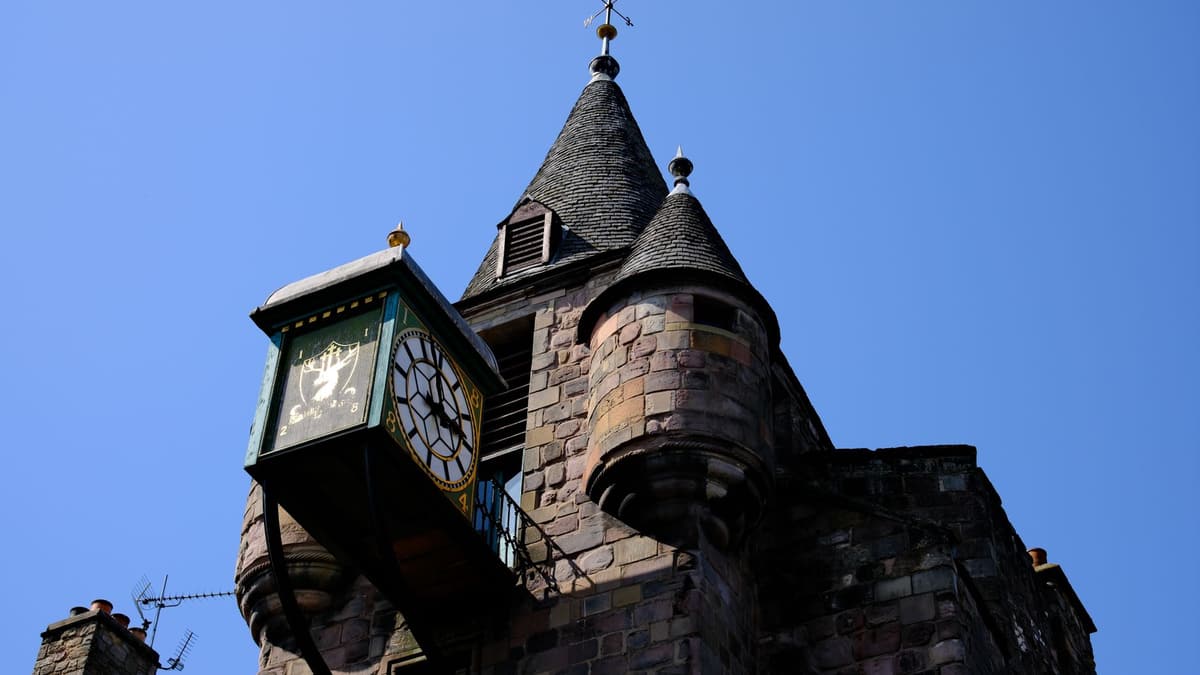
You're at the arched entrance to Chessel's Court, 240 Canongate. If the courtyard feels private, you can stay here at the pend.
이 스톱의 나머지 내용은 전체 오디오 투어에 있습니다.
You're in the Cowgate, the old street at the bottom of the valley, standing under the one visible arch of the South Bridge. Look up.
이 스톱의 나머지 내용은 전체 오디오 투어에 있습니다.
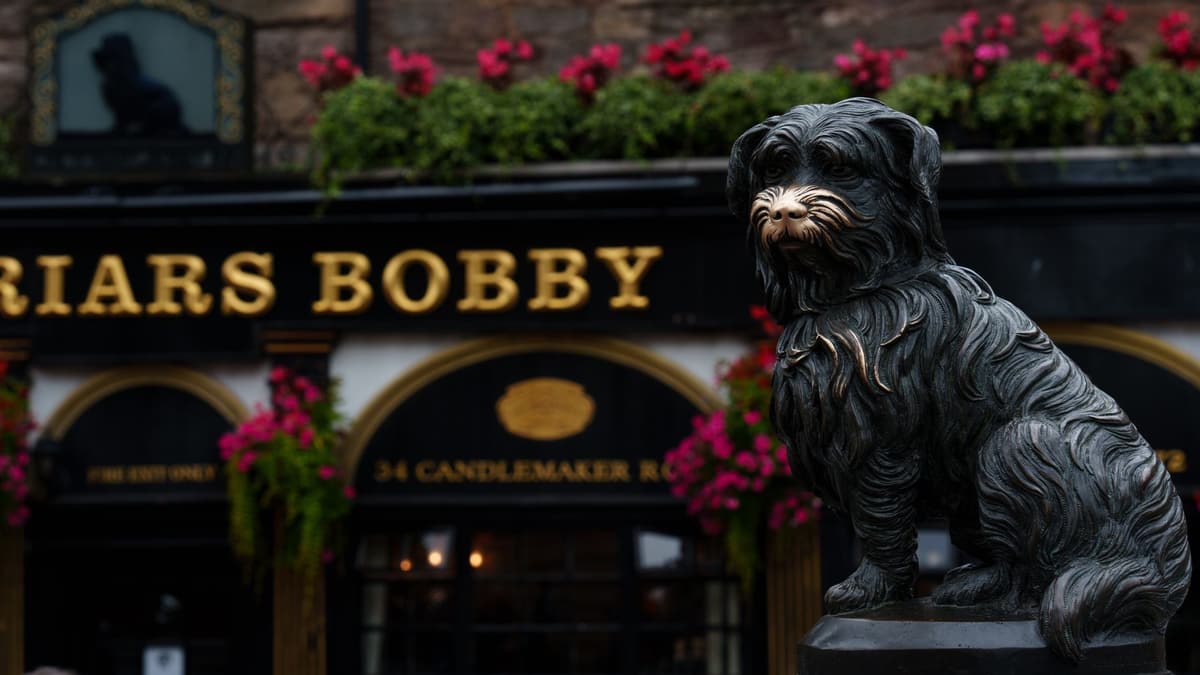
You're in Greyfriars Kirkyard, beside the domed tomb of Sir George Mackenzie, designed by James Smith. The locked gate next to it leads to the Covenanters' Prison.
이 스톱의 나머지 내용은 전체 오디오 투어에 있습니다.
다음 예정된 투어에서 다른 사람들과 함께 이 산책을 해보세요.
약 2.7km, 여유로운 페이스로 대략 39분 소요 · 7 정류장
친구는 무료로 함께 걸어요October 11, 2026 · 9 min read
From the Hollandsche Schouwburg through the old Jewish Quarter, past the Dockworker and the Dam, to the Anne Frank House on the Prinsengracht.
October 11, 2026 · 11 min read
From Van Houten's street by the Vondelpark past Leidseplein, the Rijksmuseum passage and the famous canal bench to the Anne Frank House.

October 11, 2026 · 10 min read
Follow the last days of April and May 1945 from the Anhalter Bahnhof ruin past the Gestapo site and Brandenburg Gate to the Moltke Bridge and the Reichstag.
