
October 11, 2026 · 9 min read
Amsterdam Anne Frank Walking Tour
From the Hollandsche Schouwburg through the old Jewish Quarter, past the Dockworker and the Dam, to the Anne Frank House on the Prinsengracht.
589

October 9, 2026 · 12 min read

 Přátelé chodí zdarma
Každá prohlídka funguje také jako naplánovaná skupinová procházka, ke které se můžete v aplikaci připojit.
Další audio prohlídky v Madrid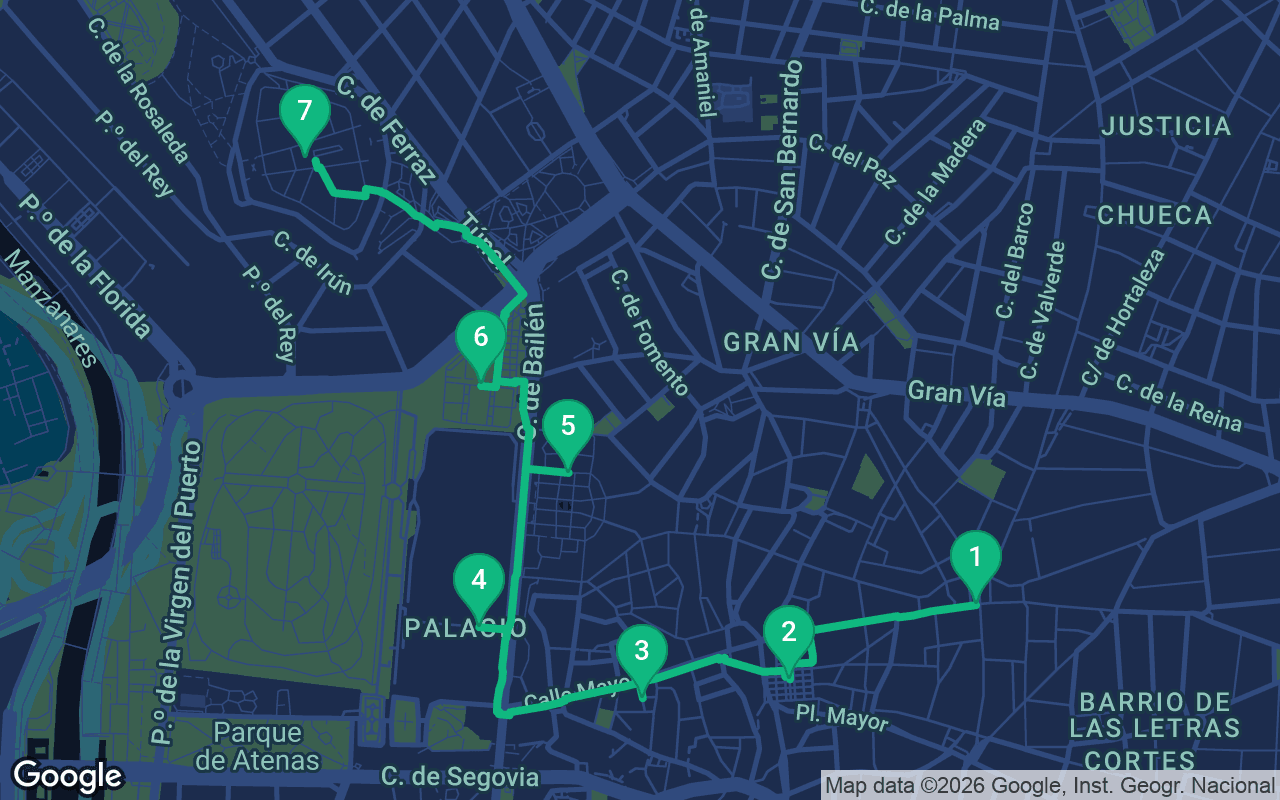
Zhruba 2,8 km, přibližně 37 minut pohodovým tempem.
Tato prohlídka je namluvená
Stisknutím tlačítka přehrávání u prvních 3 zastávek si poslechnete 30sekundovou ukázku vyprávění. V aplikaci si úvod a tyto zastávky přehrajete celé zdarma a každá se ozve zvukovým signálem, jakmile dorazíte na místo. Celá komentovaná prohlídka může být vaše za jednorázový poplatek $7.99, který vám zůstane napořád.
Funguje s aplikacemi Garmin, Komoot, Strava, OS Maps a jakýmkoli GPX programem.
Madrid was a modest town on a dry plateau until a king decided to stay, and the oldest part of the city still carries the shape of those first royal centuries. Locals call it Madrid de los Austrias, after the Habsburg kings who ruled Spain when the capital took root here. This walk starts at Puerta del Sol, the point every road in Spain is measured from, crosses the great arcaded Plaza Mayor and the old town hall square, and reaches the Royal Palace and the cathedral facing it. From there it follows the palace gardens north and finishes at an ancient Egyptian temple on a hilltop, one of the best places in the city to watch the sun go down. It is about 2.8 kilometers, under two miles, and one of the easiest self-guided walking tours in Spain to fit into an afternoon.
The walking takes under forty minutes, but give yourself two to three hours so you can linger in the squares and step into the market, and much longer if you want to tour the palace or the cathedral. The route is mostly flat, with a gentle slope down toward the palace and a short climb up into the park at the end. Expect stone paving and the odd cobble, and some steps if you take the shortcuts. Madrid summers are hot and dry, and the big squares have almost no shade, so in July and August walk in the early morning or start in the late afternoon and time your finish for sunset at the temple. Carry water. Winters are crisp and sunny, and lovely for walking. The palace, the cathedral, the market and the temple all keep their own hours and close for state events and holidays, so check before you go if you plan to go inside. Sol and Plaza Mayor are very busy, so keep an eye on your bag in the crowds. Madrid eats late, so a mid afternoon start leaves you perfectly placed for dinner nearby once the sun has set.
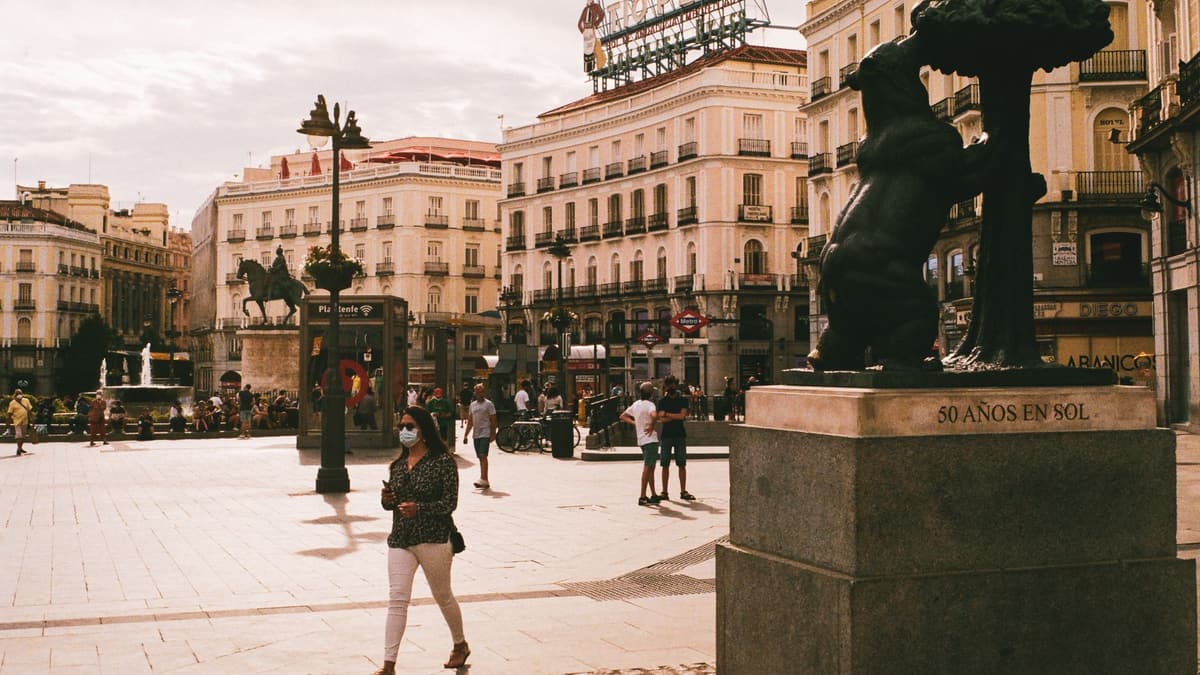
Stand in front of the long red brick building with the clock tower on the south side of the square, and look down at the pavement by its door. A stone plaque marks Kilómetro Cero, the point from which Spain's national roads are measured, so in a sense every journey in the country begins under your feet. The building is the old Real Casa de Correos, built in the eighteenth century as the royal post office and now home to the regional government. Its clock is the most watched in Spain. On New Year's Eve the whole country tunes in as it strikes midnight, and people here and in living rooms everywhere try to eat twelve grapes, one for each chime, for luck in the year ahead. Now look toward the eastern end of the square for a bronze bear reaching up into a small tree. This is El Oso y el Madroño, the bear and the strawberry tree, the emblem on Madrid's coat of arms and the city's favorite meeting point. When Philip II moved the royal court here from Toledo in 1561, Sol was the eastern edge of a small town, named after a gate in the old walls. Madrid never got a formal decree making it the capital. The court simply stayed, and the city grew around it. The horseman in the middle is Charles III, a later king with a walk of his own across town. Leave the square by Calle Mayor on its western side, walk about four minutes, and turn left through an archway into Plaza Mayor.
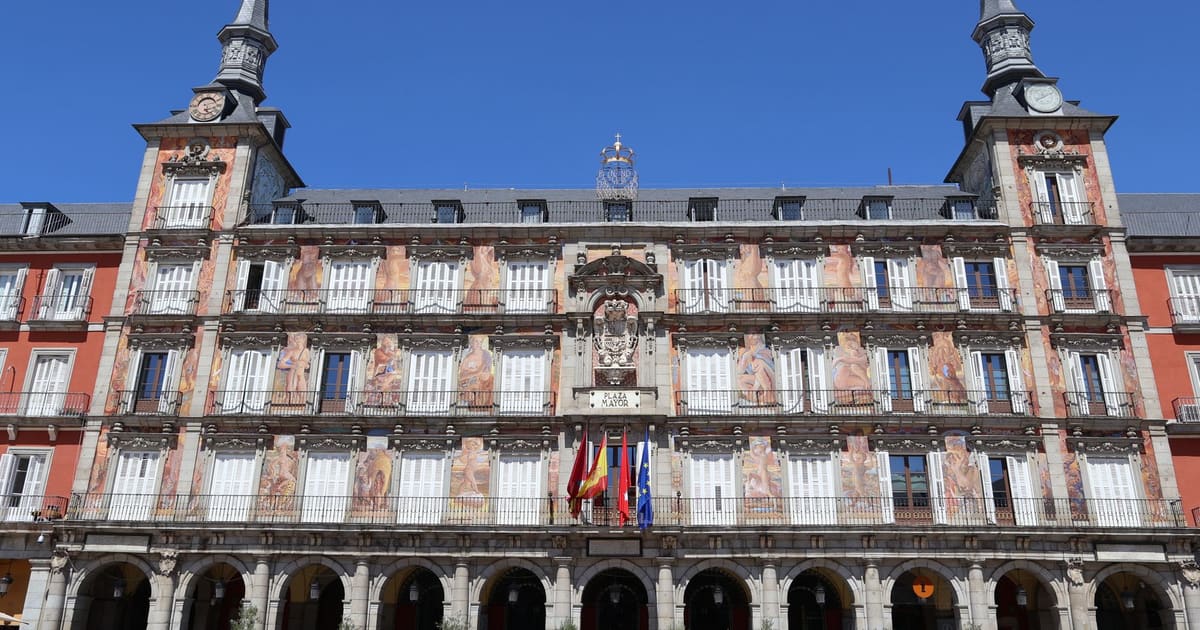
 Walk out into the middle and turn slowly. You are inside a closed rectangle of uniform red facades, three stories of balconies over a continuous arcade, entered only through archways. This was a busy market square outside the old town walls until Philip III had it rebuilt, and it was finished in 1619 to designs by the royal architect Juan Gómez de Mora. For two centuries it was the city's great stage. Crowds packed the balconies for bullfights, royal celebrations, saints' festivals, public executions and the grim ceremonies of the Inquisition, and the royal family watched from the building with the painted facade on the north side, the Casa de la Panadería, named after the bakery and bakers' guild it once housed. Its colorful murals of mythological figures were added in 1992. Fire swept the square several times, and after a terrible blaze in 1790 the architect Juan de Villanueva rebuilt it, closing the corners and giving it the unbroken look you see. The bronze rider in the center is Philip III himself, a statue begun by Giambologna and finished by Pietro Tacca, moved here in the nineteenth century. Today the arcades hold cafes and old shops, and in December the square fills with a Christmas market. Many locals will tell you the essential Plaza Mayor experience is a fried calamari sandwich from one of the bars nearby. Leave by the western side toward the glass and iron Mercado de San Miguel, a food market just outside, then turn left onto Calle Mayor. Plaza de la Villa opens on your left in about three minutes.
This small, quiet square was the heart of local government for centuries, and it holds some of the oldest buildings still standing in Madrid. Stand by the statue in the middle and look around. On your right as you face away from Calle Mayor, the brick building with slate spires and corner towers is the Casa de la Villa, the town hall, built in the seventeenth century in the same Habsburg style as Plaza Mayor. The city council met here until 2007, when it moved into a grand palace on the other side of the city. Across the square stands the much older Torre de los Lujanes, a tower house from the fifteenth century with a horseshoe arched doorway in the Mudéjar style, the work of Muslim craftsmen under Christian rule. Tradition says King Francis I of France was held prisoner here after his capture at the Battle of Pavia in 1525, though historians are not sure the story is true. The third building, with its carved stone doorway, is the Casa de Cisneros, built in the sixteenth century for a nephew of the powerful Cardinal Cisneros and later joined to the town hall by a covered bridge over the lane behind. The statue is Álvaro de Bazán, a Spanish admiral who fought at the naval battle of Lepanto. It is worth noticing how small all this is. When the court arrived in 1561, Madrid's government had nothing grander than this square to offer. Continue west along Calle Mayor for about four minutes to where it meets Calle de Bailén, and cross to the wide open square between the cathedral and the palace.
Co je v ceně
Naše prohlídky jsou zamýšlené jako meditativní a pohlcující: jdete a prostě posloucháte. Vždy jsou lepší ve společnosti a aplikace přehrává vyprávění synchronizovaně, takže vy, váš partner i vaši přátelé slyšíte každou zastávku ve stejnou chvíli.
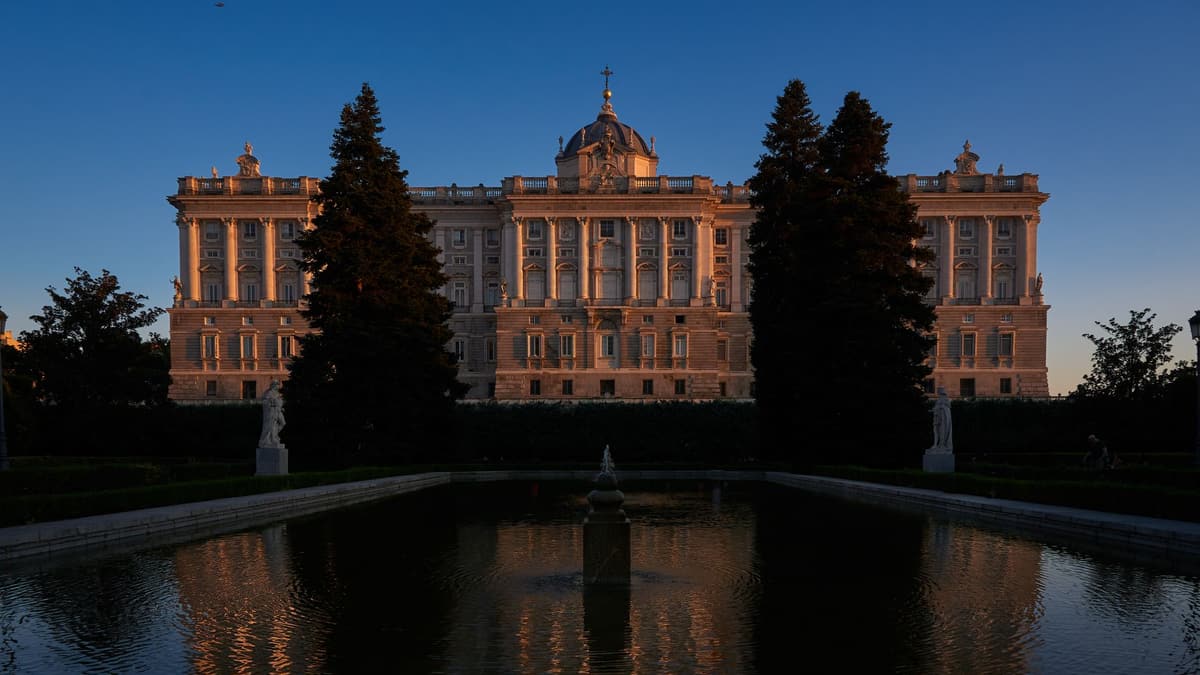
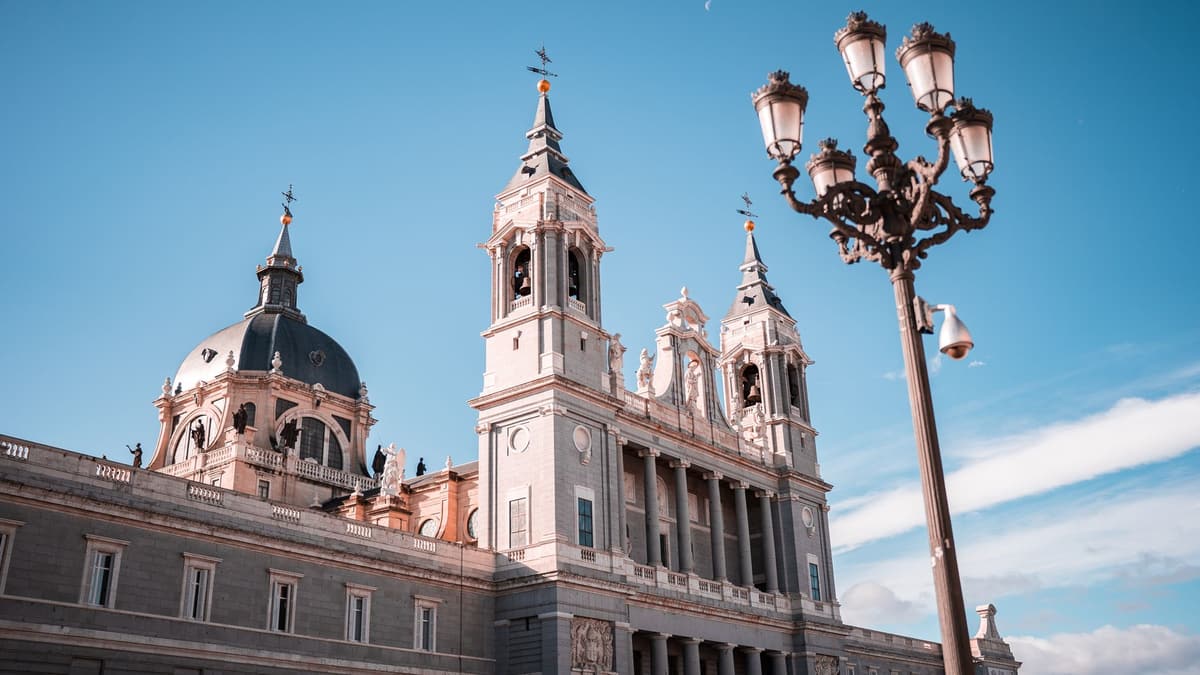
Stand in the middle of the great paved courtyard, the Plaza de la Armería, with the palace to the north and the cathedral to the south, and feel how big the sky becomes. The palace stands on the site of Madrid's oldest story.
Zbytek této zastávky najdete v celé audioprohlídce.
Find a bench among the clipped hedges and look around you. The palace fills one side, the Royal Theater, Madrid's opera house, closes the other, and in between lies a semicircle of gardens lined with stone statues of Spanish kings.
Zbytek této zastávky najdete v celé audioprohlídce.
Step into the gardens and stand by the rectangular pond with your back to the street. In front of you rise neat green walls of clipped box hedge, cone shaped cypresses and lines of stone statues, laid out in strict symmetry.
Zbytek této zastávky najdete v celé audioprohlídce.
The walk ends on a breezy hilltop beside something you would never expect to find in Madrid, a real Egyptian temple more than two thousand years old.
Zbytek této zastávky najdete v celé audioprohlídce.
Absolvuj tuto procházku s ostatními v rámci příští naplánované trasy.
Asi 2,8 km, zhruba 37 minut volným tempem · 7 zastávek
Přátelé chodí zdarmaOctober 11, 2026 · 9 min read
From the Hollandsche Schouwburg through the old Jewish Quarter, past the Dockworker and the Dam, to the Anne Frank House on the Prinsengracht.
October 11, 2026 · 11 min read
From Van Houten's street by the Vondelpark past Leidseplein, the Rijksmuseum passage and the famous canal bench to the Anne Frank House.

October 11, 2026 · 10 min read
Follow the last days of April and May 1945 from the Anhalter Bahnhof ruin past the Gestapo site and Brandenburg Gate to the Moltke Bridge and the Reichstag.
