
October 11, 2026 · 9 min read
Amsterdam Anne Frank Walking Tour
From the Hollandsche Schouwburg through the old Jewish Quarter, past the Dockworker and the Dam, to the Anne Frank House on the Prinsengracht.
589

October 11, 2026 · 13 min read

 Vrienden lopen gratis mee
Elke tour is ook beschikbaar als een geplande groepswandeling waar je in de app aan kunt deelnemen.
Meer audiotours in London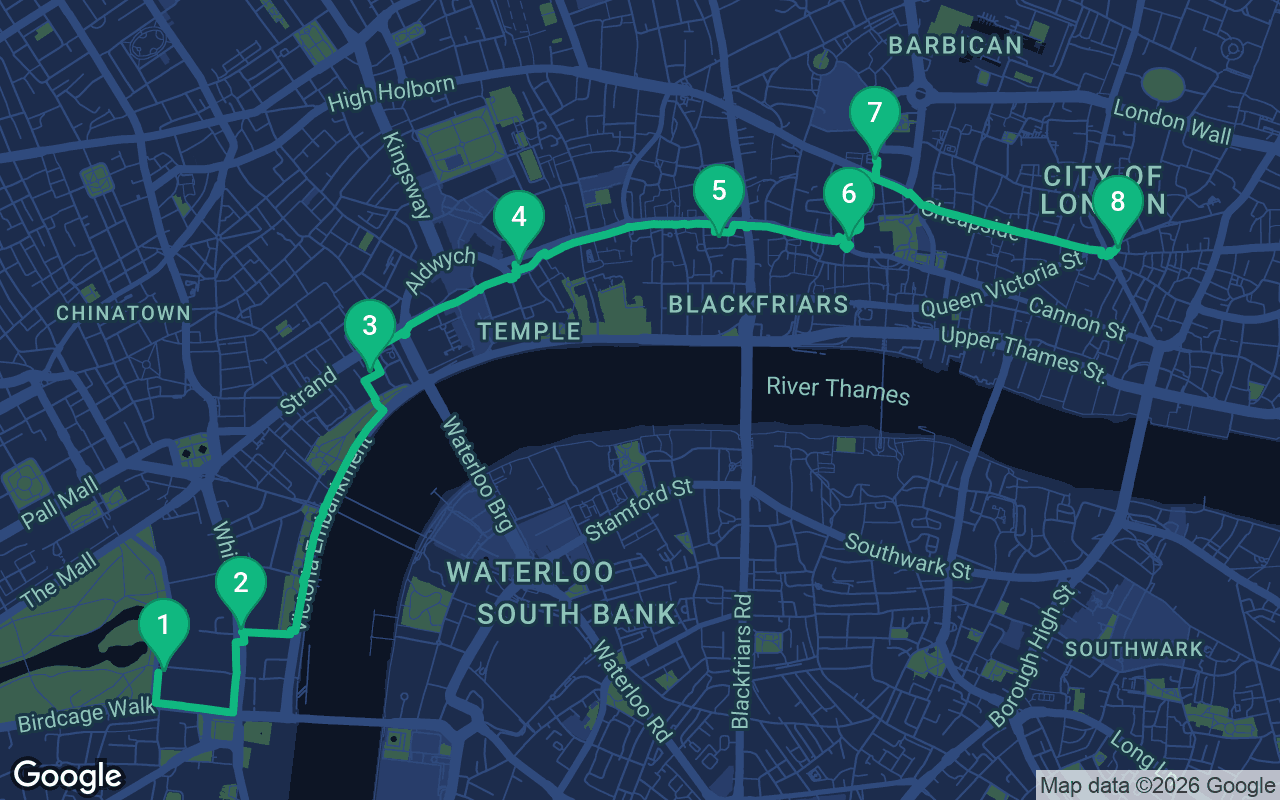
Ongeveer 4,6 km, zo'n 65 minuten op een rustig tempo.
Deze tour is ingesproken
Druk op afspelen bij de eerste 3 stops voor een demo van 30 seconden van de vertelling. In de app zijn de intro en die 3 stops volledig gratis te beluisteren, en bij elke stop klinkt een signaal zodra je aankomt. De hele tour met gids is van jou voor $16.99, een eenmalige aankoop die je voor altijd behoudt.
Werkt met Garmin, Komoot, Strava, OS Maps en elke GPX-app.
At 4.43 on the afternoon of Saturday 7 September 1940, the sirens sounded across London, and about four hundred German bombers came up the Thames. That night 430 Londoners were killed. The bombing went on for fifty-seven nights in a row, and the Blitz, as Londoners called it, would last until May 1941. This walk follows those eight months from the basement where Winston Churchill ran the war, past Downing Street and the Strand, to Fleet Street and St Paul's on the night of the "Second Great Fire of London," and ends at a crater outside the Bank of England. It runs about four and a half kilometers from Westminster to Bank, one of the more serious of our self-guided walking tours. Tens of thousands of ordinary people died in this story, so we'll tell it plainly.
The walking takes a little over an hour; with the stories, allow about two. Start at Westminster station, about five minutes from the War Rooms, and finish at Bank station, right on the last stop. The route is flat except for the gentle climb up Ludgate Hill to St Paul's. Weekdays are busy in Whitehall and the City; Sundays are quiet in the City, and some churches keep shorter hours, so check before you go if you want to look inside. The Churchill War Rooms and St Paul's Cathedral both charge for entry, but every story here works from the street. The stops mostly follow the calendar, with two exceptions we'll flag as we go.
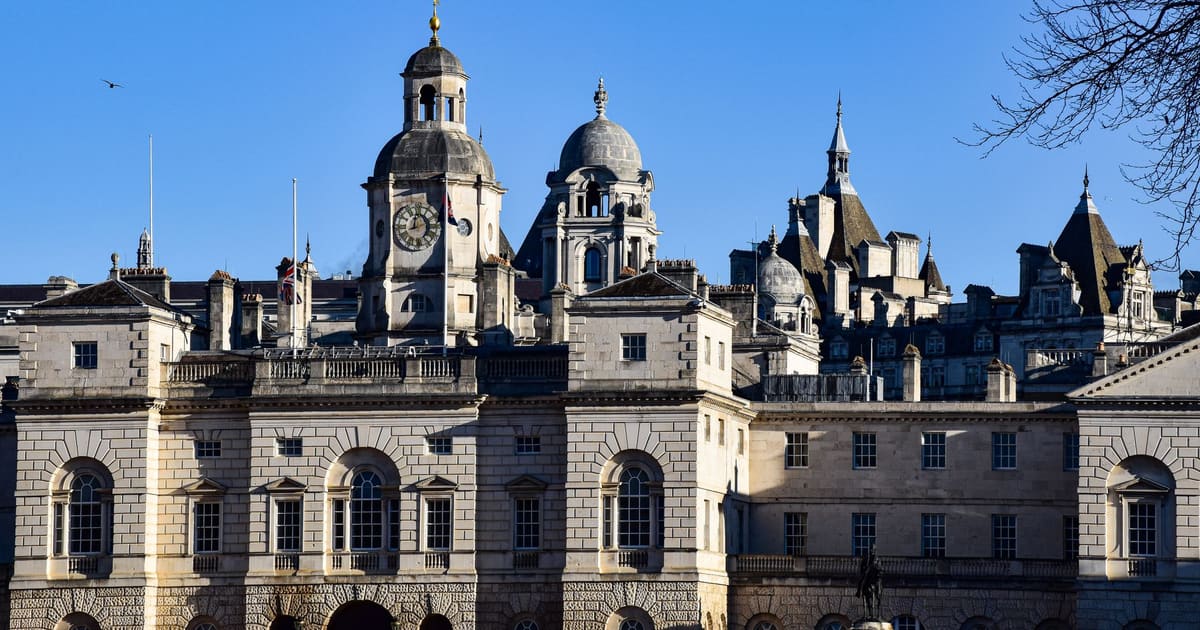
You're on King Charles Street, by the Clive Steps. Under the heavy government building beside you is a warren of basement rooms, the Cabinet War Rooms, now a museum run by the Imperial War Museum. They were picked and made ready in 1938, before the war began, as a safe place to run the country under bombing.
They weren't as safe as people hoped. The planners trusted the steel frame of the building above to protect them, but, as the Imperial War Museum puts it, "in reality a direct hit on the site would have been catastrophic." Later in September 1940, a bomb left a crater near these very steps.
The Blitz began on 7 September, a day Londoners called Black Saturday. Four days later, on 11 September, Winston Churchill broadcast to the nation from down here, warning that a German invasion might be coming.
The museum keeps small human details from those nights. During heavy raids, a man from the Office of Works named George Rance would set the weather board, the sign that told people below what it was like outside, to read "Windy," as a joke. The wooden arms of Churchill's chair are gouged from his fingers and his signet ring. And Churchill didn't always stay below. He liked to go up to the roof to watch the raids.
The Map Room was left exactly as it was when its lights were switched off, the day after Japan surrendered in August 1945. The Imperial War Museum opened the rooms to the public in 1984.
Walk east along King Charles Street to Whitehall and turn left. The gates of Downing Street are a minute along on your left.
You're at the gates of Downing Street. The street itself is closed, but you can usually glimpse the black door of Number 10 beyond them.
On the evening of 14 October 1940, Churchill was halfway through dinner here, in the steel-shuttered basement, when the bombs began to fall. He later called what he did next "a providential impulse." He got up, went to the kitchen, and ordered his cook, Georgina Landemare, the butler, the kitchen maid and the other staff to leave the food on the hot plates and go to the shelter at once. According to the kitchen maid's family, in an account published by the Churchill Project, Mrs Landemare objected: she had a soufflé in the oven for the dinner party. They went anyway. Shortly afterward, a bomb landed close behind Number 10. In his memoir Churchill wrote: "a really very loud crash, close at hand, and a violent shock showed that the house had been struck." The blast, says the Churchill Project, "devastated the kitchen and pantry as the large plate-glass window blew in." The government's own history of Number 10 says: "The kitchen, the pantry and the offices on the Treasury were shattered." The people Churchill had sent away had been standing in that kitchen minutes before. A guard hut for the soldiers outside was flattened too, but they had taken cover elsewhere.
After the October damage, in December 1940, Winston and Clementine Churchill moved into a flat called the Number 10 Annexe, directly above the War Rooms you just left. He kept using Downing Street to work and to eat, and its Garden Rooms were reinforced with steel and fitted with shutters.
Our next stop takes a step back in time, to a month before this bomb, and to a very different question: who in London got a safe place to shelter?
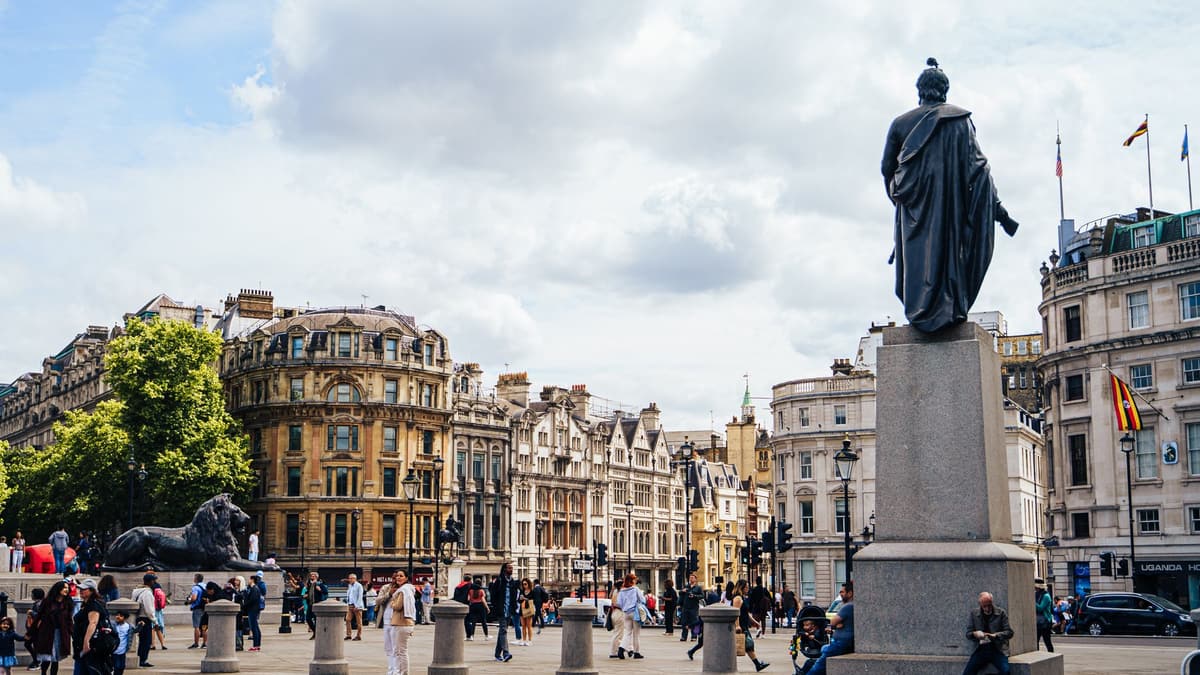
Follow your map north-east toward Trafalgar Square and along the Strand to the Savoy's entrance on Savoy Court, about fourteen minutes.
 You're at Savoy Court, the little side road off the Strand that leads to the Savoy hotel's front door. Under the hotel was a luxury air raid shelter for the hotel's guests. Phil Piratin, whom you're about to meet, described it in his memoir: three sections of cubicles, each decorated in a different color, pink, blue and green. "Armchairs and deck chairs were strewn around." You can't see it from here, but picture it below your feet.
Now go back a month, to 14 September 1940, one week into the Blitz. The bombs had been falling hardest on the East End, around the docks. That evening a group of Communists from Stepney, led by a local councillor named Phil Piratin, walked into the Savoy with East End families and went down into that shelter. They wanted to show the gap between how the rich and the poor were protected. How many came is hard to say. Piratin later wrote of "seventy people, among them a large sprinkling of children"; another man who was there, Max Levitas, remembered "forty of us." Those are their own counts.
An air raid alert was on, so the hotel couldn't put them out into the street. The waiters first quoted the hotel's prices. Piratin offered what a cup of tea and a slice of bread and butter cost in a Lyons restaurant, twopence each, and soon the tea and bread and butter arrived on trolleys.
There was a bigger fight going on about shelter. The government had discouraged people from sleeping in the Underground stations. Londoners went down anyway, and the authorities gave way and turned parts of the Tube into official shelters. Nobody can say the Savoy protest alone changed that, but it made the point where the comfortable couldn't miss it.
Head east along the Strand to the church on an island in the middle of the road, about nine minutes.
Wat er inbegrepen is
Onze tours zijn bedoeld om meditatief en meeslepend te zijn: je blijft in beweging en luistert gewoon. Samen zijn ze altijd beter, en de app speelt de vertelling synchroon af, zodat jij, je partner en je vrienden elke stop op hetzelfde moment horen.
You're facing St Clement Danes, a Wren church standing on its own island in the Strand. This is the Central Church of the Royal Air Force.
De rest van deze stop zit in de volledige audiotour.
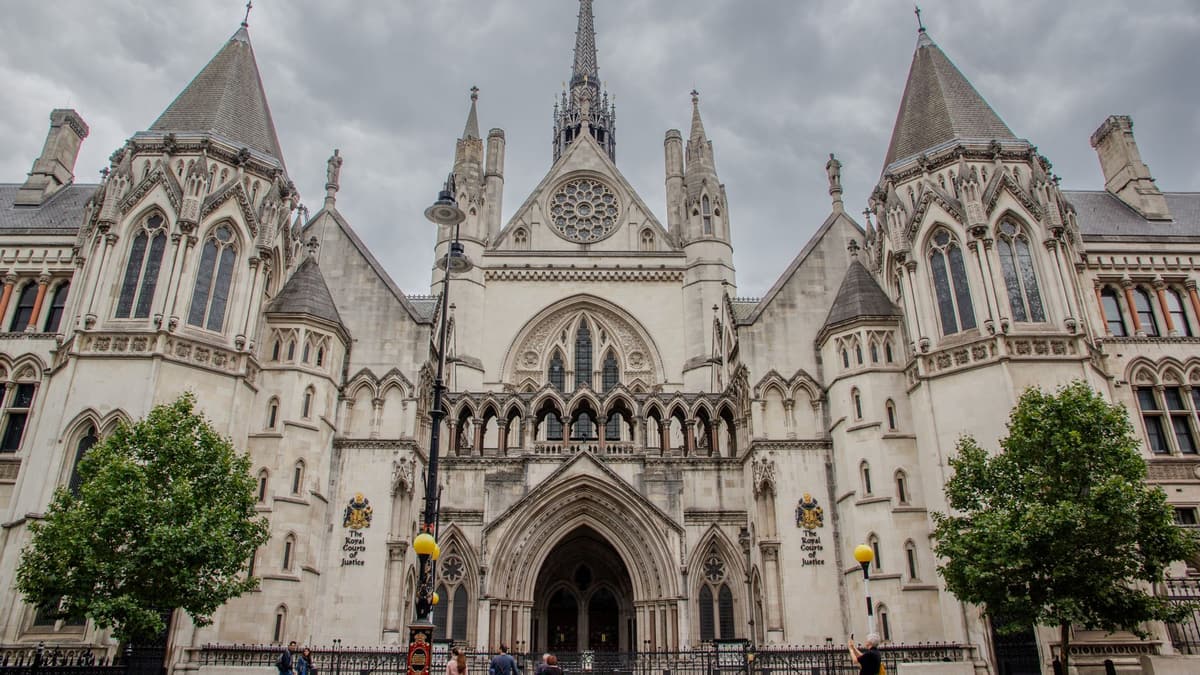
You're at St Bride's, the journalists' church, just off Fleet Street. Look up at Wren's spire, stacked in tiers like a wedding cake.
De rest van deze stop zit in de volledige audiotour.
You're at the west front of St Paul's Cathedral, by the statue of Queen Anne. Look up at the dome.
De rest van deze stop zit in de volledige audiotour.
You're at Christ Church Greyfriars. All that's left of Wren's church is the tower, now private homes, and a fragment of wall.
De rest van deze stop zit in de volledige audiotour.
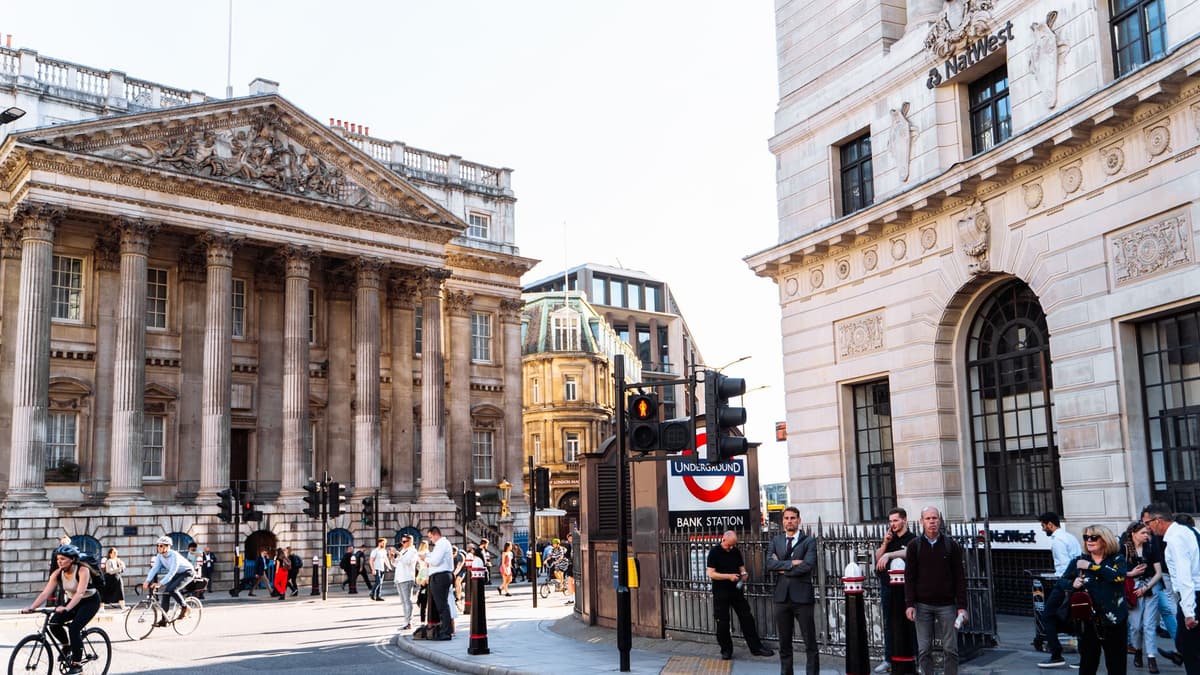
You're at Bank junction, in front of the Royal Exchange, with the Duke of Wellington on horseback and the Bank of England across the road. Under your feet is Bank station.
De rest van deze stop zit in de volledige audiotour.
Doe deze wandeling samen met anderen tijdens de eerstvolgende geplande tour.
Ongeveer 4,6 km, circa 65 minuten in een rustig tempo · 8 stops
Vrienden lopen gratis meeOctober 11, 2026 · 9 min read
From the Hollandsche Schouwburg through the old Jewish Quarter, past the Dockworker and the Dam, to the Anne Frank House on the Prinsengracht.
October 11, 2026 · 11 min read
From Van Houten's street by the Vondelpark past Leidseplein, the Rijksmuseum passage and the famous canal bench to the Anne Frank House.

October 11, 2026 · 10 min read
Follow the last days of April and May 1945 from the Anhalter Bahnhof ruin past the Gestapo site and Brandenburg Gate to the Moltke Bridge and the Reichstag.
