
October 11, 2026 · 9 min read
Amsterdam Anne Frank Walking Tour
From the Hollandsche Schouwburg through the old Jewish Quarter, past the Dockworker and the Dam, to the Anne Frank House on the Prinsengracht.
589

October 9, 2026 · 11 min read

 Znajomi spacerują za darmo
Każdy spacer odbywa się również jako zaplanowany spacer grupowy, do którego możesz dołączyć w aplikacji.
Więcej wycieczek audio w Kilkenny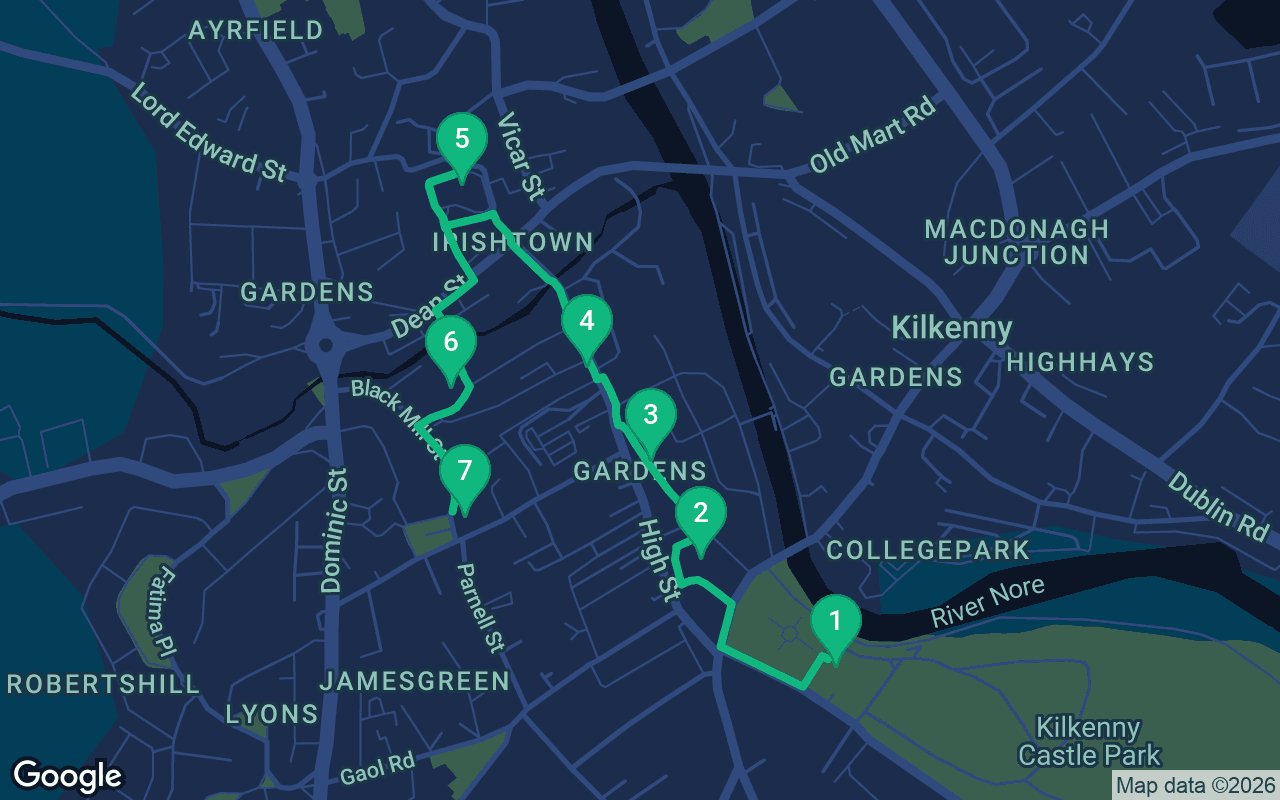
Około 1,8 km, mniej więcej 26 minut w spokojnym tempie.
Ten spacer ma narrację
Naciśnij odtwarzanie na pierwszych 3 przystankach, aby posłuchać 30-sekundowego demo narracji. W aplikacji wstęp i te przystanki odtworzysz w całości za darmo, a każdy z nich zasygnalizuje się dźwiękiem po przybyciu. Cały spacer z narracją otrzymasz za $6.99, jednorazowy zakup, który zachowasz na zawsze.
Działa z Garmin, Komoot, Strava, OS Maps i każdą aplikacją GPX.
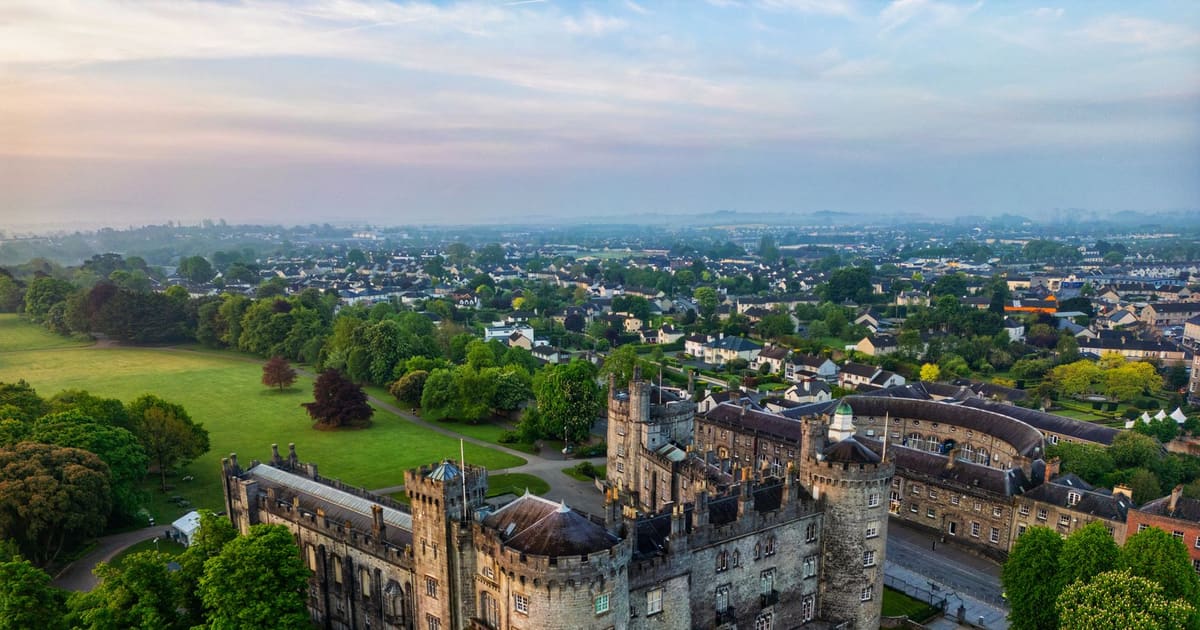
Kilkenny is a small city with a very long memory. For a few hundred years in the Middle Ages it was one of the most important towns in Ireland, and the line of streets the locals call the Medieval Mile still runs from the castle at one end to the cathedral at the other. This walk follows it. You start at Kilkenny Castle, walk up past a medieval church turned museum, the inn of a woman tried for witchcraft and a merchant's house from around 1600, and climb to St Canice's Cathedral and its round tower. Then you loop back down the west side of town past the Dominican Black Abbey to the tall Catholic cathedral of St Mary's. It is about two kilometers, and one of the most rewarding small-town self-guided walking tours in Ireland.
Allow about two hours at a stroll, and half a day if you go inside everything. The castle, the Medieval Mile Museum, Rothe House and St Canice's all charge admission and keep their own hours, and the round tower climb depends on the weather and has age limits, so check before you go. The castle park is free. Most of the route is level, but there are cobbles and uneven lanes, and the steps up to St Canice's are steep for a short stretch. Kilkenny is busy on summer weekends and during its festivals, and quieter on weekday mornings. Showers come and go, so carry a light waterproof. The old pubs on High Street and Parliament Street are part of the experience, and a bowl of soup or a pint halfway round is very much in the spirit of the place.
Stand in front of Kilkenny Castle and take in its great round towers, rising above the river Nore. The Normans built here because of the river and the high ground. Strongbow, the Norman lord who led the conquest of Leinster, put up a timber fort on this spot in the 1170s, and his son-in-law William Marshal, one of the most famous knights of his age, replaced it with a stone castle around 1200, with a tower at each corner. Three of those towers survive in the building you see. In 1391 the castle was bought by James Butler, Earl of Ormond, and his family lived here for more than five hundred years. Their name came from an office. An ancestor, Theobald Walter, was made Chief Butler of Ireland by King Henry II, and the title stuck as a surname. The Butlers became one of the two great Anglo-Norman dynasties in Ireland, rivals of the FitzGeralds, and the most powerful family in this part of the country. After the restoration of the monarchy in 1660, James Butler, the first Duke of Ormonde, remodeled the castle as a grand country house, and the Victorians gave it much of the look it has today, including the Long Gallery with its painted roof. During the Civil War in 1922 the castle was occupied by anti-Treaty fighters and taken back by pro-Treaty troops after a short siege, with members of the family still inside. The Butlers left in 1935, and in 1967 the castle was sold to the people of Kilkenny for fifty pounds. When you are ready, leave through the castle gate onto The Parade, walk up toward the town and turn right into Rose Inn Street. After a few steps, St Mary's Lane opens on your left and leads to the old church. About six minutes.
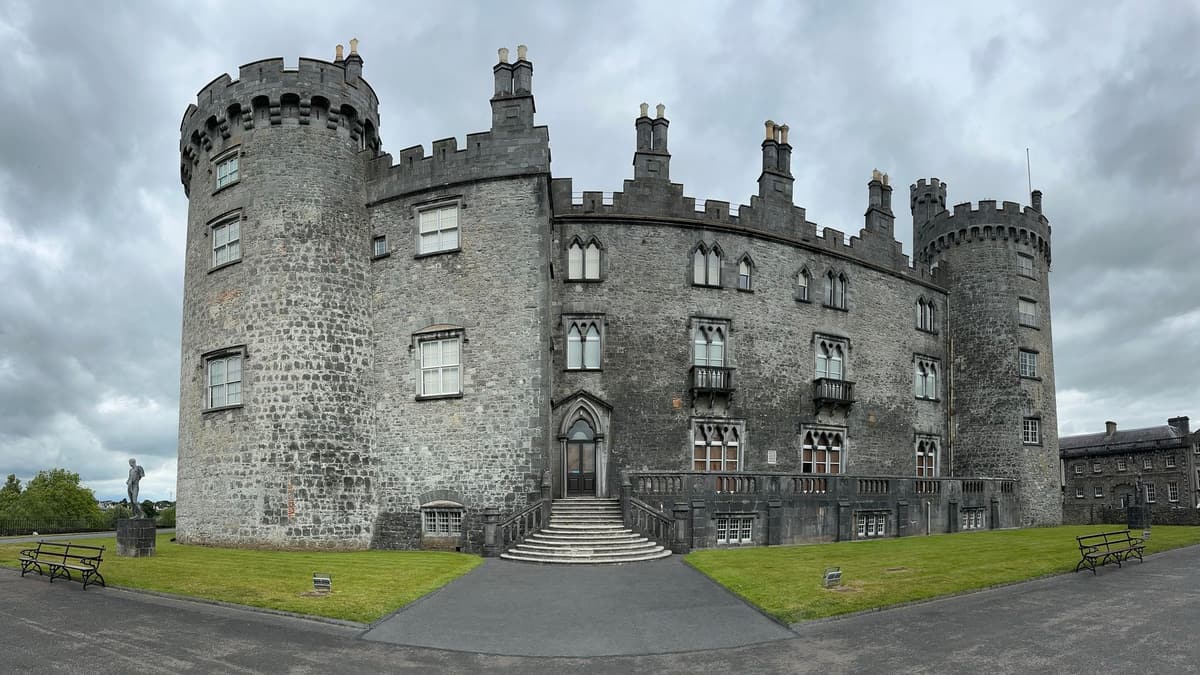 In front of you is St Mary's, the parish church of the medieval town, dating from the 1200s and now the Medieval Mile Museum. For centuries this was where Kilkenny's merchants worshiped, and where they wanted to be remembered. The church and its yard are full of their tombs, carved stone chests and slabs with the arms and names of families like the Rothes and the Shees, who grew rich trading wool, hides and wine and ran the town for generations. Inside, the museum tells the story of the medieval town, and one episode is worth knowing before you walk on. In 1366 a parliament held in Kilkenny passed the Statutes of Kilkenny. The English crown was worried that its settlers were becoming Irish, and the statutes forbade them to speak Irish, use Irish law, take Irish names, wear Irish dress, marry into Irish families or even play hurling. They show how far the mixing had already gone, and they proved almost impossible to enforce. Kilkenny today is the heartland of hurling. Just behind the church, on High Street, stands the Tholsel, the town hall built in 1761, with its arcade sheltering the pavement and its clock tower above. It is known today as City Hall, and Kilkenny has been a city by royal charter since 1609. To continue, follow St Mary's Lane round to St Kieran's Street and turn left. Kyteler's Inn is about two minutes along.
This old stone inn with its hanging sign carries the name of the most notorious woman in Kilkenny's history. Dame Alice Kyteler came from a family of merchants and moneylenders and married four times, growing richer with each marriage. In 1324, after the fourth fell ill, her stepchildren and the bishop of Ossory, Richard de Ledrede, an English Franciscan with a zeal for rooting out heresy, accused her of witchcraft. The charges were lurid: sacrificing animals to a demon, brewing potions, poisoning her husbands, sweeping the streets at night toward her son's door to bring him luck. Alice had powerful friends. One of them, a royal official, briefly had the bishop himself locked up in Kilkenny Castle. But de Ledrede kept going, and in the end Alice escaped, most likely to England, and was never heard of again. Her maid, Petronella of Meath, was not so lucky. She was flogged until she confessed and was burned at the stake in Kilkenny that year, the first person known to have been burned for heresy in Ireland. Alice's son, William Outlaw, was spared, but as part of his penance he had to pay for lead to roof part of St Canice's Cathedral, which you will see later on. The inn claims a connection to Alice's own house, and inside you can drink in a vaulted stone cellar. Just back along this street, the Butter Slip, a narrow stepped lane, climbs up to High Street. To continue, walk north along St Kieran's Street until it rejoins the main street at Parliament Street. Rothe House is a few steps along on your left, about three minutes.
Co zawiera
Nasze wycieczki mają być medytacyjne i wciągające: idziesz i po prostu słuchasz. Zawsze lepiej przeżywa się je razem, a aplikacja odtwarza narrację synchronicznie, więc ty, twój partner i twoi przyjaciele słyszycie każdy przystanek w tej samej chwili.
Stop outside Rothe House, behind its arched front on Parliament Street. It looks like one house, but it is three, built one behind the other around cobbled courtyards on a long narrow plot, with a garden at the back.
Dalsza część tego przystanku jest w pełnej audiowycieczce.
You have climbed into what was once a separate town.
Dalsza część tego przystanku jest w pełnej audiowycieczce.
In front of you is the Black Abbey, a Dominican priory founded in 1225 by William Marshal the Younger, son of the knight who built the castle.
Dalsza część tego przystanku jest w pełnej audiowycieczce.
The walk ends at St Mary's Cathedral, the Catholic cathedral of Kilkenny, and you have probably seen its tall square tower from all over town. Stand back from it to take in the whole thing.
Dalsza część tego przystanku jest w pełnej audiowycieczce.
Wykonaj ten spacer z innymi ludźmi na następnym zaplanowanym spacerze.
Około 1,8 km, mniej więcej 26 minut w spokojnym tempie · 7 przystanków
Znajomi spacerują za darmoOctober 11, 2026 · 9 min read
From the Hollandsche Schouwburg through the old Jewish Quarter, past the Dockworker and the Dam, to the Anne Frank House on the Prinsengracht.
October 11, 2026 · 11 min read
From Van Houten's street by the Vondelpark past Leidseplein, the Rijksmuseum passage and the famous canal bench to the Anne Frank House.

October 11, 2026 · 10 min read
Follow the last days of April and May 1945 from the Anhalter Bahnhof ruin past the Gestapo site and Brandenburg Gate to the Moltke Bridge and the Reichstag.
