
October 11, 2026 · 9 min read
Amsterdam Anne Frank Walking Tour
From the Hollandsche Schouwburg through the old Jewish Quarter, past the Dockworker and the Dam, to the Anne Frank House on the Prinsengracht.
589

October 9, 2026 · 12 min read

 Znajomi spacerują za darmo
Każdy spacer odbywa się również jako zaplanowany spacer grupowy, do którego możesz dołączyć w aplikacji.
Więcej wycieczek audio w Osaka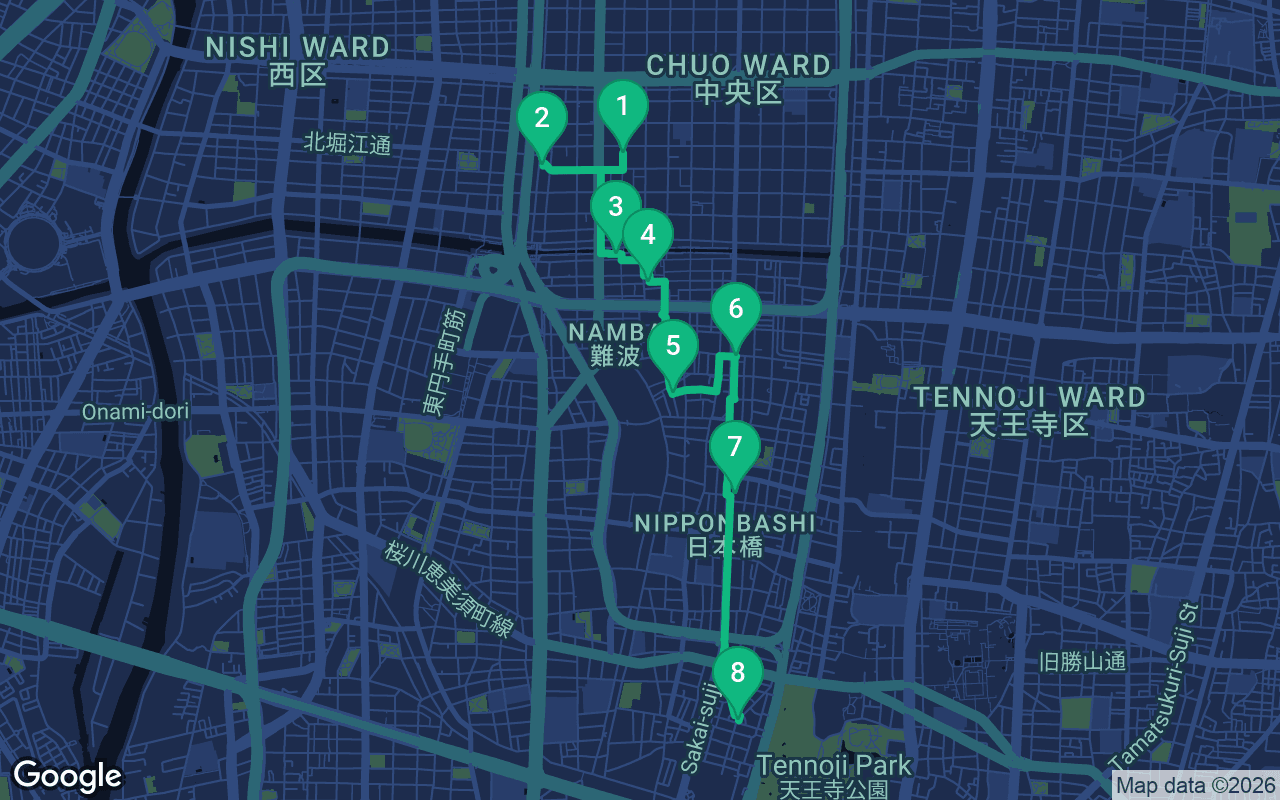
Około 3,6 km, mniej więcej 52 minut w spokojnym tempie.
Ten spacer ma narrację
Naciśnij odtwarzanie na pierwszych 3 przystankach, aby posłuchać 30-sekundowego demo narracji. W aplikacji wstęp i te przystanki odtworzysz w całości za darmo, a każdy z nich zasygnalizuje się dźwiękiem po przybyciu. Cały spacer z narracją otrzymasz za $9.99, jednorazowy zakup, który zachowasz na zawsze.
Działa z Garmin, Komoot, Strava, OS Maps i każdą aplikacją GPX.
Tokyo has its manners and Kyoto has its temples, but Osaka has its appetite. The city even has a word for it, kuidaore, which means roughly to ruin yourself through eating, and nowhere lives up to it like Minami, the loud, crowded, neon-lit south side of the center. This walk starts in the covered arcade of Shinsaibashi, ducks into the streetwear lanes of Amerikamura, crosses the canal under the famous running man of Dotonbori, then works its way south through a mossy temple alley, a street of kitchen suppliers, the fish stalls of Kuromon Market and the anime shops of Den Den Town, to finish under the retro tower of Shinsekai. It is about three and a half kilometers, flat all the way, and one of the tastiest self-guided walking tours you can take anywhere in Japan. Come hungry.
The walking takes under an hour, but give it three or four, because the whole point is to stop, browse and eat. The route is flat and paved, and much of it runs under covered arcades, which makes it a good choice on a rainy day. Timing takes a little thought. Kuromon Market is at its liveliest earlier in the day, and many of its stalls start packing up toward evening, while Dotonbori and Shinsekai are at their best once the neon comes on. A start in the early afternoon gives you a fair share of both; if the lights matter most, start later and save the market for another morning. Expect crowds in Dotonbori, Kuromon and Den Den Town, especially on weekends, and keep your bag in front of you in the thickest of them. Eating while walking is frowned on in much of Japan, so eat standing at the stall or in the seating some vendors provide. Public bins are rare, so carry a small bag for your rubbish. Some smaller places only take cash. Summers in Osaka are hot and sticky, so carry water.
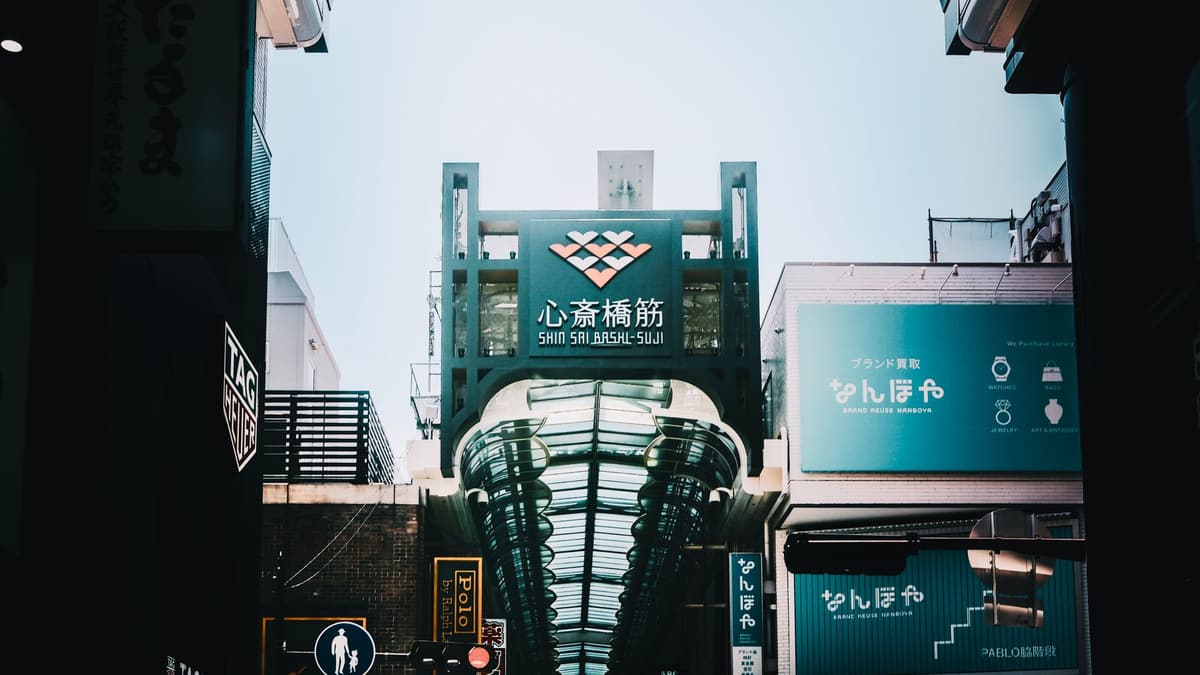
You are standing in Shinsaibashi-suji, a covered shopping arcade that runs for about six hundred meters, north to south, through the heart of Minami. Look up at the long glass roof, then down the length of the street, where the crowds flow in two steady rivers past fashion chains, drugstores, sweet shops and department stores. This has been a merchants' street since the Edo period, when Osaka was the commercial capital of Japan, nicknamed the nation's kitchen because the rice and goods of the whole country passed through its warehouses. The name comes from a bridge. In the early seventeenth century a merchant named Okada Shinsai paid for a bridge over the Nagahori canal at the arcade's northern end, and the street that grew up beside it took his name. The canal was filled in during the 1960s and the bridge is long gone, but the name stuck. Kimono dealers set up here early on, and the Daimaru department store, whose grand building still stands along the arcade, has traded on this street since it opened here as a kimono shop in the 1720s. Today it is simply the busiest shopping street in the city, at its most hectic on weekend afternoons. To reach the next stop, take one of the side streets west, cross the wide, tree-lined Midosuji boulevard at the lights, and keep going west for a few small blocks, about five minutes.
You are in Amerikamura, America Village, and this little triangle of concrete is its heart. Locals call the whole neighborhood Amemura for short, and the park is officially Mitsu Park, though everyone knows it as Sankaku Koen, the triangle park. Look around: steps where teenagers sit and eat, walls of murals and stickers, and narrow lanes radiating off in every direction, packed with vintage clothing stores, sneaker shops, record dealers, tattoo studios and tiny bars. The story of the name goes back to around the 1970s, when shops here began selling used clothes, denim and records brought over from the United States, often from cheap warehouse spaces in what had been a quiet district. Young Osakans flocked to them, the American look became the neighborhood's identity, and the name followed. Amemura has been Osaka's center of youth culture ever since, a place for street fashion, clubs and people watching. On a weekend afternoon you will see every style the city has to offer walk past this park in about ten minutes. Takoyaki stands sit around the edge, and this is a fine place for your first snack. When you are ready, head south through the lanes toward the Dotonbori canal, then turn left and walk east, crossing Midosuji again, to Ebisu Bridge and the giant neon runner, about eight minutes.
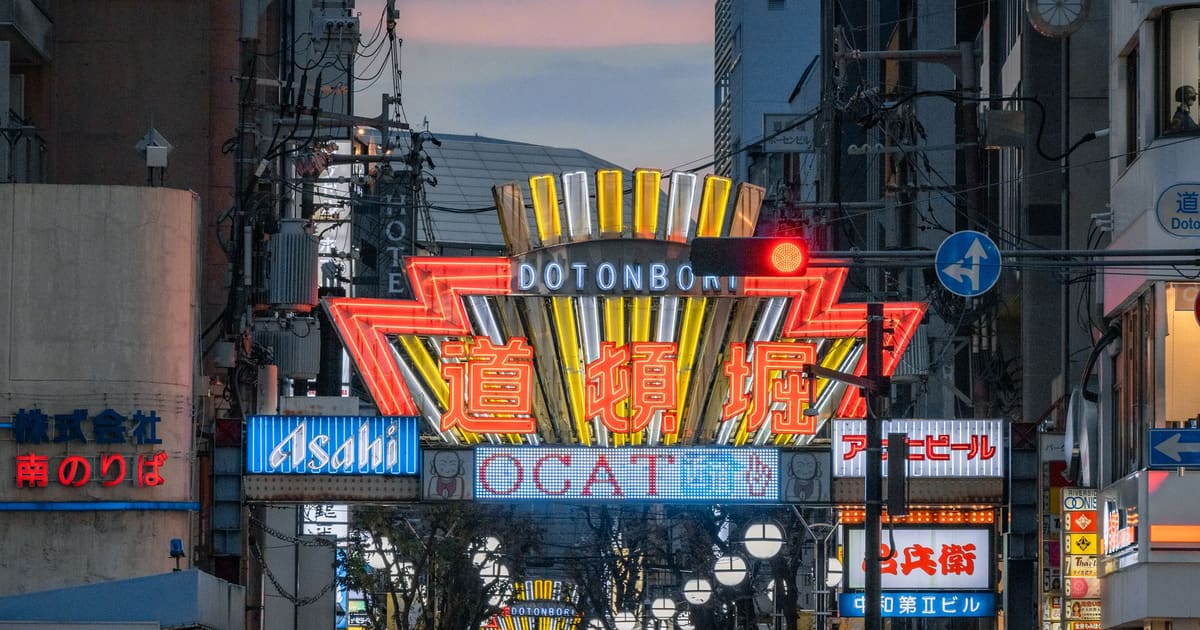
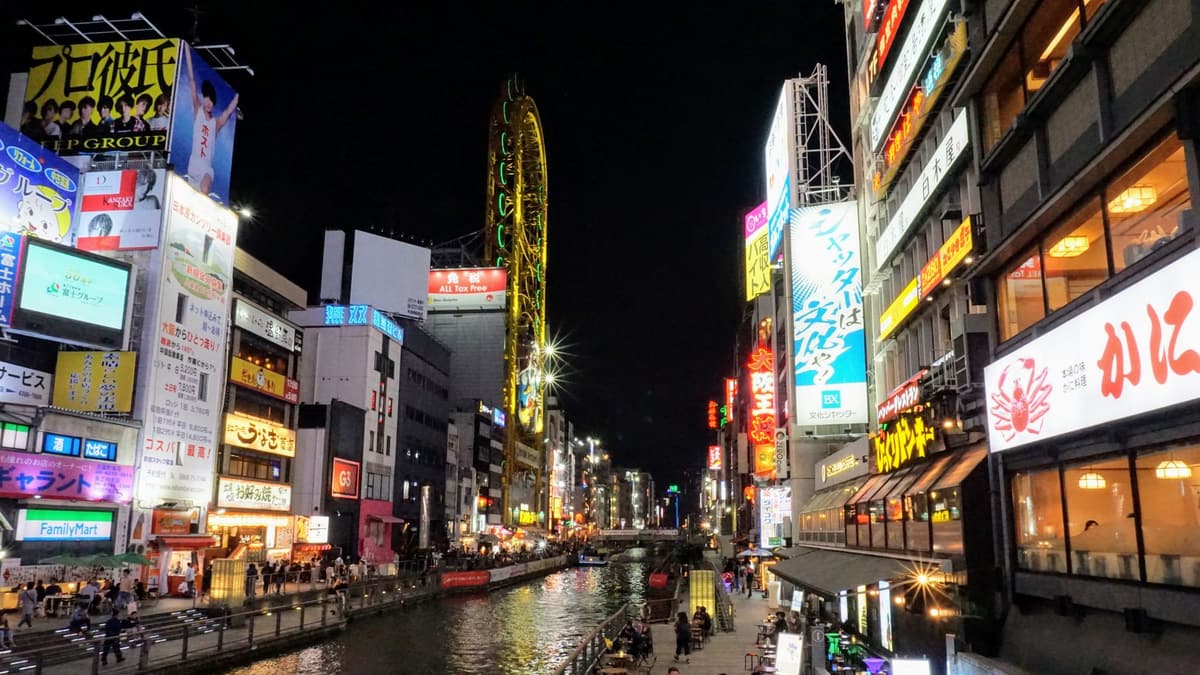
 You are at Ebisu Bridge, over the Dotonbori canal, and in front of you is the most photographed sign in Osaka: a man in a running vest with his arms flung up in victory, crossing a finish line in neon. He belongs to Glico, an Osaka confectionery company, and a running man has advertised it here since 1935. The sign has been replaced several times since then, and today's version glows with LED lights. The company's old slogan claimed that one of its caramels gave you enough energy to run three hundred meters, which is why he looks so pleased with himself. Strike his pose for a photo; everyone does. The canal below you was dug in the early seventeenth century by a merchant named Yasui Doton, who died fighting in the siege of Osaka Castle before it was finished, and the district still carries his name. Dotonbori became the city's theater district, and the restaurants followed the audiences. In 1985, when the local baseball team, the Hanshin Tigers, won the national championship, jubilant fans leapt from this bridge into the canal and threw in a statue of Colonel Sanders from a nearby fried chicken restaurant. Fans blamed a curse for the team's long run of bad luck afterward, and the battered statue was only fished out in 2009. Cross the bridge to the south bank, turn left along Dotonbori's main street, and after about a minute look for a narrow passage on your right, about three minutes.
Co zawiera
Nasze wycieczki mają być medytacyjne i wciągające: idziesz i po prostu słuchasz. Zawsze lepiej przeżywa się je razem, a aplikacja odtwarza narrację synchronicznie, więc ty, twój partner i twoi przyjaciele słyszycie każdy przystanek w tej samej chwili.
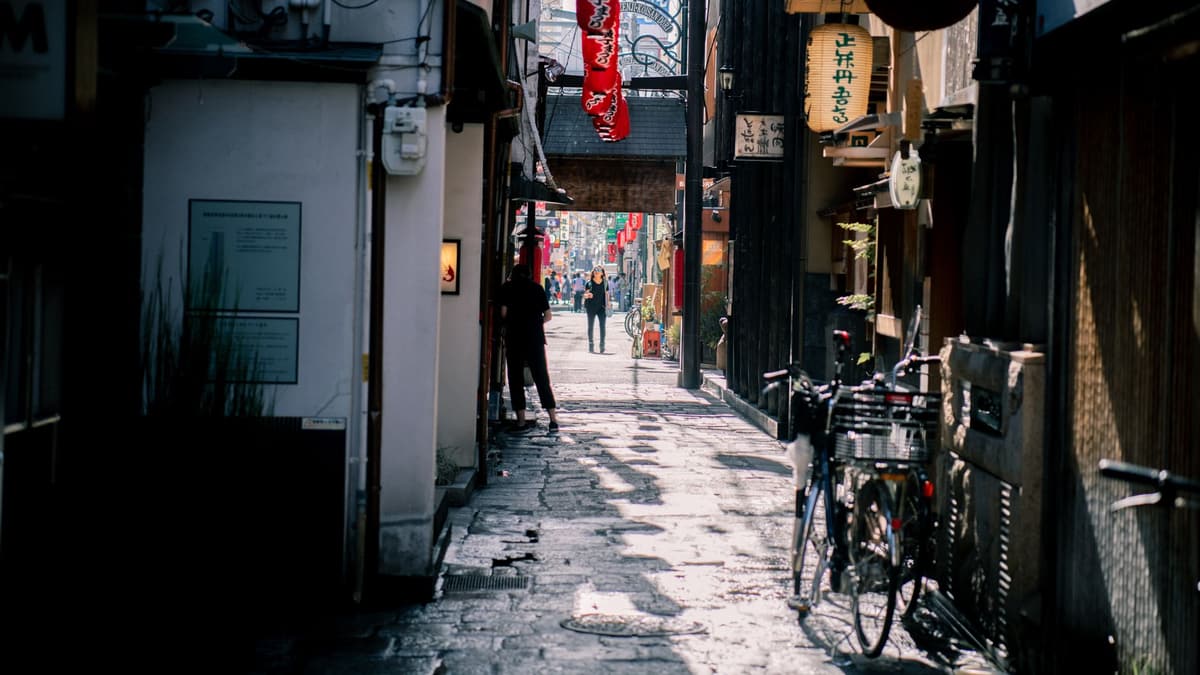
Step into Hozenji Yokocho and the noise of Dotonbori falls away. This is a narrow alley paved with stone, lined with small restaurants behind wooden fronts and paper lanterns, many of them old and some very good.
Dalsza część tego przystanku jest w pełnej audiowycieczce.
You are in Sennichimae Doguyasuji, which translates roughly as the street of tools, and the tools in question are for kitchens. This short covered arcade is where Osaka's restaurants come to stock up, and everything a food business could want is on sale.
Dalsza część tego przystanku jest w pełnej audiowycieczce.
Welcome to Kuromon Market, Osaka's kitchen, a few hundred meters of covered lanes and well over a hundred stalls selling fish, meat, fruit, vegetables and pickles.
Dalsza część tego przystanku jest w pełnej audiowycieczce.
You have reached Den Den Town, Osaka's district of electronics, games and anime, its answer to Tokyo's Akihabara. The name is a play on denki, the Japanese word for electricity.
Dalsza część tego przystanku jest w pełnej audiowycieczce.
The walk ends beneath Tsutenkaku, the tower reaching to heaven, a steel lattice tower that rises over the streets of Shinsekai, the New World.
Dalsza część tego przystanku jest w pełnej audiowycieczce.
Wykonaj ten spacer z innymi ludźmi na następnym zaplanowanym spacerze.
Około 3,6 km, mniej więcej 52 minut w spokojnym tempie · 8 przystanków
Znajomi spacerują za darmoOctober 11, 2026 · 9 min read
From the Hollandsche Schouwburg through the old Jewish Quarter, past the Dockworker and the Dam, to the Anne Frank House on the Prinsengracht.
October 11, 2026 · 11 min read
From Van Houten's street by the Vondelpark past Leidseplein, the Rijksmuseum passage and the famous canal bench to the Anne Frank House.

October 11, 2026 · 10 min read
Follow the last days of April and May 1945 from the Anhalter Bahnhof ruin past the Gestapo site and Brandenburg Gate to the Moltke Bridge and the Reichstag.
