
October 11, 2026 · 9 min read
Amsterdam Anne Frank Walking Tour
From the Hollandsche Schouwburg through the old Jewish Quarter, past the Dockworker and the Dam, to the Anne Frank House on the Prinsengracht.
589

October 9, 2026 · 11 min read

 Gli amici camminano gratis
Ogni tour funziona anche come camminata di gruppo programmata a cui puoi unirti nell'app.
Altri tour audio a Melbourne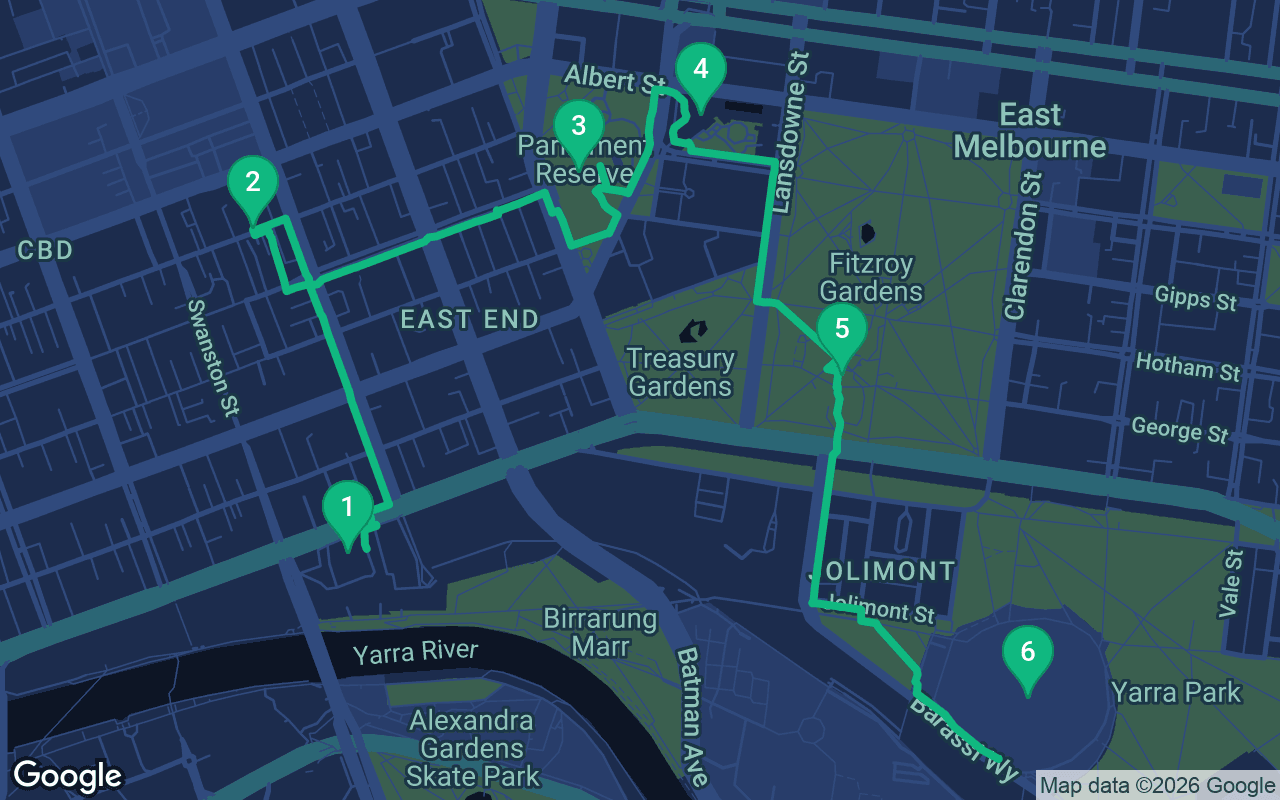
Circa 4 km, più o meno 57 minuti a passo tranquillo.
Questo tour è narrato
Premi play sulle prime 3 tappe per ascoltare una demo di 30 secondi della narrazione. Nell'app, l'introduzione e queste 3 tappe sono gratis e complete, e ogni tappa ti avvisa con un segnale acustico al tuo arrivo. L'intero tour narrato sarà tuo a $9.99, un acquisto unico che conservi per sempre.
Funziona con Garmin, Komoot, Strava, OS Maps e qualsiasi app GPX.
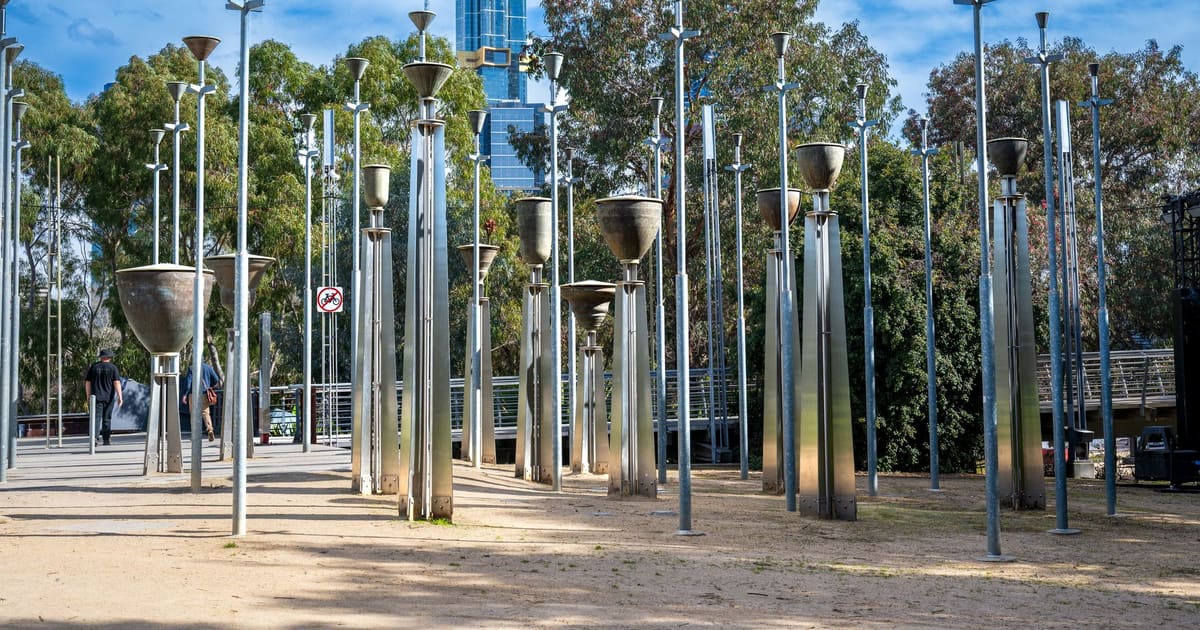
This walk covers three things Melbourne cares about deeply: politics, faith and sport. It starts at Federation Square, the city's angular public meeting place on the edge of the river, heads north to the lanterns and gates of Chinatown, then climbs the eastern end of the city to Parliament House and the great bluestone cathedral of St Patrick's. From there it crosses the Fitzroy Gardens, past a cottage shipped from England, and finishes at the Melbourne Cricket Ground, the vast stadium the whole city calls the G. All of it lies on the Country of the Wurundjeri Woi-wurrung people of the Kulin nation. The route is about three kilometers, with a gentle climb in the middle and shaded parkland in the second half, and it is one of the most varied self-guided walking tours in the city, from busy streets to quiet lawns in under an hour of walking.
Allow about two hours at a stroll, more if you go inside the cathedral or the cottage, or stop for dumplings in Chinatown, which is strongly recommended. The first half is on city footpaths, with a steady but gentle rise from the river up to Spring Street. The second half follows paths through the Fitzroy Gardens and Yarra Park, under big old elms and gums, so it is pleasantly shaded on a hot day. Even so, the Australian sun is strong, and the streets in the first half are exposed, so bring a hat, sunscreen and water. Melbourne weather can turn quickly, so a light layer is wise too. Parliament House, St Patrick's Cathedral, Cooks' Cottage and the MCG all keep their own hours, and tours of Parliament and the MCG run on a schedule, so check before you go. On a match day the area around the MCG fills with crowds, which can be great fun or a crush, depending on your mood.
Stand in the middle of the main plaza and turn slowly around. Federation Square is unlike anything else in the city: a cluster of buildings clad in a jigsaw of triangles of sandstone, zinc and glass, set around a sloping, uneven plaza paved in rust-colored stone from the far northwest of Australia. It opened in 2002, built on a deck over railway lines that had cut the city off from its river for over a century, and it was named for the centenary of Australian federation in 1901. When it opened, people either loved it or hated it, and the arguments went on for years, but it has become the place where Melbourne gathers. Crowds come here to watch big matches on the screen, to protest, to celebrate and to mourn. The buildings around you house galleries and cultural institutions. The Ian Potter Centre holds the National Gallery of Victoria's collection of Australian art, including major works by Aboriginal and Torres Strait Islander artists, and ACMI is a museum of film, television and games. Look too for the Koorie Heritage Trust, an Aboriginal-led organization that shares the art, culture and history of the Aboriginal people of southeastern Australia. The river just behind the square was a gathering place for the Kulin peoples long before any of this was built. To reach the next stop, walk to the corner of Flinders and Swanston Streets, cross Flinders Street and head north up Swanston Street. Cross Flinders Lane, Collins Street and Bourke Street, then turn right into Little Bourke Street. Chinatown begins almost at once, about eight minutes away.
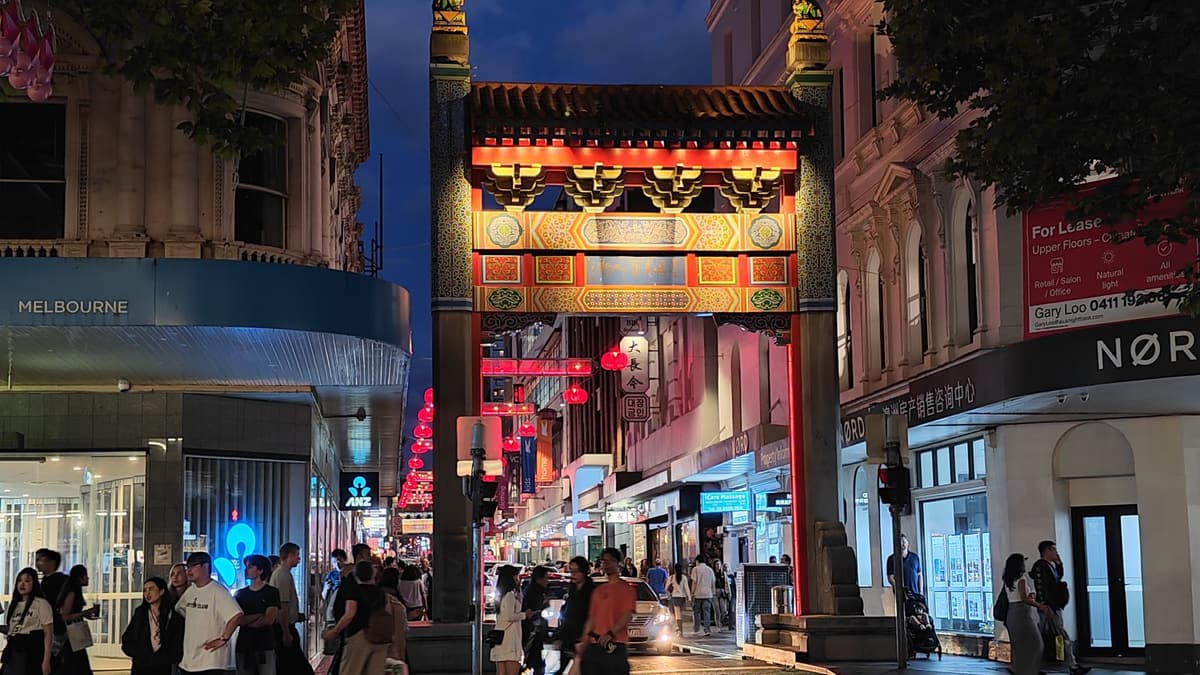 You are standing on Little Bourke Street, under strings of lanterns and close to one of the ornate gateways that span the street. This is Melbourne's Chinatown, often described as the oldest continuous Chinese settlement in the Western world. Its story begins in the 1850s, when news of gold in Victoria reached southern China and tens of thousands of Chinese men, many from the Pearl River Delta, set out for the goldfields. The colonial government was alarmed and in 1855 imposed a heavy tax on every Chinese person arriving by ship. Rather than pay it, many ships landed their passengers in South Australia instead, at the small port of Robe, and the men walked hundreds of kilometers overland to the goldfields. Little Bourke Street became their base in the city, a place to find lodgings, supplies, letters from home and news. Over time it filled with merchants, herbalists, furniture makers, temples and societies. Chinese Melburnians faced hostility and laws designed to keep them out, especially after federation, when the White Australia policy shut the door on new arrivals for decades. Community leaders such as the merchant Lowe Kong Meng spoke out against that treatment with dignity and skill. The Chinese Museum, in a lane just off the street, tells this history and is home to a great processional dragon that comes out for Lunar New Year. Today Chinatown is crowded with restaurants of every kind, and it is a good place for a snack. To reach the next stop, walk east along Little Bourke Street, crossing Russell Street and Exhibition Street, for about eight minutes, with the street rising gently. At its end you reach Spring Street, and Parliament House stands across the road and a little to your right.
Cross to the front of Parliament House and look up at its grand flight of steps and the row of tall columns above them. It was begun in 1856, when gold had made Victoria fabulously rich, and built in stages over the following decades. The architects planned a great dome on top, but it was never built, and you can see the building still waiting for it. Victoria was a pioneer of democracy in some important ways. In 1856 it was one of the first places in the world to use a secret ballot, printed by the government and marked in private, an idea so closely tied to this part of the world that it was long known overseas as the Australian ballot. The building has another claim to fame. When the colonies joined together as the Commonwealth of Australia in 1901, the new federal Parliament met here, and it stayed for twenty-six years while the national capital at Canberra was being built. During that time the Victorian Parliament moved out to the Royal Exhibition Building a short way north. The building also carries a harder history. In the 1870s and 1880s, Wurundjeri leader William Barak and the residents of the Coranderrk station near Healesville walked to the city more than once to petition the government to let them keep and run their own land. Their campaign led to a parliamentary inquiry in 1881 that recommended the station be kept, though later laws broke the community apart. To reach the next stop, walk north along Spring Street past the Parliament gardens, then turn right and head uphill to the east, steering by the cathedral's spires, which rise just beyond the gardens. It takes about six minutes.
Cosa è incluso
I nostri tour sono pensati per essere meditativi e immersivi: ti muovi e semplicemente ascolti. Sono sempre più belli in compagnia, e l'app riproduce la narrazione in sincronia, così tu, il tuo partner e i tuoi amici sentite ogni tappa nello stesso momento.
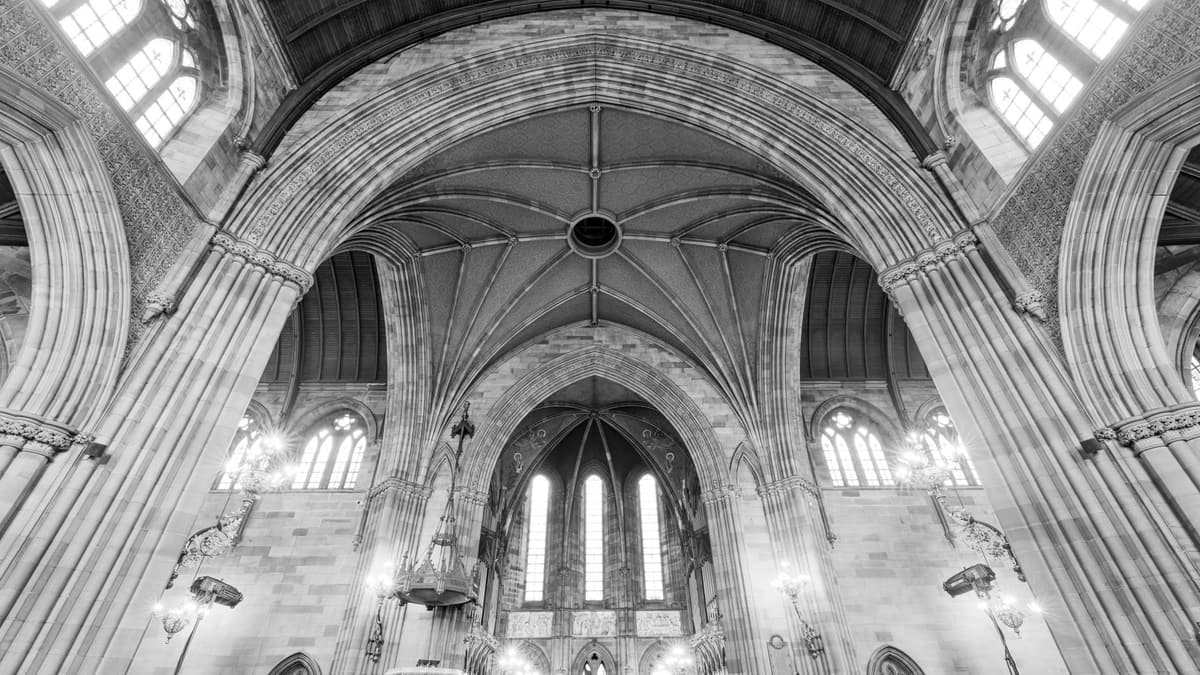
Stand back from the western front of St Patrick's and look up. The dark stone is Victorian bluestone, a volcanic basalt quarried around Melbourne, and it gives the cathedral a stern, solid look quite unlike the honey-colored sandstone churches of Sydney.
Il resto di questa tappa è nel tour audio completo.
In front of you is a small two-story cottage with a steep roof and a neat cottage garden, and it looks as if it has wandered in from rural England, because it has.
Il resto di questa tappa è nel tour audio completo.
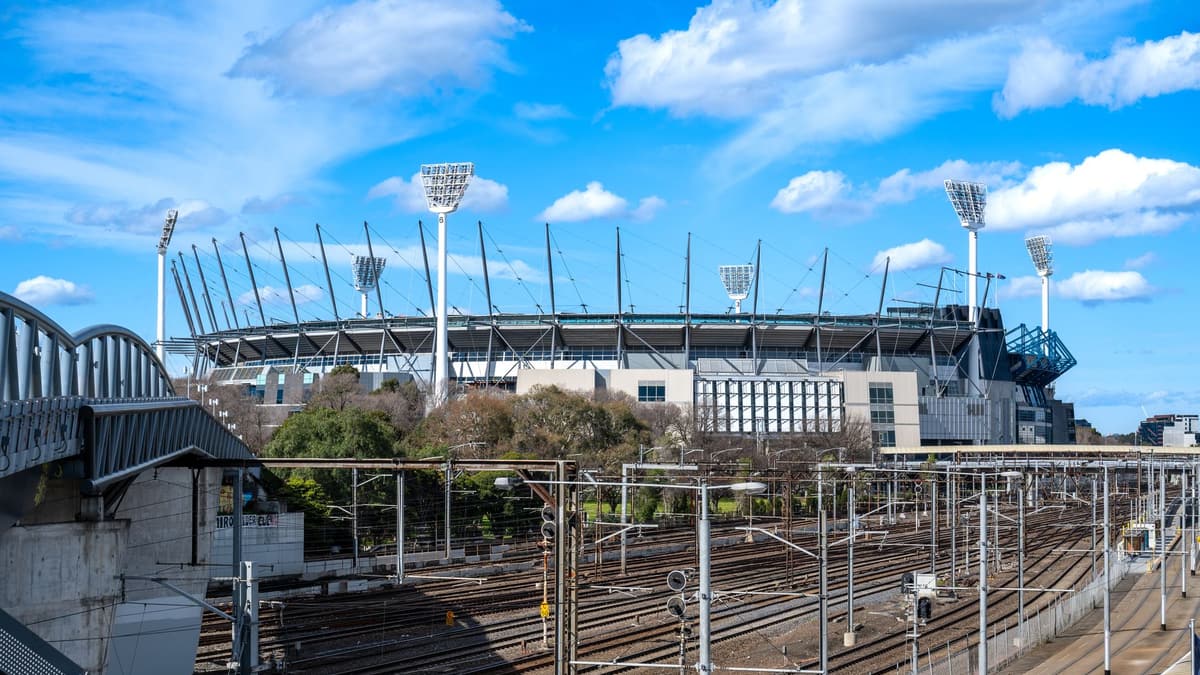
You have reached the Melbourne Cricket Ground, the MCG, or simply the G to Melburnians. Stand back and take in the size of it.
Il resto di questa tappa è nel tour audio completo.
Fai questa camminata in compagnia alla prossima uscita in programma.
Circa 4 km, circa 57 minuti a passo lento · 6 tappe
Gli amici camminano gratisOctober 11, 2026 · 9 min read
From the Hollandsche Schouwburg through the old Jewish Quarter, past the Dockworker and the Dam, to the Anne Frank House on the Prinsengracht.
October 11, 2026 · 11 min read
From Van Houten's street by the Vondelpark past Leidseplein, the Rijksmuseum passage and the famous canal bench to the Anne Frank House.

October 11, 2026 · 10 min read
Follow the last days of April and May 1945 from the Anhalter Bahnhof ruin past the Gestapo site and Brandenburg Gate to the Moltke Bridge and the Reichstag.
