
October 11, 2026 · 9 min read
Amsterdam Anne Frank Walking Tour
From the Hollandsche Schouwburg through the old Jewish Quarter, past the Dockworker and the Dam, to the Anne Frank House on the Prinsengracht.
589

October 11, 2026 · 12 min read

 Os amigos caminham grátis
Cada tour também funciona como uma caminhada em grupo agendada que você pode acessar no app.
Mais passeios de áudio em Osaka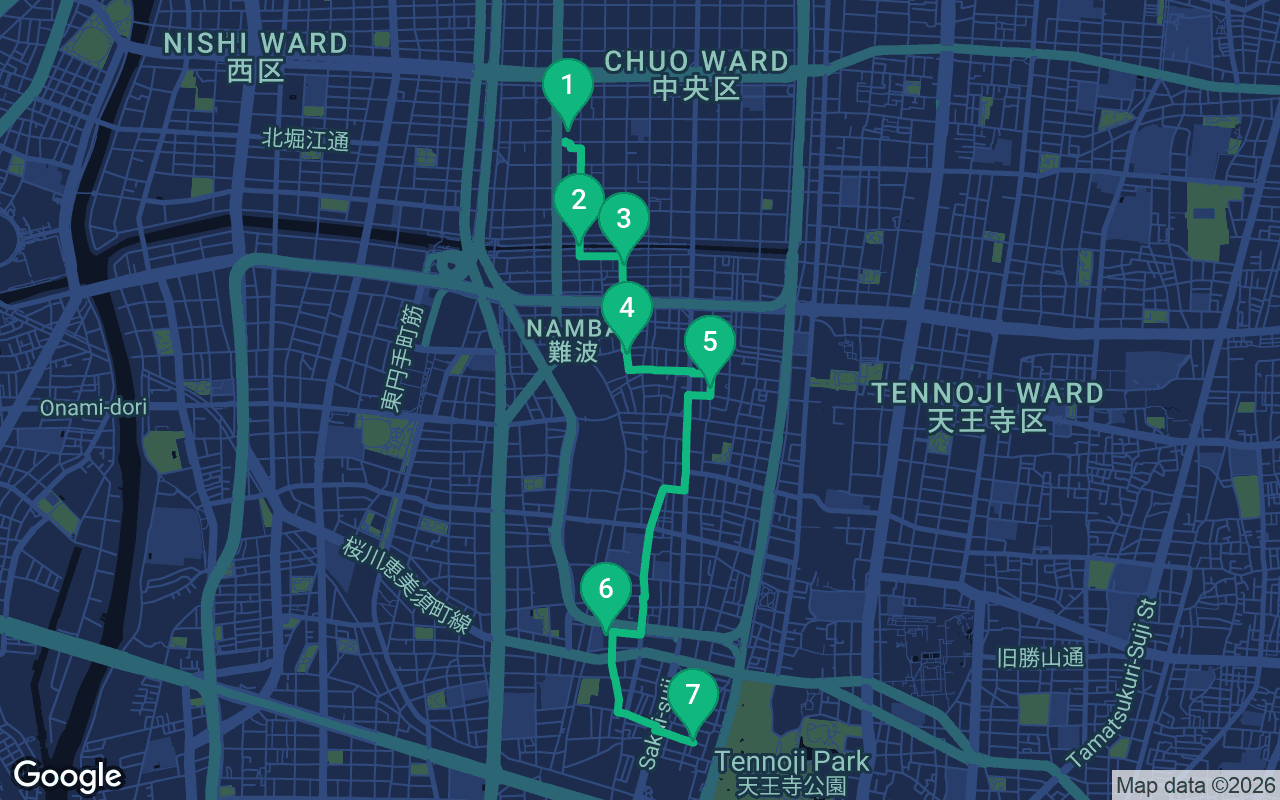
Cerca de 3,5 km, mais ou menos 49 minutos em passo tranquilo.
Este passeio é narrado
Aperte o play nas primeiras 3 paradas para ouvir uma demonstração de 30 segundos da narração. No aplicativo, a introdução e essas 3 paradas tocam completas e de graça, e cada uma avisa com um sinal sonoro quando você chega. Todo o passeio narrado é seu por $15.99, uma compra única que você guarda para sempre.
Funciona com Garmin, Komoot, Strava, OS Maps e qualquer app de GPX.
Osaka has a word for itself: kuidaore. It means to ruin yourself through extravagance on food, and it's the city's own byword. This is the old merchant city of Japan. In the Edo period, the domains of the country kept warehouses here, and Osaka became the great hub where goods gathered and were sent back out again. It was later nicknamed "tenka no daidokoro," the nation's kitchen. This walk eats its way through that reputation, from the polished to the plain. You start in a department-store food basement, cross the canal under the famous running man, and eat okonomiyaki from a griddle that's been going since 1945. Then you try takoyaki beside the street where Osaka buys its takoyaki pans, walk the length of Kuromon Market, stop at the merchants' own shrine, and finish at the counter where Kushikatsu Daruma began in 1929, and where one of the city's best-known table rules was born. It's one of our self-guided walking tours, about 3.5 kilometers from Daimaru in Shinsaibashi to Kushikatsu Daruma in Shinsekai, under the Tsutenkaku tower.
The walking takes about 50 minutes, but with five tastings and two stops just to look, allow three and a half to four hours. It's flat all the way, and much of it runs through shopping arcades and market streets. Start late in the morning: the okonomiyaki house opens at 11, and you want to reach Kuromon Market by mid-afternoon, because many of its stalls close around 5 or 6 in the evening. Avoid Sundays and national holidays, when a good number of Kuromon's shops are shut. You pay for your own food as you go. Share every plate and order small, because the last stop is the big one. Carry cash. The takoyaki shop and the kushikatsu counter both take cash only. If you have allergies, ask staff before you order: batters, sauces and dashi contain wheat, egg, soy and fish. Eat at the stall or shop where you bought your food, not while you're walking, and queue patiently where there's a line. Hours change, so check before you go. Shinsaibashi Station on the Midosuji Line is a short walk from the start.
You're in the food basement of Daimaru Shinsaibashi, a department store at 1-7-1 Shinsaibashisuji. Look along the counters: sweets, bento boxes and more. This floor is called a depachika.
The word joins two others: depato, department store, and chika, basement. The idea goes back to 1936, when Matsuzakaya opened the first basement food market at its store in Nagoya. The word itself boomed much later, in 2000. Daimaru has a long history of its own. It traces its roots to a dry-goods shop in Kyoto in 1717, and in 2010 it merged with Matsuzakaya, the company that started the whole basement food idea.
Why start here? Because a depachika is a fine way into Osaka's story. This was the merchant city. In the Edo period, the domains of Japan kept warehouses here, called kurayashiki. Goods from all over the country gathered in Osaka and were sent out again from here. Later, people gave the city a nickname for it: tenka no daidokoro, the nation's kitchen. The phrase isn't an Edo-period saying, but the idea behind it is right in front of you. A whole country's worth of food, gathered on one floor.
What to order here: just one small sweet, or simply take a slow look along the bento counters. Don't fill up. There's a lot of eating ahead, and the next stop is only a few minutes away. The store opens at 10 in the morning, and the food floor's own hours can differ, so check before you go.
When you're ready, come up to street level and walk south through the Shinsaibashi-suji shopping arcade for about seven minutes. When the arcade ends at the canal, you're on Ebisubashi bridge.
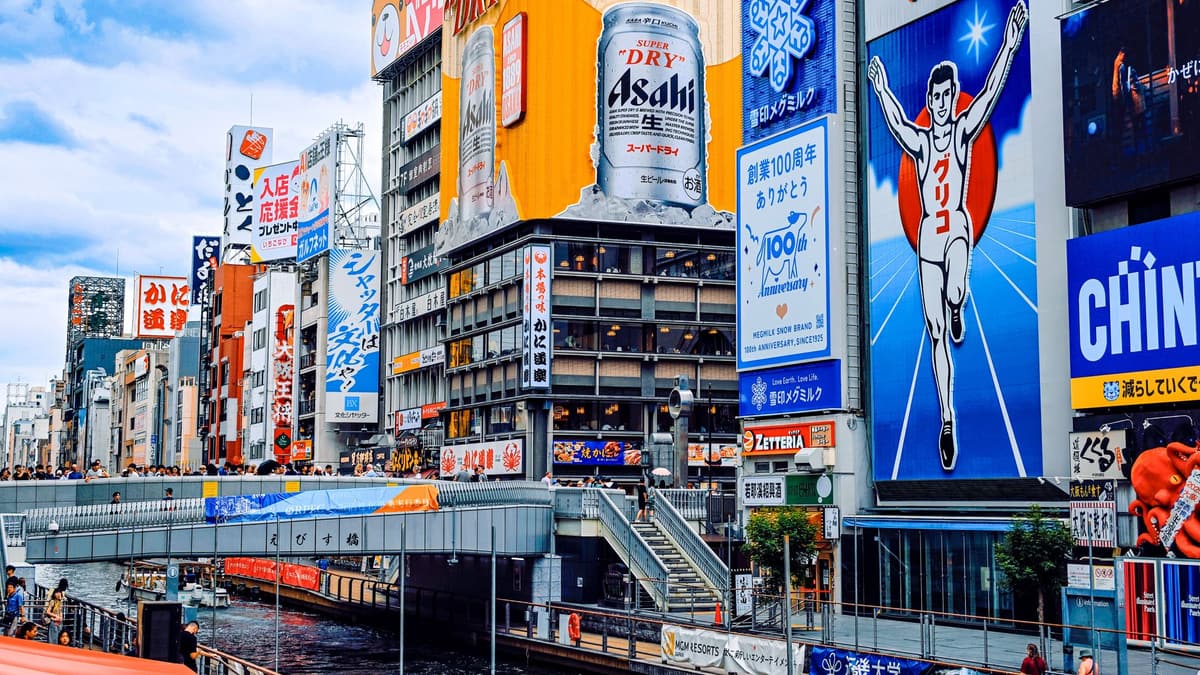
Stop in the middle of Ebisubashi bridge and look along the canal. On the building wall beside the canal, you'll see him: a giant running man. That's the Glico sign, and he's been running here since 1935.
The sign you see isn't the original. It's the sixth version, an LED sign put up in October 2014. It's 20 meters tall and just over ten meters wide, and it's lit from sunset to midnight. Glico is a confectionery company, and its runner is one of the most famous sights in Osaka. If you look down, you'll see the river walk running along the water below.
The canal under your feet is the Dotonbori. Digging began in 1612 and was finished by 1615. It carries the name of Doton, one of the men credited with digging it, though historians disagree about who he really was. Over the centuries, the streets along the canal became a district of theaters and teahouses. Later, the theaters gave way to restaurants, and Dotonbori became the food street it is today. That's where the word kuidaore belongs most of all. If anywhere in Osaka invites you to ruin yourself on food, it's here.
This is a stop for looking, not eating. Take your photo with the runner, and take in the signs and the crowds.
Now walk off the south end of the bridge and turn left onto Dotonbori, the street along the canal. Mizuno is about three minutes along.
You're outside Mizuno, at 1-4-15 Dotonbori. Okonomiyaki is a savory pancake cooked on a hot griddle, and this family has been making it since 1945. It's run today by the third generation of the family, and it holds a Michelin Bib Gourmand. It's walk-in only, so you may have to wait. On weekend evenings the line can run 20 to 45 minutes, which is one more reason to come at 11, when it opens.
What to order here: the yamaimo-yaki, to share. Its batter is made with grated mountain yam instead of the usual flour. The other house special is the Mizuno-yaki. Mizuno is open from 11 in the morning until 10 at night, with last orders at 9. Sources disagree on whether it closes on any particular day, so check before you go.
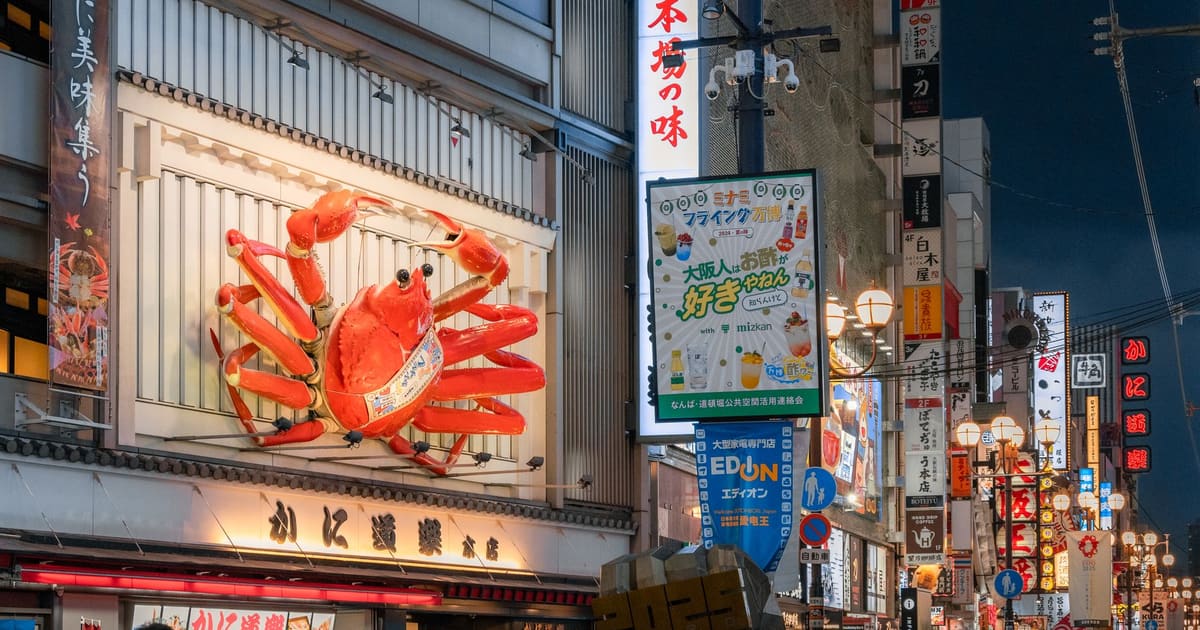
While you're here, look around, because this little stretch is full of Dotonbori's famous faces. A few doors back toward the bridge, outside the Nakaza Cuidaore Building, stands Kuidaore Taro, a drumming clown. He stood for decades outside a restaurant called Cui-daore, reportedly from 1950 until the restaurant closed in 2008. The restaurant is gone, but he's still here, drumming. On the same street you'll find the giant moving crab of Kani Doraku.
And just south of here, if you have time, slip into Hozenji Yokocho. It's a stone-paved alley about 80 meters long, rebuilt after the air raids of the war. It's the setting of a 1940 story by the writer Oda Sakunosuke, called "Meoto Zenzai," named after the sweet shop in the alley. The shop dates from 1883, and every order comes as two bowls of red-bean soup.
From Mizuno, head south, away from the canal, for about five minutes to Sennichimae. Wanaka's main shop is there, a few steps from the entrance to the Doguyasuji arcade.
O que está incluído
Nossos passeios foram feitos para ser meditativos e imersivos: você caminha e simplesmente escuta. Eles são sempre melhores em companhia, e o aplicativo toca a narração sincronizada, para que você, seu par e seus amigos ouçam cada parada ao mesmo tempo.
You're at the main shop of Wanaka, in Namba Sennichimae. Takoyaki are round dumplings of batter with a piece of octopus inside, cooked in a pan full of round hollows.
O restante desta parada está no passeio em áudio completo.
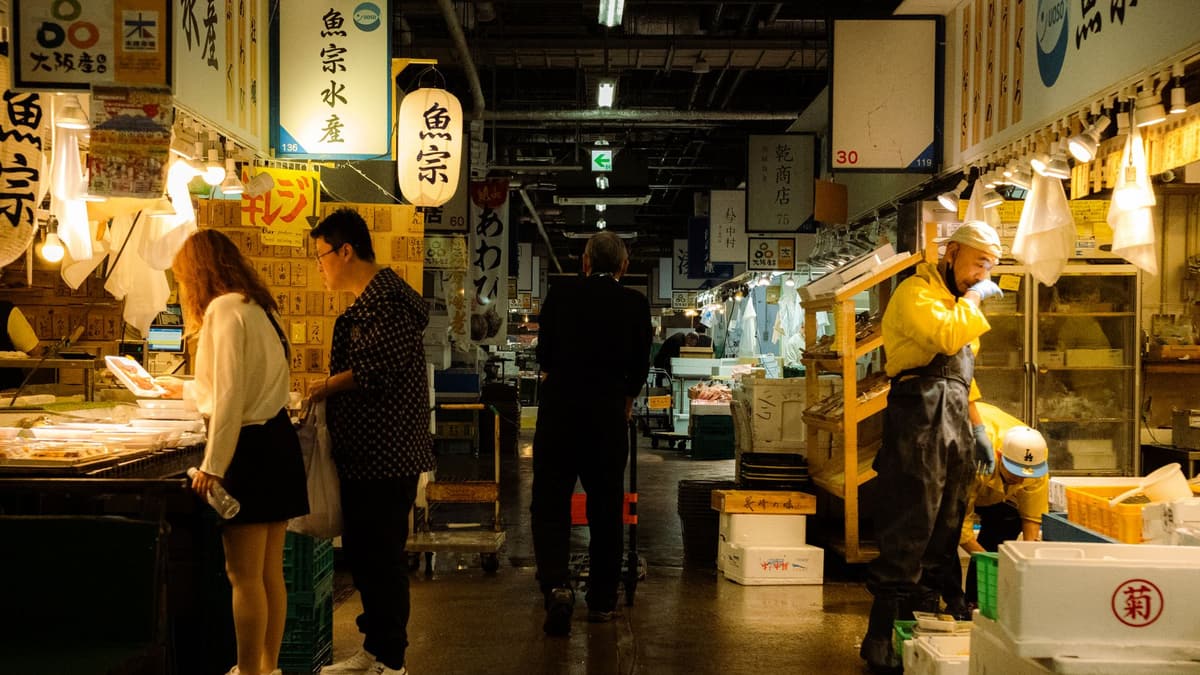
You're in Kuromon Market. Look along the market street.
O restante desta parada está no passeio em áudio completo.
You're at Imamiya Ebisu Shrine, in Naniwa Ward. Step through the gate and look around.
O restante desta parada está no passeio em áudio completo.
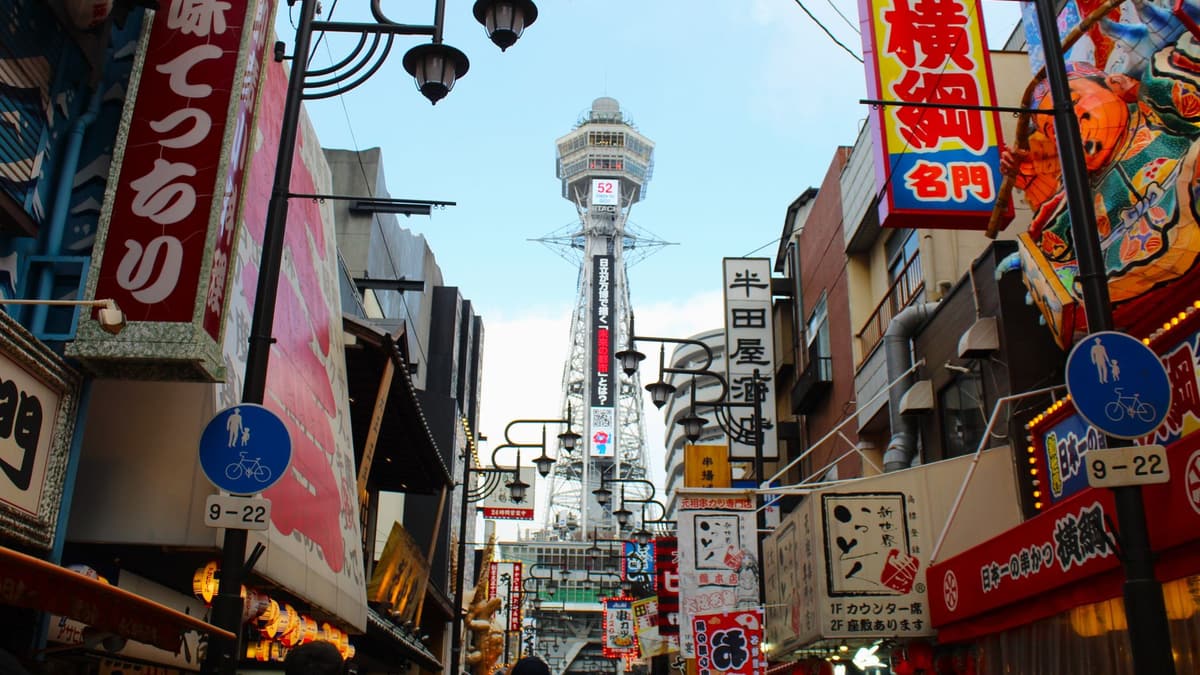
You're in Shinsekai, under the Tsutenkaku tower, outside the head shop of Kushikatsu Daruma. Look inside: it's a single counter with 12 seats.
O restante desta parada está no passeio em áudio completo.
Faça esta caminhada com outras pessoas no próximo passeio agendado.
Cerca de 3,5 km, aproximadamente 49 minutos em ritmo leve · 7 paradas
Os amigos caminham grátisOctober 11, 2026 · 9 min read
From the Hollandsche Schouwburg through the old Jewish Quarter, past the Dockworker and the Dam, to the Anne Frank House on the Prinsengracht.
October 11, 2026 · 11 min read
From Van Houten's street by the Vondelpark past Leidseplein, the Rijksmuseum passage and the famous canal bench to the Anne Frank House.

October 11, 2026 · 10 min read
Follow the last days of April and May 1945 from the Anhalter Bahnhof ruin past the Gestapo site and Brandenburg Gate to the Moltke Bridge and the Reichstag.
