
October 11, 2026 · 9 min read
Amsterdam Anne Frank Walking Tour
From the Hollandsche Schouwburg through the old Jewish Quarter, past the Dockworker and the Dam, to the Anne Frank House on the Prinsengracht.
589

October 9, 2026 · 10 min read

 Друзі гуляють безкоштовно
Кожен тур також доступний як запланована групова прогулянка, до якої можна приєднатися в додатку.
Більше аудіотурів у Heidelberg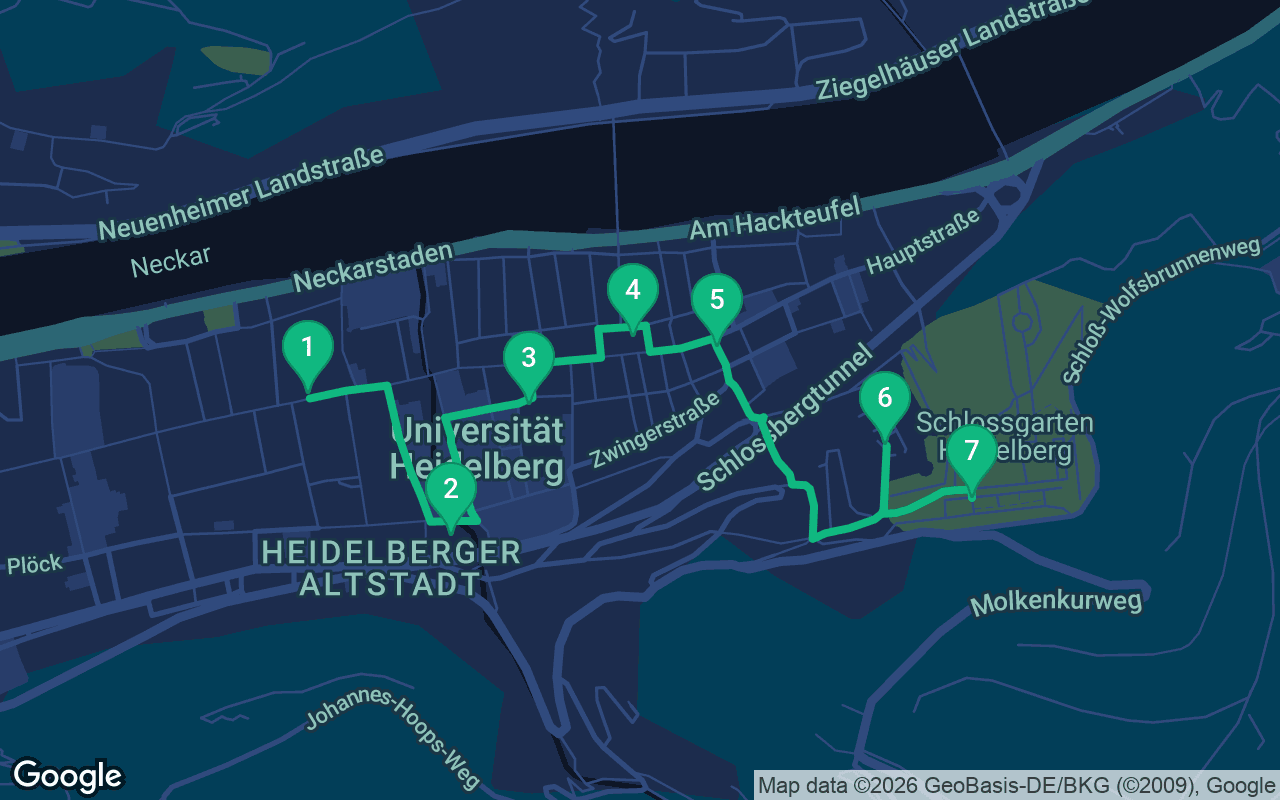
Приблизно 2 км, приблизно 32 хвилин у легкому темпі.
Цей тур озвучено
Натисніть відтворення на перших 3 зупинках, щоб послухати 30-секундний фрагмент розповіді. У додатку вступ і ці зупинки звучать повністю й безкоштовно, а про кожну з них вас сповістить звуковий сигнал, щойно ви прибудете. Весь тур із розповіддю буде вашим за $7.99, одноразова покупка назавжди.
Працює з Garmin, Komoot, Strava, OS Maps та будь-яким застосунком GPX.
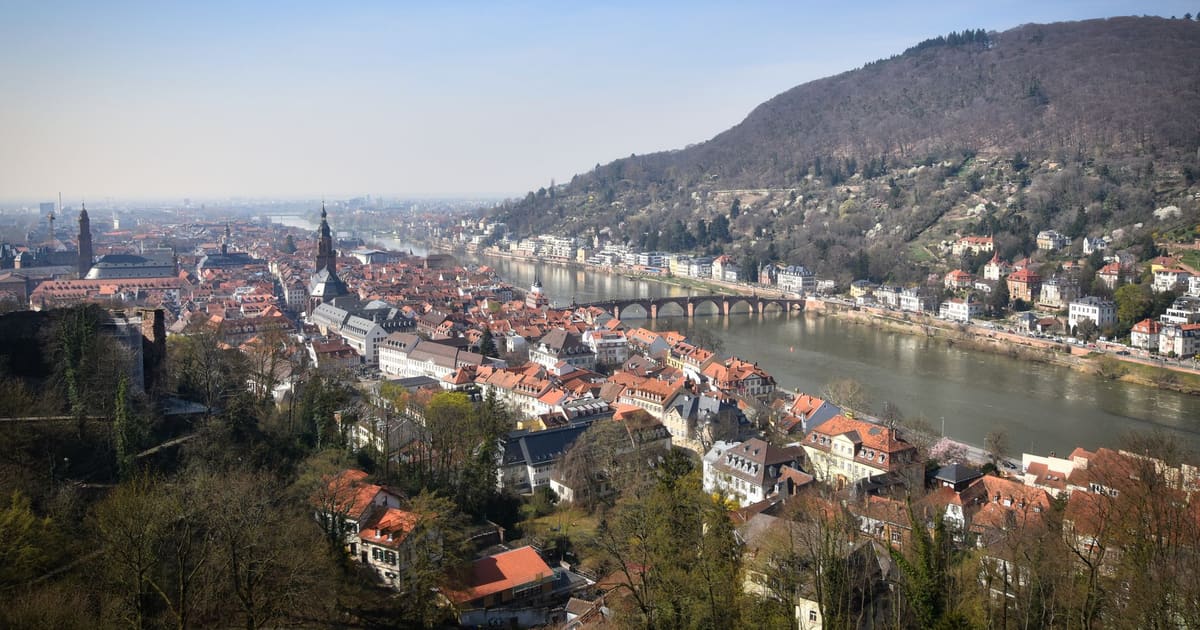
Heidelberg is a university town folded into a narrow valley, with the Neckar River on one side, wooded hills on the other, and a red sandstone castle hanging over the rooftops. This walk follows the long pedestrian street of the Altstadt, the old town, from the city museum past the oldest church in town, the student quarter and a bright Baroque church to the market square, then climbs to the castle and ends in the ruined terraces of its once famous garden. It is a little under two kilometers, about a mile and a quarter, with one serious climb near the end, and it makes one of the most rewarding self-guided walking tours in southern Germany.
Allow two to three hours, more if you go into the museum or spend time inside the castle grounds. The first two thirds of the walk are flat, on paved and cobbled lanes. Then it gets steep. The Burgweg, the lane from the Kornmarkt up to the castle, climbs some 80 meters in a short distance on rough cobbles, and on a warm day it will make you puff. Take it slowly, stop to look back at the view, and wear shoes with a good grip, especially after rain. If the climb is too much, a funicular railway, the Bergbahn, runs up to the castle from a station right on the Kornmarkt. The castle courtyard and the giant barrel need a ticket, and the funicular may be bundled with it, so check the current tickets and hours before you go. Mornings are quieter, before the coach groups arrive, and the late afternoon light turns the red stone a deep rose. The Hauptstrasse has little shade, but the castle garden has plenty.
You are standing on the Hauptstrasse, the main street of the old town, in front of a dignified Baroque palace set back behind a little courtyard. It was built in the early eighteenth century as the town house of a law professor, which tells you something about Heidelberg straight away: here the professors had the grand houses. Today it holds the Kurpfälzisches Museum, the museum of the Electoral Palatinate, the old state whose rulers lived in the castle you will reach at the end of the walk. Its most famous object is very small. In 1907 a workman in a sand pit at Mauer, a village a few miles southeast of here, dug up a human lower jaw. It turned out to be one of the oldest human fossils ever found in Europe, roughly 600,000 years old, and it gave its name to a whole early human species, Homo heidelbergensis. The original is kept by the university, and the museum shows a cast. Look out too for a carved altar of the twelve apostles by Tilman Riemenschneider, the great woodcarver of the late Middle Ages. Now walk east along the Hauptstrasse for about three minutes to University Square, then turn right down Grabengasse, with the big red sandstone University Library on your right. The church stands just beyond it, across the street called Plöck.
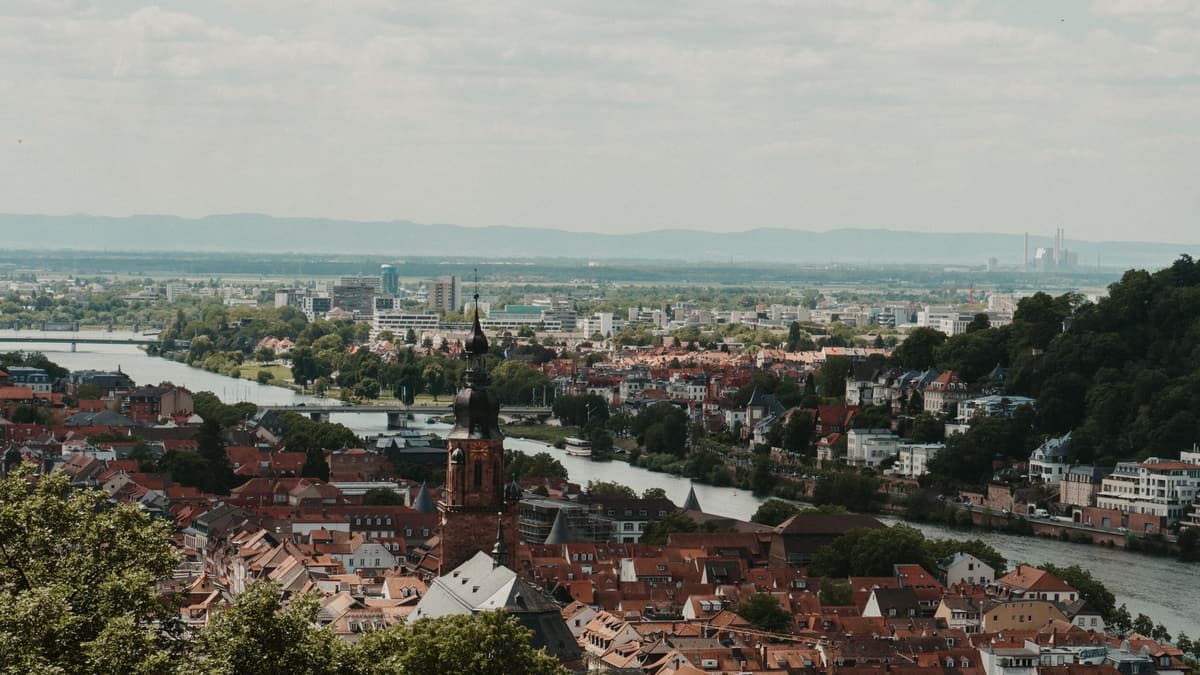 In front of you is the Peterskirche, St. Peter's Church, the oldest parish church in Heidelberg and the university's own church. A church stood here before the old town around it was laid out, though what you see is a late Gothic building heavily restored in the nineteenth century. Walk slowly around the outside and look at the walls. They are covered with stone memorial plaques, dozens of them, many for the professors and their families who were buried here over the centuries. The University of Heidelberg was founded in 1386 by the Elector Rupert I, which makes it the oldest university in today's Germany, and for a long time its teachers came to this church to worship and, in the end, to rest. One of the most touching memorials is to Olympia Fulvia Morata, an Italian scholar from Ferrara who wrote poetry and letters in Latin and Greek at a time when very few women were allowed an education. She fled to Germany for her Protestant faith, settled in Heidelberg with her husband, and died here in 1555, still in her twenties. Just behind you, the University Library keeps treasures like the Codex Manesse, a famous illuminated book of medieval love songs. Walk back north up Grabengasse to University Square, and at its far corner, beside the Old University, turn right into Augustinergasse. Follow it east for about three minutes.
On the way here you passed the door of the old Student Jail, the Studentenkarzer, at the start of Augustinergasse. For about a century, until 1914, the university had its own courts and its own lockup. Students caught drunk, brawling or disturbing the peace at night could be sentenced to days in these rooms, and many treated a stay as a badge of honor, covering every wall with graffiti, names and painted portraits that you can still see if you visit. Now look up at the tall, pale facade in front of you. This is the Jesuit Church, and it belongs to a very different chapter of the town's story. Heidelberg had been a stronghold of the Protestant Reformation, but in 1685 the throne of the Palatinate passed to a Catholic branch of the ruling family, and the new electors brought in the Jesuits to win the town back. Their church went up in the first half of the eighteenth century, with the tower only finished much later. Step inside if the doors are open. After the dark Gothic churches, the light is the surprise: a tall, airy hall of white and soft color, built to lift the spirits. From here walk north for a minute to the Hauptstrasse, turn right, and in about three minutes you reach the market square.
Що входить
Наші екскурсії задумані медитативними та захопливими: ви рухаєтеся й просто слухаєте. Разом завжди краще, і додаток відтворює розповідь синхронно, тож ви, ваш партнер і ваші друзі чуєте кожну зупинку одночасно.
You are on the Marktplatz, the market square, with the Town Hall at the far end and the Church of the Holy Spirit, the Heiliggeistkirche, filling the middle.
Продовження цієї зупинки є в повній аудіоекскурсії.
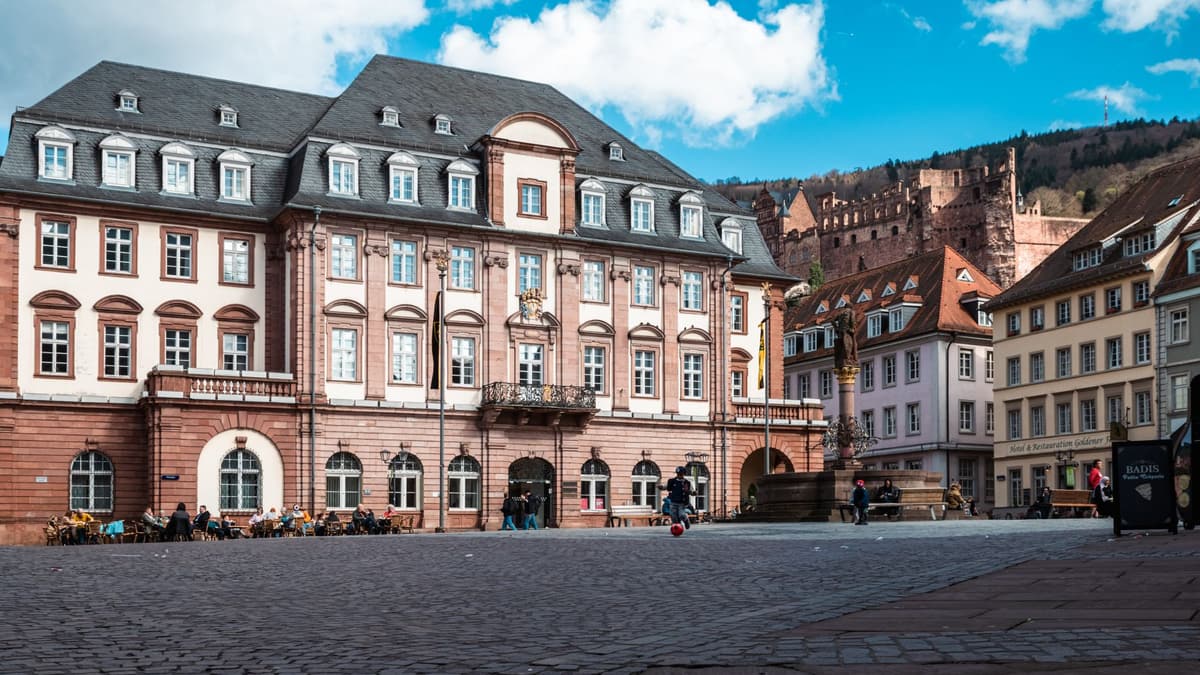
This small sloping square was once the grain market, and it gives you the best view in the old town. Stand near the Madonna on her tall column and look up.
Продовження цієї зупинки є в повній аудіоекскурсії.
Catch your breath and look around. For centuries this was the home of the Electors Palatine, among the most powerful princes of the Holy Roman Empire, and each of them added a palace wing in the style of his day.
Продовження цієї зупинки є в повній аудіоекскурсії.
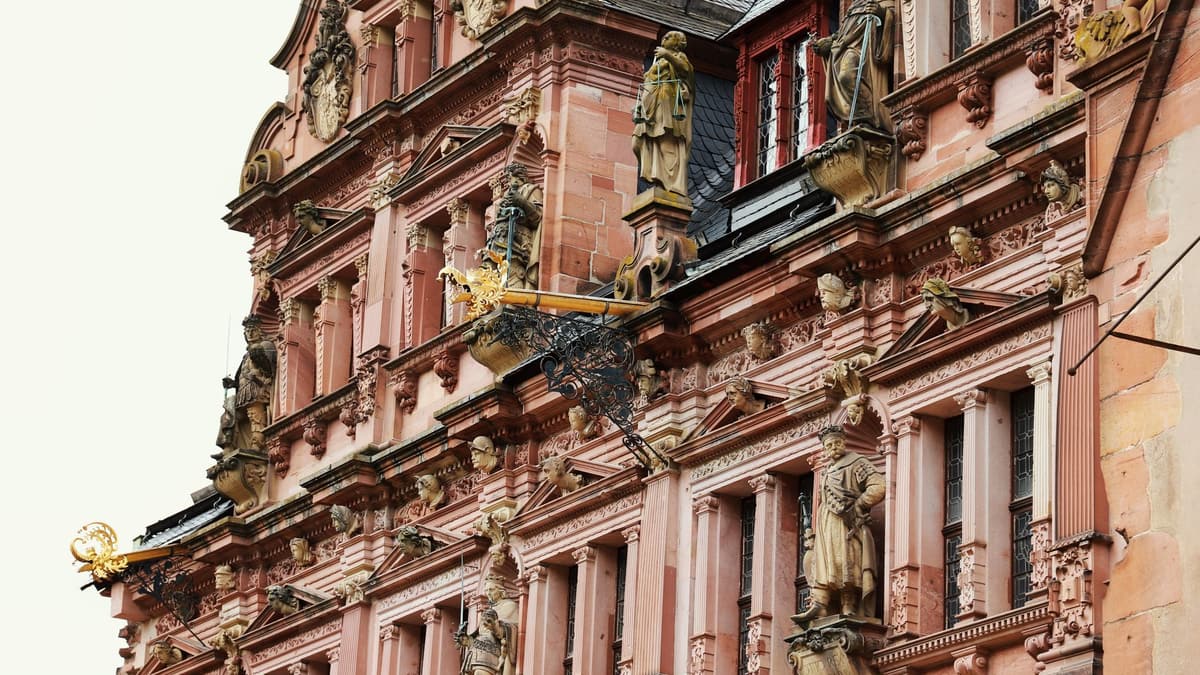
You end in the Hortus Palatinus, the Palatine Garden, or what remains of it. Stand on one of the broad terraces and imagine it four hundred years ago.
Продовження цієї зупинки є в повній аудіоекскурсії.
Зробіть цю прогулянку разом з іншими людьми на наступному запланованому турі.
Приблизно 2 км, приблизно 32 хвилин у легкому темпі · 7 зупинок
Друзі гуляють безкоштовноOctober 11, 2026 · 9 min read
From the Hollandsche Schouwburg through the old Jewish Quarter, past the Dockworker and the Dam, to the Anne Frank House on the Prinsengracht.
October 11, 2026 · 11 min read
From Van Houten's street by the Vondelpark past Leidseplein, the Rijksmuseum passage and the famous canal bench to the Anne Frank House.

October 11, 2026 · 10 min read
Follow the last days of April and May 1945 from the Anhalter Bahnhof ruin past the Gestapo site and Brandenburg Gate to the Moltke Bridge and the Reichstag.
