
October 11, 2026 · 9 min read
Amsterdam Anne Frank Walking Tour
From the Hollandsche Schouwburg through the old Jewish Quarter, past the Dockworker and the Dam, to the Anne Frank House on the Prinsengracht.
589

October 8, 2026 · 13 min read

 Друзья гуляют бесплатно
Каждую экскурсию можно пройти в составе запланированной группы, к которой легко присоединиться в приложении.
Ещё аудиоэкскурсии в Philadelphia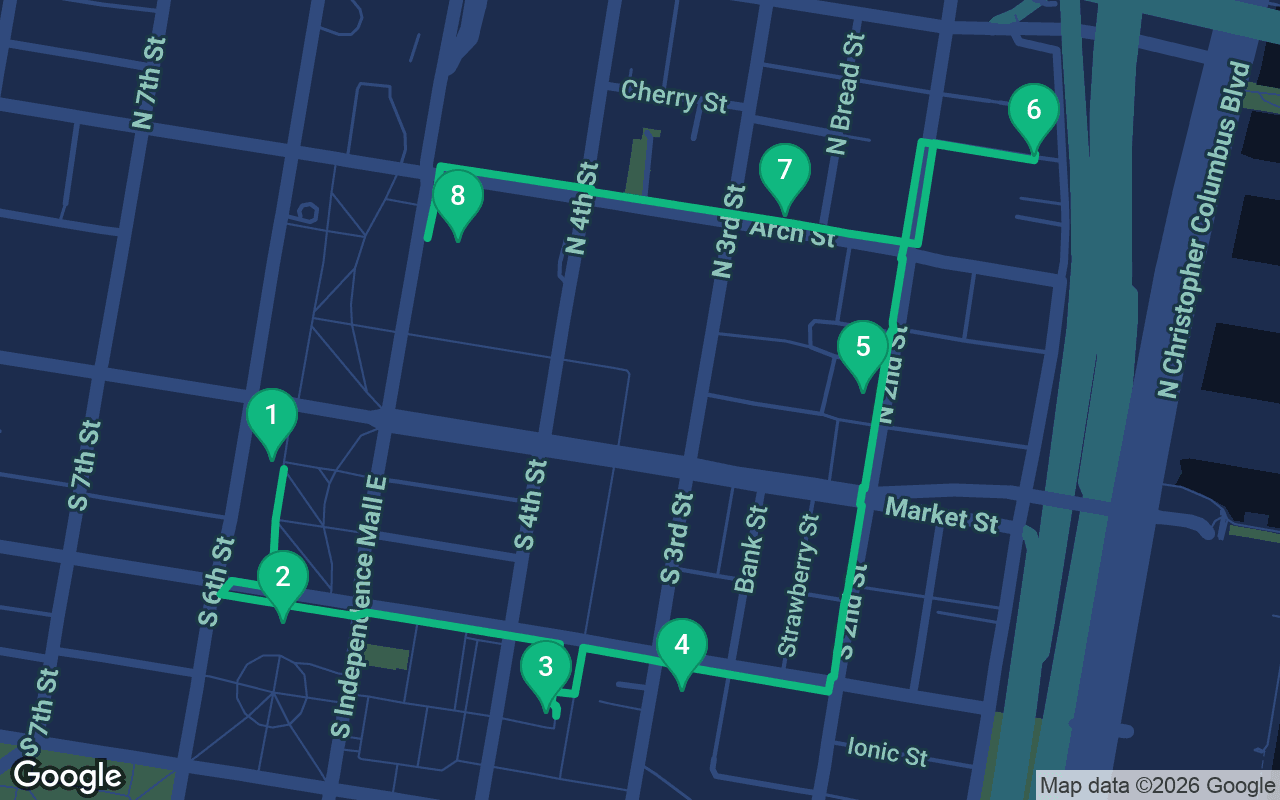
Примерно 2,2 км, около 31 минут в спокойном темпе.
Эта экскурсия озвучена
Нажмите «Воспроизвести» на первых 3 остановках, чтобы послушать 30-секундный фрагмент озвучки. В приложении вступление и эти остановки звучат полностью и бесплатно, а о каждой из них вас оповестит звуковой сигнал, когда вы до неё дойдёте. Вся экскурсия будет вашей за $7.99, это разовая покупка навсегда.
Совместимо с Garmin, Komoot, Strava, OS Maps и любыми приложениями для GPX.
Philadelphia was the capital of the Revolution, and nearly every founding moment of the United States happened within a few blocks of where this walk begins. You start at the Liberty Bell, cross to Independence Hall, then follow Chestnut Street east past the hall of the First Continental Congress and the Museum of the American Revolution. From there you turn north into Old City, the oldest part of town, for the church of the founders, the oldest lived-in street in the country and the Betsy Ross House, and you finish at the grave of Benjamin Franklin. The whole line is a little over two kilometers, under a mile and a half, and flat as a table, which makes it one of the easiest and richest self-guided walking tours in America. It is a walk about big documents and small lives, statesmen in the Assembly Room and craftsmen in narrow brick houses, and the way the two were tangled together in the same few streets.
The walking takes only about half an hour, but give yourself three hours or more if you want to go inside the main sights. The route is flat, with brick sidewalks and some cobbles in Old City, so any comfortable shoes will do. The Liberty Bell is usually free to see, with airport style security at the door and a line that grows through the day. Independence Hall is seen on a guided visit that often needs a timed ticket in the busier months, and the Museum of the American Revolution, the Betsy Ross House and the inside of Christ Church Burial Ground have their own hours and admission, so check before you go and plan the morning around any times you book. Arrive early to beat the crowds at the bell. Philadelphia summers are hot and humid and the open lawns of Independence Mall have little shade, while the narrow streets of Old City are kinder in the heat. In winter the wind cuts across the mall, so bring a warm layer. Elfreth's Alley is a street of private homes, so visit it quietly.
Inside the long glass pavilion hangs the Liberty Bell, and if you stand at the right angle you can see the tower of Independence Hall through the window behind it, where the bell once hung. It was ordered from a foundry in London in 1751 for the Pennsylvania State House, and it cracked the first time it was rung after arriving. Two local metalworkers, John Pass and John Stow, melted it down and recast it, twice, and their names are on it. Read the words around the crown: Proclaim Liberty throughout all the Land unto all the Inhabitants thereof, a line from the Book of Leviticus. You might notice that Pennsylvania is spelled with one n, a spelling that was still in use at the time. Nobody in 1776 called it the Liberty Bell. That name came in the 1830s from abolitionists, who read the inscription as a demand to end slavery and made the bell their symbol. Later it became an emblem for suffragists, civil rights marchers and freedom movements around the world. The famous crack is partly a repair: a thin fracture was drilled out in an attempt to fix it, and then in the 1840s, after a ringing for Washington's birthday, it split further and the bell fell silent for good. In the decades around 1900 it traveled the country by train for exhibitions before coming home to stay. Leave by the far end of the pavilion, cross Chestnut Street at the crosswalk, and walk up to the red brick building with the white steeple, about two minutes away.
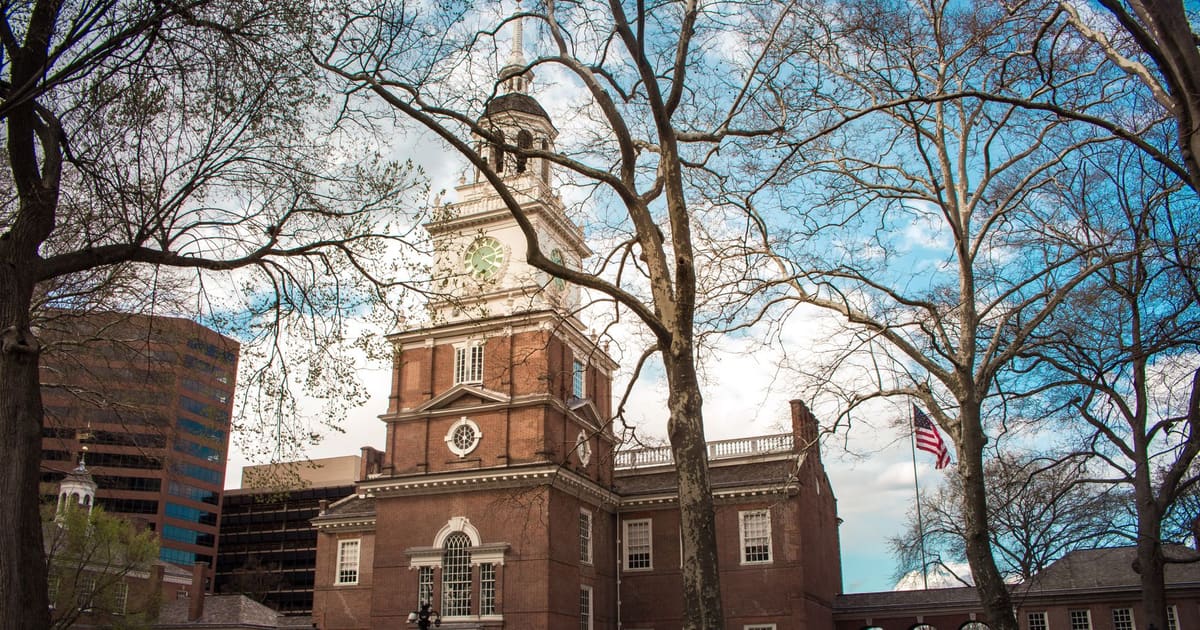
In front of you stands Independence Hall, built between 1732 and 1753 as the Pennsylvania State House, the seat of the colony's assembly. It is a modest building for what happened inside it. In the Assembly Room on the ground floor, the Second Continental Congress named George Washington commander of the army in 1775, voted for independence on July 2, 1776, and approved the Declaration of Independence two days later. On July 8 the Declaration was read aloud to the public for the first time in the yard behind the building. Eleven years later, in the summer of 1787, delegates gathered in the same room behind closed doors and shuttered windows and wrote the Constitution. Washington presided from a tall carved chair with a half sun on its back, and the chair is still there. As the last delegates signed, James Madison's notes record Benjamin Franklin remarking that he had often looked at that sun during the sessions without being able to tell whether it was rising or setting, and that now he knew it was rising. The building on your right as you face the hall is Congress Hall, where the national Congress met in the 1790s, when Philadelphia was briefly the capital, and the one on your left housed the early Supreme Court. Today the whole complex is a World Heritage Site. When you are ready, walk east along Chestnut Street, crossing Fifth and Fourth streets, past the marble temple front of the Second Bank of the United States on your right. Just before Third Street, a short brick lane on the right leads to a small hall at its end, about four minutes away.
 At the end of the lane sits Carpenters' Hall, a small, beautifully proportioned brick building in the shape of a cross, with a white cupola on top. It was built in the early 1770s by the Carpenters' Company of Philadelphia, a guild of master builders founded in 1724, and remarkably the company still owns and runs it. In September 1774, delegates from twelve of the thirteen colonies met here as the First Continental Congress to decide how to respond to Britain's punishment of Boston after the Tea Party. They had been offered the State House, but they chose this hall instead, partly as a quiet snub to the conservative leaders of the Pennsylvania assembly who met there. Inside these walls the delegates agreed to boycott British goods and to meet again the following spring, which is how the Second Congress, and everything that followed it, came about. John Adams recorded Patrick Henry telling the room that the old distinctions between Virginians and New Englanders were gone, and that he was not a Virginian but an American. The hall had a colorful later life too. In 1798 a bank renting space here was robbed of a huge sum, in one of the first bank robberies in the country, and an innocent blacksmith who had worked on its locks was thrown in jail before the real thief was caught. Entry is usually free, but check before you go. Walk back out to Chestnut Street, turn right, and continue to the corner of Third Street. The museum is the large brick and stone building just across Third, about two minutes away.
Что входит
Наши экскурсии задуманы как медитативные и захватывающие: вы идёте и просто слушаете. Вместе всегда лучше, и приложение воспроизводит озвучку синхронно, так что вы, ваш партнёр и ваши друзья слышите каждую остановку одновременно.
The Museum of the American Revolution opened in 2017 on the anniversary of the first battles at Lexington and Concord, and it tells the whole story of the war, from the first protests to the peace.
Продолжение этой остановки есть в полной аудиоэкскурсии.
Look up at the tall white steeple of Christ Church, one of the finest Georgian churches in the country. The congregation was founded in 1695 as part of the Church of England, and the present building went up between the 1720s and 1740s.
Продолжение этой остановки есть в полной аудиоэкскурсии.
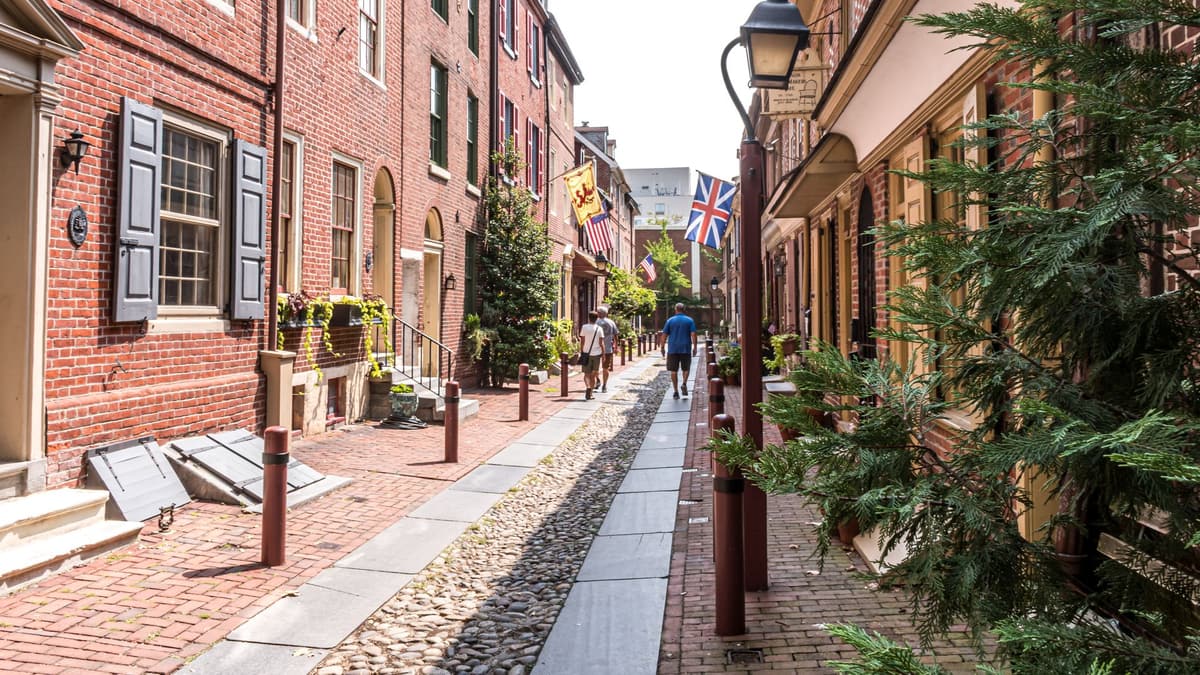
Step into Elfreth's Alley and the city goes quiet. This narrow cobbled lane was opened around 1702, and people have been living along it ever since, which makes it the oldest continuously inhabited residential street in the United States.
Продолжение этой остановки есть в полной аудиоэкскурсии.
This small brick house, with its steep roof and tiny windows, belongs to one of the best loved stories in America, and one of the hardest to prove. Elizabeth Griscom grew up in a Quaker family and learned the upholstery trade.
Продолжение этой остановки есть в полной аудиоэкскурсии.
At the corner of Fifth and Arch, part of the old brick wall of Christ Church Burial Ground has been replaced with iron railings, so you can see the most visited grave in Philadelphia straight from the sidewalk.
Продолжение этой остановки есть в полной аудиоэкскурсии.
Пройдите этот маршрут вместе с другими во время следующей запланированной прогулки.
Около 2,2 км, примерно 31 мин в спокойном темпе · 8 остановок
Друзья гуляют бесплатноOctober 11, 2026 · 9 min read
From the Hollandsche Schouwburg through the old Jewish Quarter, past the Dockworker and the Dam, to the Anne Frank House on the Prinsengracht.
October 11, 2026 · 11 min read
From Van Houten's street by the Vondelpark past Leidseplein, the Rijksmuseum passage and the famous canal bench to the Anne Frank House.

October 11, 2026 · 10 min read
Follow the last days of April and May 1945 from the Anhalter Bahnhof ruin past the Gestapo site and Brandenburg Gate to the Moltke Bridge and the Reichstag.
