
October 11, 2026 · 9 min read
Amsterdam Anne Frank Walking Tour
From the Hollandsche Schouwburg through the old Jewish Quarter, past the Dockworker and the Dam, to the Anne Frank House on the Prinsengracht.
589

October 9, 2026 · 13 min read

 Arkadaşlar ücretsiz yürür
Her tur aynı zamanda uygulamada katılabileceğiniz planlı bir grup yürüyüşü olarak da gerçekleştirilir.
Dublin'de daha fazla sesli tur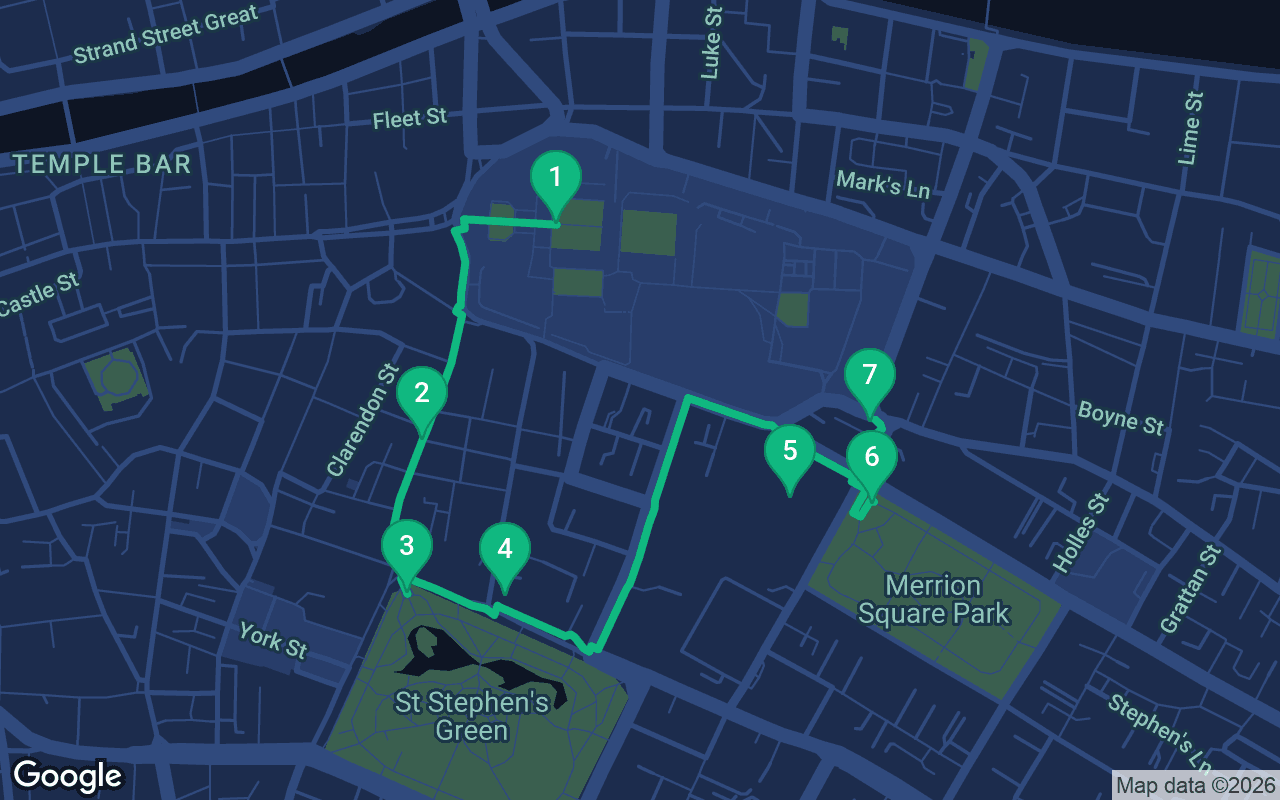
Yaklaşık 2,1 km, rahat bir tempoyla aşağı yukarı 30 dakika.
Bu tur sesli anlatımlıdır
Anlatımdan 30 saniyelik bir demo dinlemek için ilk 3 durakta oynat düğmesine basın. Uygulamada giriş bölümü ve bu 3 durak baştan sona ücretsizdir ve her birine vardığınızda sesli bir uyarı çalar. Tüm sesli tur, kalıcı olarak sahip olacağınız tek seferlik bir satın alma ile $7.99 karşılığında sizin olur.
Garmin, Komoot, Strava, OS Maps ve tüm GPX uygulamalarıyla çalışır.
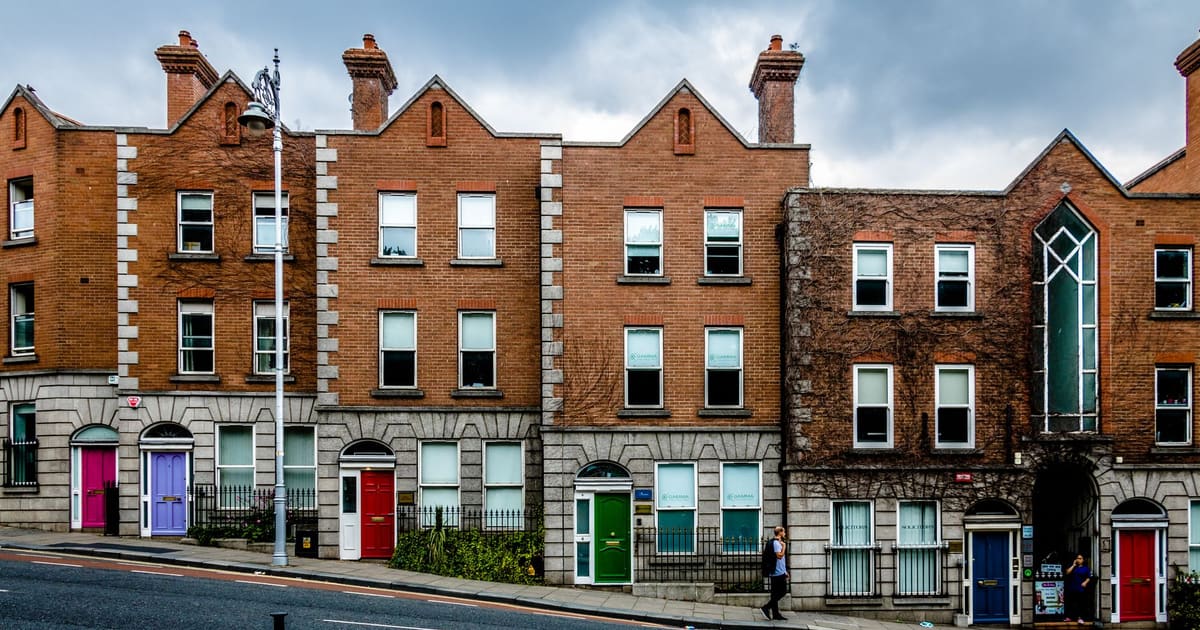
In the eighteenth century Dublin was one of the largest cities in Europe, with its own parliament and a building boom to match, and the elegant southeast of the city is what that boom left behind. This walk starts inside the cobbled squares of Trinity College, climbs Grafton Street to St Stephen's Green, and then heads east into the Georgian squares of brick houses, tall windows and painted front doors. It finishes at a small Victorian pharmacy that James Joyce wrote into Ulysses, a few steps from Pearse Station. It is about two kilometers, flat the whole way, shares no stops with the Medieval City walk, and is one of the most relaxed self-guided walking tours you can do in Dublin.
Allow about an hour and a half at a stroll, and much longer if you go into the museums. The Book of Kells at Trinity is very popular and sold by timed ticket, so book ahead, and the Little Museum of Dublin is seen on guided visits that can fill up, so check before you go. The National Gallery's permanent collection has long been free to enter, though special exhibitions may charge. Sweny's Pharmacy is run by volunteers and keeps its own hours. The route is flat and paved, with one gentle rise up Grafton Street. Grafton Street is at its busiest on Saturday afternoons and in the run up to Christmas, so mornings are easier. Dublin rain arrives without much warning, but the gallery and the museums make good shelter. The parks close their gates at dusk, at times that change with the seasons. There are plenty of cafes along the way, and a picnic on the grass in St Stephen's Green or Merrion Square is a fine way to break the walk.
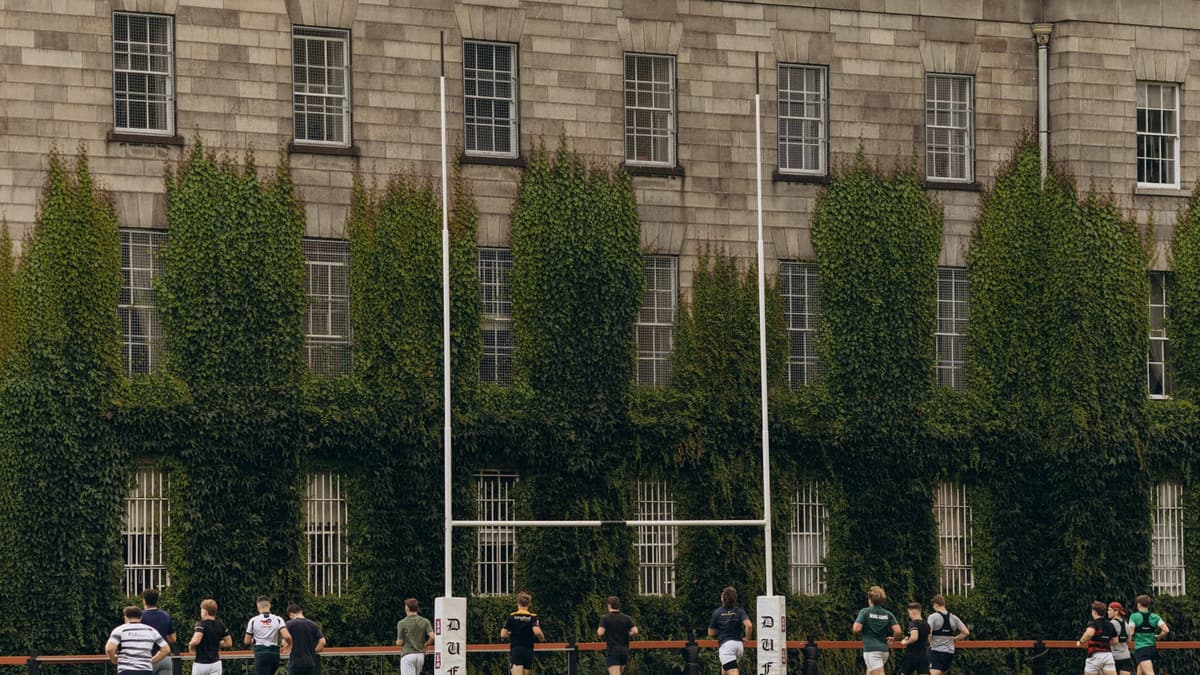
Stand in the cobbled square inside Trinity College, with the tall bell tower, the Campanile, in front of you. Students have a superstition that if you walk under it while the bell rings, you will fail your exams, so many of them walk around. Queen Elizabeth I granted the college its charter in 1592, on the grounds of a monastery that had been closed down, and for most of its history it was a Protestant institution at the heart of the ruling class. Catholics were admitted from 1793, but for much of the twentieth century the Catholic bishops forbade their flock to attend without permission, a ban lifted only in 1970. Women were admitted in 1904. To your right, as you face the Campanile, is the Old Library, finished in the 1730s, whose Long Room is one of the great library interiors of the world. Its prize is the Book of Kells, the four gospels written and painted by monks around the year 800, full of spiraling animals and knotwork so fine you need a magnifying glass. It takes its name from the monastery at Kells, where it was kept for centuries, and it came to Trinity in the 1660s. When you leave through the Front Gate onto College Green, look across the road at the great curved building without windows. That was the Irish Parliament House, where the Protestant parliament of the Georgian boom sat until the Act of Union abolished it at the start of 1801 and Ireland was governed from London. The Bank of Ireland bought it soon after. Turn left past the statues of Edmund Burke and Oliver Goldsmith at the gate, cross toward the bottom of Grafton Street, and walk up it a short way. About six minutes.
 You are on Grafton Street, Dublin's best known shopping street, a gentle slope of shopfronts between Trinity and St Stephen's Green. It was laid out in the early eighteenth century and named for the Dukes of Grafton, a family descended from King Charles II, and it has been closed to traffic since the 1980s. Down at the bottom, by St Andrew's Church on Suffolk Street, you may have passed the bronze of Molly Malone with her cart, the heroine of the city's unofficial anthem, though there is no good evidence she ever lived. Look for Bewley's Cafe, with its mosaic front. It has served coffee here since 1927, and its stained glass windows are by Harry Clarke, the finest Irish artist in glass of his time. The real music of Grafton Street is the busking. On almost any day you will hear singers, string players and whole bands every few meters. Glen Hansard busked here as a teenager, and his film Once opens on this street. On Christmas Eve, famous Irish musicians often join him for a charity busk that draws a big crowd. Just off the street, on Harry Street to your right as you face the Green, a statue of Phil Lynott of Thin Lizzy leans against the wall with his bass guitar. Take your time and stop for a song or two. Then carry on up the slope to the top of Grafton Street, about three minutes, where a stone arch marks the corner of St Stephen's Green.
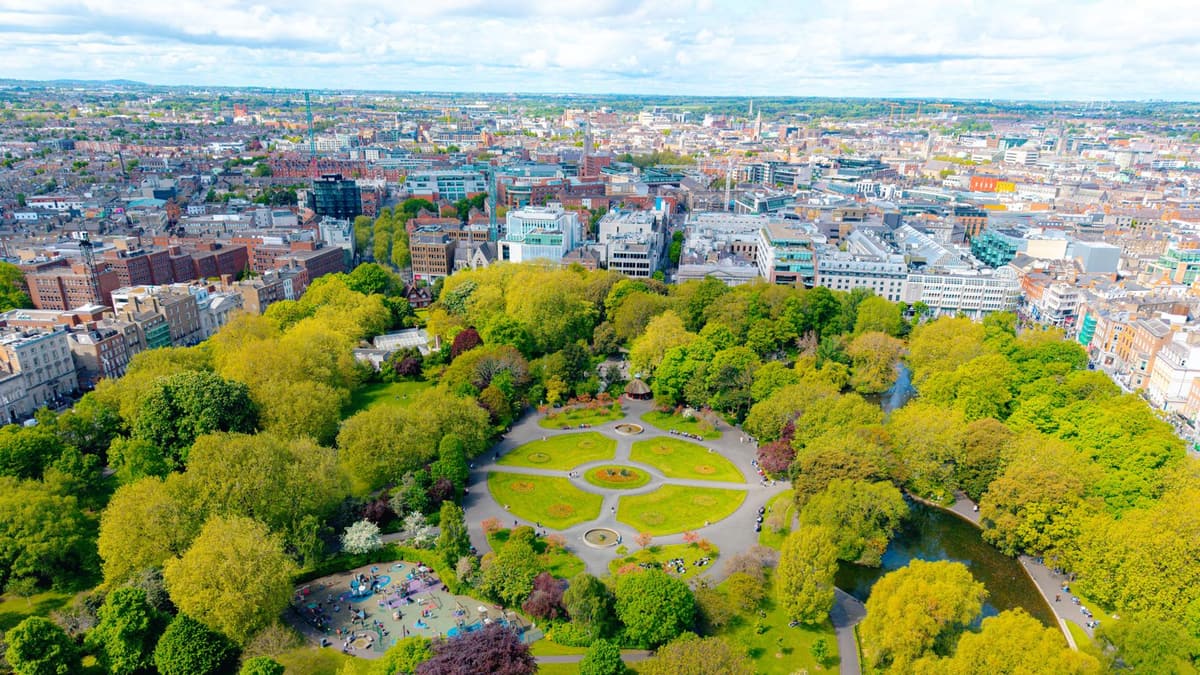
Stand in front of the stone arch at the corner of the Green. This is Fusiliers' Arch, raised in 1907 to remember the soldiers of the Royal Dublin Fusiliers who died in the Boer War in South Africa, and their names are carved on the underside. Nationalists at the time called it Traitors' Gate. Look closely at the stonework and you will see small pockmarks, usually said to be bullet strikes from Easter 1916. On Easter Monday that year, members of the Irish Citizen Army under Michael Mallin, with Countess Constance Markievicz as his second in command, took over the Green and dug trenches in it. It was a poor place to hold. Soldiers set up a machine gun in the Shelbourne Hotel, overlooking the park from the north side, and the rebels withdrew to the Royal College of Surgeons on the west side, where they held out until the surrender. The story goes that both sides held their fire each day so the park keeper could feed the ducks. Civilians were killed in the crossfire around the city, and the Rising was not popular at first, but the executions of its leaders that followed turned many people toward the rebels' cause. Mallin was among those shot. Markievicz was spared, and in 1918 she became the first woman elected to the British House of Commons, a seat she refused to take. Walk in through the arch. The Green was common land until the city enclosed it in the 1660s, and it later became a private garden for the people living around it. It was Arthur Edward Guinness, Lord Ardilaun, of the brewing family, who paid to landscape it and open it to everyone in 1880. In the northeast corner, a group of gaunt bronze figures remembers the Famine of the 1840s, when about a million people died and as many again emigrated. On the south side, a bust of James Joyce faces the building where he studied. When you are ready, come back out through the arch and turn right along the north side of the Green. The Little Museum is a two minute walk along.
Neler dahil
Turlarımız meditatif ve sürükleyici olacak şekilde tasarlandı: yürürsünüz ve sadece dinlersiniz. Birlikte her zaman daha güzeldir; uygulama anlatımı senkronize çalar, böylece siz, partneriniz ve arkadaşlarınız her durağı aynı anda duyarsınız.
Stop outside the Little Museum of Dublin and take a good look at the house itself, because it is a fine example of what this walk is about.
Bu durağın devamı tam sesli turda.
You have reached the National Gallery of Ireland, which opened in 1864. Outside the older wing on Merrion Square stands a statue of William Dargan, the railway builder who paid for the great industrial exhibition held on the lawn next door in 1853, which led…
Bu durağın devamı tam sesli turda.
Here is Oscar Wilde, sprawled on a boulder in a green smoking jacket with a pink collar, made of colored stones by the sculptor Danny Osborne in 1997. He is looking across the road at Number 1 Merrion Square, the corner house where he grew…
Bu durağın devamı tam sesli turda.
The little shop in front of you, with its old wooden shopfront, is Sweny's Pharmacy, and it is famous because of a bar of soap.
Bu durağın devamı tam sesli turda.
Bir sonraki planlı turda bu yürüyüşü diğer insanlarla birlikte yapın.
Kolay tempoda yaklaşık 2,1 km, tahminen 30 dakika · 7 durak
Arkadaşlar ücretsiz yürürOctober 11, 2026 · 9 min read
From the Hollandsche Schouwburg through the old Jewish Quarter, past the Dockworker and the Dam, to the Anne Frank House on the Prinsengracht.
October 11, 2026 · 11 min read
From Van Houten's street by the Vondelpark past Leidseplein, the Rijksmuseum passage and the famous canal bench to the Anne Frank House.

October 11, 2026 · 10 min read
Follow the last days of April and May 1945 from the Anhalter Bahnhof ruin past the Gestapo site and Brandenburg Gate to the Moltke Bridge and the Reichstag.
