
October 11, 2026 · 9 min read
Amsterdam Anne Frank Walking Tour
From the Hollandsche Schouwburg through the old Jewish Quarter, past the Dockworker and the Dam, to the Anne Frank House on the Prinsengracht.
589

October 9, 2026 · 13 min read

 Arkadaşlar ücretsiz yürür
Her tur aynı zamanda uygulamada katılabileceğiniz planlı bir grup yürüyüşü olarak da gerçekleştirilir.
Krakow'de daha fazla sesli tur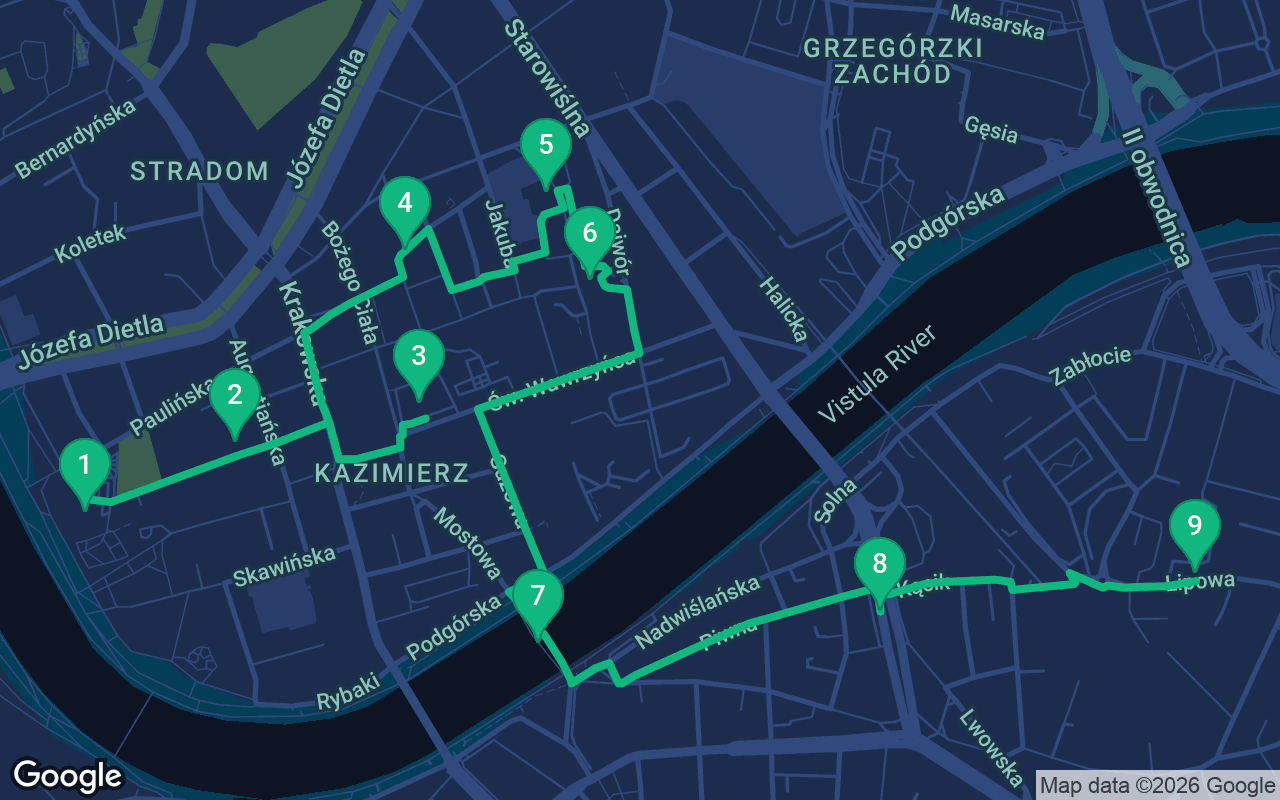
Yaklaşık 3,9 km, rahat bir tempoyla aşağı yukarı 53 dakika.
Bu tur sesli anlatımlıdır
Anlatımdan 30 saniyelik bir demo dinlemek için ilk 3 durakta oynat düğmesine basın. Uygulamada giriş bölümü ve bu 3 durak baştan sona ücretsizdir ve her birine vardığınızda sesli bir uyarı çalar. Tüm sesli tur, kalıcı olarak sahip olacağınız tek seferlik bir satın alma ile $9.99 karşılığında sizin olur.
Garmin, Komoot, Strava, OS Maps ve tüm GPX uygulamalarıyla çalışır.
South of Krakow's old town, along a bend of the Vistula, lies Kazimierz, for centuries a town of its own where Christians and Jews lived side by side. This walk begins at Skałka, the riverside church of a martyred bishop, passes the great Gothic churches of Christian Kazimierz and the lively Plac Nowy, then enters the old Jewish town with its synagogues and ancient cemetery. From there it crosses the river into Podgórze, where the German occupiers forced Krakow's Jews into a ghetto in 1941, and ends at Oskar Schindler's factory. It is about 3.9 kilometers, under two and a half miles, and it tells the story of a thriving community, its destruction, and its quiet return. Of all the self-guided walking tours in Krakow, this is the one that stays with people longest.
The walking takes under an hour, but plan for half a day, and a full one if you want to go inside the synagogues and the factory museum. The route is flat, on pavements and some cobbles, with one easy footbridge over the river. Morning is the gentlest time for Kazimierz, before the cafes fill, and it leaves the afternoon for the museum at the end. Summers can be hot and there is little shade in Podgórze, so carry water; in winter the wind along the river bites, so bring a warm layer. Several of the places on this walk have their own entry rules and tickets. The synagogues close for the Sabbath, from Friday evening to Saturday evening, and on Jewish holidays, and men are asked to cover their heads, with skullcaps usually provided. The churches are places of worship, so dress modestly and keep quiet during services. The factory museum often sells out in busy months, so book ahead, and check before you go for all of them. Above all, this is a walk through places of mourning as well as everyday life. Move gently, and keep the selfies for the cafes.
Stand in the courtyard in front of the white Baroque church with its twin towers, on a low rise above the Vistula. Skałka means "little rock," and this is one of the most sacred places in Poland. Here, according to tradition, Bishop Stanislaus of Krakow was killed in 1079 on the orders of King Boleslaus the Bold, after a bitter quarrel between the two whose causes historians still debate. The bishop was later made a saint and became a patron of Poland, and every spring a great procession comes here from Wawel Castle in his honor. Look at the pond in the courtyard, with the statue of the saint rising from it on a column. Legend says the king's men cut the bishop's body to pieces and threw it into this water, where the pieces miraculously came together again, and its water is still said to heal. The church belongs to the Pauline Fathers, and beneath it is the Crypt of the Distinguished, the resting place of some of Poland's great writers and artists: the medieval chronicler Jan Długosz, the painter and playwright Stanisław Wyspiański, the painter Jacek Malczewski, the composer Karol Szymanowski and the Nobel Prize winning poet Czesław Miłosz. To continue, walk east along Skałeczna street, away from the river. St. Catherine's is on your left in about three minutes.
Look up at the long brick church on the corner. Its roof is so tall and steep that it seems to belong to a much bigger city. St. Catherine's was founded in the fourteenth century by King Casimir the Great, the same king who gave Kazimierz its name and its town charter in 1335, and it was handed to the Augustinian friars, who still serve it. Kazimierz was then a separate town with its own walls, market square and town hall, and this was meant to be its great church. Over the centuries it suffered badly. An earthquake in 1443 damaged it, and fires and floods followed. Look along the side wall facing the street for its richly carved Gothic porch. If the doors are open, step in. The interior is high and spare, with soaring windows and very little clutter, and it feels less like a parish church than a vast, calm hall of light. The acoustics make it a favorite place for concerts. Walk on east along Skałeczna to Krakowska street, cross it, and go into Plac Wolnica, the old market square of Christian Kazimierz, with its former town hall in the middle. The big church on the far corner is Corpus Christi. About five minutes.
 You are now at the great church of Christian Kazimierz, its tall brick tower topped with a Baroque cap. Casimir the Great founded it soon after he founded the town, and it took most of the next century to build. The square beside it, Plac Wolnica, was the town's market, and its old town hall, now an ethnographic museum, is a reminder of how big and independent Kazimierz once was. Kazimierz stayed a separate town until 1800, when it was absorbed into Krakow. Step inside the church and the medieval brick shell gives way to a feast of Baroque gold: a towering high altar, carved choir stalls, and the detail everyone remembers, a pulpit shaped like a boat, a nod to the old image of the Church as a ship carrying the faithful. Look for the tomb of Saint Stanislaus Kazimierczyk, a canon of this church in the fifteenth century who was known for his care of the poor and was declared a saint in 2010. The church is run by canons who have served here for six centuries, and it is still very much a working parish. When you leave, walk north along Bożego Ciała, the street named after the church, for three or four minutes. It brings you out at Plac Nowy, with a round brick building in its middle.
Neler dahil
Turlarımız meditatif ve sürükleyici olacak şekilde tasarlandı: yürürsünüz ve sadece dinlersiniz. Birlikte her zaman daha güzeldir; uygulama anlatımı senkronize çalar, böylece siz, partneriniz ve arkadaşlarınız her durağı aynı anda duyarsınız.
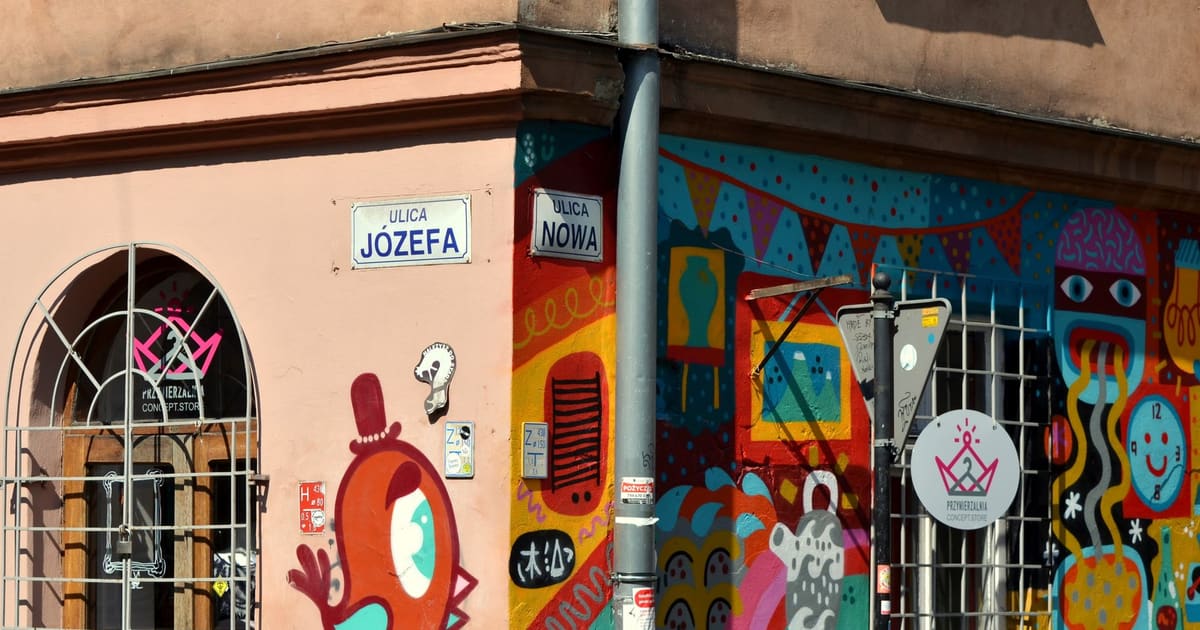
Welcome to the beating heart of modern Kazimierz.
Bu durağın devamı tam sesli turda.
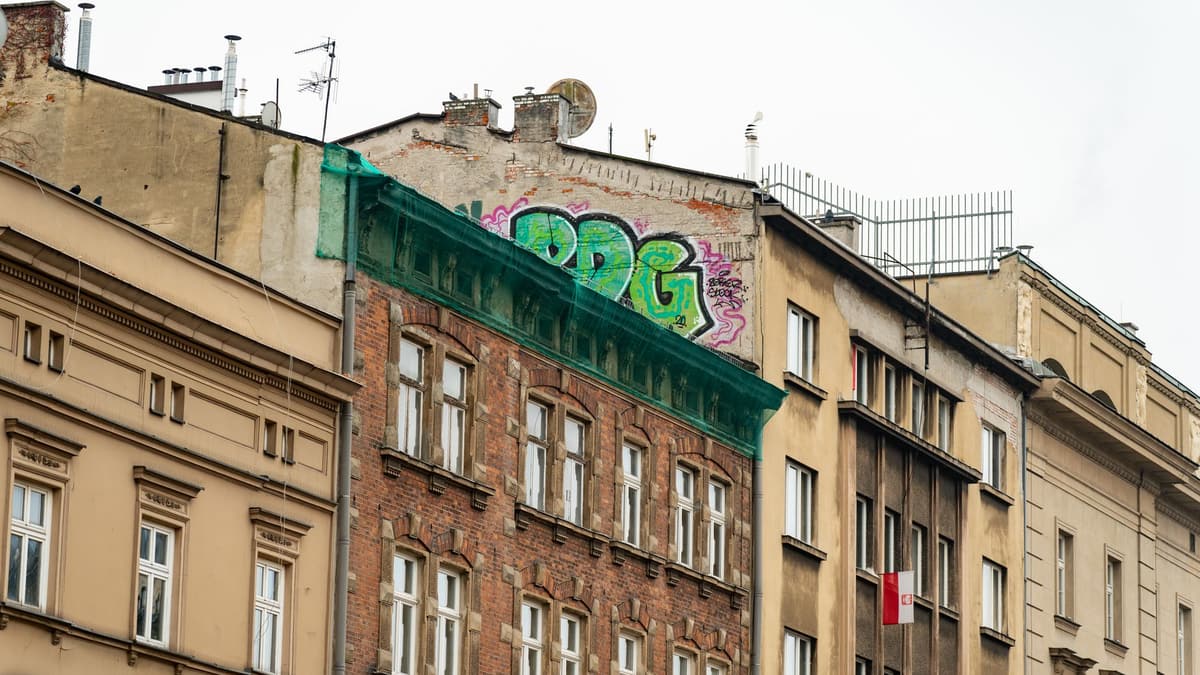
Walk through the gate into the small courtyard. This is the Remuh Synagogue, the smallest of Kazimierz's historic synagogues and one of very few still used for prayer.
Bu durağın devamı tam sesli turda.
Stand at the southern end of Szeroka and look at the stone and brick building in front of you, with its crenelated top.
Bu durağın devamı tam sesli turda.
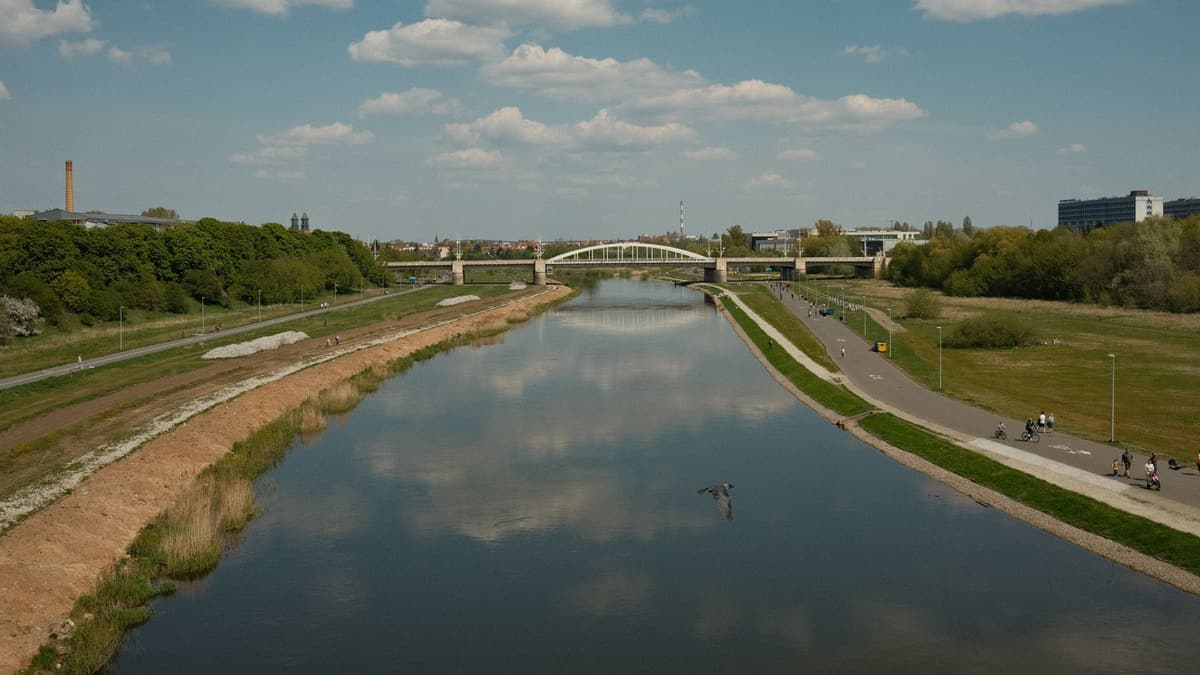
Step onto the footbridge and stop in the middle, with the river below you. Look up at the cables and you will see figures balancing on them, acrobats poised between the water and the sky, by the sculptor Jerzy Kędziora.
Bu durağın devamı tam sesli turda.
Stand at the edge of the square and take in the rows of large, empty metal chairs, spread across the open space and along the tram stops. Before the war this was Plac Zgody, Concord Square.
Bu durağın devamı tam sesli turda.
The walk ends at the gates of the old Emalia enamel works. Look at the front of the low administration building on Lipowa street.
Bu durağın devamı tam sesli turda.
Bir sonraki planlı turda bu yürüyüşü diğer insanlarla birlikte yapın.
Kolay tempoda yaklaşık 3,9 km, tahminen 53 dakika · 9 durak
Arkadaşlar ücretsiz yürürOctober 11, 2026 · 9 min read
From the Hollandsche Schouwburg through the old Jewish Quarter, past the Dockworker and the Dam, to the Anne Frank House on the Prinsengracht.
October 11, 2026 · 11 min read
From Van Houten's street by the Vondelpark past Leidseplein, the Rijksmuseum passage and the famous canal bench to the Anne Frank House.

October 11, 2026 · 10 min read
Follow the last days of April and May 1945 from the Anhalter Bahnhof ruin past the Gestapo site and Brandenburg Gate to the Moltke Bridge and the Reichstag.
