
October 11, 2026 · 9 min read
Amsterdam Anne Frank Walking Tour
From the Hollandsche Schouwburg through the old Jewish Quarter, past the Dockworker and the Dam, to the Anne Frank House on the Prinsengracht.
589

October 9, 2026 · 9 min read

 Arkadaşlar ücretsiz yürür
Her tur aynı zamanda uygulamada katılabileceğiniz planlı bir grup yürüyüşü olarak da gerçekleştirilir.
Ubud'de daha fazla sesli tur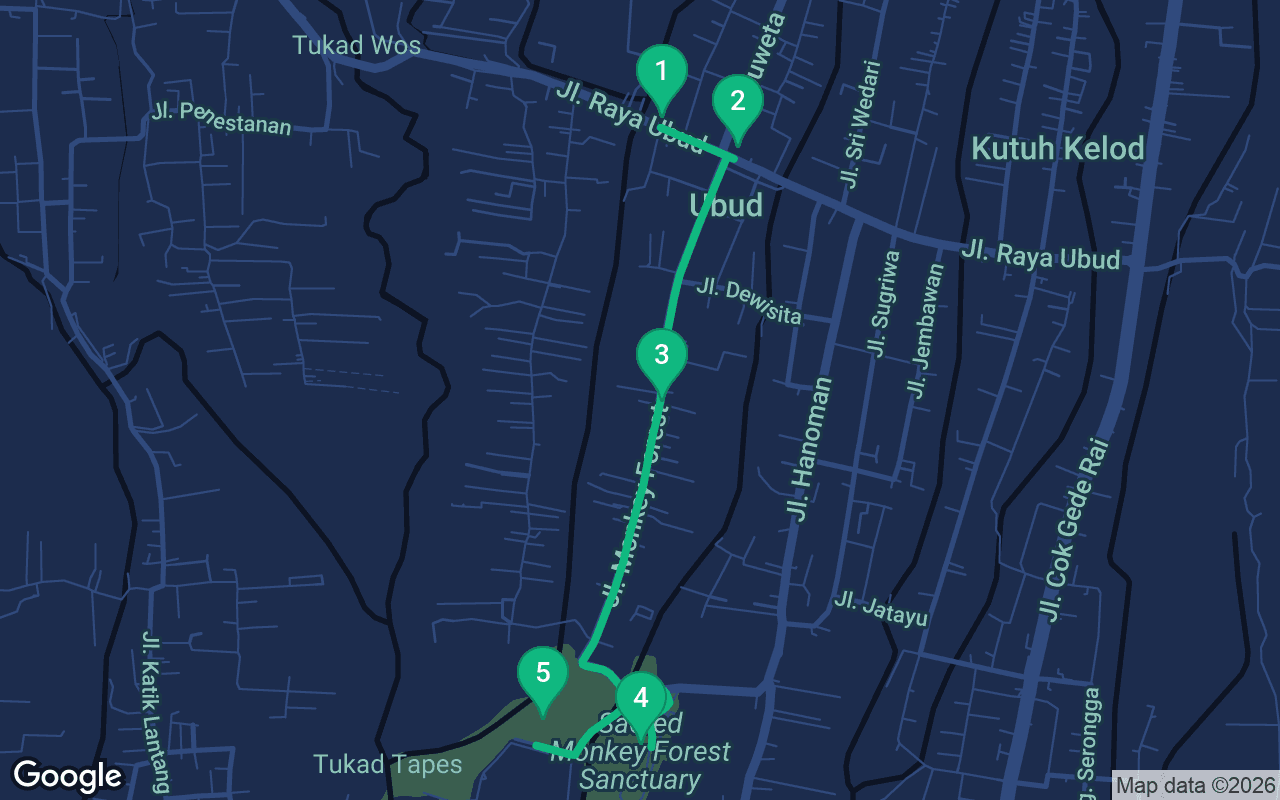
Yaklaşık 2,4 km, rahat bir tempoyla aşağı yukarı 32 dakika.
Bu tur sesli anlatımlıdır
Anlatımdan 30 saniyelik bir demo dinlemek için ilk 3 durakta oynat düğmesine basın. Uygulamada giriş bölümü ve bu 3 durak baştan sona ücretsizdir ve her birine vardığınızda sesli bir uyarı çalar. Tüm sesli tur, kalıcı olarak sahip olacağınız tek seferlik bir satın alma ile $7.99 karşılığında sizin olur.
Garmin, Komoot, Strava, OS Maps ve tüm GPX uygulamalarıyla çalışır.
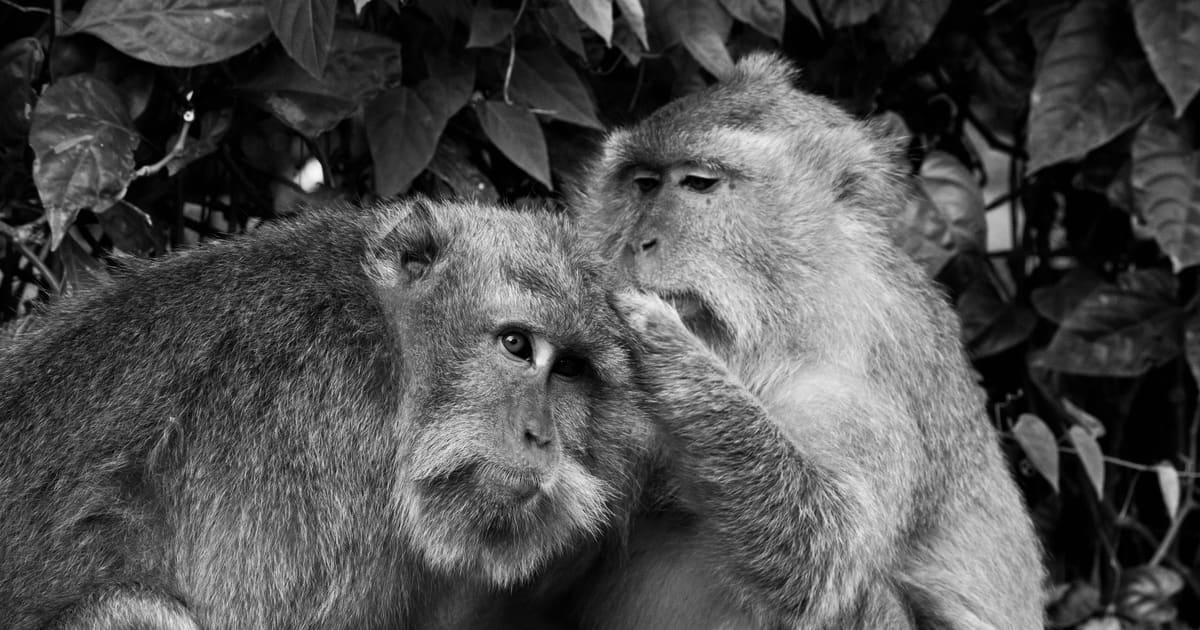
Ubud sits in the green hills of central Bali, and for generations it has been the island's home of painting, music and dance. This walk runs through the middle of it, from the town's royal heart to its sacred forest. It begins at Pura Taman Saraswati, a temple to the goddess of learning set behind a pond full of lotus flowers, passes the palace of Ubud's royal family, and follows Jalan Monkey Forest south past the village football field to the Sacred Monkey Forest Sanctuary. It ends deep among the trees, at a moss-covered temple of the dead. The route is about two kilometers, gently downhill most of the way, and it is one of the most memorable self-guided walking tours in Bali, because you finish among more than a thousand monkeys.
The walking takes about half an hour, but give it a whole morning: an hour in town and at least another hour or two in the forest. Go early. Ubud is cooler than the coast but still hot and humid by late morning, the traffic gets heavier as the day goes on, and the forest is calmer before the crowds arrive. In the rainy season, roughly November to March, afternoons often bring heavy downpours. The pavements on Jalan Monkey Forest are narrow, uneven and broken in places, with gaps over drains and scooters close by, so watch your step. Inside the forest the paths are paved but include steep steps down into a ravine. The forest has an entry ticket and set opening times, so check before you go. Bring a sarong and sash if you want to look inside a temple. Most important of all, prepare for the monkeys: leave food and snacks behind, carry nothing in plastic bags, zip your bag shut and put sunglasses, hats, earrings and anything dangling away before you enter. Do not feed or touch the monkeys.
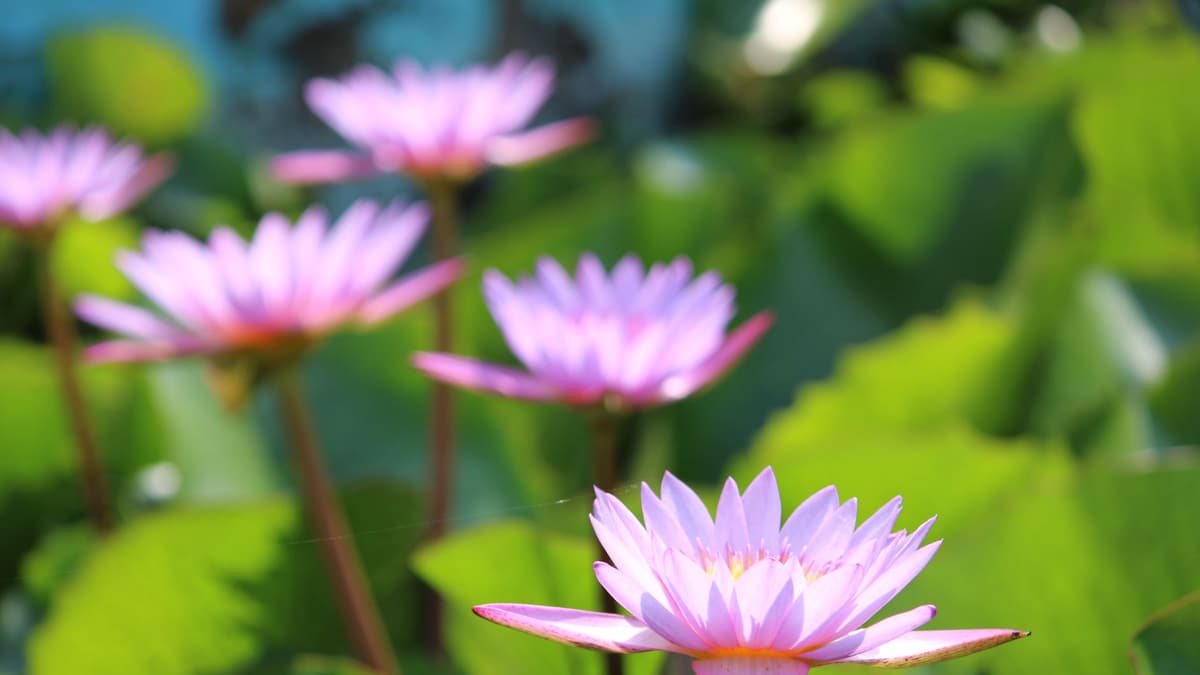
You are standing at the edge of a long pond, crowded with lotus plants, with a raised walkway running through the middle of it toward a temple of red brick and carved grey stone. This is Pura Taman Saraswati, the water temple of Saraswati, the Hindu goddess of knowledge, learning and the arts. She is usually shown as a graceful woman holding a palm-leaf book and a stringed instrument, often riding a swan, and she suits Ubud perfectly, a town that has lived off its artists for generations. Walk slowly along the path toward the gate and look at the carving: every surface is covered in flowers, leaves and mythical figures. The temple was designed and carved in the middle of the twentieth century by I Gusti Nyoman Lempad, an Ubud artist and builder whose sculpture and ink drawings are among the most admired in Bali, and who lived to a famously great age. Once every 210 days, on the day sacred to Saraswati, Balinese Hindus bless their books, school papers and old palm-leaf manuscripts with offerings, and by tradition nobody reads or writes until the blessing is done. In the evenings, a stage in front of the temple is often used for dance performances. When you are ready, go back out to Jalan Raya Ubud, turn left and walk east. The palace is about three minutes away, on your left, facing the corner where Jalan Monkey Forest heads south.
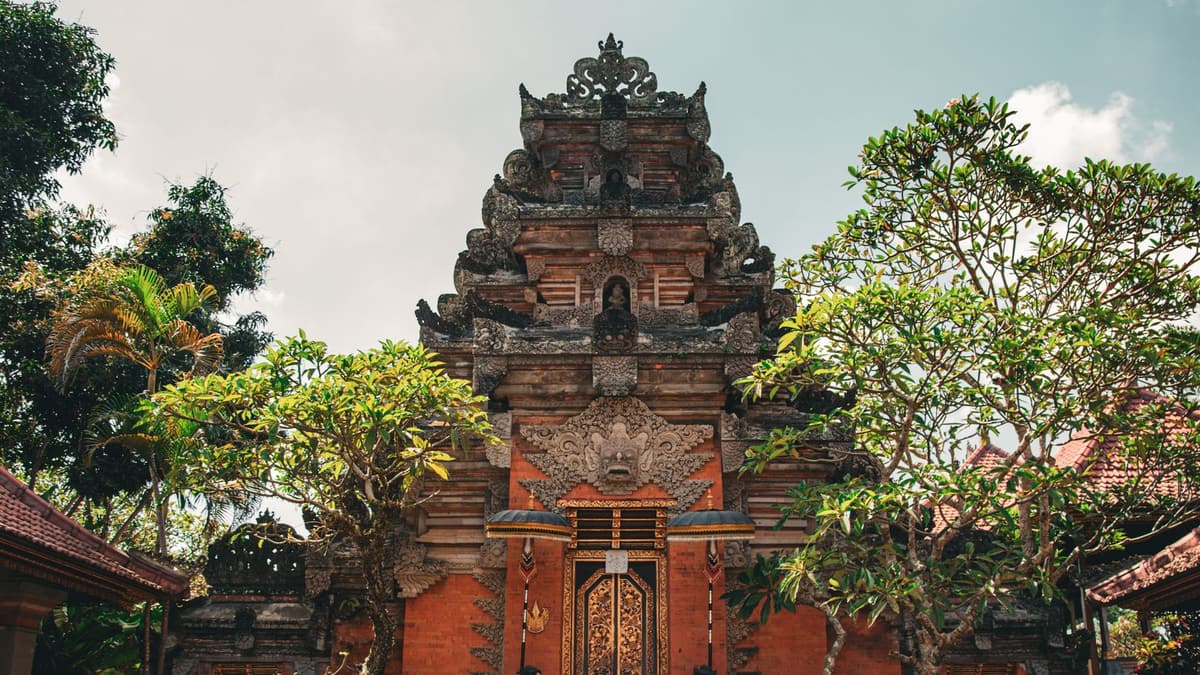
 You are now outside the palace of Ubud's royal family, known in Balinese as Puri Saren Agung. Step through the main gate into the first courtyard if it is open, and look at the gateways: tall, carved and painted, with fierce guardian faces above the doors and stone figures standing watch on either side. The palace is not a single building but a set of walled courtyards and pavilions, much like a very large family home, and the royal family still lives in the inner parts. In the nineteenth century the lords of Ubud, a branch of the princely family of Sukawati, served under the kingdom of Gianyar, and the town's influence grew through the shifting alliances and wars between Bali's kingdoms. Their descendants, who carry the title Cokorda, still play a central part in the life of the town, supporting temple ceremonies and the dance and music troupes. In the 1930s, members of the family welcomed Western artists to Ubud, a story for another walk. Royal cremations here are among the largest ceremonies in Bali, with towering, brightly decorated platforms carried through the streets by hundreds of men. Most evenings, a dance performance takes place in the courtyard; check before you go for the schedule. Across the road is the Ubud art market. To go on, walk south down Jalan Monkey Forest, keeping to the pavement. The football field is on your right, about eight minutes away.
In the middle of all the shops and cafes, a wide patch of grass opens up beside the road. This is Ubud's football field, and it works like an old-fashioned village green. On most afternoons there is a game going, local teams or just schoolboys in bare feet, while people sit at the edges and watch. Look along Jalan Monkey Forest in both directions and imagine it without the shops. Within living memory this was a quiet road with rice fields along it and a few family homestays, leading down to the forest at the end. Ubud has grown enormously since, but the field has stayed open, and on big days it becomes the center of town. Temple festivals bring processions down this road: women carrying tall towers of fruit, flowers and cakes balanced on their heads, men in white headcloths, and a marching gamelan of gongs and cymbals, playing a fast, clanging music meant to drive away bad spirits. On the eve of Nyepi, the day of silence, the neighborhoods of Ubud parade their giant demon figures through these streets before the island falls quiet. If you meet a procession, step aside, let it pass and enjoy it; there is nothing to buy and no ticket. From here, keep walking south down Jalan Monkey Forest as the road slopes downhill. The entrance to the forest is at the bottom, about ten minutes away.
Neler dahil
Turlarımız meditatif ve sürükleyici olacak şekilde tasarlandı: yürürsünüz ve sadece dinlersiniz. Birlikte her zaman daha güzeldir; uygulama anlatımı senkronize çalar, böylece siz, partneriniz ve arkadaşlarınız her durağı aynı anda duyarsınız.
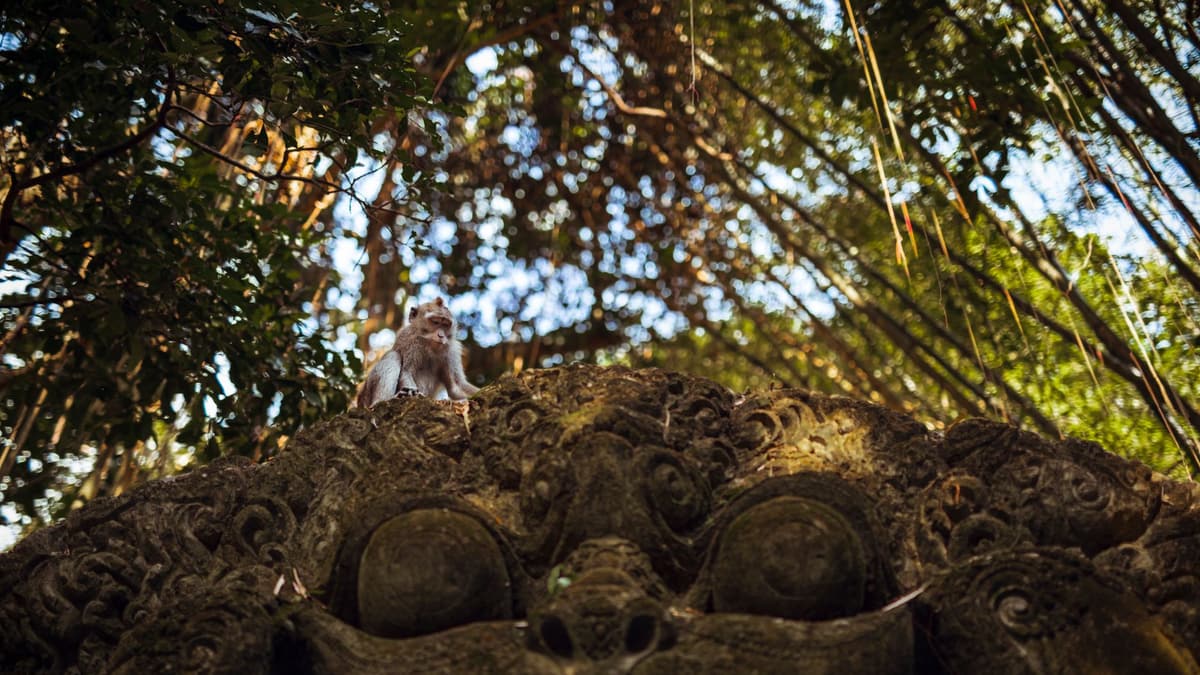
You have reached the Sacred Monkey Forest Sanctuary, known in Balinese as Mandala Suci Wenara Wana. Once through the entrance, the temperature drops and the light turns green.
Bu durağın devamı tam sesli turda.
The walk ends here, in front of the great temple of the forest, Pura Dalem Agung Padangtegal. Stand back and look at the gate.
Bu durağın devamı tam sesli turda.
Bir sonraki planlı turda bu yürüyüşü diğer insanlarla birlikte yapın.
Kolay tempoda yaklaşık 2,4 km, tahminen 32 dakika · 5 durak
Arkadaşlar ücretsiz yürürOctober 11, 2026 · 9 min read
From the Hollandsche Schouwburg through the old Jewish Quarter, past the Dockworker and the Dam, to the Anne Frank House on the Prinsengracht.
October 11, 2026 · 11 min read
From Van Houten's street by the Vondelpark past Leidseplein, the Rijksmuseum passage and the famous canal bench to the Anne Frank House.

October 11, 2026 · 10 min read
Follow the last days of April and May 1945 from the Anhalter Bahnhof ruin past the Gestapo site and Brandenburg Gate to the Moltke Bridge and the Reichstag.
