
October 11, 2026 · 9 min read
Amsterdam Anne Frank Walking Tour
From the Hollandsche Schouwburg through the old Jewish Quarter, past the Dockworker and the Dam, to the Anne Frank House on the Prinsengracht.
589

October 9, 2026 · 10 min read

 Друзі гуляють безкоштовно
Кожен тур також доступний як запланована групова прогулянка, до якої можна приєднатися в додатку.
Більше аудіотурів у Hanoi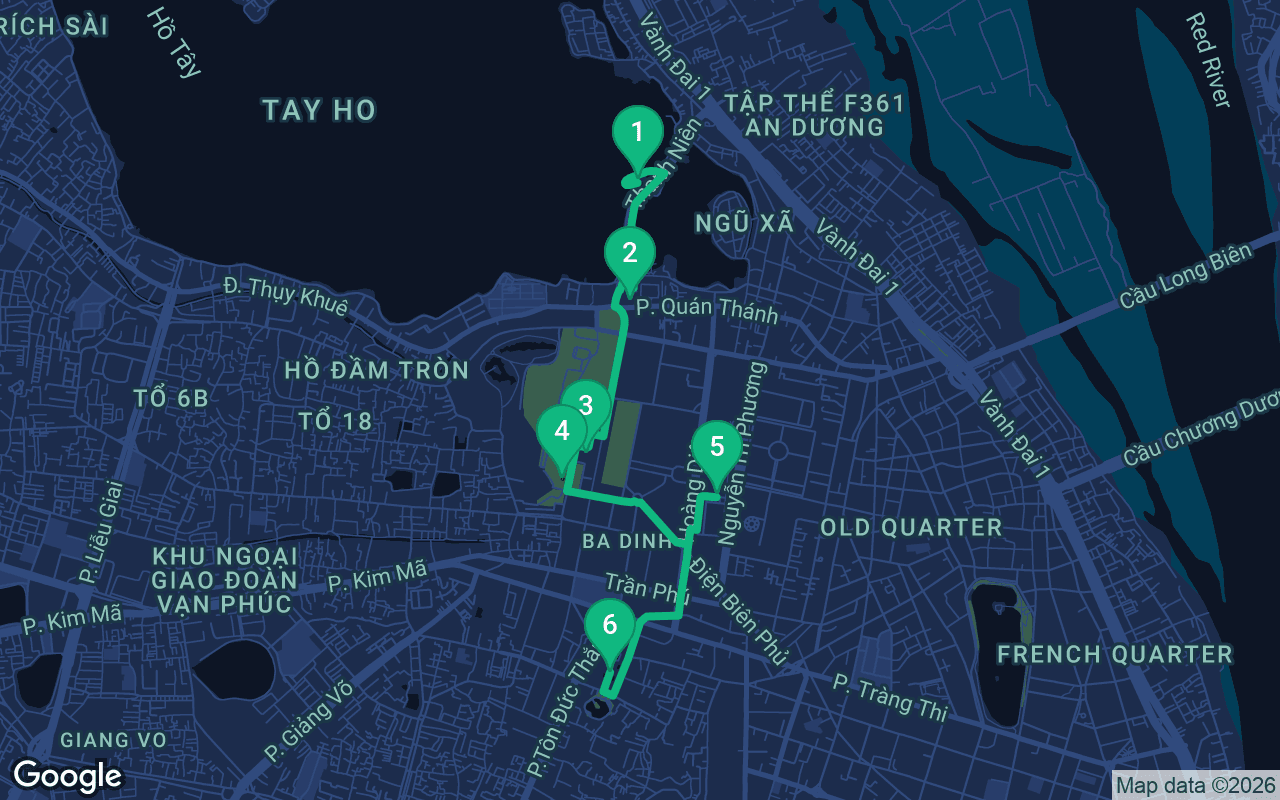
Приблизно 4,5 км, приблизно 62 хвилин у легкому темпі.
Цей тур озвучено
Натисніть відтворення на перших 3 зупинках, щоб послухати 30-секундний фрагмент розповіді. У додатку вступ і ці зупинки звучать повністю й безкоштовно, а про кожну з них вас сповістить звуковий сигнал, щойно ви прибудете. Весь тур із розповіддю буде вашим за $10.99, одноразова покупка назавжди.
Працює з Garmin, Komoot, Strava, OS Maps та будь-яким застосунком GPX.
If the Old Quarter is Hanoi's busy heart, Ba Đình is its formal face: wide boulevards, mustard-yellow colonial villas, and the places where Vietnam's history has been written, from the first royal capital a thousand years ago to the founding of the modern state. This walk begins at an ancient pagoda on an island in West Lake, passes a guardian temple and the granite mausoleum of Ho Chi Minh, and crosses into the excavated grounds of the Imperial Citadel of Thăng Long. It ends among the courtyards of the Temple of Literature, the country's first university. The route covers about four and a half kilometers on flat, shaded streets, and it is one of the best self-guided walking tours for understanding how Vietnam sees itself.
Allow a full morning, four hours or more if you go inside the mausoleum, the citadel and the Temple of Literature, each of which deserves its own hour. Start early. The mausoleum opens to visitors in the morning only, it closes on some weekdays, and for a couple of months most years the body is away for maintenance, so check the current hours before you go. Its dress code is strict: shoulders and knees covered, no hats inside, bags and cameras handed in, and complete silence in the hall. Pagodas and temples also ask for modest dress, so it is simplest to wear it all day. The walk is flat, on wide pavements, and Ba Đình has more shade than most of Hanoi, but from late spring to early autumn the heat and humidity are heavy, so carry water and rest in the temple courtyards. The boulevards here are calmer than the Old Quarter, but at crossings the same rule applies: walk at a slow, even pace, and let the motorbikes steer around you. Several sights charge small entry fees and keep their own hours, so check before you go.
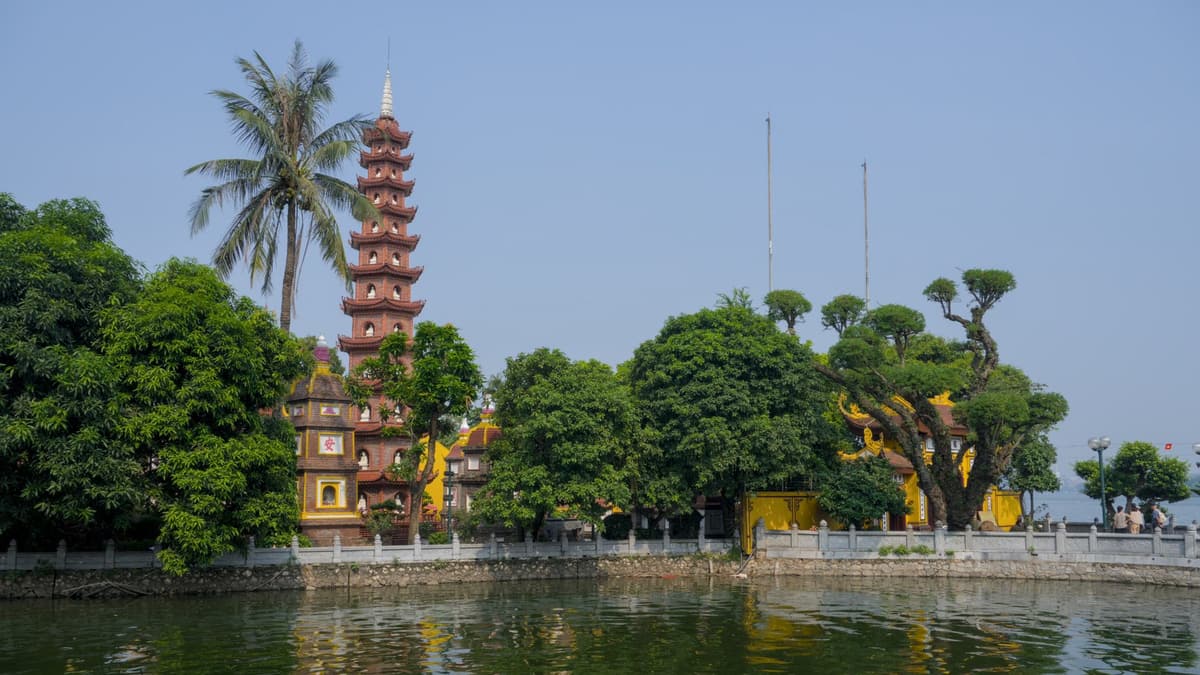
Stand on the little causeway that leads out to Trấn Quốc Pagoda and look at the tall, slender stupa rising above the trees, eleven tiers of red brick with a small white Buddha in each arched niche. This is the oldest pagoda in Hanoi. It was founded in the sixth century, when the city did not yet exist, on the bank of the Red River, and in the early 1600s, as the river ate away at the bank, it was moved to this small island in West Lake. Its name has changed with the times. The one it carries now, Trấn Quốc, means "defending the nation". The stupa is a modern addition from the late 1990s, but the courtyards behind it are full of older stone towers marking the graves of former monks. In the garden, look for a bodhi tree grown from a cutting of the tree in India under which the Buddha is said to have reached enlightenment, a gift from the Indian president during a visit in 1959. Behind you, the water stretching west is Hồ Tây, West Lake, the largest lake in the city. When you leave, walk south along Thanh Niên, the tree-lined road between West Lake and smaller Trúc Bạch Lake. In 1967 the American pilot John McCain, later a US senator, was shot down and parachuted into Trúc Bạch, on your left, and a small stone memorial on its shore marks the spot. The temple is at the end of the road, about seven minutes away.
 At the southern end of Thanh Niên, where it meets a busy junction, a triple gateway marks Quán Thánh Temple. This is the guardian of the north, one of four sacred temples that protected the old capital, and it is dedicated to Huyền Thiên Trấn Vũ, a Taoist god of the north whose emblems are the snake and the turtle. A shrine has stood on this spot since the early days of the royal city, though the buildings have been rebuilt many times. Walk through the courtyard, past the stone stelae and the old trees, into the main hall, and let your eyes adjust to the dark. Waiting there is one of the masterpieces of Vietnamese bronze casting, a seated statue of the god cast in 1677, nearly four meters tall and weighing about four tonnes. One hand rests on the hilt of a sword, a snake winds around the blade, and its point rests on the back of a turtle. Tradition credits the work to the bronze-casting craftsmen who lived beside the lake you just walked past. The scale of it in such a small, dim room is striking. Back out at the junction, cross carefully and head south down Hùng Vương, a broad boulevard lined with trees and grand buildings. After about ten minutes the mausoleum appears on your right, facing the wide lawns of Ba Đình Square.
You are at the edge of Ba Đình Square, the political center of Vietnam. Across the great lawn stands the mausoleum of Ho Chi Minh, a heavy block of grey granite with a columned portico and a simple inscription, guarded by soldiers in white uniforms. On 2 September 1945, on this square, Ho Chi Minh read the declaration of independence of the Democratic Republic of Vietnam to a vast crowd. He opened it by quoting the American Declaration of Independence, that all men are created equal. Decades of war followed, against the French and then in the conflict with the United States and South Vietnam. Ho Chi Minh died in 1969, before it ended. He had asked to be cremated, but his body was embalmed instead, and the mausoleum, inspired by Lenin's in Moscow, opened in 1975. For many Vietnamese he is "Uncle Ho", the father of the nation, and you will see families and school groups queuing with real reverence. Opinions of his politics differ around the world, and the place asks visitors for respect, not agreement. If you join the line, you file past the glass case in a cool, hushed hall without stopping. Flag ceremonies on the square mark the start and end of each day. The next stop sits just behind the mausoleum. Walk around its south side along Chùa Một Cột street, about three minutes, following the signs.
Що входить
Наші екскурсії задумані медитативними та захопливими: ви рухаєтеся й просто слухаєте. Разом завжди краще, і додаток відтворює розповідь синхронно, тож ви, ваш партнер і ваші друзі чуєте кожну зупинку одночасно.
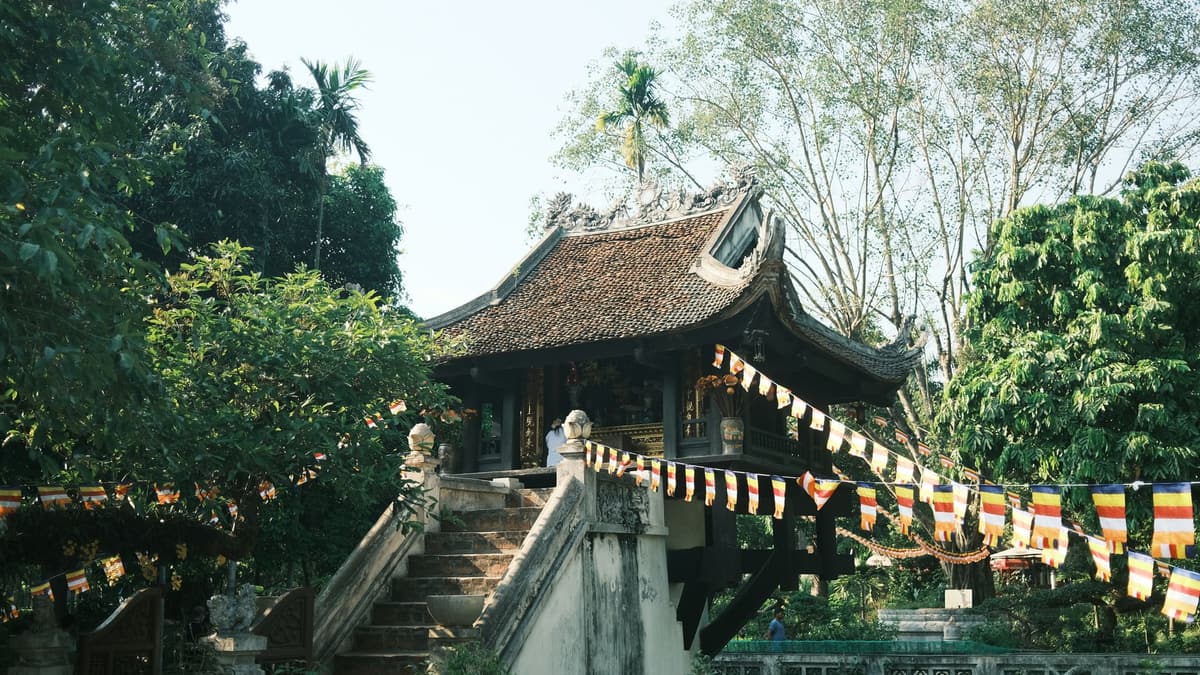
Tucked behind the mausoleum, in a small square pond, stands one of the most beloved buildings in Vietnam, and one of the smallest.
Продовження цієї зупинки є в повній аудіоекскурсії.
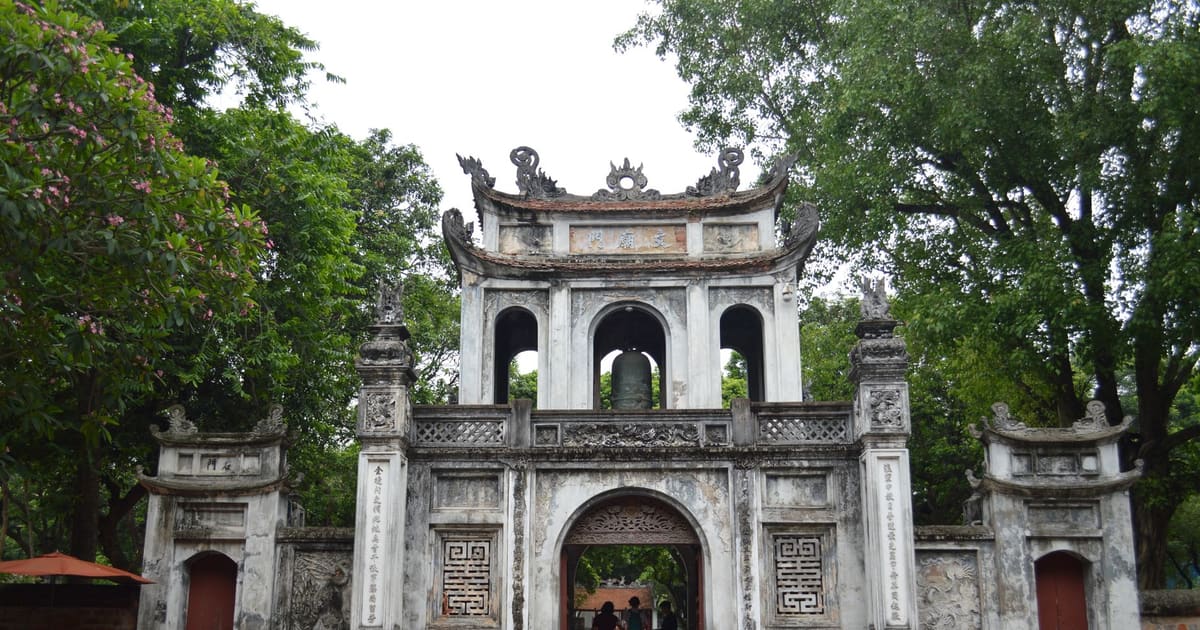
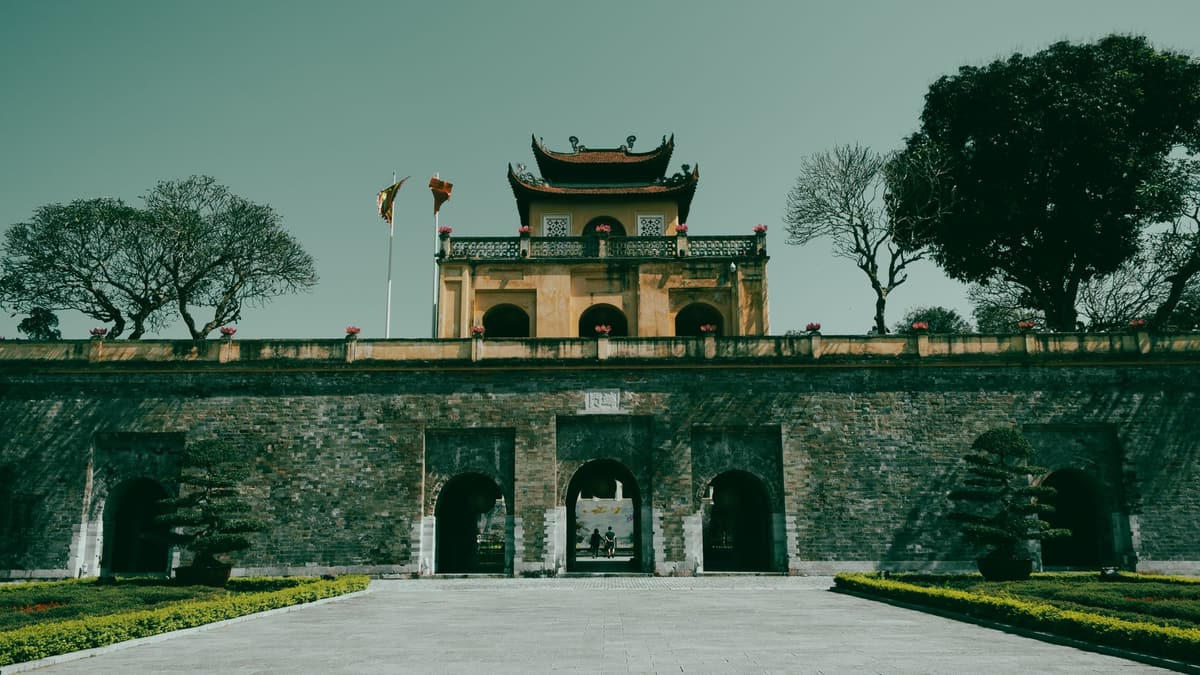
Pass through the gate into the Imperial Citadel of Thăng Long, a World Heritage site since 2010 and the heart of royal power in Vietnam for most of the last thousand years.
Продовження цієї зупинки є в повній аудіоекскурсії.
You finish at the gate of the Temple of Literature, Văn Miếu, founded in 1070 to honor Confucius, and a few years later the site of Vietnam's first national university, the Imperial Academy.
Продовження цієї зупинки є в повній аудіоекскурсії.
Зробіть цю прогулянку разом з іншими людьми на наступному запланованому турі.
Приблизно 4,5 км, приблизно 62 хвилин у легкому темпі · 6 зупинок
Друзі гуляють безкоштовноOctober 11, 2026 · 9 min read
From the Hollandsche Schouwburg through the old Jewish Quarter, past the Dockworker and the Dam, to the Anne Frank House on the Prinsengracht.
October 11, 2026 · 11 min read
From Van Houten's street by the Vondelpark past Leidseplein, the Rijksmuseum passage and the famous canal bench to the Anne Frank House.

October 11, 2026 · 10 min read
Follow the last days of April and May 1945 from the Anhalter Bahnhof ruin past the Gestapo site and Brandenburg Gate to the Moltke Bridge and the Reichstag.
