2026. október 7. · 9 perc
Best Places and Surfaces for Dog Walks
Can dogs run on concrete? Does pavement wear their nails down? What each surface does to paws and joints, and the lead rules in parks and farmland.

How long you should walk your dog depends mostly on its breed, then on its age, health and the weather. The Royal Kennel Club rates every breed's daily exercise needs in one of three bands: up to 30 minutes for a Chihuahua, up to an hour for a Pug, a French Bulldog or a Greyhound, and more than two hours for high-energy breeds like the Labrador and the Border Collie. Most adult dogs need at least one walk a day, often two. Puppies need short, gentle outings while their joints are still growing, older dogs do best on shorter walks more often, and on hot days a shorter walk, or none, is the safe choice. Below is how long to walk your dog at each stage, and the signs that a walk was too much. If your dog is a puppy, getting old, or has a health problem, check with your vet before you change how far you go.
The Royal Kennel Club lists 230 breeds, and every breed page gives an exercise figure. Counting them up, about half the breeds are rated at up to an hour a day, more than a third at more than two hours, and around 20 at up to 30 minutes. Some of the placings aren't what you'd guess from size alone: the Great Dane, a giant breed, sits in the more-than-two-hours band alongside the Labrador and the Border Collie, while the Greyhound, built for speed, is rated at up to an hour. The two-hour figure is total exercise, not necessarily two hours on a lead, so for a high-energy dog it can include off-lead running, fetch and training as well as walks. If your dog is a cross, look up the breeds in its mix and then watch the dog in front of you: a young Labrador cross that's still bouncing off the walls after an hour is telling you something the chart can't. Minutes aren't the only measure, either. The PDSA calls a slow, meandering walk with time to sniff and explore "great for their mental health", so not every walk needs to be a brisk one.
The best-known rule for puppies comes from the Royal Kennel Club: "five minutes of formal exercise per month of age (up to twice a day) until the puppy is fully grown", so 15 minutes at three months and 20 at four. Not every body agrees with it. The PDSA, the UK veterinary charity, says "there's no scientific evidence behind this rule, and although it might work for some, it's not appropriate for most puppies", and advises building a puppy's walking stamina gradually instead, stopping to let them rest whenever they get tired. Where the two agree is on the kind of exercise: both say to limit high-impact activity while the joints are developing, which the Kennel Club spells out as jumping from heights and sharp, sudden turns such as chasing a ball, and the PDSA as jumping, twisting and skidding. They also agree that growing takes a while. The PDSA says most dogs are fully grown by a year, but larger breeds such as Labradors, Dobermans and Great Danes can take 18 months to two years, so the puppy stage lasts longer for big dogs. My take is to treat the five-minute rule as a ceiling on structured lead walks, not a target, and to let the puppy's tiredness decide when you turn back. Play at their own pace in a garden or at home is a different thing from a walk on a lead and doesn't need timing in the same way.
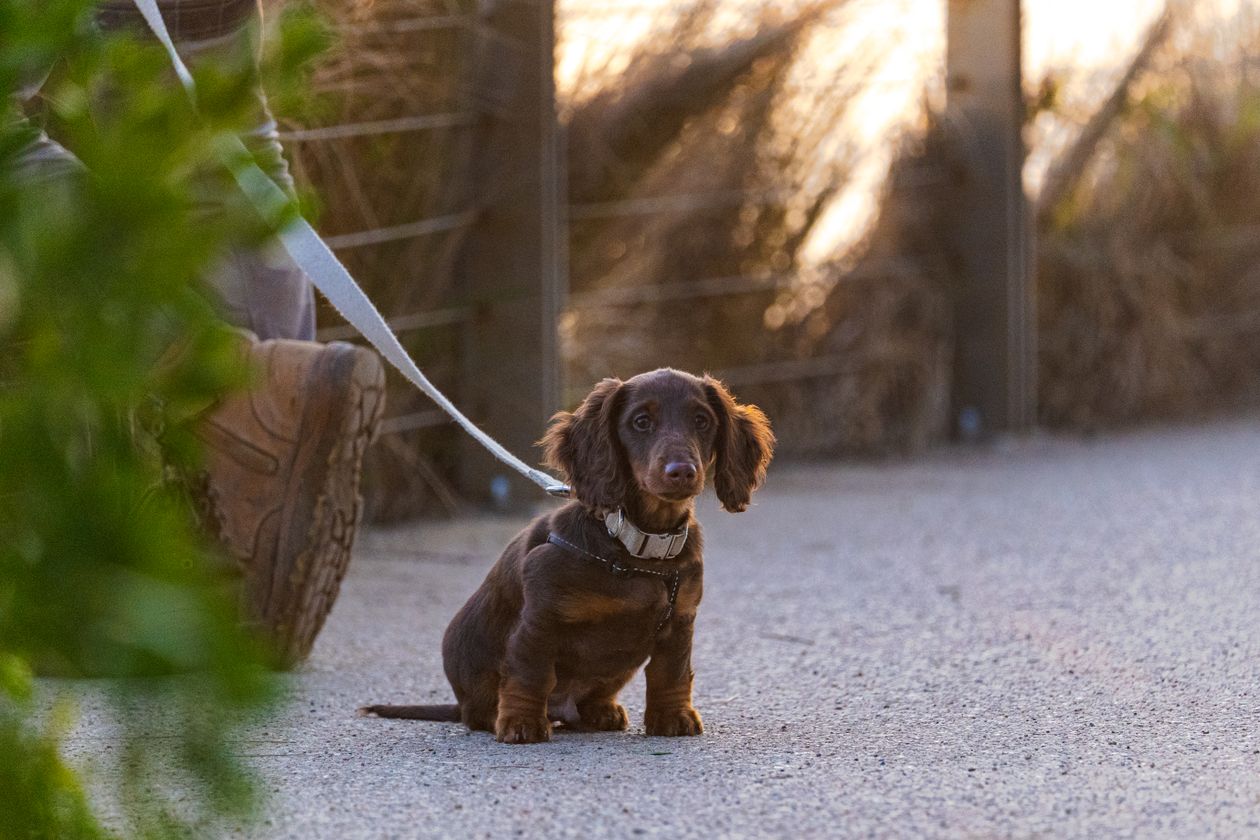 Photo: Jaxie Jia, Pexels
Dogs reach their senior years at different ages depending on size. VCA Animal Hospitals gives seven to eight years for large breeds like Labradors and around ten for small breeds like Shih Tzus. The advice for older dogs is consistent across the vet bodies: keep them walking, but change the shape of the walk. The PDSA's guidance is "little and often", because joints get stiffer when they haven't been used for a while, and it suggests sticking to a fairly short route in case your dog gets tired. For a dog with arthritis, a VCA vet suggests starting with 10 minutes of walking three times a day, and lengthening the walks week by week as long as the dog doesn't get stiffer. The ground matters too. VCA's vets warn against slippery, sloping or bumpy footing when arthritic dogs play, and the same logic applies on a walk: a flat park path or short grass is kinder than a rooty forest trail or a slick pavement. Keep an eye on how long your dog can comfortably walk over the months: VCA notes that a significant drop can be a sign of pain, heart disease or another illness, and that's a reason to see your vet rather than simply walk less.
Most people know dogs die in hot cars. Fewer know that exercise causes far more heatstroke. A study of the UK veterinary records of 905,543 dogs found that exercise triggered 74% of heat-related illness cases, against 5% caused by being shut in a vehicle. Young male dogs were more likely to overheat during exercise, and flat-faced (brachycephalic) dogs, such as Pugs, Bulldogs and French Bulldogs, had higher odds of every type of heat illness. The RSPCA's advice for warm days is to walk at dawn and dusk, and its campaign line is "if in doubt, don't go out". Check the ground too: the Royal Kennel Club suggests putting the back of your hand on the pavement for seven seconds, and "if it's too painful for your hand, then it's too painful for your dog's paws." Older dogs struggle at both ends of the thermometer, so the PDSA suggests walking them in the cooler part of a hot day and a coat in the cold. The RSPCA lists these signs of heatstroke:
If you see them, stop the walk and get your dog into shade, pour water that's cooler than the dog over its body while avoiding the head, and take it to a vet, calling ahead so they're ready.
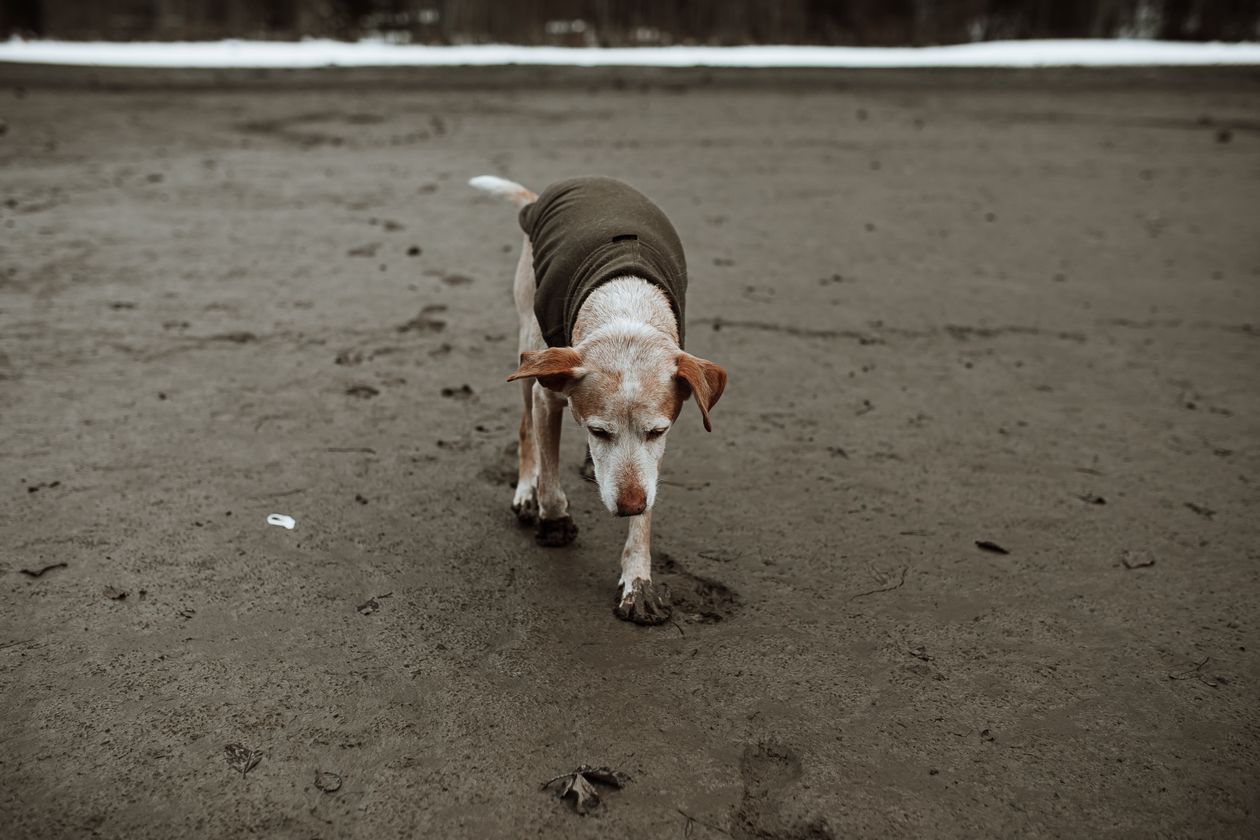 Photo: Naomi Salome, Pexels
Dogs don't tell you when they've had enough in words, so the signs are in what they do during and after the walk. The PDSA's line for older dogs is that if they lie down on a walk or stop chasing a toy, they need to rest, and its advice for puppies is the same: if they get tired, stop and let them rest until they're ready to go on. Afterwards, look at how your dog moves later that day and the next morning. VCA's guidance for arthritic dogs is to lengthen walks only if there's no increase in stiffness, which also works the other way: if your dog is stiffer or sore after a walk, it was probably more than they're ready for, so make the next one shorter, and ask your vet if it keeps happening. On a warm day, heavy panting and drooling can be the start of heatstroke rather than ordinary tiredness, so treat them as the warning signs above. A gradual decline over months, where your dog wants to turn for home sooner and sooner, is worth a vet check.
| Your dog | Where to start |
|---|---|
| Puppy | Short walks with rests; the Kennel Club's five minutes per month of age, up to twice a day, as an upper limit |
| Adult, breed rated up to 30 minutes (such as a Chihuahua) | Up to 30 minutes a day |
| Adult, breed rated up to an hour (such as a Pug or Greyhound) | Up to an hour a day, often split into two walks |
| Adult, high-energy breed (such as a Labrador or Border Collie) | More than two hours of exercise a day, walks plus play and training |
| Older or arthritic dog | About 10 minutes, three times a day, lengthened week by week if there's no extra stiffness |
| Any dog on a hot day | Dawn or dusk only, after the seven-second pavement check, or a game indoors instead |
A daily walk is easier to keep up when someone else is coming too. Walk With Me is a dog walking app as well as a walking app: dog-friendly walks show as pink markers on the map, so you can join one near you or set up your own for a time and length that suits your dog. It's free on the App Store and Google Play.
2026. október 7. · 9 perc
Can dogs run on concrete? Does pavement wear their nails down? What each surface does to paws and joints, and the lead rules in parks and farmland.
2026. szeptember 11. · 8 perc
Meet the dog with its owner, ask the right questions, check the collar and lead, and save the vet's number. What to know before you walk anyone's dog.

2026. augusztus 30. · 8 perc
Train each dog alone first, give each one a side, and use two matching leads. When a coupler helps, when it doesn't, and when to walk them separately.