October 16, 2026 · 7 min read
Passing Dogs on Narrow Sidewalks
Master dog leash etiquette on narrow sidewalks. Learn spatial tricks, decision rules, and clear communication to pass other dogs without tension.
August 30, 2026 · 10 min read
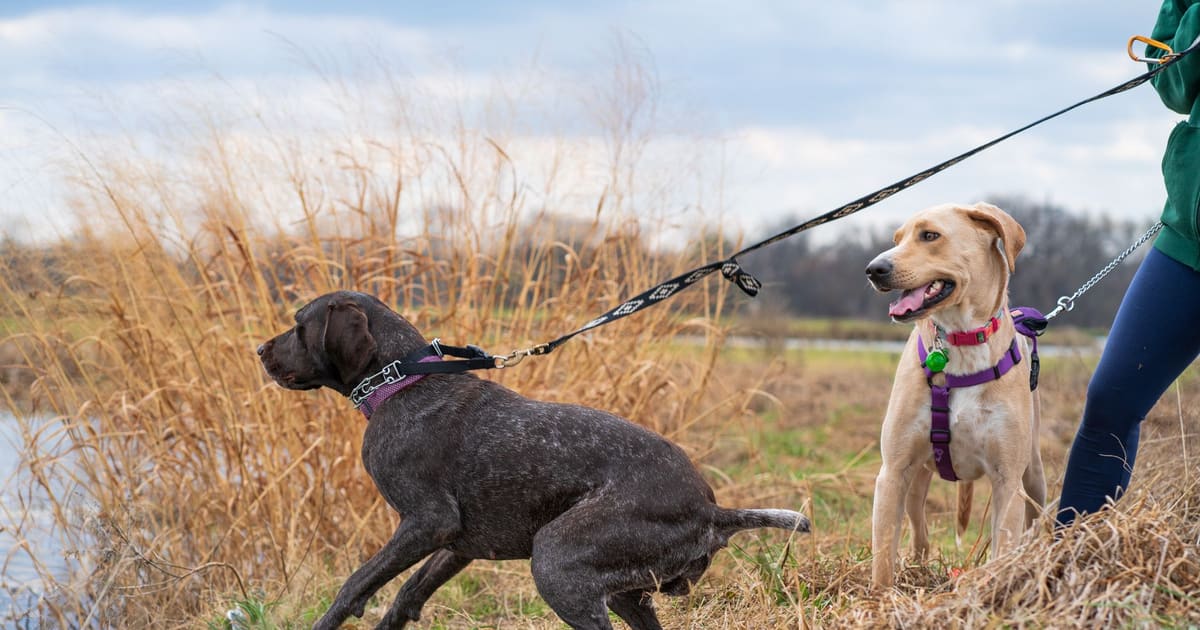
Walking two dogs at the same time is usually a complete disaster.
You step out of your front door with high hopes, but within three minutes, you are wrapped up like a mummy in heavy nylon webbing. Your left arm is stretched three inches longer than your right, your dogs are performing a chaotic dance around your ankles, and your neighbors are watching the circus from their windows. Let's be honest: walking two dogs at once can feel like walking two jobs. If you are tired of getting your legs wrapped in nylon every time a squirrel runs by, you might want to find a partner using our dog walking app to split the load, but if you must go solo, you need a system that keeps your hands free and your dogs separate.
Many owners think retractable leashes are the perfect solution. They assume giving each dog fifteen feet of thin cord lets them sniff peaceably without colliding. It is a trap. Retractable leashes offer zero physical leverage. When one dog bolts left and the other dashes right, you lose all mechanical advantage. The thin cords tangle instantly, forming tight, dangerous knots that can cut your skin or pinch your dogs. You end up frantically clicking plastic buttons while your dogs spin like a cheap plastic top.
Another major issue with retractable leashes is the constant tension they create. Because the spring mechanism always pulls back on the collar, your dogs learn that pulling is the only way to move forward. Multiply that by two dogs, and you have two animals constantly straining against their collars, dragging you down the street. The handle of a retractable leash is also bulky. Trying to hold two of these plastic handles in one hand is like trying to juggle wet soap in a rainstorm. If one dog lunges, you are highly likely to drop one or both handles, sending your dogs running with a loud plastic casing clattering behind them, which only terrifies them more.
What works instead is surprisingly simple. You need short, fixed-length flat leashes. Specifically, four-foot or five-foot leashes made of heavy nylon or leather. Do not go longer than five feet. Short leashes keep your dogs within your immediate sphere of control. Use two different colors. This visual trick lets you instantly see which dog is doing what, even in your peripheral vision. When they cross, you know exactly which hand needs to loop over the other to untangle them without looking down.
Your action step for this week is straightforward. Put your retractable leashes in the closet. Buy two distinct, brightly colored four-foot flat leashes. Take both dogs out for a quick three-minute driveway session just to get used to the weight and length of the new gear.
A leash coupler is a Y-shaped strap that hooks two dogs to a single leash. It sounds brilliant. One leash to hold, one hand free, zero tangles. But couplers only work in a perfect fantasy world. In reality, dogs are individuals with different paces, sniffing habits, and bathroom schedules. When you couple them, the faster dog drags the slower dog. The dog who needs to poop is yanked mid-squat by the dog chasing a leaf. This constant, unpredictable pulling frustrates both pets, leading to grumpiness and leash reactivity. It turns a simple stroll into a frustrating tug-of-war where you are just a passenger.
Couplers also remove your ability to communicate with each dog individually. When you pull on the main leash to redirect Dog A, you are also pulling on Dog B. This confuses them. They cannot tell if the correction is for them or their partner. Over time, this lack of clear communication leads to learned helplessness or increased aggression. If one dog gets startled by a passing car, they might redirect their fear onto the dog clipped right next to them, sparking a fight that you cannot easily break because their heads are locked together by a short piece of webbing.
What works instead is the split-hand anchor method. You hold one leash in each hand, but you use your body as the central divider. Your left hand controls your left dog, and your right hand controls your right dog. By keeping them physically separated by the width of your torso, they cannot easily wrap around each other. If one dog stops to sniff, you can let that leash slide slightly through your hand while keeping your other arm steady, allowing the second dog to keep moving forward. It keeps the power balance in your hands, not their necks.
Your action step for this week is to practice holding one leash in each hand during your next backyard session. Walk in straight lines and practice letting one dog stop while you gently guide the other dog to a halt beside you, keeping a clear physical gap between them.
We all want that picture-perfect walk where our dogs trot side-by-side in perfect harmony like show ponies. So, we let them walk right next to each other. This is a recipe for competitive tension. Dogs naturally cue off each other. If Dog A takes a fast step, Dog B feels the need to match it. Before you know it, they are racing each other, pulling you down the pavement like a team of sled dogs. They also get in each other's physical space, leading to accidental shoulder checks that can spark a quick, angry scuffle.
When dogs walk shoulder-to-shoulder, they also share a single field of vision. If they spot a rabbit, they both react at the exact same millisecond. This simultaneous surge of adrenaline is incredibly difficult to control. If they are staggered, however, you have a split second to react to the first dog's body language before the second dog even notices what is happening. That tiny window of time is the difference between a controlled correction and getting pulled flat onto your face.
What works instead is the staggered lane system. You must assign each dog a permanent lane and a slight stagger. For example, your older, calmer dog walks on your left side, slightly behind your heel. Your younger, more energetic dog walks on your right side, slightly ahead. This physical separation prevents them from feeding off each other's forward energy. It also means they cannot cross paths directly in front of you, which is the main cause of those ankle-wrapping tangles.
Your action step for this week is to choose which side each dog belongs on based on their personality and size. For your next three walks, do not let them swap sides. If Dog A tries to drift to the right, gently block them with your leg and guide them back to the left. Consistency here is everything.
When you walk one dog, managing a distraction like a cat or a delivery truck is relatively simple. You brace yourself, redirect, and move on. When you walk two dogs, a distraction triggers a chain reaction. Dog A spots the cat and lunges. Dog B sees Dog A lunge and assumes there is a threat or a chase, so they lunge too. Now you are dealing with double the weight and double the momentum. Trying to pull back with raw arm strength is a losing battle. You will hurt your shoulders, lose your footing, or drop a leash.
The mistake most walkers make is trying to pull the dogs back toward their chest. This triggers the opposition reflex. When you pull a dog backward, their natural physical instinct is to lean forward and pull harder against the pressure. With two dogs doing this, you are fighting a losing battle against physics. You need to redirect their heads and change their line of sight, not just pull back on their necks.
What works instead is the anchor turn and body block. Instead of pulling back with your arms, you must lock your elbows against your ribs, bend your knees to lower your center of gravity, and use your entire body weight as an anchor. Turn your back to the distraction and walk in the opposite direction immediately. By turning your body, you force the dogs to follow your core movement rather than trying to win an arm-wrestling match with them. Use your hips to block their path if they try to circle back around you.
Your action step for this week is to find a quiet space like a driveway or a park corner. Practice the sudden 180-degree turn with both dogs when there are no distractions around. Get them used to the idea that when your hips turn, the walk changes direction instantly.
When you let both dogs sniff and pee whenever and wherever they want, chaos ensues. Dog A stops at a fire hydrant. Dog B smells it too, tries to crowd in, and their leashes twist into a pretzel. Then Dog B decides to lift a leg while Dog A is still sniffing, leading to messy accidents. Letting them treat the entire walk as a free-for-all bathroom break guarantees you will spend the whole time untangling cords and cleaning up messes.
This constant stopping also ruins the cardiovascular benefit of the walk for you. A good walk should have some rhythm. If you stop every five feet because one of your dogs found a particularly interesting blade of grass, you are not walking, you are just standing in the cold while your dogs read the local scent map.
What works instead is structured sniffing zones. Divide your walk into work time and sniff time. During work time, both dogs must walk in their designated lanes without stopping. Every few minutes, find a safe patch of grass, give a release cue like "go sniff," and let them explore. Even during sniff time, you must keep them on opposite sides of the grass patch. Guide them to separate spots so they do not crowd each other or tangle their gear. When the timer is up, use a prompt cue like "let's go" to bring them back into their structured lanes.
Your action step for this week is to identify three specific grassy areas along your usual walking route. Use these as your designated bathroom stops. Keep your dogs in their structured lanes between these stops, refusing to let them stop at every single mailbox pole.
If you try to do everything yourself every single day, you will eventually start to dread your daily walks. Walking two dogs is physically demanding and mentally exhausting. You have to be hyper-aware of your surroundings, manage two sets of body language, and constantly adjust your grip. Sometimes, the best solution is simply to share the load with someone else who understands the struggle.
This is where finding a local walking partner makes a massive difference. When you have another person with you, you can each handle one dog. This gives each dog the individual attention they need while still allowing them to socialize and walk together as a pack. It turns a stressful chore into a relaxing, social activity for both you and your pets. You can chat, share tips, and enjoy the outdoors without the constant fear of getting tangled.
If you want to make your daily strolls a lot easier, open the Walk With Me map on your phone and look for the pink paw markers to find other dog owners walking near you. You can schedule a joint walk, split the pack, and turn a chaotic double-dog struggle into a smooth, shared stroll.
October 16, 2026 · 7 min read
Master dog leash etiquette on narrow sidewalks. Learn spatial tricks, decision rules, and clear communication to pass other dogs without tension.
October 7, 2026 · 6 min read
Wondering where to walk your dog for healthy joints and safe paws? We compare grass, dirt, and concrete across heat, shock absorption, and daily wear.
September 27, 2026 · 8 min read
Learn how to use a dog walking app to find local pack walks, coordinate safe parallel walks, and build a social routine for your pup.