
October 11, 2026 · 9 min read
Amsterdam Anne Frank Walking Tour
From the Hollandsche Schouwburg through the old Jewish Quarter, past the Dockworker and the Dam, to the Anne Frank House on the Prinsengracht.
589

October 9, 2026 · 10 min read

 친구는 무료로 함께 걸어요
모든 투어는 앱에서 참여할 수 있는 정기 그룹 걷기 모임으로도 운영됩니다.
Cebu City의 오디오 투어 더 보기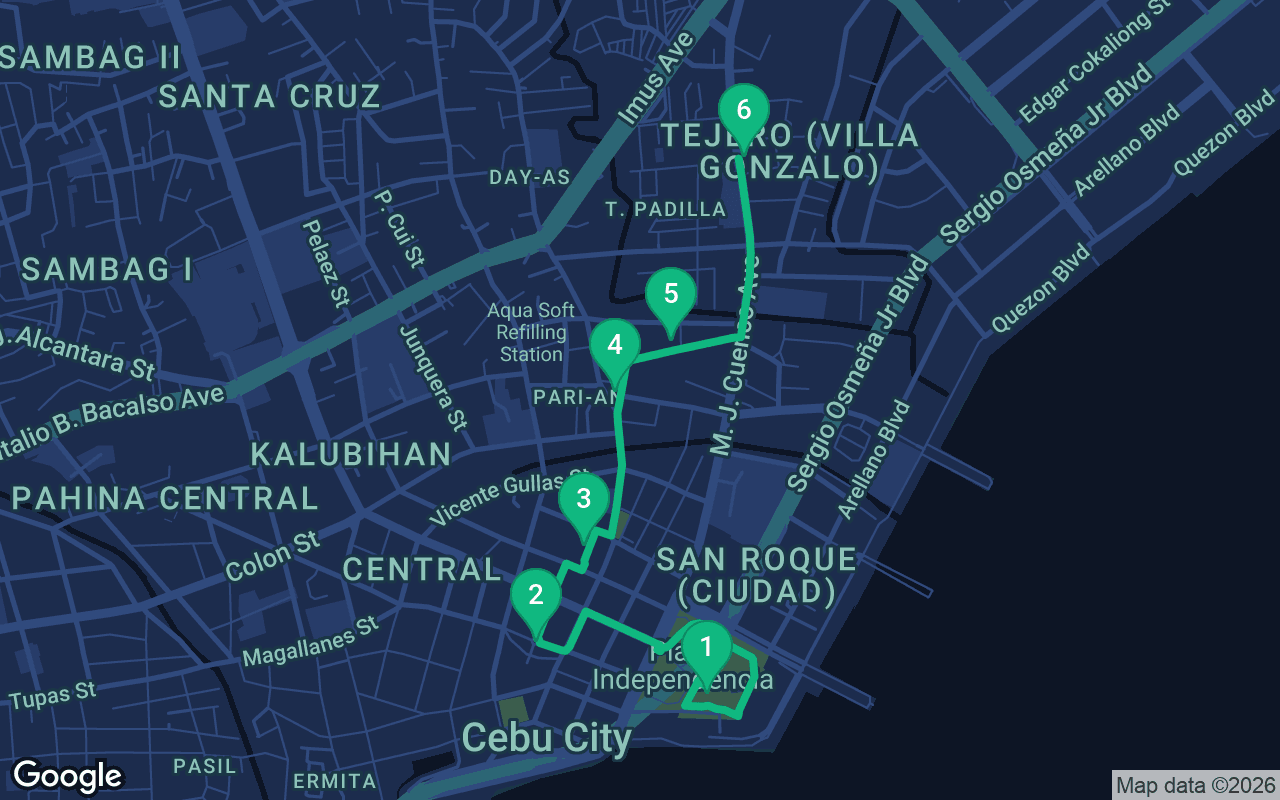
약 2.5km, 여유로운 페이스로 대략 35분 소요.
음성 가이드가 포함된 투어입니다
처음 3개 스톱에서 재생을 누르면 여기에서 나레이션을 30초 데모로 들을 수 있습니다. 앱에서는 인트로와 이 스톱들을 무료로 끝까지 들으실 수 있으며, 각 스톱에 도착하면 알림음이 울립니다. 전체 오디오 투어는 $7.99에 한 번만 구매하시면 평생 소장하실 수 있습니다.
Garmin, Komoot, Strava, OS Maps 및 모든 GPX 앱과 호환됩니다.
Cebu is where the Spanish story in the Philippines began, and where the first fight against it was won. This walk covers the ground where both happened. It starts at Fort San Pedro by the harbor, the small stone fort Spain built when it came to stay, and ends at Museo Sugbo, the old provincial jail that now tells the island's story. In between you visit the cross Ferdinand Magellan planted in 1521, pass the basilica of the Santo Niño, step into the cathedral, circle a sculpture that crowds five centuries into one plaza, and wander the old Chinese quarter of Parian with its coral-stone houses. It is about two and a half kilometers and flat the whole way, one of the shorter self-guided walking tours you can do in the Philippines and one of the richest.
The walking itself takes little more than half an hour, but give it a whole morning, because the fort, Casa Gorordo and Museo Sugbo each deserve time inside, and the basilica is worth a quiet sit. Cebu is hot and humid all year. Start early, ideally before nine, carry water and a hat, and duck into the churches and museums when the sun is at its strongest. Heavy showers are common in the wet months, roughly June to November, so a small umbrella earns its place in your bag. The ground is flat, but downtown pavements are narrow, broken in places and often taken over by vendors, so watch your step and cross the busy roads with care, using the lights where there are any. The streets around the basilica fill with worshippers on Fridays, the Santo Niño's devotion day, and in January, during the Sinulog festival, the whole district can be packed. In any crowd, keep your phone and bag close to you. The churches are working places of worship, so cover your shoulders and knees, keep your voice down, and stay at the back if a Mass is under way. The fort and the museums charge small entry fees and keep their own hours, so check before you go.
Stand at the gate of Fort San Pedro and take in the shape of the place. It is a triangle, with two walls facing the sea and the third facing the land, and a bastion at each corner. It is the smallest Spanish fort of its kind in the country and the oldest, because this is where Spain's lasting presence in the Philippines began. In 1565 an expedition led by Miguel López de Legazpi sailed in from Mexico, forty-four years after Magellan's ill-fated visit. The people of Sugbo, as Cebu was then called, did not welcome them. There was fighting, much of the town burned, and the Spaniards dug in on this shore. Their first fort was a stockade of logs and earth, named after Legazpi's flagship, the San Pedro. The stone walls you see came later, raised over the following generations against raiders who came by sea. Cebu was the first Spanish settlement in the islands and Legazpi's base until he moved on, in the end to Manila in 1571. After Spanish rule ended, the fort served the Americans as barracks and the Japanese during the war, and the city has since made it a park. Step inside to walk the ramparts and look out over the harbor where the ferries come in from the other islands. When you are done, leave by the gate and walk north along the edge of Plaza Independencia, past the obelisk raised to Legazpi, then head west toward the city hall. The little pavilion of Magellan's Cross stands in front of it, beside the basilica, about ten minutes from the fort.
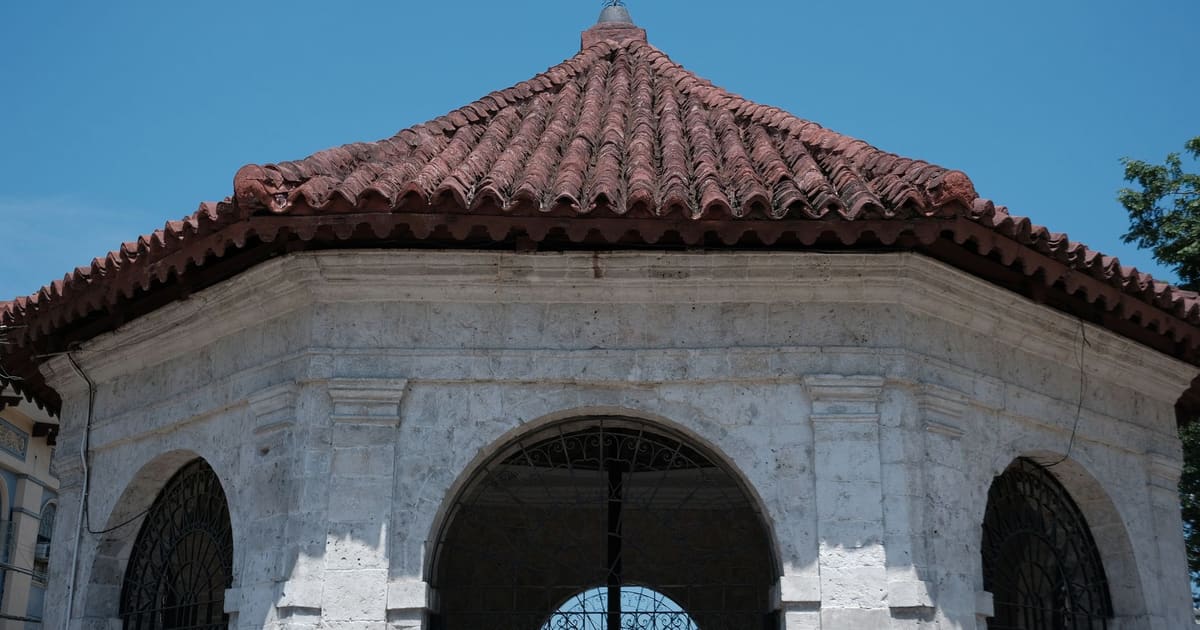
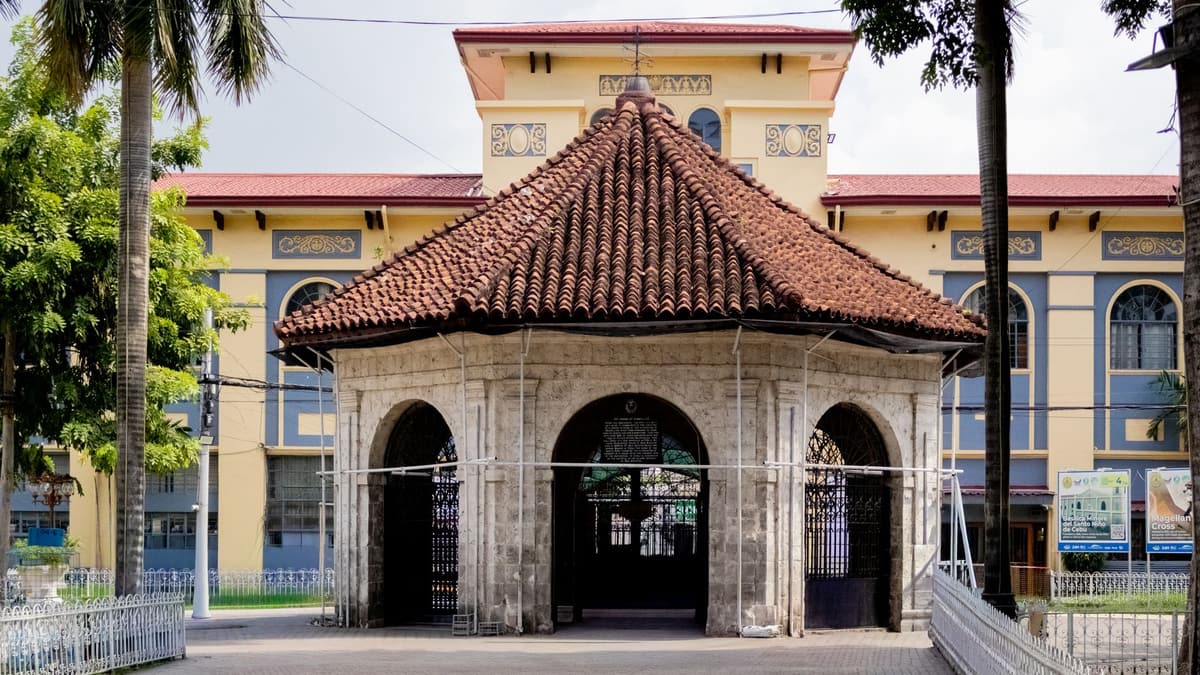
Under the small pavilion in front of you stands a tall wooden cross, and on the ceiling above it a painting shows the scene it remembers. Ferdinand Magellan, a Portuguese captain sailing for Spain, reached Cebu in April 1521 on the first voyage to cross the Pacific. The ruler of Sugbo, Rajah Humabon, received him as a trading partner and ally, and about a week later Humabon, his wife and hundreds of his people were baptized. A cross was planted to mark the day. A sign here says the original is sealed inside the wooden one you see, to protect it from pilgrims who once chipped off pieces to keep as relics; historians are less sure how much of it survives. Magellan's welcome did not last. He demanded that the chiefs of nearby Mactan, the island across the channel, submit to Spain, and one of them, Lapulapu, refused. On April 27, 1521, Magellan waded ashore at Mactan with a small force and was killed in the shallows. His fleet limped on without him, and a single ship, under Juan Sebastián Elcano, made it home to Spain in 1522, completing the first voyage around the world. Filipinos remember Lapulapu as the first of their people to turn back a European invader, and the city on Mactan, where Cebu's airport is, now bears his name. Before you go, notice who is here: pilgrims lighting candles, families taking photos, vendors selling candles and rosaries. From the cross, walk north with the walls of the basilica on your left, then jog right at the corner, and in about four minutes the white front of the cathedral appears.
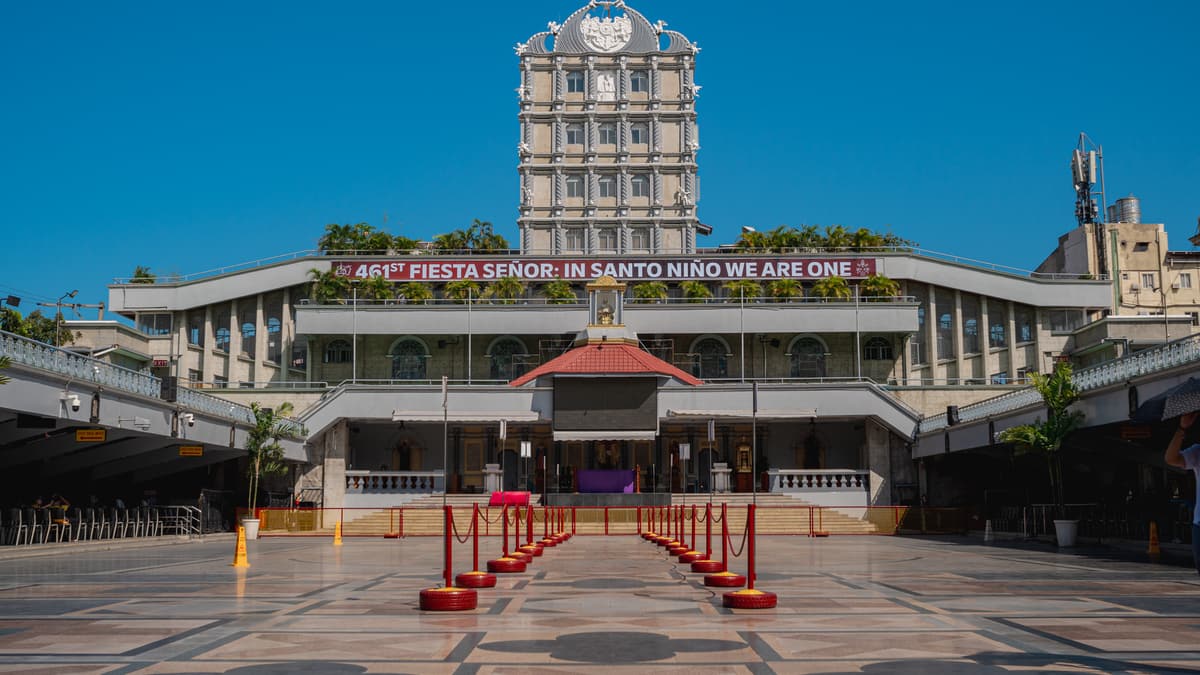
You have just walked past the Basilica Minore del Santo Niño, and its story belongs here, before the cathedral's. When Legazpi's men came ashore in 1565, a soldier searching a burned house found a small wooden statue of the Christ Child in a box. It was taken to be the very image Magellan had given Humabon's wife forty-four years before, apparently kept by the people of Sugbo all that time. The Augustinian friars built their church on the spot where it was found, and the Santo Niño has been Cebu's most beloved image ever since, the oldest Christian relic in the country. Every January the Sinulog festival fills the city with drums and dancers in its honor, and on any day you will see candle sellers outside the basilica swaying in a slow prayer dance on behalf of their customers. The building in front of you now is Cebu Metropolitan Cathedral, the seat of the archbishop and the mother church of a diocese founded in 1595. Its white facade and the bell tower beside it belong to a church that rose slowly through the Spanish centuries and was badly damaged in the Second World War, then restored in the years that followed. Step in if a service is not under way, and the nave is cool and calm after the streets. The old buildings beside it hold the archdiocese's museum of religious art, worth a look if it is open. From the cathedral, walk north for about five minutes, through the busy blocks of downtown, until a great sculpture rises from a small plaza ahead.
포함 사항
저희 투어는 명상하듯 몰입할 수 있도록 만들어졌습니다. 걸으며 그저 귀 기울이시면 됩니다. 함께하면 언제나 더 좋고, 앱이 나레이션을 동기화해 재생하므로 당신과 파트너, 친구들이 모든 스톱을 같은 순간에 들을 수 있습니다.
You are now in Parian, and the sculpture in front of you is the Heritage of Cebu Monument, the work of the Filipino sculptor Eduardo Castrillo, unveiled around the turn of this century.
이 스톱의 나머지 내용은 전체 오디오 투어에 있습니다.
Casa Gorordo is one of the finest surviving examples in Cebu of the bahay na bato, the stone house that well-off families built across the islands in the Spanish era. Stand back on the pavement and read it from the bottom up.
이 스톱의 나머지 내용은 전체 오디오 투어에 있습니다.
The walk ends at Museo Sugbo, and the building gives away its first job as soon as you look at it: high coral-stone walls, a heavy gate and a courtyard ringed with cells.
이 스톱의 나머지 내용은 전체 오디오 투어에 있습니다.
다음 예정된 투어에서 다른 사람들과 함께 이 산책을 해보세요.
약 2.5km, 여유로운 페이스로 대략 35분 소요 · 6 정류장
친구는 무료로 함께 걸어요October 11, 2026 · 9 min read
From the Hollandsche Schouwburg through the old Jewish Quarter, past the Dockworker and the Dam, to the Anne Frank House on the Prinsengracht.
October 11, 2026 · 11 min read
From Van Houten's street by the Vondelpark past Leidseplein, the Rijksmuseum passage and the famous canal bench to the Anne Frank House.

October 11, 2026 · 10 min read
Follow the last days of April and May 1945 from the Anhalter Bahnhof ruin past the Gestapo site and Brandenburg Gate to the Moltke Bridge and the Reichstag.
