
October 11, 2026 · 9 min read
Amsterdam Anne Frank Walking Tour
From the Hollandsche Schouwburg through the old Jewish Quarter, past the Dockworker and the Dam, to the Anne Frank House on the Prinsengracht.
589

October 9, 2026 · 10 min read

 친구는 무료로 함께 걸어요
모든 투어는 앱에서 참여할 수 있는 정기 그룹 걷기 모임으로도 운영됩니다.
Malacca의 오디오 투어 더 보기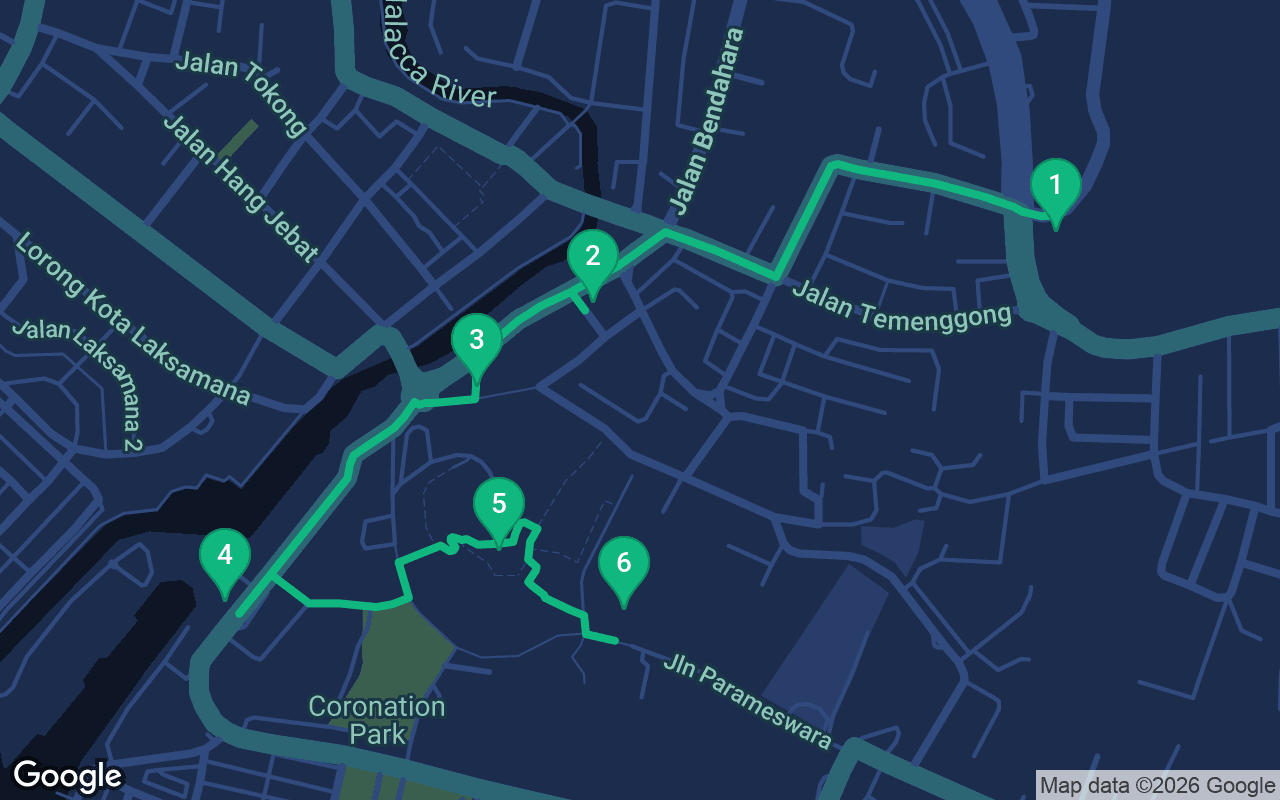
약 2.1km, 여유로운 페이스로 대략 31분 소요.
음성 가이드가 포함된 투어입니다
처음 3개 스톱에서 재생을 누르면 여기에서 나레이션을 30초 데모로 들을 수 있습니다. 앱에서는 인트로와 이 스톱들을 무료로 끝까지 들으실 수 있으며, 각 스톱에 도착하면 알림음이 울립니다. 전체 오디오 투어는 $7.99에 한 번만 구매하시면 평생 소장하실 수 있습니다.
Garmin, Komoot, Strava, OS Maps 및 모든 GPX 앱과 호환됩니다.
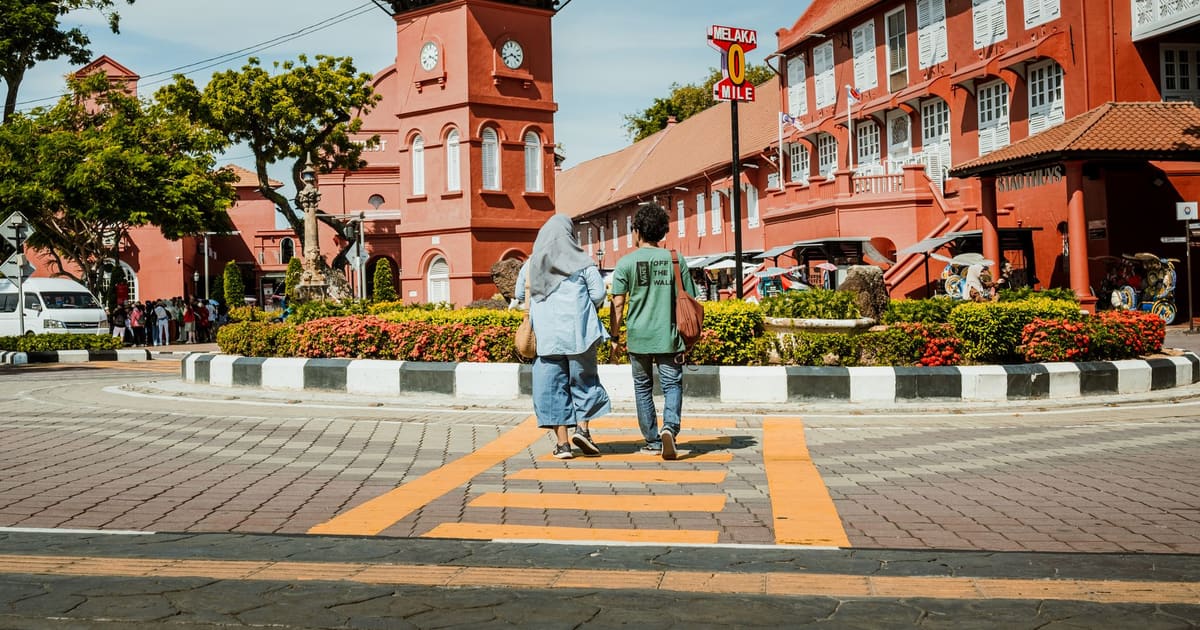
Around 1400, a prince from Sumatra named Parameswara settled at the mouth of a small river on the west coast of the Malay peninsula, and within a few decades his town was one of the great ports of Asia, where ships from China, India and Arabia met to trade spices, silk and porcelain. Everyone wanted it. The Portuguese took Malacca in 1511, the Dutch in 1641 and the British after them, and each left its mark on the low hill above the river. This short walk, about two kilometers, follows five centuries of that history. It starts on Bukit China, the hill of the old Chinese community, passes a Gothic church and the red buildings of Dutch Square, visits a replica Portuguese galleon by the river, climbs to a ruined church on the hilltop and comes down to the place where Malaysia's independence was announced. You will see the name written both ways, Malacca and Melaka, the Malay spelling used on most signs, and it is one of the most rewarding self-guided walking tours in Malaysia.
Allow about an hour of walking, and half a day if you go into the churches and museums. The distance is short but Malacca is hot and very humid all year, so start early, ideally around eight, when the light on Dutch Square is lovely and the tour buses have not yet arrived. Carry plenty of water and wear a hat. There are two climbs. Bukit China is a steep hill of graves, and you can stay at its foot or walk up as far as you like, and St Paul's Hill is a short, steady climb up steps, with little shade at the top. Afternoon thunderstorms are common, often arriving quickly after a bright morning, so keep an umbrella handy and wait them out in a museum or café. Christ Church and St Francis Xavier's Church are working churches, so dress modestly and be quiet inside, especially during services. The museums keep their own hours and sometimes close for a day each week, so check before you go. The old town is a UNESCO World Heritage Site, and on weekends and holidays it fills up fast, so a weekday morning is best.
You are standing at the foot of Bukit China, Chinese Hill, a green slope covered in thousands of old graves, many shaped like horseshoes and set into the hillside to look out over the town. It is often said to be the largest and oldest Chinese cemetery outside China, and some of its graves go back to the 1600s. The hill's story starts with a legend. The Malay Annals, the old court chronicle of Malacca, tell how a Ming emperor sent a princess, Hang Li Po, to marry Sultan Mansur Shah in the fifteenth century, and how her hundreds of attendants were given this hill to live on. No Chinese record confirms the marriage, but the Chinese fleets of Admiral Zheng He did call at Malacca in those years, and the hill became the heart of the town's Chinese community. Beside you is the small red temple of Poh San Teng, built in the late 1700s, and next to it the Sultan's Well, which legend says was dug for the princess's household. People still toss coins into it, because it is said that whoever does so will return to Malacca. In the 1980s, the state planned to level the hill for development, and a determined campaign by the Chinese community saved it. Walk up a little way if you like, then come down and head west toward the old town, with the hill behind you, for about eight minutes. Two tall church spires rise ahead on Jalan Laksamana.
 In front of you stand the twin spires of St Francis Xavier's Church, a Gothic church in pale stone that would look at home in a French town. That is no accident. It was begun in 1849 by a French priest, and its pointed arches and stained glass are a very European sight among the shophouses of Malacca. The church honors Francis Xavier, the Spanish Jesuit who was one of the most traveled missionaries of his age, and who made Malacca his base in Asia. He arrived in 1545 and passed through several times, teaching and preaching. In 1547, here in Malacca, he met a Japanese man named Anjiro, sometimes written Yajiro, whose stories about his country persuaded Xavier to go there. Xavier sailed from Malacca for Japan in 1549, taking Anjiro with him, and became one of the first Christian missionaries to reach the country. He never forgot this town, and the town has not forgotten him either, as you will see again later on the walk. If the doors are open, step inside for a minute to see the high, cool nave and the colored light. Malacca's Catholic community, including many Portuguese Eurasians whose families have been here for centuries, still worships here. Then walk southwest along Jalan Laksamana for about two minutes. The road opens onto a square painted deep red.
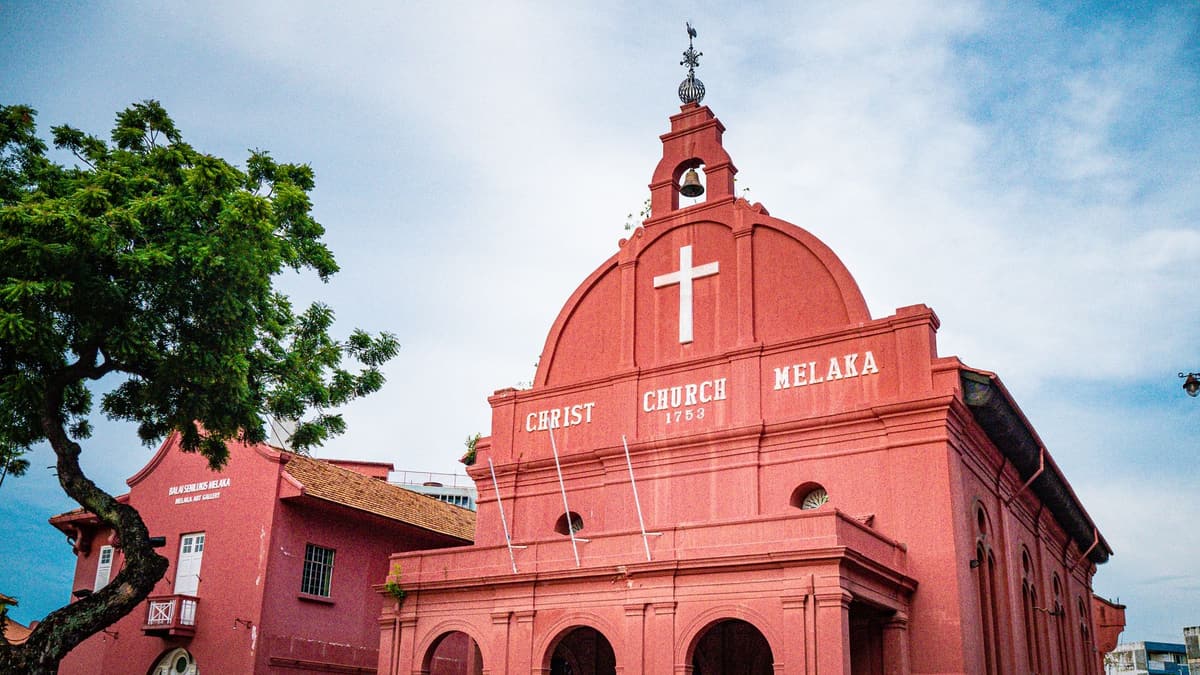
Welcome to Dutch Square, the most photographed spot in Malacca, where almost everything is painted the color of terracotta. The Dutch captured Malacca from the Portuguese in 1641, after a long siege fought with the help of the Malay sultanate of Johor, and ruled it for more than a century and a half. The big building climbing the hillside ahead of you and to the left is the Stadthuys, the town hall and governor's residence, built in the mid 1600s and often described as the oldest surviving Dutch building in the East. Today it holds a museum of history and ethnography. The church you passed as you came in is Christ Church, finished in 1753 to mark a hundred years of Dutch rule. Its heavy ceiling beams are said to have each been cut from a single tree, without a joint. It is now an Anglican church, and it is still in use. In the middle of the square stand a clock tower, a gift from a wealthy Chinese family in the 1880s, and a fountain honoring Queen Victoria, both from the British years. For much of their history these buildings were white, and the bold red came later, under British rule. Around you, trishaws decorated with plastic flowers, fairy lights and cartoon characters wait for riders, often blasting pop music. Then walk southwest from the square, keeping the river on your right, for about five minutes. A great wooden ship rises ahead.
포함 사항
저희 투어는 명상하듯 몰입할 수 있도록 만들어졌습니다. 걸으며 그저 귀 기울이시면 됩니다. 함께하면 언제나 더 좋고, 앱이 나레이션을 동기화해 재생하므로 당신과 파트너, 친구들이 모든 스톱을 같은 순간에 들을 수 있습니다.
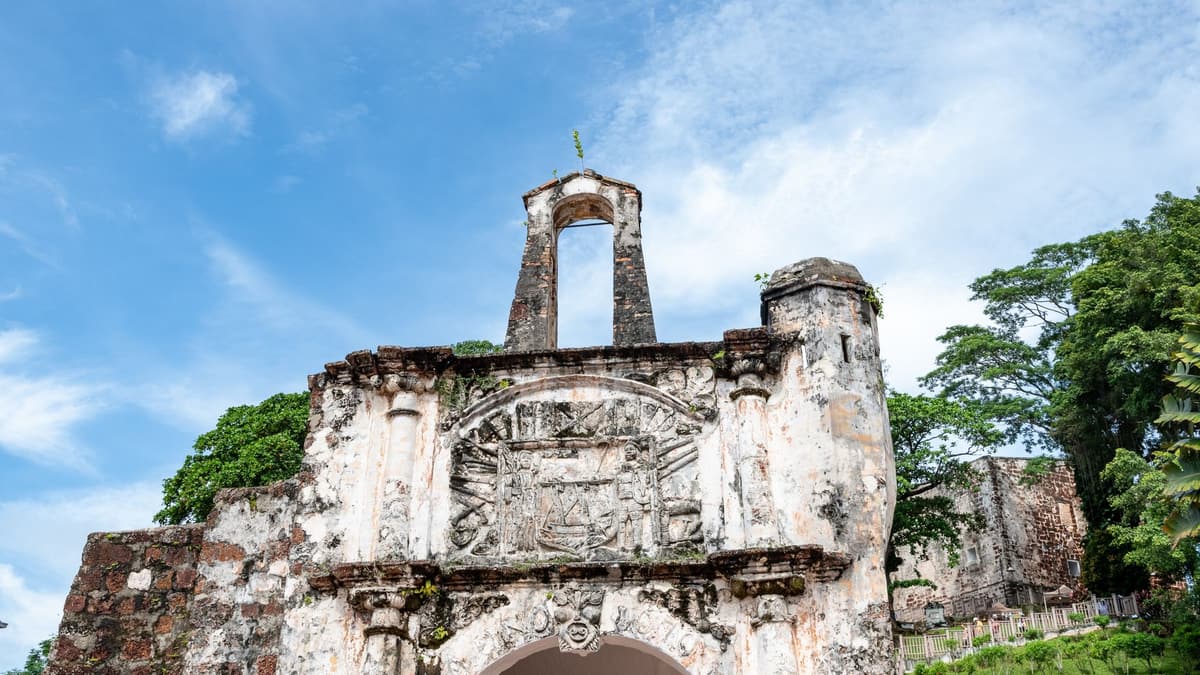
You cannot miss it: the tall wooden hull of a Portuguese carrack, its masts towering over the riverbank. This is a full size replica of the Flor de la Mar, and it holds the Maritime Museum, which opened here in 1994.
이 스톱의 나머지 내용은 전체 오디오 투어에 있습니다.
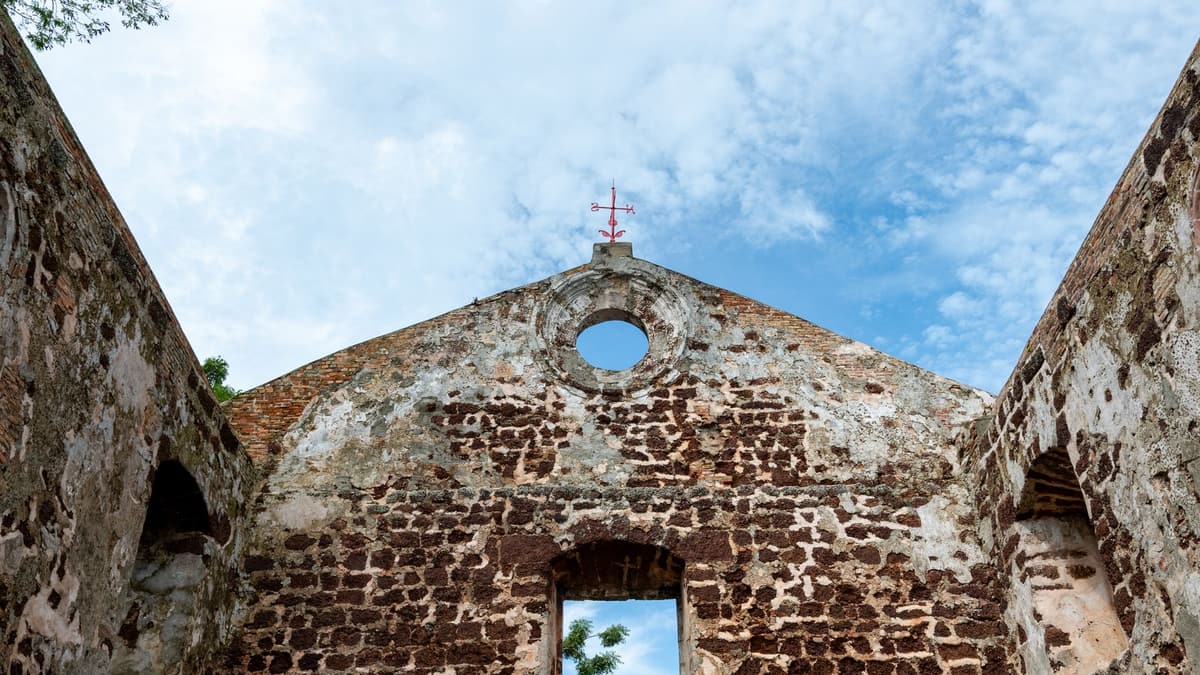
You are on top of St Paul's Hill, standing in a roofless church of weathered stone, open to the sky. This hill was the heart of the Malay sultanate, where tradition places the sultan's palace.
이 스톱의 나머지 내용은 전체 오디오 투어에 있습니다.
The walk ends at the Proclamation of Independence Memorial, a graceful white building with two onion domes.
이 스톱의 나머지 내용은 전체 오디오 투어에 있습니다.
다음 예정된 투어에서 다른 사람들과 함께 이 산책을 해보세요.
약 2.1km, 여유로운 페이스로 대략 31분 소요 · 6 정류장
친구는 무료로 함께 걸어요October 11, 2026 · 9 min read
From the Hollandsche Schouwburg through the old Jewish Quarter, past the Dockworker and the Dam, to the Anne Frank House on the Prinsengracht.
October 11, 2026 · 11 min read
From Van Houten's street by the Vondelpark past Leidseplein, the Rijksmuseum passage and the famous canal bench to the Anne Frank House.

October 11, 2026 · 10 min read
Follow the last days of April and May 1945 from the Anhalter Bahnhof ruin past the Gestapo site and Brandenburg Gate to the Moltke Bridge and the Reichstag.
