
October 11, 2026 · 9 min read
Amsterdam Anne Frank Walking Tour
From the Hollandsche Schouwburg through the old Jewish Quarter, past the Dockworker and the Dam, to the Anne Frank House on the Prinsengracht.
589

October 9, 2026 · 10 min read

 친구는 무료로 함께 걸어요
모든 투어는 앱에서 참여할 수 있는 정기 그룹 걷기 모임으로도 운영됩니다.
Munich의 오디오 투어 더 보기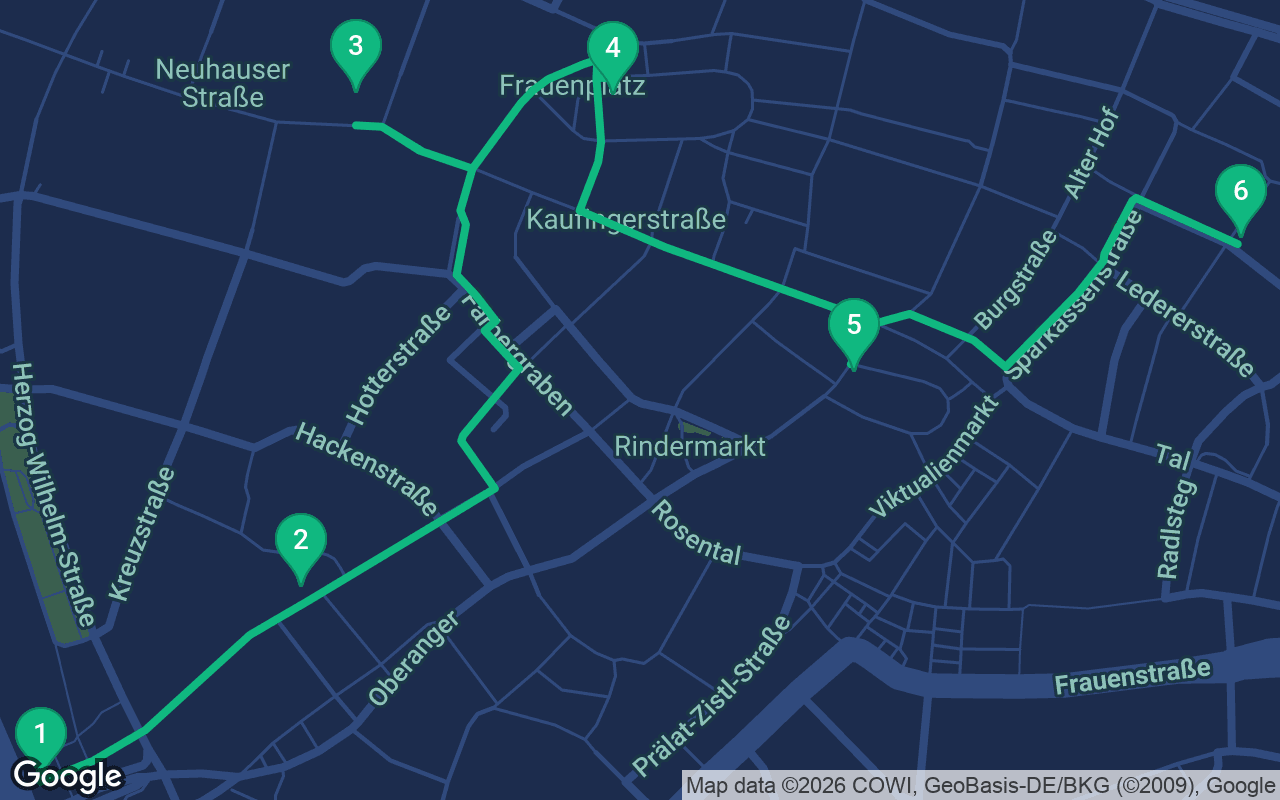
약 1.9km, 여유로운 페이스로 대략 26분 소요.
음성 가이드가 포함된 투어입니다
처음 3개 스톱에서 재생을 누르면 여기에서 나레이션을 30초 데모로 들을 수 있습니다. 앱에서는 인트로와 이 스톱들을 무료로 끝까지 들으실 수 있으며, 각 스톱에 도착하면 알림음이 울립니다. 전체 오디오 투어는 $6.99에 한 번만 구매하시면 평생 소장하실 수 있습니다.
Garmin, Komoot, Strava, OS Maps 및 모든 GPX 앱과 호환됩니다.
Munich's old town is small enough to cross in twenty minutes and rich enough to fill a whole day. This walk enters it the way travelers did in the Middle Ages, through one of the old city gates, then threads past a tiny Baroque church that glows like a jewelry box, the great Jesuit church where a famous king lies buried, and the twin onion domes of the cathedral. From Marienplatz, the city's main square, you climb toward Old Peter, the oldest parish church in town, and finish with a stroll through the food market to the most famous beer hall in the world. It is about two kilometers, flat and easy, and one of the most satisfying self-guided walking tours you can do in an afternoon. Along the way you will meet the same Bavarian duke more than once, and he turns out to be behind both a great church and the beer.
The walking takes well under an hour, but allow two to three hours with church visits, a look around the food market and a climb of Old Peter's tower. The streets are flat and almost all pedestrianized, though the old cobbles can be uneven. The central shopping streets get very crowded on Saturdays and around midday, so a weekday morning start gives you the churches in peace. The churches are working places of worship, so keep your voice low inside, dress modestly and step back during services. The tower climb at St. Peter's and the royal crypt at St. Michael's usually charge a small fee and keep their own hours, so check before you go. In summer the stone squares soak up the heat, but there is shade in the narrow side streets and the market's chestnut trees. In winter the Christmas market fills Marienplatz and the surrounding streets, which is magical but slow going. And save your appetite for the end, because the walk finishes among sausages, pretzels and very large glasses of beer.
You are standing in front of Sendlinger Tor, one of the gates of medieval Munich. Two stout towers of brick flank a single wide arch, and behind them the old town begins. The towers date from the fourteenth century, when Munich built a second, larger ring of walls as the town outgrew its first. The gate took its name from Sendling, the village to the southwest, because the road through here led out toward it. Three of Munich's old gates survive, this one, the Karlstor to the north and the Isartor to the east, and together they mark where the city wall once ran. The walls themselves came down around two hundred years ago, as the city burst its old limits, and the ring of busy roads you crossed to get here follows their line. The tall central gate tower that once rose between these two is gone too. In 1906 the three narrow passages here were replaced with the one big arch you see now, so that trams and carts could get through. Stand under it for a moment and look along the street ahead. That is Sendlinger Strasse, once the road into town for farmers bringing goods to market, and now a long, pedestrian shopping street lined with old townhouses. Walk through the arch and up Sendlinger Strasse for about four minutes. Keep watching the houses on both sides, and look for a narrow church facade squeezed between them, its base carved to look like rough rock.
 This narrow facade belongs to the Asam Church, officially the church of St. John of Nepomuk, and it is one of the great surprises of Munich. It was built from 1733 by two brothers, Egid Quirin Asam, a sculptor and stucco artist, and Cosmas Damian Asam, a painter, who had spent their careers decorating churches for other people. Here they decided to build one for themselves, right next to Egid Quirin's own house, and to pay for it themselves, so nobody could tell them to hold back. Above the rocky base and the door stands St. John of Nepomuk, a Bohemian priest who was thrown from a bridge into the river in Prague. Step inside, and give your eyes a moment. The church is tiny, only about eight meters wide, and every surface is covered: twisting dark columns, gilded figures, marble, stucco and painted sky. The brothers worked with light like stage designers. The lower part of the church is deliberately dim, and the light grows brighter as your eye rises, until it pours onto the Holy Trinity above the high altar through windows you cannot see from below, as if heaven were opening above you. The brothers meant this as their private chapel, but the people of Munich insisted on being let in, and it has been open to all ever since. It is said that Egid Quirin could look straight down onto the altar from a window in his house next door. When you are done, come back out and head north through the side streets of the old Hacken quarter. In about six minutes you reach the busy pedestrian shopping street, Neuhauser Strasse, with a tall, pale church front ahead of you.
This is St. Michael's Church, built by the Jesuits in the late sixteenth century, and it is the largest Renaissance church north of the Alps. It was paid for by Duke Wilhelm V of Bavaria, a deeply religious ruler who wanted a monument to the Catholic faith at a time when much of Germany had turned Protestant. Look up at the facade. Between the two doorways, a bronze Archangel Michael is slaying a demon, and above him stand statues of Bavarian rulers, a reminder that this church celebrated the dynasty as much as the faith. During construction, in 1590, the tower collapsed, and the duke took it as a sign that the church should be even bigger, so the plans grew. Inside, the vast white barrel vault spans the nave without a single supporting pillar, one of the widest of its kind in the world. Look for the grand monument to Eugène de Beauharnais, Napoleon's stepson, who married a Bavarian princess and settled in Munich; it was carved by the Danish sculptor Bertel Thorvaldsen. Below the choir lies the royal crypt, where members of the Wittelsbach family who ruled Bavaria for more than seven hundred years are buried. The most visited coffin belongs to King Ludwig II, the dreamer who built Neuschwanstein and died mysteriously in Lake Starnberg in 1886. There are usually fresh flowers on it. From the church, walk east along the shopping street for a minute, then turn left into Augustinerstrasse. Look for the bronze wild boar outside the hunting and fishing museum on the corner, with its snout rubbed shiny by passing hands. In two or three minutes the cathedral's towers rise ahead.
포함 사항
저희 투어는 명상하듯 몰입할 수 있도록 만들어졌습니다. 걸으며 그저 귀 기울이시면 됩니다. 함께하면 언제나 더 좋고, 앱이 나레이션을 동기화해 재생하므로 당신과 파트너, 친구들이 모든 스톱을 같은 순간에 들을 수 있습니다.
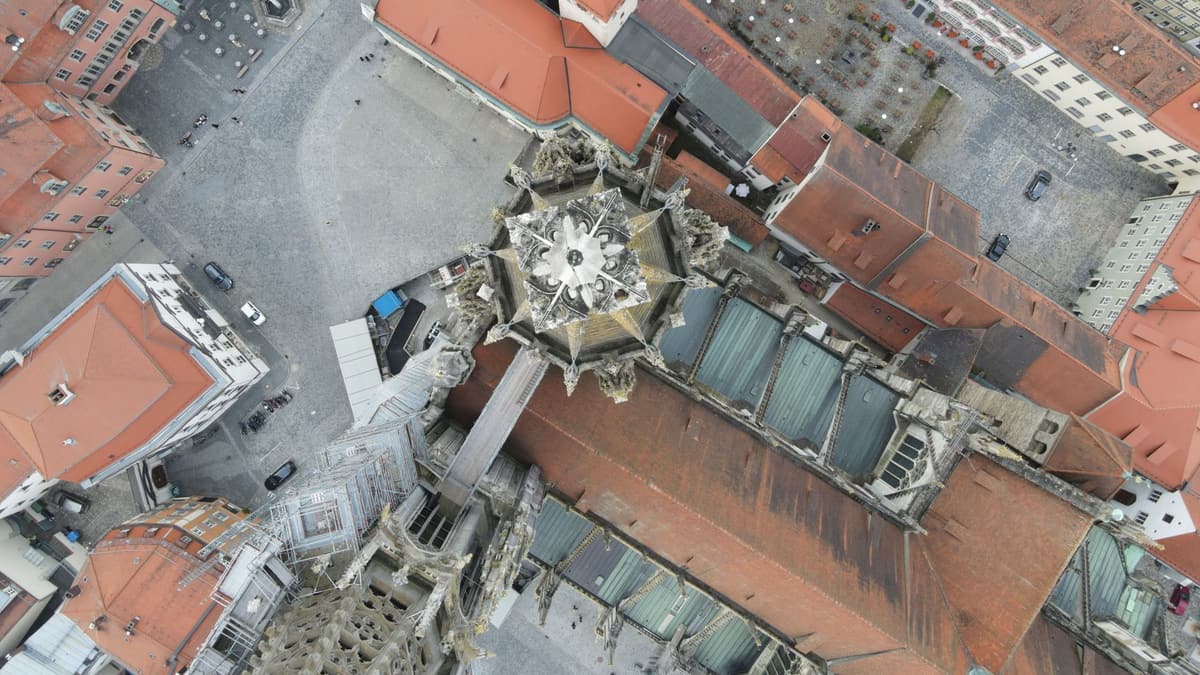
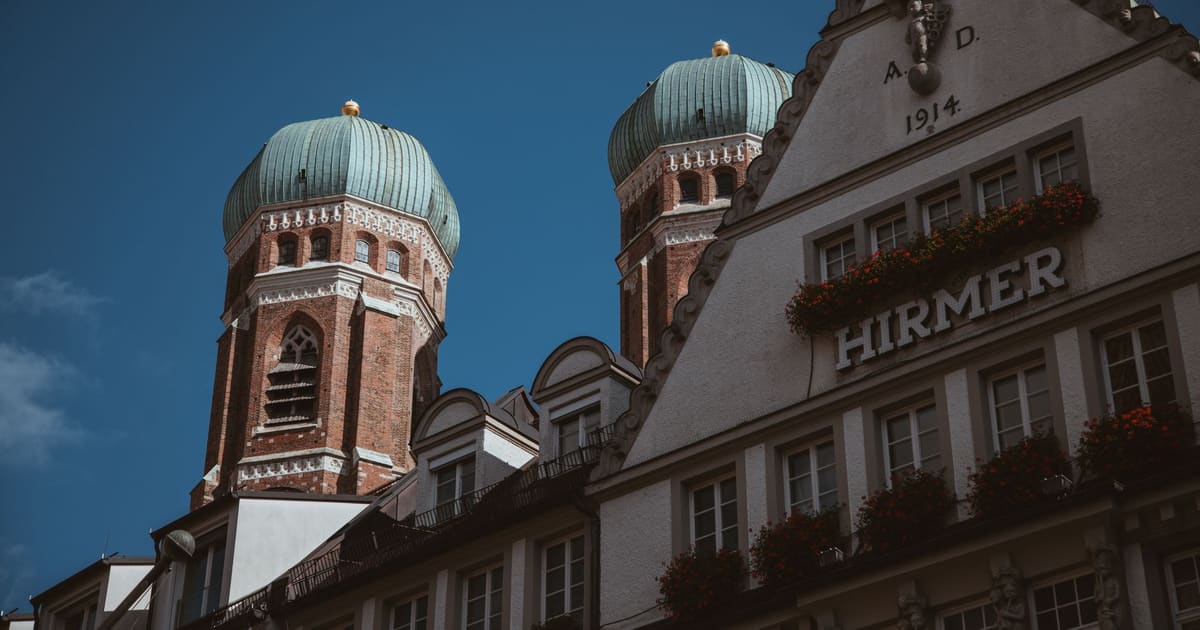
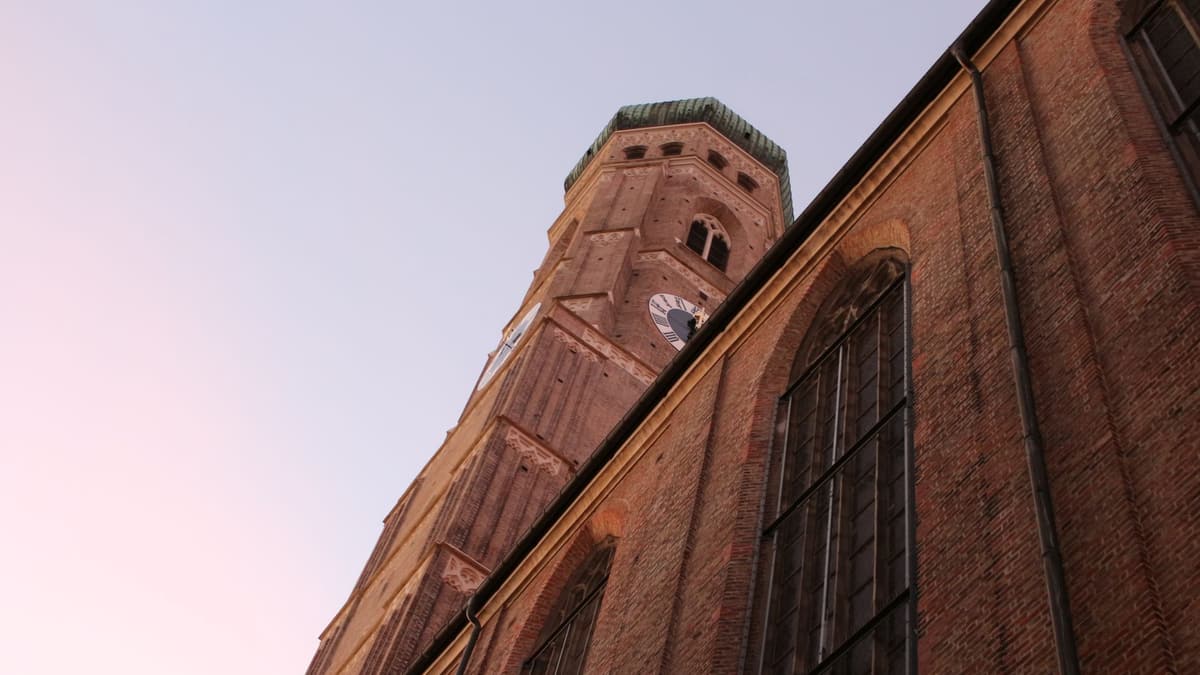
You are standing beneath the Frauenkirche, the Cathedral of Our Dear Lady, and those two towers with their green onion domes are the emblem of Munich.
이 스톱의 나머지 내용은 전체 오디오 투어에 있습니다.
You are at the foot of St. Peter's Church, Alter Peter or Old Peter to locals, the oldest parish church in the city.
이 스톱의 나머지 내용은 전체 오디오 투어에 있습니다.
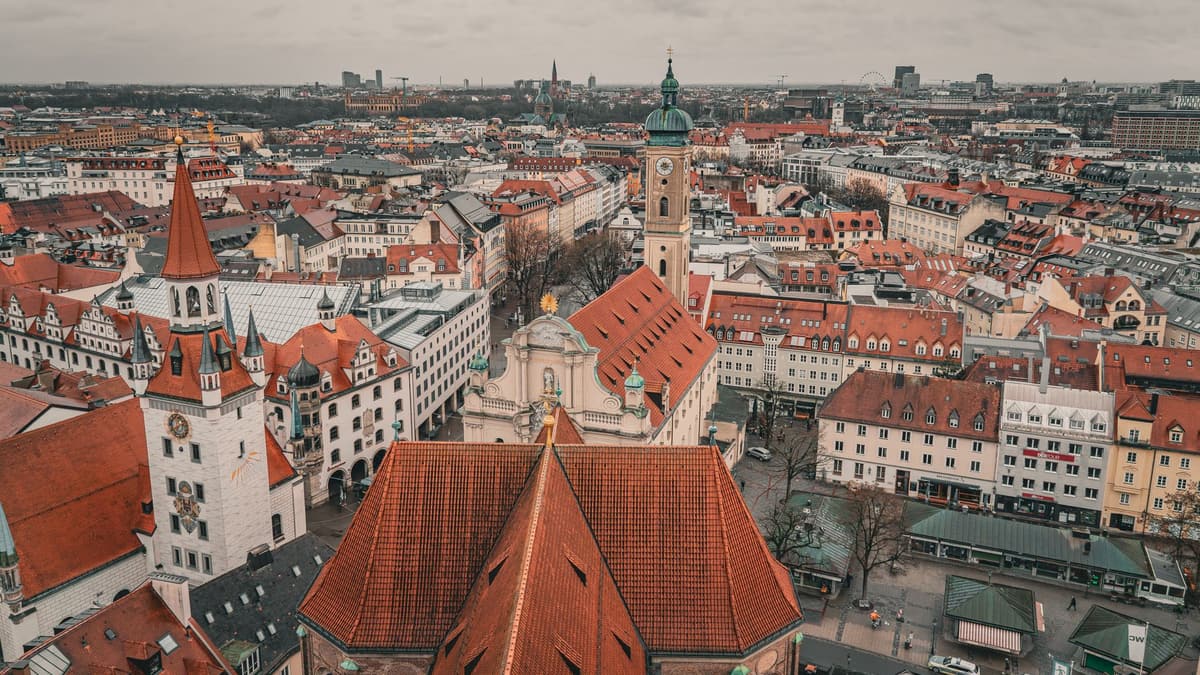
Take your time in the Viktualienmarkt on the way: Munich's open-air food market has traded on this spot since the early nineteenth century, with stalls of cheese, sausages, fruit and flowers under a tall striped maypole, and a beer garden among the trees.
이 스톱의 나머지 내용은 전체 오디오 투어에 있습니다.
다음 예정된 투어에서 다른 사람들과 함께 이 산책을 해보세요.
약 1.9km, 여유로운 페이스로 대략 26분 소요 · 6 정류장
친구는 무료로 함께 걸어요October 11, 2026 · 9 min read
From the Hollandsche Schouwburg through the old Jewish Quarter, past the Dockworker and the Dam, to the Anne Frank House on the Prinsengracht.
October 11, 2026 · 11 min read
From Van Houten's street by the Vondelpark past Leidseplein, the Rijksmuseum passage and the famous canal bench to the Anne Frank House.

October 11, 2026 · 10 min read
Follow the last days of April and May 1945 from the Anhalter Bahnhof ruin past the Gestapo site and Brandenburg Gate to the Moltke Bridge and the Reichstag.
