
October 11, 2026 · 9 min read
Amsterdam Anne Frank Walking Tour
From the Hollandsche Schouwburg through the old Jewish Quarter, past the Dockworker and the Dam, to the Anne Frank House on the Prinsengracht.
589

October 9, 2026 · 9 min read

 Vrienden lopen gratis mee
Elke tour is ook beschikbaar als een geplande groepswandeling waar je in de app aan kunt deelnemen.
Meer audiotours in Delft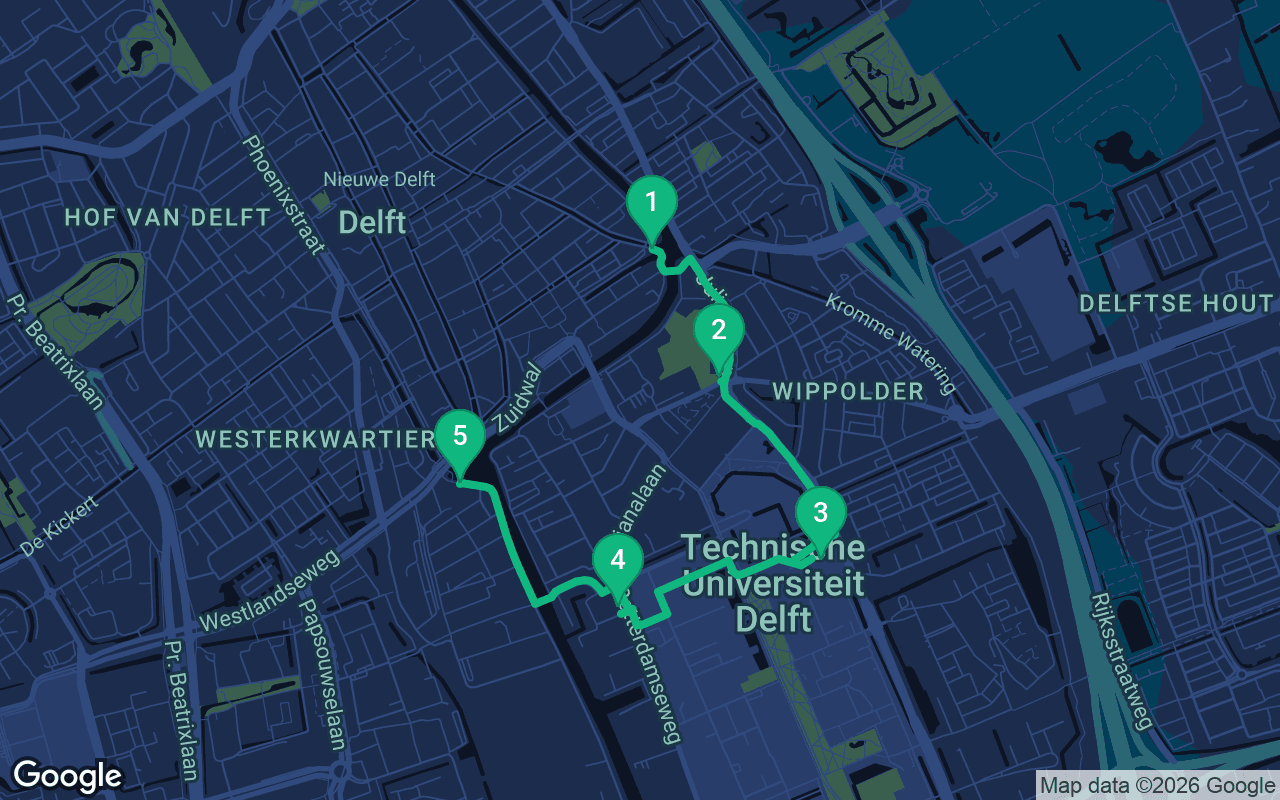
Ongeveer 3 km, zo'n 41 minuten op een rustig tempo.
Deze tour is ingesproken
Druk op afspelen bij de eerste 3 stops voor een demo van 30 seconden van de vertelling. In de app zijn de intro en die 3 stops volledig gratis te beluisteren, en bij elke stop klinkt een signaal zodra je aankomt. De hele tour met gids is van jou voor $8.99, een eenmalige aankoop die je voor altijd behoudt.
Werkt met Garmin, Komoot, Strava, OS Maps en elke GPX-app.
Most visitors to Delft stay inside the ring of canals around the market square, and they miss a side of the town that tells a different story. This walk follows the eastern and southern edge of Delft, from the last of its medieval town gates, through the green campus of the country's oldest technical university, to the pottery that has made Delft blue since the seventeenth century. It ends on the waterside where Johannes Vermeer looked across the old harbor and painted one of the most admired cityscapes in the world. The route is about three kilometers, flat the whole way, and of all our self-guided walking tours of Delft it is the one for anyone curious about how this small town shaped the wider world, from blue and white pottery to modern engineering.
Allow about forty minutes for the walking, and two to three hours with stops, more if you take the full tour at Royal Delft or linger among the glasshouses. The ground is flat and paved, with a few stretches along busy roads and over canal bridges. This is a cycling town, and on and around the university campus the bike traffic can be heavy, especially at the start and end of lectures. Bikes have priority on the bike paths, which are usually paved in red, so stay off the red lanes and look both ways before every crossing. The canal edges have no railings, so keep an eye on children near the water. The botanic garden and Royal Delft both charge admission and keep their own hours, so check before you go. The campus is open and breezy, with less shade than the old town, so bring a hat in summer and a windproof layer the rest of the year. The walk finishes a few minutes from Delft Station, which makes it easy to end with a train back to The Hague or Rotterdam.
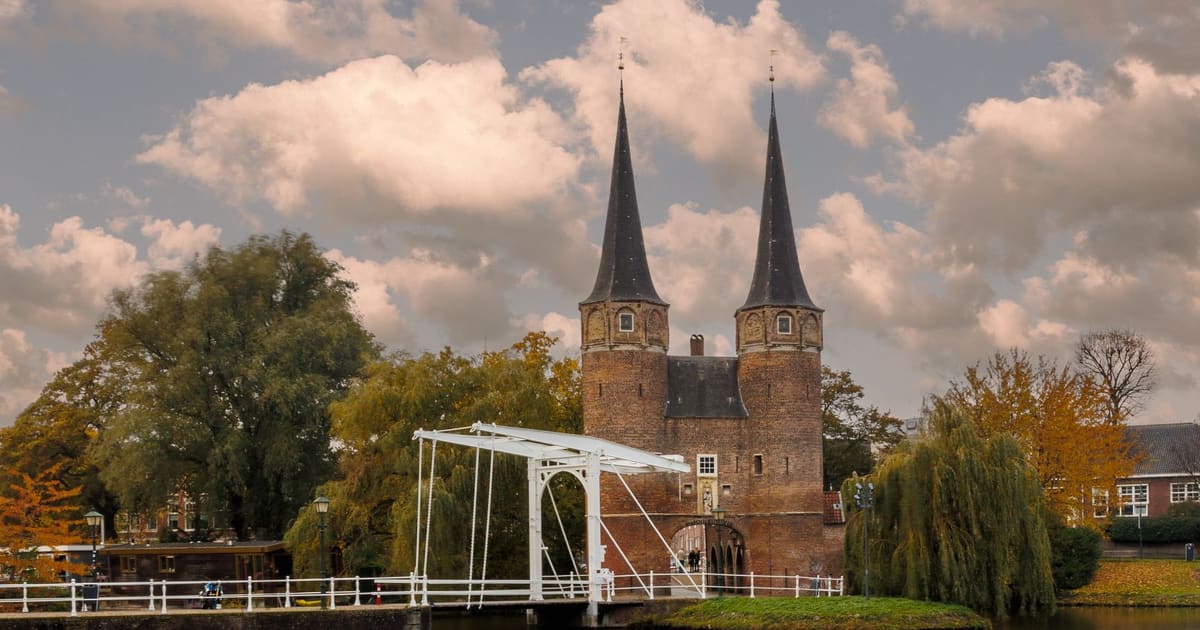
Begin beside the Oostpoort, the East Gate, and find a spot on the water where you can see the whole of it. Two slim towers with tall pointed spires rise side by side over a brick gateway, with a white wooden drawbridge stretched across the canal beside them. It looks almost too pretty to have been built for defense, but that is exactly what it was. In the Middle Ages, Delft was enclosed by walls and a moat, and the gates were where the town controlled who and what came in. Traders paid their tolls here, watchmen checked strangers, and at night the gates were shut. The oldest parts of the Oostpoort go back to around 1400, and the elegant spires were added roughly a century later. Delft once had a whole ring of gates, but as the town outgrew its walls in the nineteenth century they were torn down one after another, and this is the only one left. The canal in front of you follows the line of the old moat, and if you look along it you can picture the walls that once ran beside it. The gate is not a museum, so enjoy it from the outside, ideally from the bridge, where the towers reflect in the water on a still day. Then cross the drawbridge to the far bank and head south for about six minutes to the gates of the botanic garden.
 You have reached the TU Delft Botanic Garden, a peaceful walled garden with glasshouses, ponds and old trees, tucked away on the edge of the university. It feels like a secret, and on a weekday morning you may have it nearly to yourself. The garden belongs to the Delft University of Technology, and it was founded in the early twentieth century with a very particular purpose. At the time, the college in Delft was training engineers and technologists to work in the Dutch colonies in the East Indies, today's Indonesia, and the garden's job was to grow the useful plants of the tropics so students could study them up close. That is why the glasshouses here are still full of plants that people eat, drink, wear or build with: crops behind familiar things like coffee, tea, spices and rubber, growing a long way from the plantations that once made the Netherlands rich. Step inside a glasshouse if the garden is open, and the warm, wet air hits you at once. Outside, the gardens are laid out for strolling, with benches beneath the trees and a pond with water plants. It is a small place, but a good reminder that Delft's connections reached across the oceans. Check opening times before you go. From here, head south into the university campus, following the main avenue between the faculty buildings, for about nine minutes, until you see a vast slab of concrete and a lawn that slopes up into the sky.
Stand in front of the library and you may wonder at first where the building is. The TU Delft Library looks like a lawn: a huge sloping roof of grass that rises gently from the ground, with a tall white cone poking up through the middle. It was designed by the Delft architecture practice Mecanoo and opened in the late 1990s, and it quickly became one of the landmarks of modern Dutch architecture. The reason for the design sits right across from you. That great angular concrete hall is the Aula, the university's main auditorium, built in the 1960s and looking rather like a spaceship that has just touched down. The architects did not want a big new building blocking the view of it, so they tucked the library into the ground and planted its roof with grass. On sunny days students climb the slope to read, nap and eat lunch up there. Inside, if you can step in, a towering wall of books runs the full height of the hall, and the cone holds study floors stacked one above another, glowing at night like a lantern. The university itself goes back to 1842, when King William II founded a royal academy here to train civil engineers, and it has grown into the largest technical university in the country. From here, walk west out of the campus and cross the broad canal, the Schie, the old waterway that runs south toward Rotterdam, about nine minutes, to the pottery on its far side.
Wat er inbegrepen is
Onze tours zijn bedoeld om meditatief en meeslepend te zijn: je blijft in beweging en luistert gewoon. Samen zijn ze altijd beter, en de app speelt de vertelling synchroon af, zodat jij, je partner en je vrienden elke stop op hetzelfde moment horen.
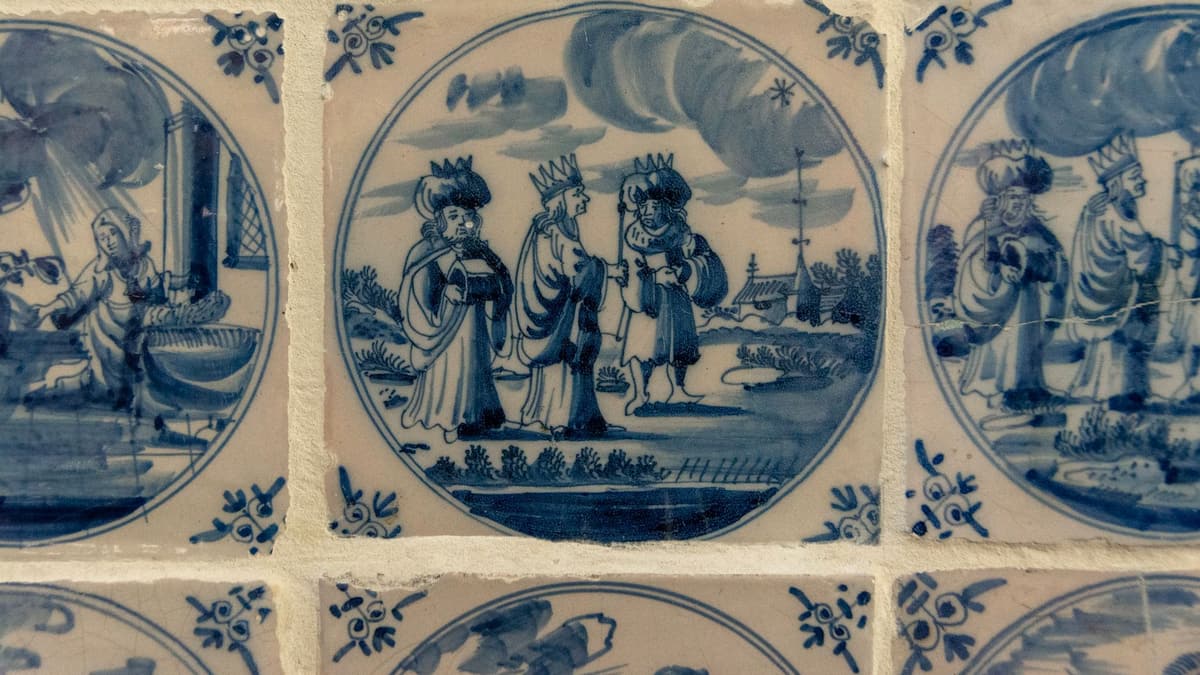
In front of you is Royal Delft, the last of the town's seventeenth-century potteries still at work, and the place where the story of Delft blue comes together.
De rest van deze stop zit in de volledige audiotour.
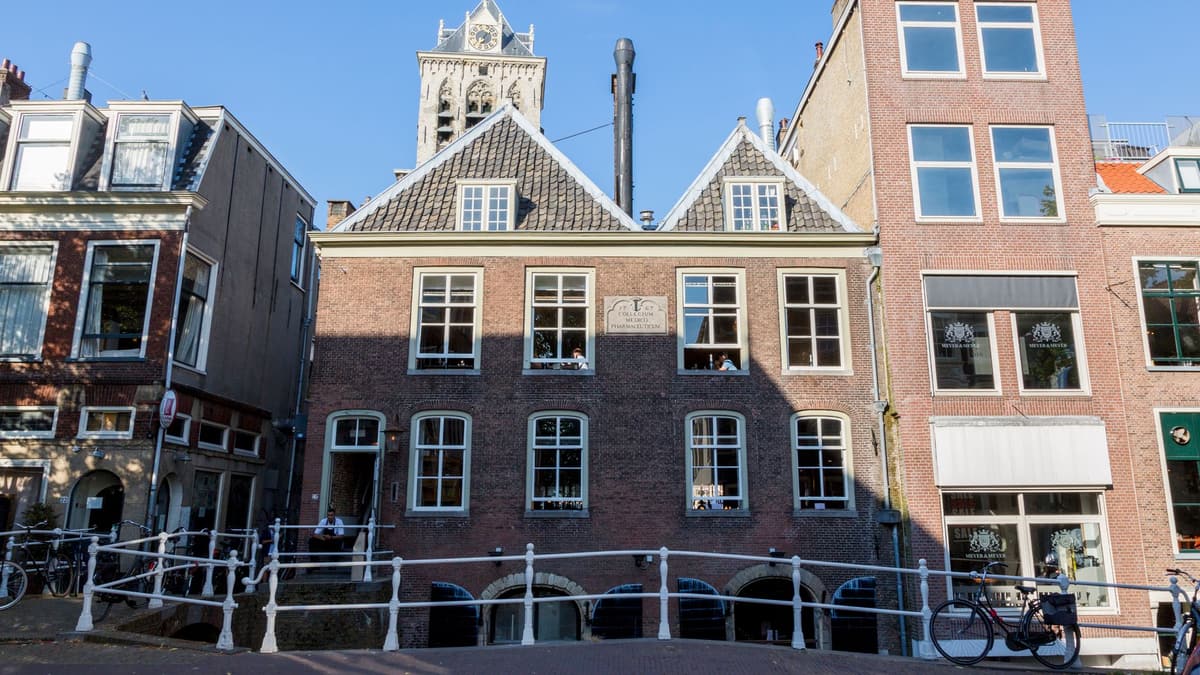
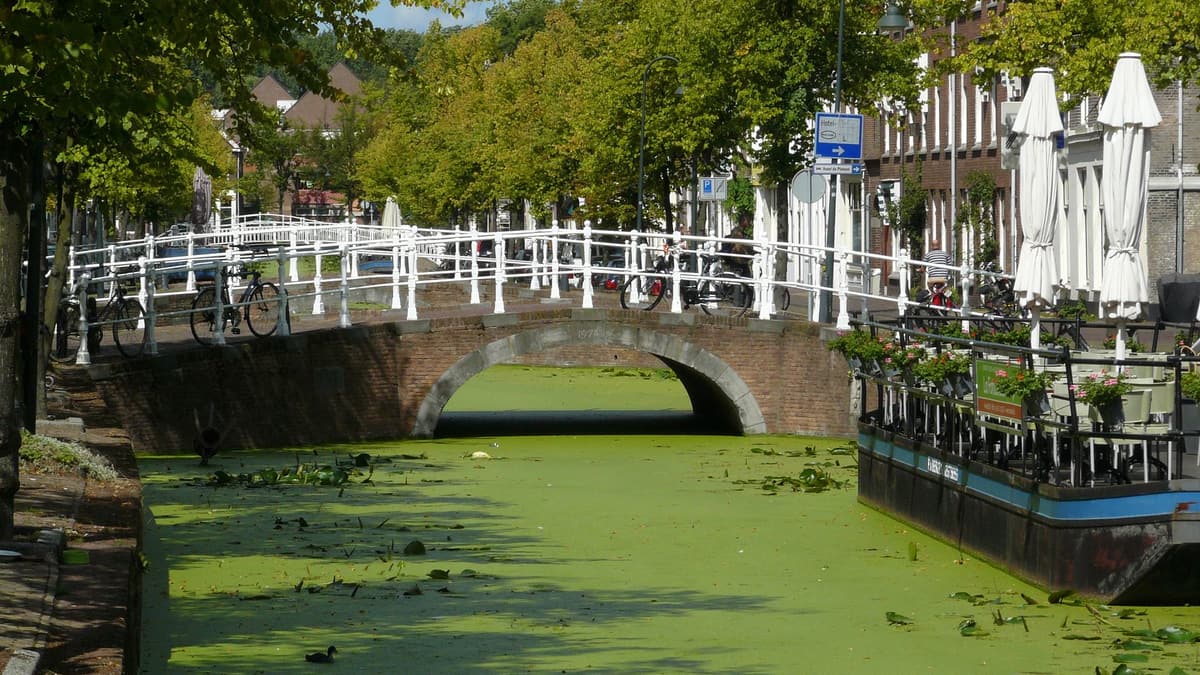
The walk ends on the bank of the Kolk, the old harbor basin at the southern edge of the town, and this is where Johannes Vermeer found the subject of his most famous landscape. Face north across the water.
De rest van deze stop zit in de volledige audiotour.
Doe deze wandeling samen met anderen tijdens de eerstvolgende geplande tour.
Ongeveer 3 km, circa 41 minuten in een rustig tempo · 5 stops
Vrienden lopen gratis meeOctober 11, 2026 · 9 min read
From the Hollandsche Schouwburg through the old Jewish Quarter, past the Dockworker and the Dam, to the Anne Frank House on the Prinsengracht.
October 11, 2026 · 11 min read
From Van Houten's street by the Vondelpark past Leidseplein, the Rijksmuseum passage and the famous canal bench to the Anne Frank House.

October 11, 2026 · 10 min read
Follow the last days of April and May 1945 from the Anhalter Bahnhof ruin past the Gestapo site and Brandenburg Gate to the Moltke Bridge and the Reichstag.
