
October 11, 2026 · 9 min read
Amsterdam Anne Frank Walking Tour
From the Hollandsche Schouwburg through the old Jewish Quarter, past the Dockworker and the Dam, to the Anne Frank House on the Prinsengracht.
589

October 8, 2026 · 12 min read

 Друзі гуляють безкоштовно
Кожен тур також доступний як запланована групова прогулянка, до якої можна приєднатися в додатку.
Більше аудіотурів у Boston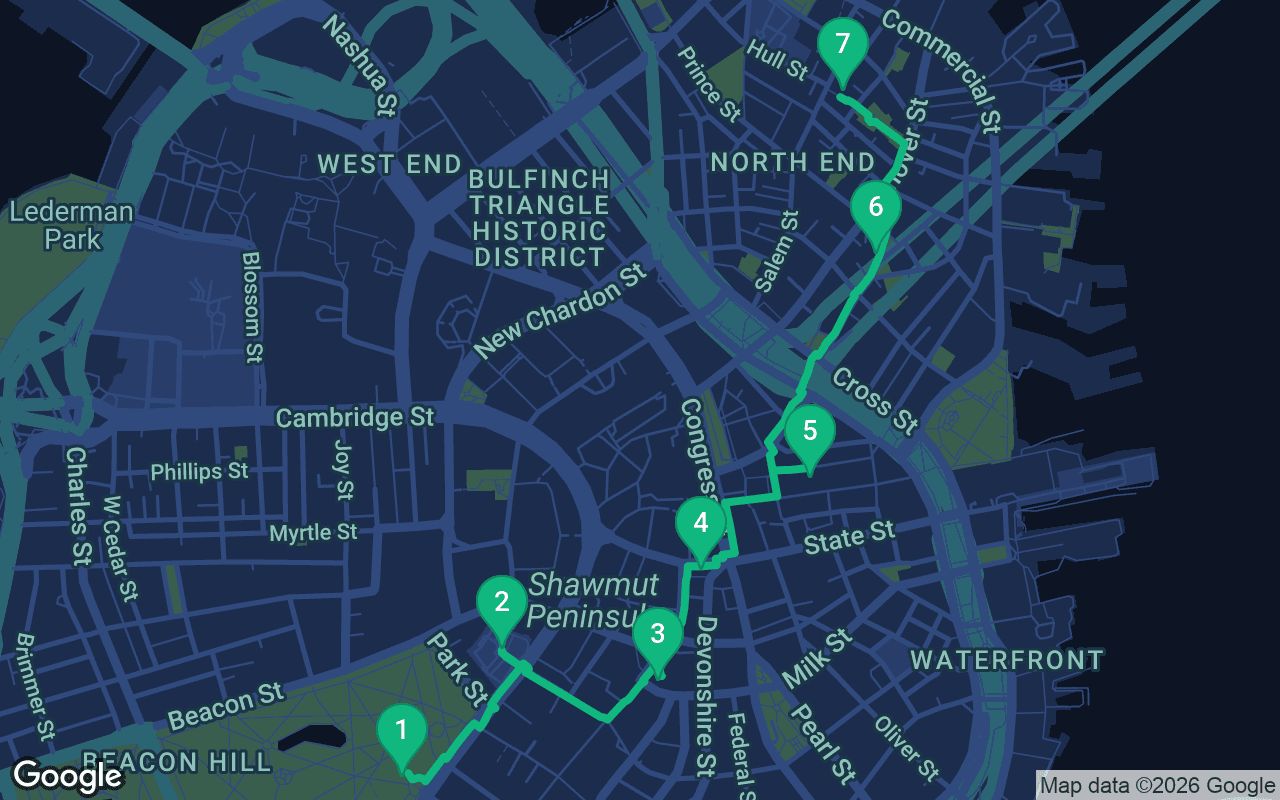
Приблизно 2,3 км, приблизно 33 хвилин у легкому темпі.
Цей тур озвучено
Натисніть відтворення на перших 3 зупинках, щоб послухати 30-секундний фрагмент розповіді. У додатку вступ і ці зупинки звучать повністю й безкоштовно, а про кожну з них вас сповістить звуковий сигнал, щойно ви прибудете. Весь тур із розповіддю буде вашим за $7.99, одноразова покупка назавжди.
Працює з Garmin, Komoot, Strava, OS Maps та будь-яким застосунком GPX.
Boston is where the American Revolution stopped being an argument and turned into a fight, and a remarkable amount of that story still stands within a short stroll of itself. This walk follows the heart of the Freedom Trail, the red line set into the sidewalks that links the city's revolutionary sites, from Boston Common through downtown and into the North End, finishing beneath the steeple of Old North Church. Along the way you stand at the graves of the patriots, in the hall where the Tea Party began, under the balcony where the Declaration of Independence was read to the town, and outside the little wooden house Paul Revere lived in on the night of his ride. It is about two kilometers, a mile and a quarter, and one of the best self-guided walking tours in the country for the amount of history you get per step. The story unfolds roughly in the order it happened, so by the time you reach the lanterns you will know exactly why they mattered.
Allow two to three hours. The walking itself takes well under an hour, but several stops are worth going inside, and the North End will tempt you to linger over an espresso and a pastry. The route is mostly flat, with a gentle downhill from the Common toward the harbor. Expect old brick sidewalks, cobbles and the odd uneven stone, especially in the burying ground and the North End, so wear comfortable shoes. Follow the red line in the pavement, sometimes a double row of red brick and sometimes a painted stripe, and you will rarely need to look at a map. Old South Meeting House, the Old State House, the Paul Revere House and Old North Church all keep their own hours and some charge admission, so check before you go if you want to see inside. Mornings are quietest; by midday in summer the trail fills with school groups and guides in tricorn hats. New England weather changes fast, so carry a layer. Winter can be bitterly cold and icy underfoot, summer afternoons are humid, and downtown has little shade, though the narrow streets of the North End offer more.
Stand near the visitor center on the Tremont Street side of the Common and look down at the path for a line of red brick. That is the Freedom Trail, two and a half miles and sixteen sites, dreamed up by a local newspaperman in 1951 so that visitors could find their own way through the city's history. You are going to follow it north. The Common itself comes first, and it is the oldest public park in the United States. The Puritan settlers bought this land in 1634 from William Blaxton, a solitary clergyman who had been living on the peninsula before they arrived, and for two centuries it was shared ground where townspeople grazed their cows, drilled the militia, and gathered to watch punishments and hangings. The cows were finally banned in 1830. In the tense years before the Revolution, the Common became a camp for British soldiers sent to keep order in a rebellious town, and on the night of April 18, 1775, redcoats assembled at its western edge, which was then the shore of a tidal bay, and climbed into boats bound for the road to Lexington and Concord. Look up the slope to the gold dome of the Massachusetts State House, finished in 1798; its dome was first sheathed in copper rolled by Paul Revere's company. When you are ready, follow the red line to the northern corner of the Common, cross toward the tall white steeple of Park Street Church, and continue along Tremont Street for about three minutes to the old graveyard right beside it.
 Pass through the heavy Egyptian style gateway into the Granary Burying Ground, opened in 1660 and named after the town's grain store, which once stood where Park Street Church is now. Step inside and let your eyes adjust to the crowd of slate headstones, many carved with winged skulls and solemn faces, the Puritan way of reminding the living where everyone ends up. A startling number of famous names lie here, and small signs point the way. The tall obelisk in the middle marks the parents of Benjamin Franklin, who was born in Boston before he made his name in Philadelphia. Samuel Adams, the tireless organizer of the resistance, is here, and so is John Hancock, the merchant whose enormous signature sits at the center of the Declaration, under a tall stone column. Paul Revere has both a small old headstone and a larger newer marker. Near the front lie the five men killed in the Boston Massacre, among them Crispus Attucks, a sailor of African and Native American descent who is often called the first to die in the cause of independence. One honest caveat: in the nineteenth century the stones were rearranged into neat rows, partly to make the grass easier to mow, so many no longer stand over the people they name. Leave by the gate, turn left along Tremont Street, walk one block to the dark granite King's Chapel, and turn right down School Street, past the old city hall with Franklin's statue out front. Old South Meeting House is at the bottom of the street, about five minutes away.
On the corner in front of you stands Old South Meeting House, a plain brick Puritan meeting house topped by one of the most graceful steeples in Boston. Built in 1729, it was the largest building in colonial Boston, which is why the town met here whenever a crowd was too big for Faneuil Hall. The biggest crowd of all came on December 16, 1773. Three ships loaded with taxed tea sat at Griffin's Wharf, and thousands of people packed in here and spilled out into the street while the owner of one of the ships rode out to the royal governor's country house to ask permission to sail away without paying the duty. The answer was no. As darkness fell the meeting broke up, and soon afterward a band of men roughly disguised as Mohawks marched down to the wharf and dumped 342 chests of tea into the harbor. Tradition says a few words from Samuel Adams were the signal, though historians still debate that. Two more details are worth knowing. Benjamin Franklin was born just across Milk Street and was baptized by this congregation in its earlier meeting house, and the poet Phillis Wheatley, brought to Boston enslaved as a small child, became a member of the church here. During the British occupation, troops gutted the interior and used it as a riding school. In the 1870s the building came close to demolition, and the campaign to save it was one of the first historic preservation fights in the country. Walk north along Washington Street for about three minutes, and the Old State House appears where the street meets State Street.
Що входить
Наші екскурсії задумані медитативними та захопливими: ви рухаєтеся й просто слухаєте. Разом завжди краще, і додаток відтворює розповідь синхронно, тож ви, ваш партнер і ваші друзі чуєте кожну зупинку одночасно.
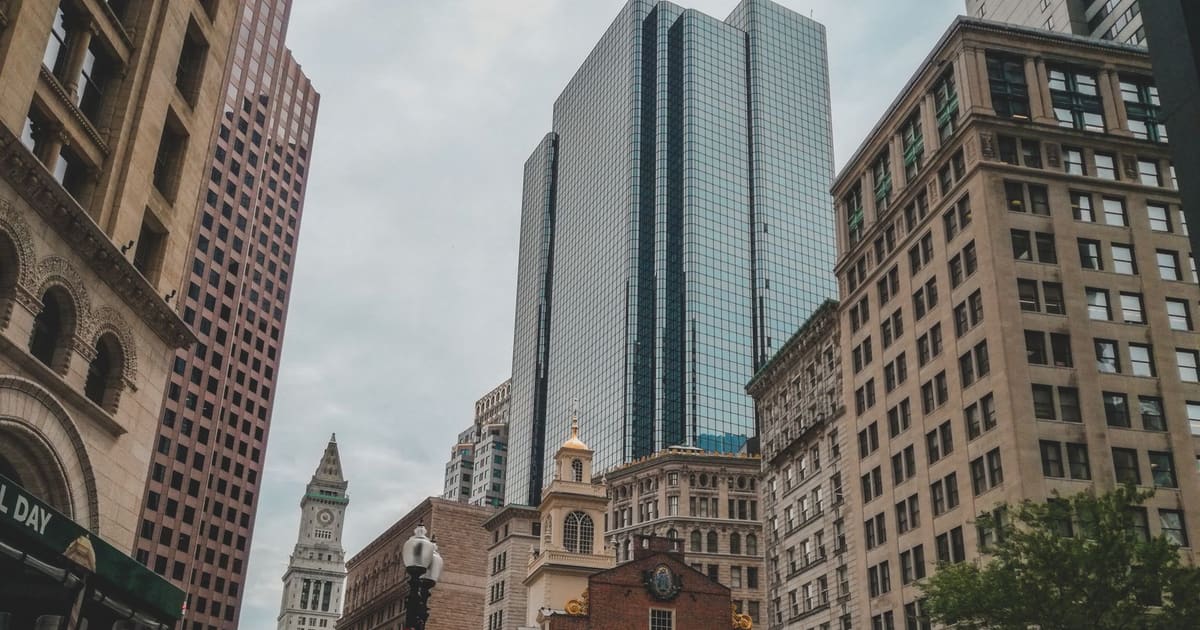
This small brick building with a tiered tower, squeezed in among office blocks, is the Old State House, built in 1713 and the oldest surviving public building in Boston.
Продовження цієї зупинки є в повній аудіоекскурсії.
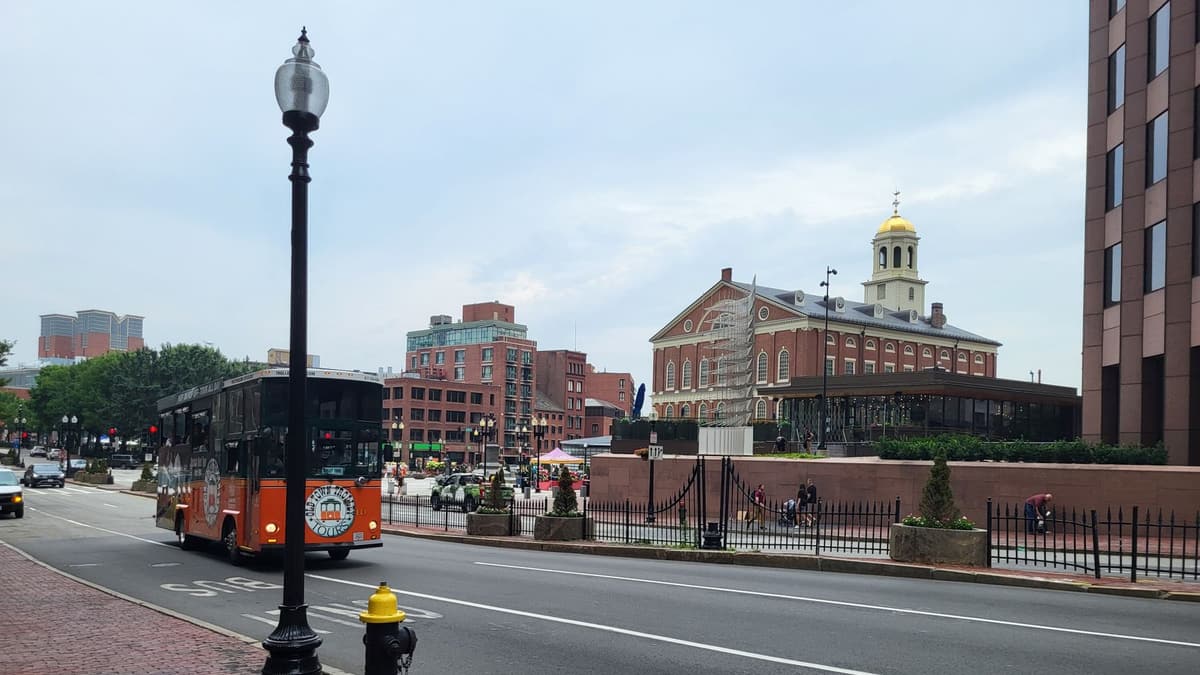
Faneuil Hall has been Boston's marketplace and meeting room since 1742, when the wealthy merchant Peter Faneuil paid for it and gave it to the town. Look up at the cupola first.
Продовження цієї зупинки є в повній аудіоекскурсії.
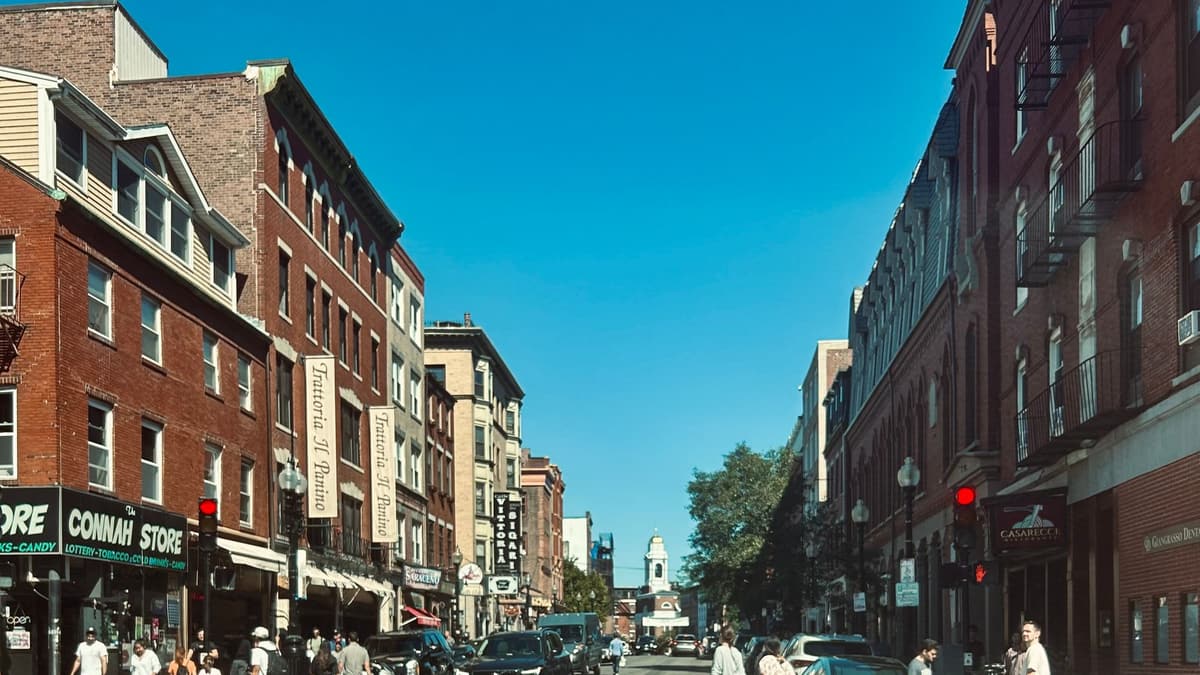
North Square is the old heart of the North End, and the small dark wooden house in front of you is the oldest building in downtown Boston.
Продовження цієї зупинки є в повній аудіоекскурсії.
Walk around to the front of Old North Church on Salem Street and look up at the steeple. Officially this is Christ Church, built in 1723, and it is the oldest standing church building in Boston.
Продовження цієї зупинки є в повній аудіоекскурсії.
Зробіть цю прогулянку разом з іншими людьми на наступному запланованому турі.
Приблизно 2,3 км, приблизно 33 хвилин у легкому темпі · 7 зупинок
Друзі гуляють безкоштовноOctober 11, 2026 · 9 min read
From the Hollandsche Schouwburg through the old Jewish Quarter, past the Dockworker and the Dam, to the Anne Frank House on the Prinsengracht.
October 11, 2026 · 11 min read
From Van Houten's street by the Vondelpark past Leidseplein, the Rijksmuseum passage and the famous canal bench to the Anne Frank House.

October 11, 2026 · 10 min read
Follow the last days of April and May 1945 from the Anhalter Bahnhof ruin past the Gestapo site and Brandenburg Gate to the Moltke Bridge and the Reichstag.
