
October 11, 2026 · 9 min read
Amsterdam Anne Frank Walking Tour
From the Hollandsche Schouwburg through the old Jewish Quarter, past the Dockworker and the Dam, to the Anne Frank House on the Prinsengracht.
589

October 9, 2026 · 12 min read

 Teman jalan gratis
Setiap tur juga berjalan sebagai jalan kaki kelompok terjadwal yang dapat Anda ikuti di aplikasi.
Tur audio lainnya di Manila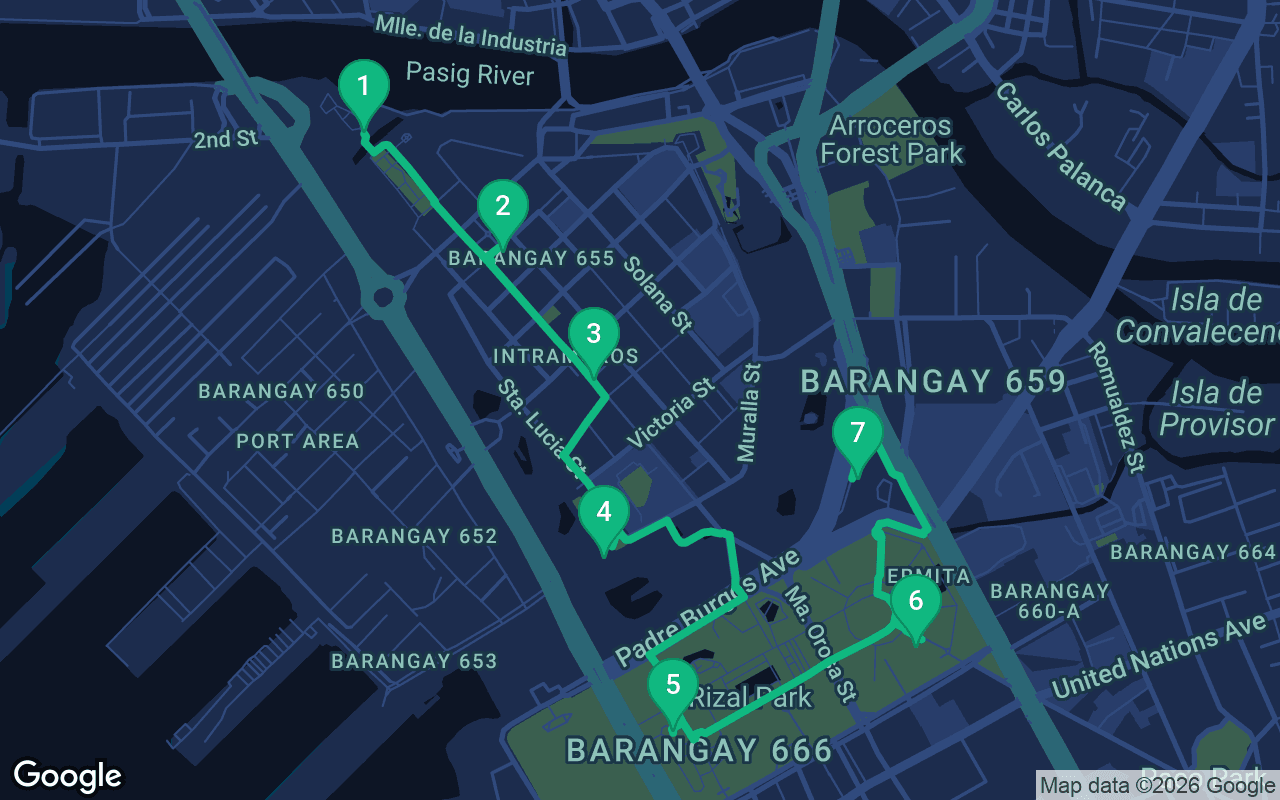
Sekitar 4 km, kira-kira 54 menit dengan ritme santai.
Tur ini dilengkapi narasi suara
Tekan putar pada 3 pemberhentian pertama untuk mendengarkan demo narasi 30 detik di sini. Di aplikasi, pengantar dan pemberhentian-pemberhentian ini bisa Anda dengarkan secara lengkap dan gratis, dan setiap pemberhentian membunyikan nada pemberitahuan saat Anda tiba. Seluruh tur berpemandu ini bisa Anda miliki selamanya hanya dengan $9.99, sekali beli untuk seterusnya.
Berfungsi dengan Garmin, Komoot, Strava, OS Maps, dan aplikasi GPX apa pun.
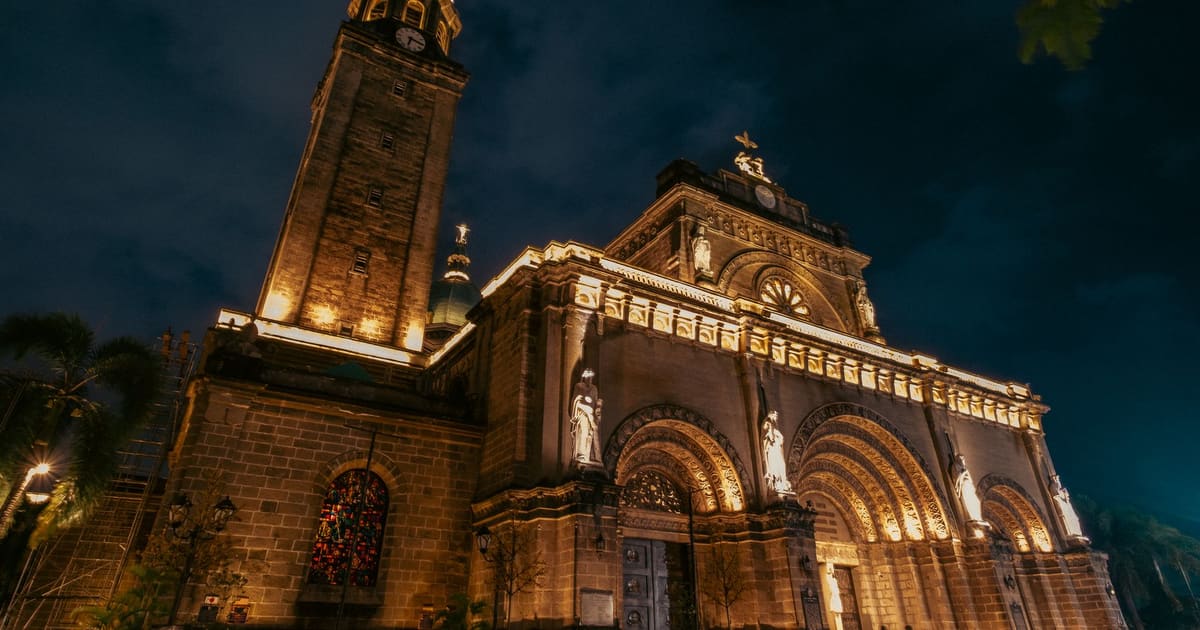
Manila began inside these walls. For more than three centuries Intramuros, the walled city, was the seat of Spain's rule over the Philippines, a grid of churches, convents and mansions guarded by stone bastions on the bank of the Pasig River. This walk starts at Fort Santiago at the river mouth, runs the length of the old city past the cathedral and the oldest stone church in the country, leaves by the southern bastion, then crosses Rizal Park to the monument to the national hero and the grand museum buildings on the park's eastern side. It is about four kilometers and flat all the way, and among the most rewarding self-guided walking tours in Asia if you want to understand how the Philippines came to be.
The walking takes under an hour, but give it at least half a day, because Fort Santiago, the San Agustin museum and the National Museum could each fill a morning on their own. Manila is hot and humid all year, and from roughly June to October it is also wet, with heavy afternoon downpours and the occasional typhoon. Start early, carry water, a hat and an umbrella, and use the churches and museums as places to cool off. Intramuros has quiet streets and some shade, but the stretch through Rizal Park is open lawn and paving, so try to cross it before the midday sun. The fort and San Agustin charge for entry, and the national museums at the end of the walk have not charged general admission in recent years; entry rules and hours change, so check before you go. All along the route, drivers of pedicabs and horse-drawn carriages called kalesas will offer you rides, and a polite no is enough. Churches are places of worship first, so cover shoulders and knees and keep quiet if a wedding or a Mass is under way, which on weekends it often is. Rizal Park gets crowded on weekends and holidays, so keep your phone and bag close there.
Stand inside the main gate of Fort Santiago and look back at it: above the arch, a carved relief shows Saint James, Santiago, on horseback, the patron saint of Spain and the fort's namesake. Beyond the walls flows the Pasig River, and this spot at its mouth is where Manila's story begins. Before the Spanish came, a fortified settlement called Maynila stood here, ruled by Rajah Sulayman and tied by trade and marriage to the sultanate of Brunei. The name comes from nilad, a mangrove shrub that grew along the shore. In 1570 a Spanish force attacked and burned the settlement, and in 1571 Miguel López de Legazpi, who had come north from Cebu, founded the Spanish city of Manila on its ashes and made it the capital of the colony. A fort of logs went up first, then this one in stone in the 1590s, guarding the river and the walled city behind it. The fort's most famous prisoner was José Rizal. He was held here at the end of 1896, tried for rebellion and condemned, and on his last night he wrote his farewell poem, Mi último adiós, and hid it in a small lamp that was handed to his family. Bronze footprints set into the ground trace his final walk out of the fort, and a museum in the building where he was held tells his story. The fort's dungeons hold darker memories as well, from the Japanese occupation, when the military police held and killed prisoners here. When you are ready, walk back out through the gate and follow General Luna Street south-east. In about six minutes the cathedral rises on your left, facing Plaza de Roma.
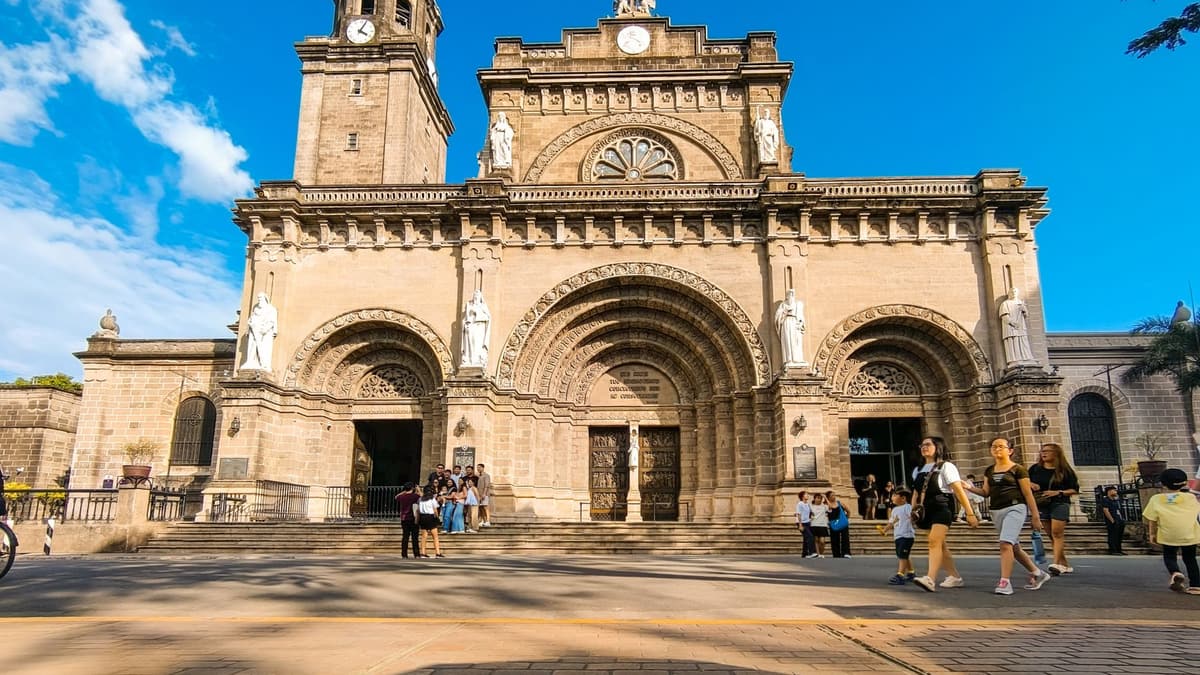
 Across Plaza de Roma stands Manila Cathedral, its stone facade lined with statues of saints and a green dome rising behind. It is the eighth cathedral on this site. The first, built of wood and thatch after Manila became a diocese in 1579, burned within a few years; its successors were brought down by typhoon, fire, earthquakes, and finally the battle of 1945, and the building you see was completed in 1958. In the middle of the plaza stands a statue of King Charles IV of Spain, put up in thanks for the smallpox vaccine that a royal expedition carried across the world to these islands in the early 1800s.
This square was the heart of the Spanish colony. Around it stood the governor's palace, the city hall and the cathedral, and much of the wealth that paid for them came from the sea. From 1565 until 1815, the Manila galleons sailed between here and Acapulco in Mexico, usually one or two a year. They carried Chinese silk, porcelain and spices east across the Pacific and came back loaded with Mexican silver, which China wanted above all else. Chinese junks unloaded their cargoes at Manila, merchants inside the walls bought space in the galleons' holds, and for two and a half centuries this small walled city was the hinge between Asia and the Americas. Step inside the cathedral if it is open, for the stained glass and the cool. Then continue south-east along General Luna Street for about five minutes to San Agustin Church, on the corner with Calle Real.
Across Plaza de Roma stands Manila Cathedral, its stone facade lined with statues of saints and a green dome rising behind. It is the eighth cathedral on this site. The first, built of wood and thatch after Manila became a diocese in 1579, burned within a few years; its successors were brought down by typhoon, fire, earthquakes, and finally the battle of 1945, and the building you see was completed in 1958. In the middle of the plaza stands a statue of King Charles IV of Spain, put up in thanks for the smallpox vaccine that a royal expedition carried across the world to these islands in the early 1800s.
This square was the heart of the Spanish colony. Around it stood the governor's palace, the city hall and the cathedral, and much of the wealth that paid for them came from the sea. From 1565 until 1815, the Manila galleons sailed between here and Acapulco in Mexico, usually one or two a year. They carried Chinese silk, porcelain and spices east across the Pacific and came back loaded with Mexican silver, which China wanted above all else. Chinese junks unloaded their cargoes at Manila, merchants inside the walls bought space in the galleons' holds, and for two and a half centuries this small walled city was the hinge between Asia and the Americas. Step inside the cathedral if it is open, for the stained glass and the cool. Then continue south-east along General Luna Street for about five minutes to San Agustin Church, on the corner with Calle Real.
San Agustin Church does not look like much from outside, a plain, heavy facade behind a gate guarded by carved granite lions in the Chinese style, but it is the oldest stone church in the Philippines, finished in 1607 by the Augustinian friars, the first order to arrive with Legazpi. It has outlived everything around it. Earthquakes brought down the city's other churches again and again, and San Agustin's thick walls rode them out. Inside, the ceiling looks carved and coffered, but it is flat, painted in trompe l'oeil by two Italian artists in the nineteenth century, and Legazpi himself is buried here. Together with three Spanish-era churches in the provinces, it is a UNESCO World Heritage Site. This is also the place to remember February 1945. When American and Filipino forces came to take Manila back from the Japanese, the Japanese troops holding the city refused to withdraw. For a month the battle went street by street, and in its last weeks it reached these walls. Japanese troops massacred civilians across the city, and people who had sheltered in this church and its monastery were among those killed. American artillery, firing to break into the walled city, flattened much of what was left. By early March an estimated 100,000 civilians were dead, and Intramuros lay in ruins. Of its seven churches, only San Agustin was left standing. The monastery next door is now a museum, and its cloisters are among the most peaceful places in Manila. On a small plaza nearby, a sculpture called Memorare Manila 1945 remembers the civilians who died. Continue south along General Luna Street toward the end of the walled city, then follow the walls a short way to the garden of the round bastion, about six minutes.
Yang termasuk
Tur kami dirancang agar terasa meditatif dan imersif: Anda terus bergerak dan cukup mendengarkan. Tur selalu lebih seru dinikmati bersama, dan aplikasi memutar narasi secara sinkron, sehingga Anda, pasangan, dan teman-teman mendengar setiap pemberhentian pada saat yang sama.
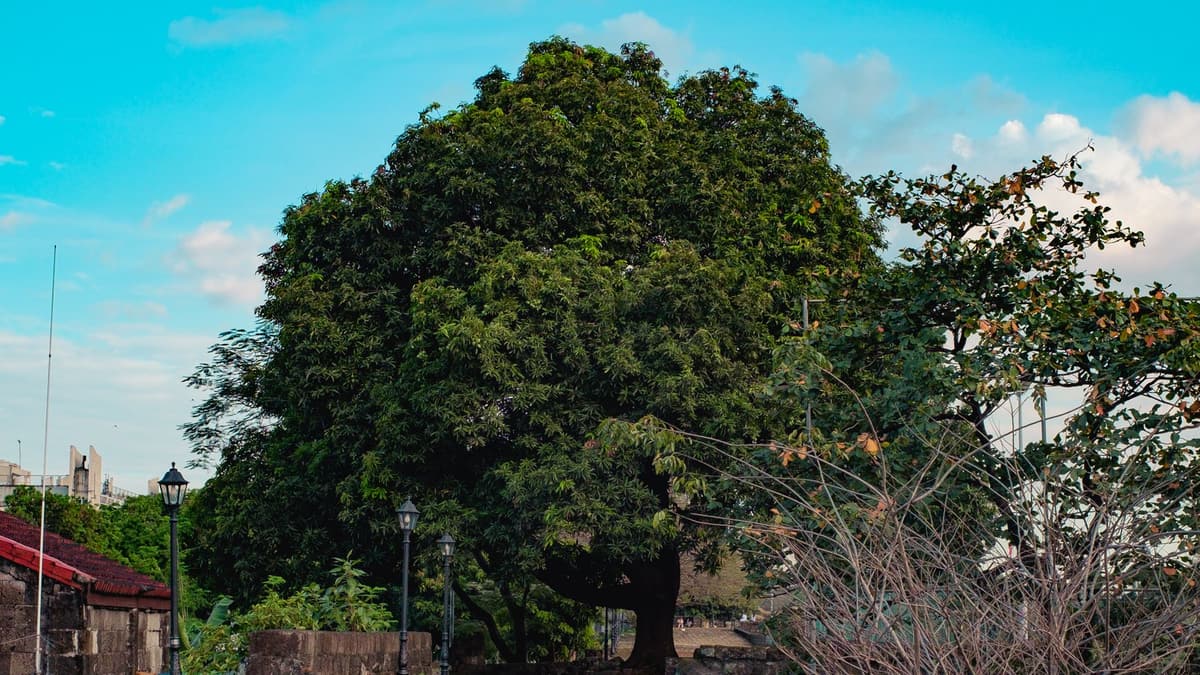
You are in the garden of Baluarte de San Diego, at the southern corner of the walls, and if you could see it from above it would look like the ace of spades. Its core is older than the walls themselves.
Lanjutan pemberhentian ini ada di tur audio lengkap.
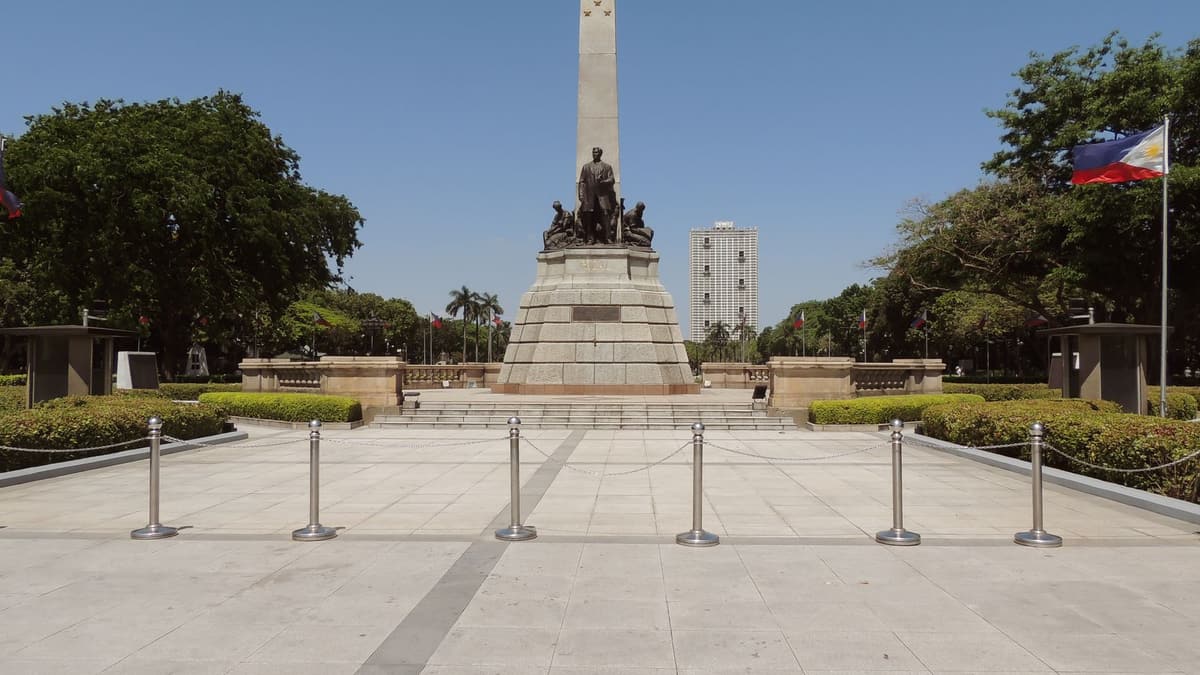
You are in Rizal Park, which many Manileños still call Luneta, in front of the monument to José Rizal, the national hero of the Philippines.
Lanjutan pemberhentian ini ada di tur audio lengkap.
Two matching classical buildings face each other across Agrifina Circle at the eastern end of the park.
Lanjutan pemberhentian ini ada di tur audio lengkap.
The walk ends at the grandest of the government buildings, the old Legislative Building, its long colonnaded front facing the park. It was built in the 1920s for the Philippine Legislature, the elected assembly that American rule allowed Filipinos as a step toward self-government.
Lanjutan pemberhentian ini ada di tur audio lengkap.
Lakukan jalan-jalan ini bersama orang lain pada tur terjadwal berikutnya.
Sekitar 4 km, kira-kira 54 menit dengan ritme santai · 7 titik henti
Teman jalan gratisOctober 11, 2026 · 9 min read
From the Hollandsche Schouwburg through the old Jewish Quarter, past the Dockworker and the Dam, to the Anne Frank House on the Prinsengracht.
October 11, 2026 · 11 min read
From Van Houten's street by the Vondelpark past Leidseplein, the Rijksmuseum passage and the famous canal bench to the Anne Frank House.

October 11, 2026 · 10 min read
Follow the last days of April and May 1945 from the Anhalter Bahnhof ruin past the Gestapo site and Brandenburg Gate to the Moltke Bridge and the Reichstag.
