
October 11, 2026 · 9 min read
Amsterdam Anne Frank Walking Tour
From the Hollandsche Schouwburg through the old Jewish Quarter, past the Dockworker and the Dam, to the Anne Frank House on the Prinsengracht.
589

October 9, 2026 · 10 min read

 Teman jalan gratis
Setiap tur juga berjalan sebagai jalan kaki kelompok terjadwal yang dapat Anda ikuti di aplikasi.
Tur audio lainnya di Rothenburg ob der Tauber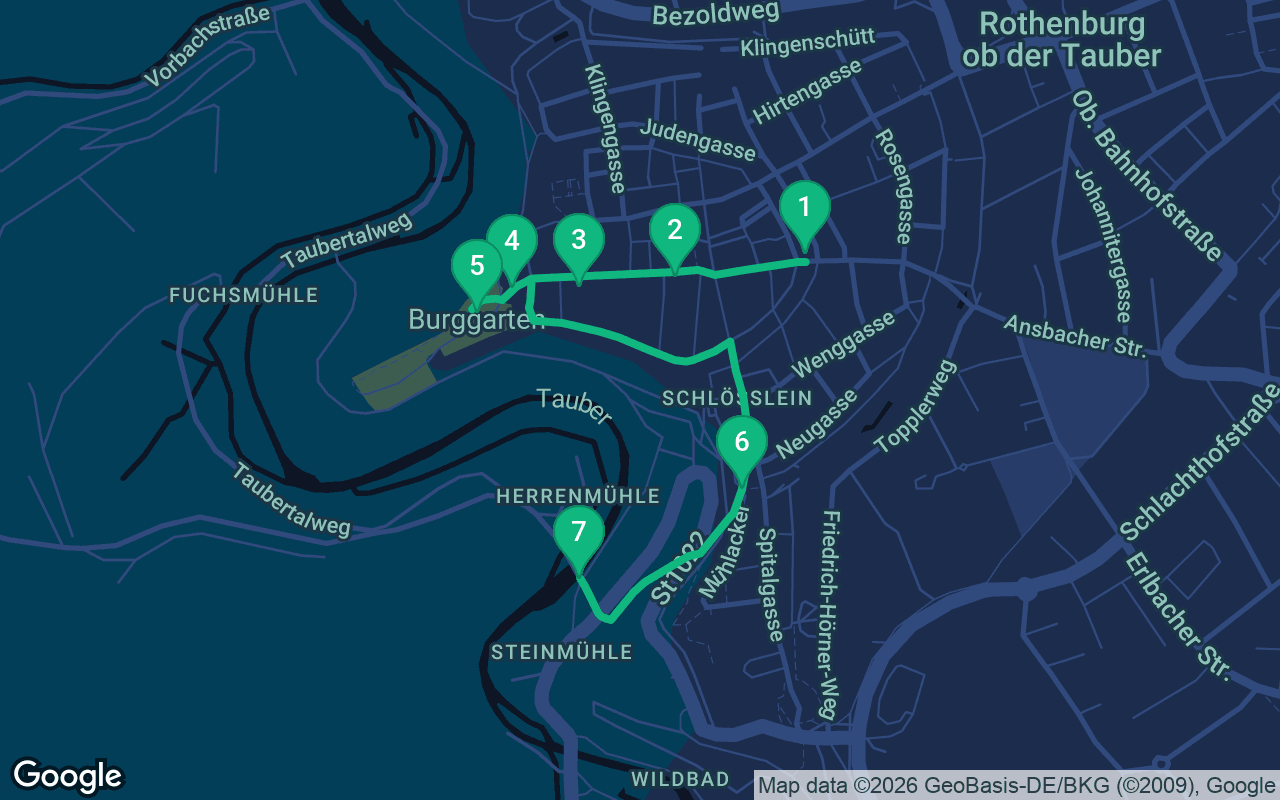
Sekitar 1,7 km, kira-kira 23 menit dengan ritme santai.
Tur ini dilengkapi narasi suara
Tekan putar pada 3 pemberhentian pertama untuk mendengarkan demo narasi 30 detik di sini. Di aplikasi, pengantar dan pemberhentian-pemberhentian ini bisa Anda dengarkan secara lengkap dan gratis, dan setiap pemberhentian membunyikan nada pemberitahuan saat Anda tiba. Seluruh tur berpemandu ini bisa Anda miliki selamanya hanya dengan $6.99, sekali beli untuk seterusnya.
Berfungsi dengan Garmin, Komoot, Strava, OS Maps, dan aplikasi GPX apa pun.
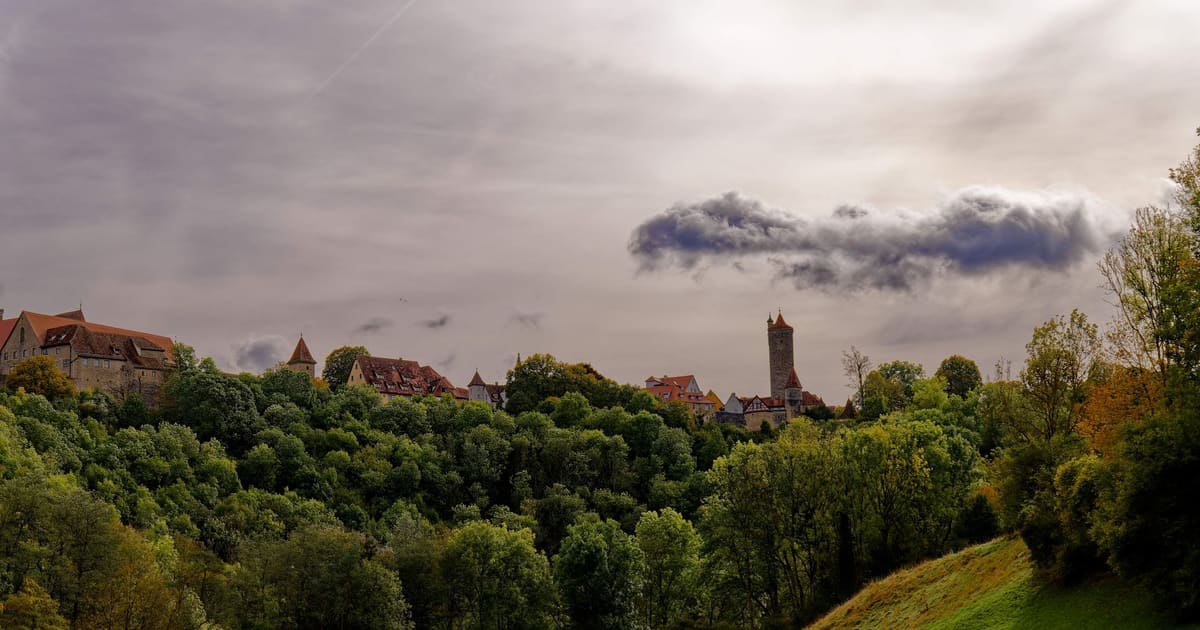
Rothenburg ob der Tauber takes its name from the river below it, yet most visitors never go down to see it. This short walk does. It starts at the Markus Tower, a survivor of the town's very first wall, follows the grand Herrngasse past a museum of Christmas and the oldest church in town to the tallest of the town gates, and comes out in the Castle Garden, on the rocky spur where Rothenburg began. From there it drops through the Kobolzell Gate down a steep old lane into the green Tauber valley and ends at a medieval bridge with the whole walled town above you. It is about 1.7 kilometers, just over a mile, a compact and quietly lovely addition to the self-guided walking tours of this little town.
Allow an hour and a half to two hours, more if you visit the Christmas Museum. The first half of the walk is level, along cobbled streets. The second half is not: the lane from the Kobolzell Gate down to the river is steep and cobbled, and it can be slippery in the wet, so wear shoes with a good grip and take your time. Remember too that the walk ends at the bottom of the valley, so you will need to climb back up into town afterward, about ten to fifteen minutes of steady uphill on the same lane or the paths beside the wall. The valley is green and shaded in places, while the Castle Garden is open and sunny. Morning and late afternoon light are lovely on the walls, and the Herrngasse is calmest early, before the day visitors arrive. Check the Christmas Museum's hours before you go, since they change with the season.
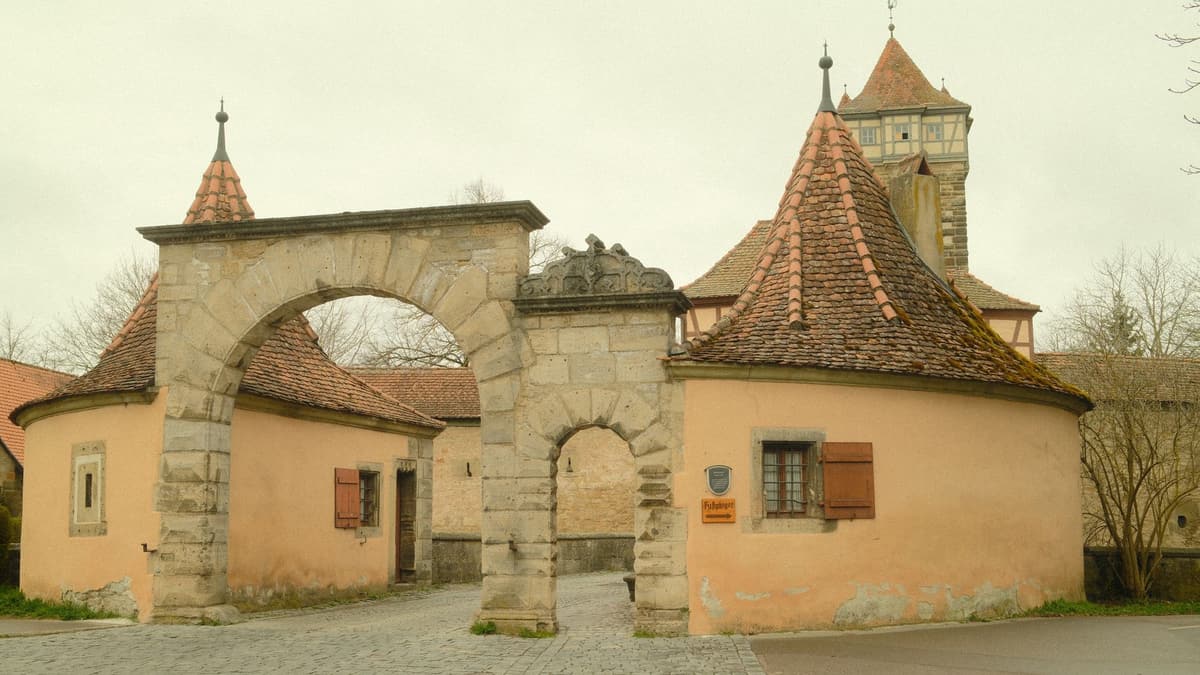
You are standing beside the Markus Tower, the Markusturm, a tall, plain stone tower with an archway through it. Look closely, because this is one of the oldest things in Rothenburg. It was built around the end of the twelfth century as a gate in the town's first wall, when Rothenburg was a much smaller place clustered close to its castle. As the town grew, new walls went up farther out, and most of this inner ring disappeared, built over by houses. But you can still trace its line. The street running south from here is called Alter Stadtgraben, the Old Town Moat, because that is exactly what it was. The building attached to the tower is the old Büttelhaus, the bailiff's house, which served as the town jail, and the tower itself held prisoners until the middle of the nineteenth century. Picture the prisoners up there, looking down on the market traffic they could no longer join. Next to it stands the Röder Arch, a later gateway. A short walk north, by the White Tower, another gate of the first wall, lay the medieval Jewish quarter, home to Rabbi Meir of Rothenburg, one of the great Jewish scholars of the thirteenth century. Now walk west along Hafengasse to the Market Square, about three minutes. The museum is at the far corner of the square, where Herrngasse begins.
 In Rothenburg it is Christmas all year round, and this is the place that made it so. The building belongs to Käthe Wohlfahrt, a family firm that grew from a small business selling German Christmas decorations into one of the best known Christmas shops in the world. Inside is the German Christmas Museum, and it is far more interesting than you might expect. It tells how Germans came to bring a tree indoors, and how the first decorations were things you could eat: apples, nuts, cookies and sugar figures. Later came the glass baubles of Lauscha, a glassmaking village in Thuringia, and the story goes that a poor glassblower there, unable to afford real fruit and nuts, made glass ones instead. Look out for early Advent calendars, carved nutcrackers and smoking men from the Ore Mountains, candlelit wooden pyramids that spin in the heat, and the slow change of the bearded gift bringer from a stern bishop into the jolly figure we know today. Even if you skip the museum, step into the shop to see its lavish displays. And somewhere along this street, try a Schneeball, a snowball, Rothenburg's local pastry: strips of dough rolled into a ball, fried and dusted with sugar. Then walk west down the Herrngasse for about two minutes. The church is on your left.
You are on the Herrngasse, the Lords' Lane, the widest and grandest street in Rothenburg, lined with the tall houses of the families who ran the town. In front of you is its most modest building, and its oldest church. The Franciscan friars came to Rothenburg in the late thirteenth century, and their church, begun soon after, is older than any other church still standing in town. Franciscans preached poverty, and their church shows it: plain walls and no grand tower. Step inside if it is open, and you will find something rare. Across the church runs a rood screen, a partition that once separated the friars' choir, where they sang their services, from the nave, where ordinary townspeople stood. Most German churches lost their rood screens in later centuries, as tastes and forms of worship changed, so seeing one in place gives you a real sense of how a medieval church was divided. Look too at the walls and floor, covered with the memorial slabs and painted epitaphs of knights and wealthy families of the town, some of them showing the dead in armor or long robes. It is a quiet, cool place, and after the bustle of the shops it feels like stepping back several centuries. Now continue to the very end of the Herrngasse, about two minutes, to the great gate tower.
Yang termasuk
Tur kami dirancang agar terasa meditatif dan imersif: Anda terus bergerak dan cukup mendengarkan. Tur selalu lebih seru dinikmati bersama, dan aplikasi memutar narasi secara sinkron, sehingga Anda, pasangan, dan teman-teman mendengar setiap pemberhentian pada saat yang sama.
This is the Burgtor, the Castle Gate, with the tallest gate tower in Rothenburg's walls. It guarded the way out to the castle spur and the valley road, and it is built to take no chances.
Lanjutan pemberhentian ini ada di tur audio lengkap.
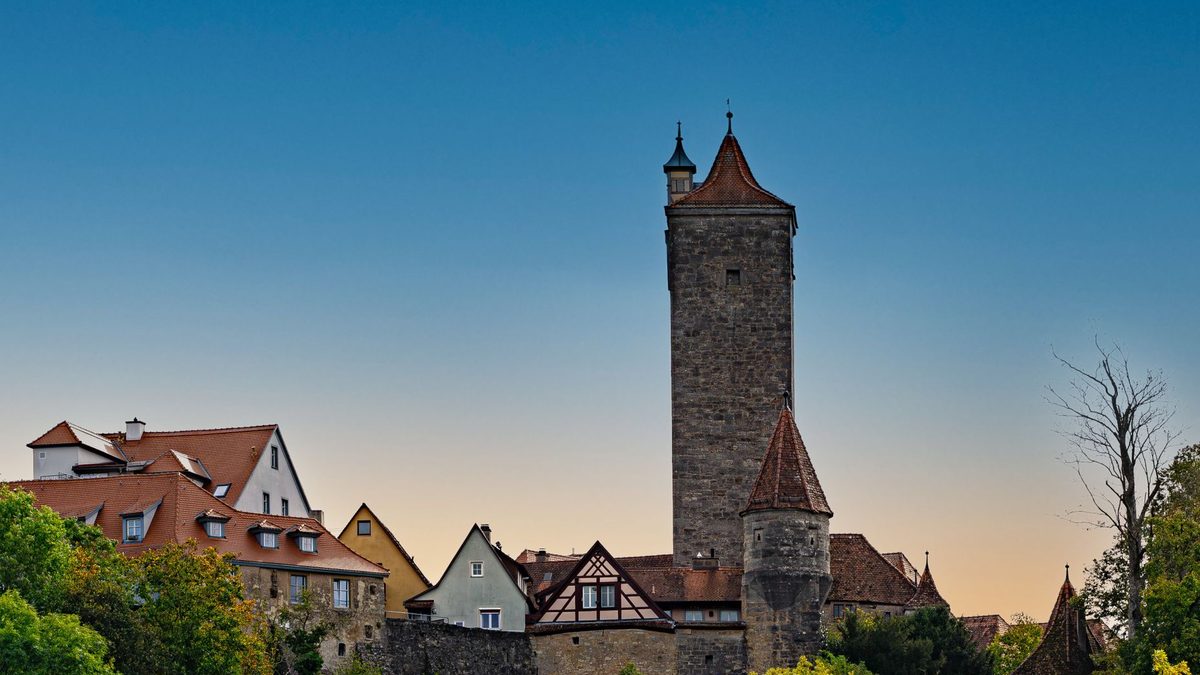
You are now standing on the spot where Rothenburg began.
Lanjutan pemberhentian ini ada di tur audio lengkap.
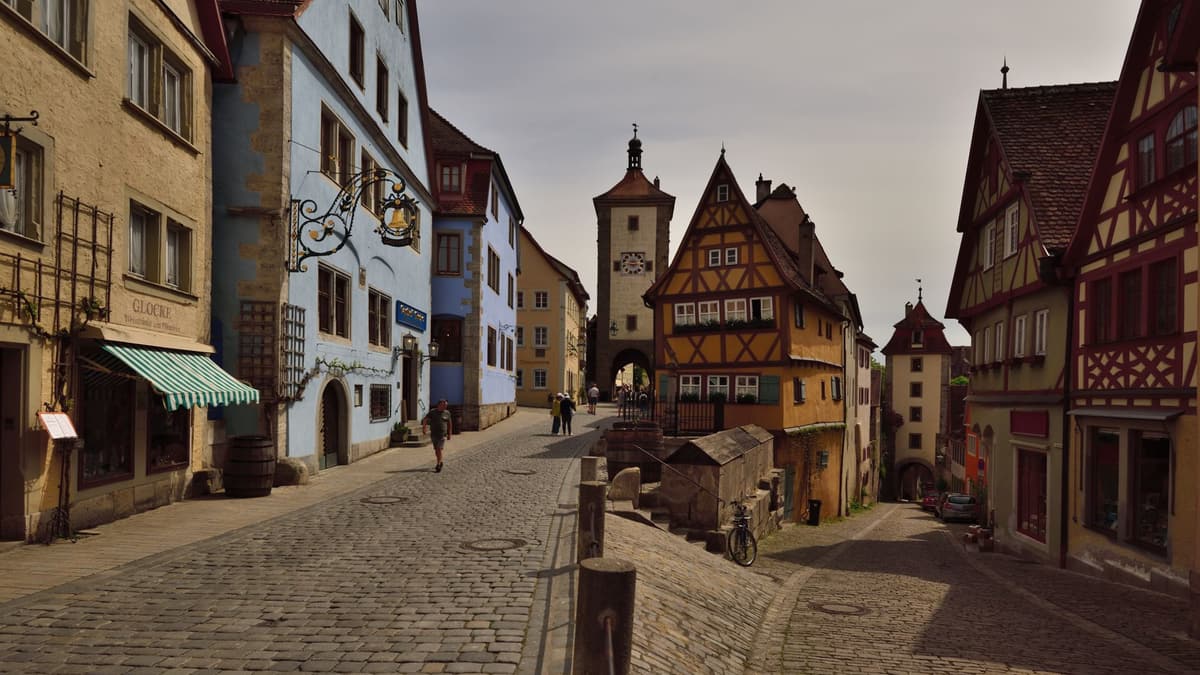
On the way here, Burggasse took you along the inside of the wall, with glimpses over the valley, and then past the Plönlein, that famous fork in the road with its yellow house.
Lanjutan pemberhentian ini ada di tur audio lengkap.
You end at the Double Bridge, the Doppelbrücke, and the name makes sense the moment you look at it. It has two tiers of arches, one stacked on top of the other, like a small Roman aqueduct, carrying the old road across the Tauber valley.
Lanjutan pemberhentian ini ada di tur audio lengkap.
Lakukan jalan-jalan ini bersama orang lain pada tur terjadwal berikutnya.
Sekitar 1,7 km, kira-kira 23 menit dengan ritme santai · 7 titik henti
Teman jalan gratisOctober 11, 2026 · 9 min read
From the Hollandsche Schouwburg through the old Jewish Quarter, past the Dockworker and the Dam, to the Anne Frank House on the Prinsengracht.
October 11, 2026 · 11 min read
From Van Houten's street by the Vondelpark past Leidseplein, the Rijksmuseum passage and the famous canal bench to the Anne Frank House.

October 11, 2026 · 10 min read
Follow the last days of April and May 1945 from the Anhalter Bahnhof ruin past the Gestapo site and Brandenburg Gate to the Moltke Bridge and the Reichstag.
