
October 11, 2026 · 9 min read
Amsterdam Anne Frank Walking Tour
From the Hollandsche Schouwburg through the old Jewish Quarter, past the Dockworker and the Dam, to the Anne Frank House on the Prinsengracht.
589

October 9, 2026 · 12 min read

 친구는 무료로 함께 걸어요
모든 투어는 앱에서 참여할 수 있는 정기 그룹 걷기 모임으로도 운영됩니다.
Siena의 오디오 투어 더 보기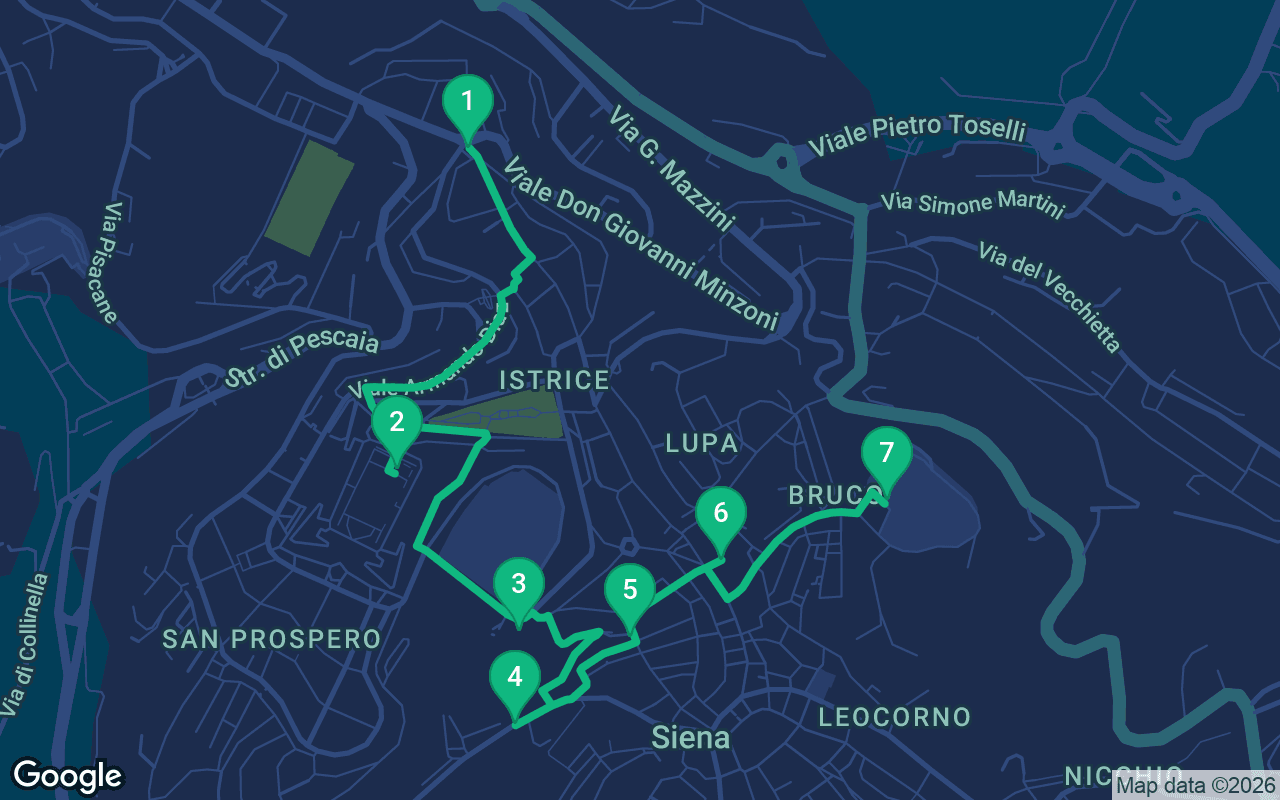
약 3km, 여유로운 페이스로 대략 44분 소요.
음성 가이드가 포함된 투어입니다
처음 3개 스톱에서 재생을 누르면 여기에서 나레이션을 30초 데모로 들을 수 있습니다. 앱에서는 인트로와 이 스톱들을 무료로 끝까지 들으실 수 있으며, 각 스톱에 도착하면 알림음이 울립니다. 전체 오디오 투어는 $8.99에 한 번만 구매하시면 평생 소장하실 수 있습니다.
Garmin, Komoot, Strava, OS Maps 및 모든 GPX 앱과 호환됩니다.
Most visitors to Siena never get past the Campo and the cathedral, which leaves the northern half of the city to the people who live in it. This walk goes there. It starts at Porta Camollia, the gate where pilgrims from the north came in, crosses the ramparts of the fortress Florence built to hold the city down, and then follows the life of Saint Catherine, Siena's own saint and one of the patron saints of Italy, from the church that keeps her head to the fountain at the bottom of her street and the house where she was born. It ends among the bankers of Piazza Salimbeni and in the vast Franciscan church on the city's eastern edge. It is one of our quieter self-guided walking tours, about three kilometers long, with one deep valley in the middle that you will not forget.
The walking takes about forty-five minutes, so allow two to three hours with time inside the churches and the sanctuary, and a little longer if you want to circle the fortress walls. The first part is easy, a gentle stroll downhill from the gate and some ramps up onto the bastions. The middle is the hard part. From San Domenico a steep lane and steps drop into the valley of Fontebranda, and from the fountain you climb straight back up through the sanctuary and on to the main street on the ridge, a short but real climb with a sharp gradient. After that it is gentle going to the end. Streets are paved in stone and can be slick when wet, so wear shoes with grip. The fortress park has trees, but the lanes in between are mostly open, so carry water on a hot day. San Domenico and the Sanctuary of Saint Catherine are working places of prayer with their own hours and services, so check before you go, dress with shoulders and knees covered, and keep your voice down inside. Mornings are calmest, and this side of town stays relaxed even when the Campo is heaving.
Walk through the arch to the outer side of the gate and turn around to read the Latin words carved above it: Cor magis tibi Sena pandit, Siena opens her heart to you wider than this gate. It is one of the loveliest welcomes any city has ever carved over its door, and it went up around 1600, when the gate was rebuilt and the Medici grand duke who now ruled Siena was due to ride through it. Porta Camollia faces north, and for travelers on the Via Francigena, the great medieval pilgrim road from Canterbury to Rome, this was the way into the city. Around the year 990 an English archbishop, Sigeric, wrote down the stops on his journey home from Rome, and Siena is on his list. Pilgrims still walk the route today, and you may see a few with backpacks and walking poles passing under the arch. A short way outside the gate stands a column marking a famous meeting in 1452, when the Holy Roman Emperor Frederick III first met his young bride, Eleanor of Portugal, here in front of the city, a match arranged by Siena's bishop of the day. The street running back into town is lined with ordinary shops and bars, the everyday Siena this walk is about. When you are ready, go back through the gate, follow the main street south for a couple of minutes, then bear right and downhill toward the trees and the long brick bastions of the fortress, about ten minutes.
Climb up onto the ramparts and walk out along the top. The Fortezza Medicea is a broad square of brick walls with an arrow-shaped bastion at each corner, built to face both ways, outward against any enemy and inward against the city itself. Its story is the end of Siena's freedom. For four hundred years Siena was an independent republic, but by the 1550s it was caught between the great powers of the day. Spanish troops of the emperor Charles V built a fortress on this hill to control the town, and in 1552 the Sienese rose up, threw the garrison out with French help and tore the fortress down. The answer was a long siege by imperial and Florentine forces. The city starved, and in April 1555 it surrendered. Some of the defenders carried on the republic for a few more years from the hill town of Montalcino, but Siena itself was soon handed to Cosimo I de' Medici of Florence, the old enemy. Cosimo built this new fortress in the 1560s, and it said all it needed to about who was now in charge. Today it is something much gentler, a park on the walls where locals run laps, walk dogs and sit on the grass, and the views over the rooftops and out to the hills are some of the best in town. From the eastern bastions you can already see your next stop, the tall brick church on the next hill. Leave the fortress by the gate facing the city and follow the tree-lined avenue south past the football stadium to the church, about eight minutes.
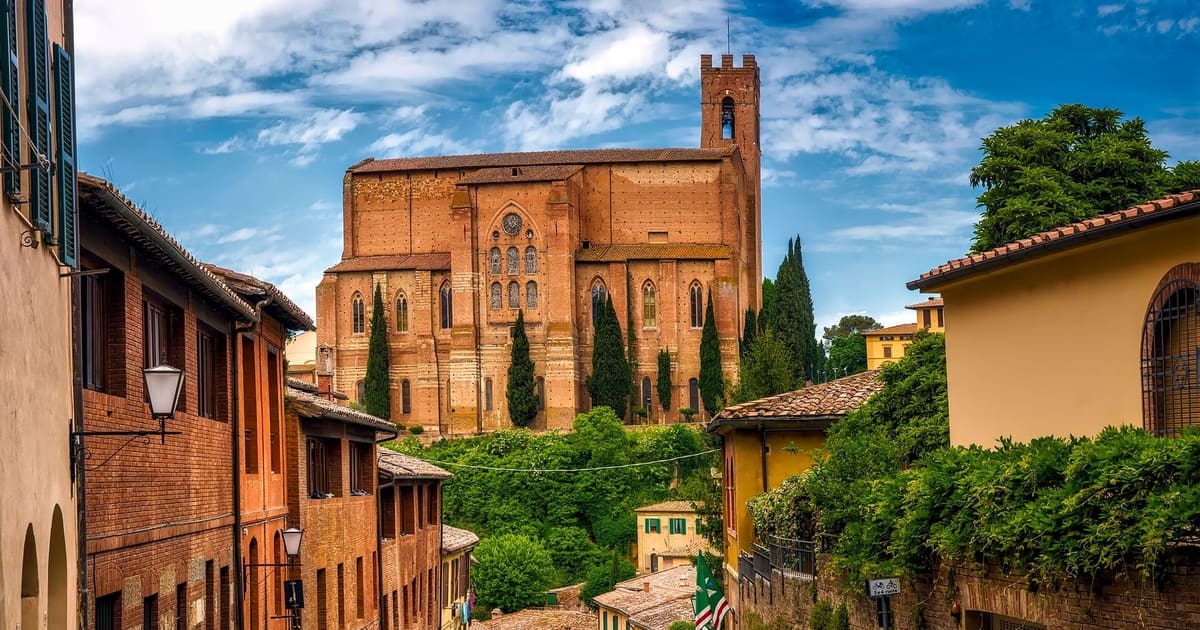
In front of you is the huge, barnlike brick church of the Dominican friars, plain on the outside the way the preaching orders liked their churches. It was begun in the thirteenth century, and this is where Catherine's spiritual life took shape. She was a girl of the neighborhood just down the hill, and as a teenager she joined the Mantellate, laywomen who wore the Dominican habit while living at home. Inside, near the entrance, a raised chapel called the Cappella delle Volte is where she prayed and where she received that habit. On its wall is a fresco portrait of her by Andrea Vanni, a painter who knew her, and it is considered the only true likeness of her. Look at the face, calm and long, nothing like the swooning saint of later art. On the right side of the nave is the chapel of Saint Catherine, with frescoes by Sodoma of her ecstasies, and in a marble tabernacle on the altar is her head. Catherine died in Rome in 1380 and her body lies there still, but in 1384 the head was brought home to Siena. The story goes that Sienese admirers smuggled it out of Rome in a bag, and when guards stopped them and looked inside, they found only rose petals, which turned back into the relic once the city was safe. Before you leave, go out to the side of the church and look across the valley, where the cathedral and the Torre del Mangia line up on the opposite ridge. Then take the steep lane and steps down the hill below the church to the south, about four minutes.
포함 사항
저희 투어는 명상하듯 몰입할 수 있도록 만들어졌습니다. 걸으며 그저 귀 기울이시면 됩니다. 함께하면 언제나 더 좋고, 앱이 나레이션을 동기화해 재생하므로 당신과 파트너, 친구들이 모든 스톱을 같은 순간에 들을 수 있습니다.
At the bottom of the valley, set into the hillside, stands Fontebranda, a broad brick fountain house with three tall pointed arches and a row of battlements along the top.
이 스톱의 나머지 내용은 전체 오디오 투어에 있습니다.
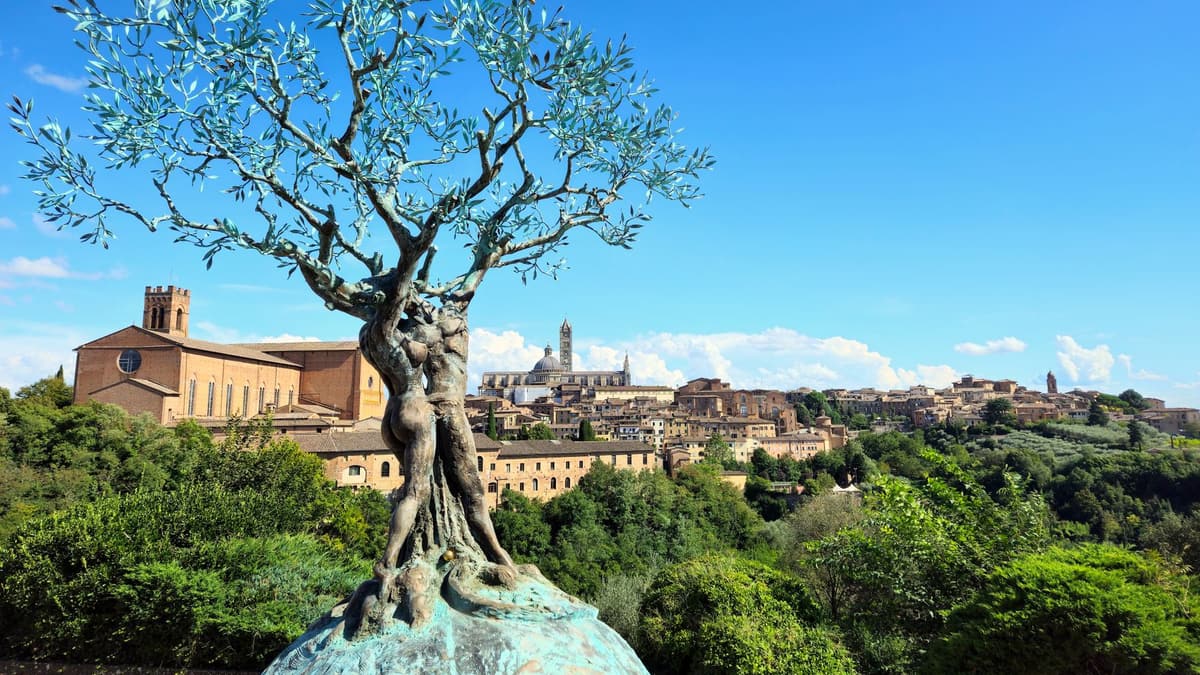
You are at the entrance to the house where Catherine was born, now a cluster of chapels and courtyards built around the family home.
이 스톱의 나머지 내용은 전체 오디오 투어에 있습니다.
This small, formal square is the headquarters of the Monte dei Paschi di Siena, founded by the city in 1472 and widely called the oldest bank in the world still in business.
이 스톱의 나머지 내용은 전체 오디오 투어에 있습니다.
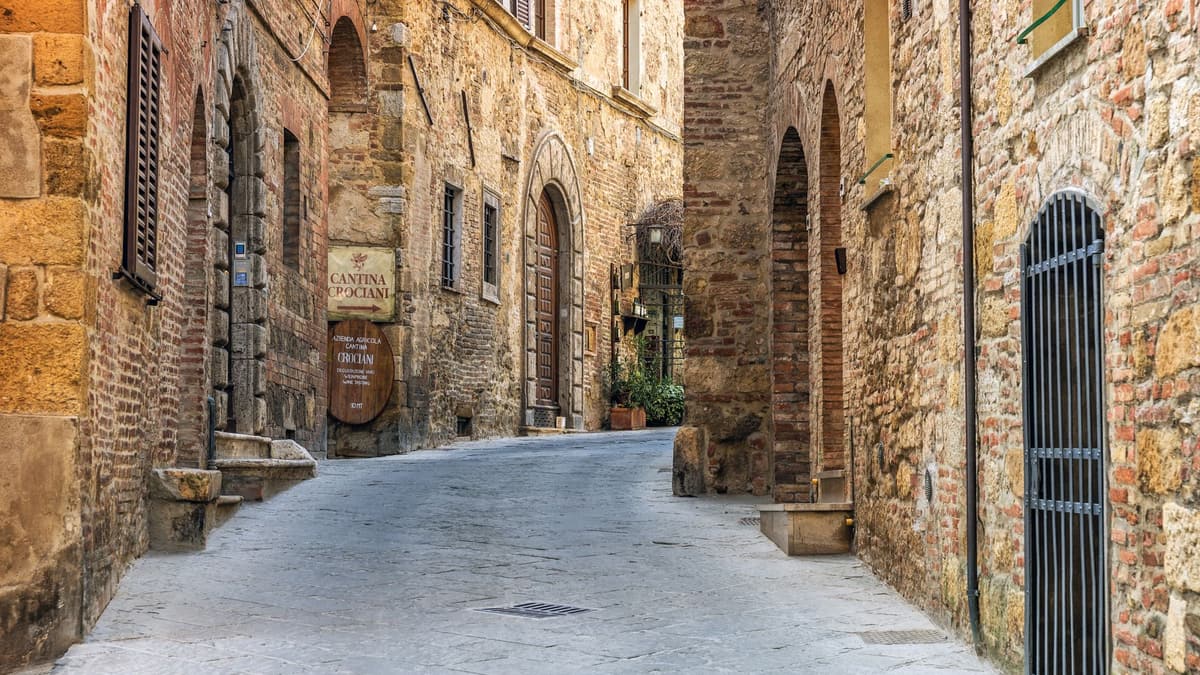
The walk ends in front of the Basilica di San Francesco, the Franciscan answer to San Domenico across town, and just as large.
이 스톱의 나머지 내용은 전체 오디오 투어에 있습니다.
다음 예정된 투어에서 다른 사람들과 함께 이 산책을 해보세요.
약 3km, 여유로운 페이스로 대략 44분 소요 · 7 정류장
친구는 무료로 함께 걸어요October 11, 2026 · 9 min read
From the Hollandsche Schouwburg through the old Jewish Quarter, past the Dockworker and the Dam, to the Anne Frank House on the Prinsengracht.
October 11, 2026 · 11 min read
From Van Houten's street by the Vondelpark past Leidseplein, the Rijksmuseum passage and the famous canal bench to the Anne Frank House.

October 11, 2026 · 10 min read
Follow the last days of April and May 1945 from the Anhalter Bahnhof ruin past the Gestapo site and Brandenburg Gate to the Moltke Bridge and the Reichstag.
