
October 11, 2026 · 9 min read
Amsterdam Anne Frank Walking Tour
From the Hollandsche Schouwburg through the old Jewish Quarter, past the Dockworker and the Dam, to the Anne Frank House on the Prinsengracht.
589

October 9, 2026 · 9 min read

 Vrienden lopen gratis mee
Elke tour is ook beschikbaar als een geplande groepswandeling waar je in de app aan kunt deelnemen.
Bekijk de audiotour-pagina van Abu Dhabi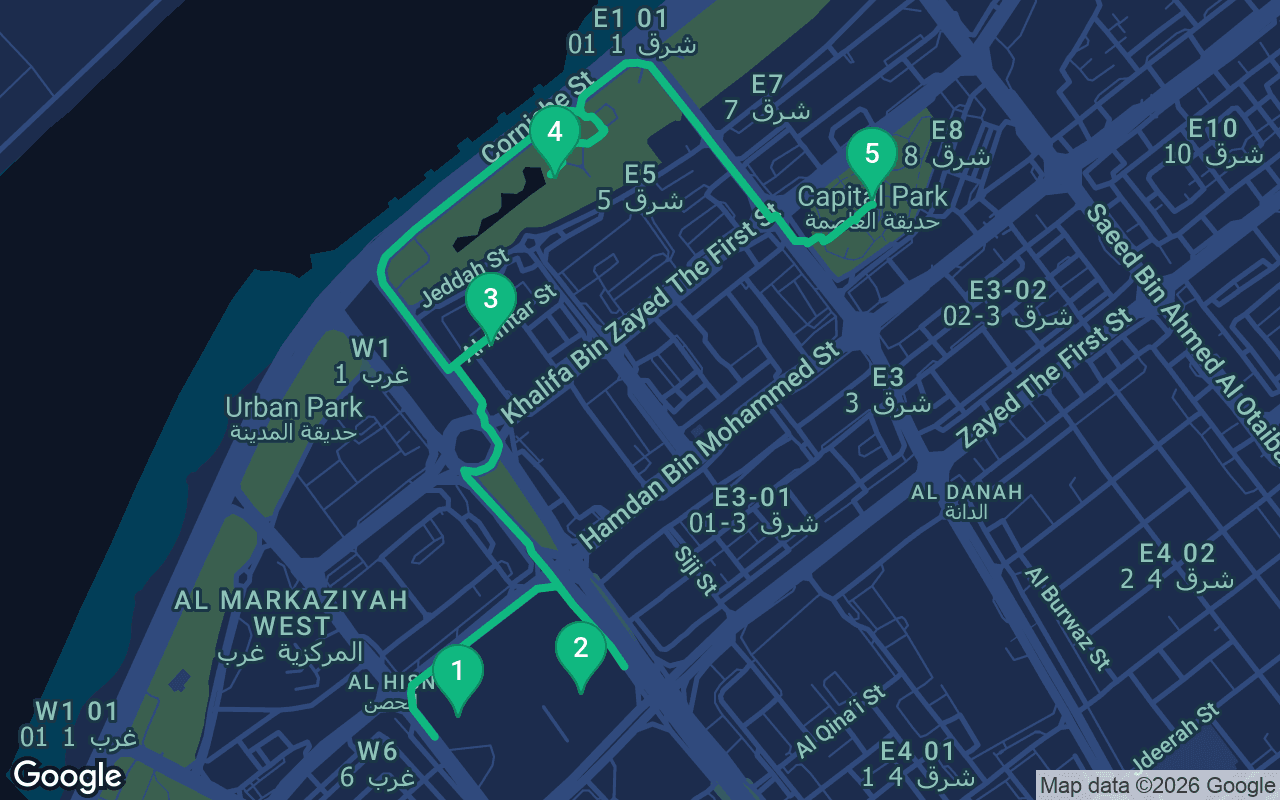
Ongeveer 4 km, zo'n 57 minuten op een rustig tempo.
Deze tour is ingesproken
Druk op afspelen bij de eerste 3 stops voor een demo van 30 seconden van de vertelling. In de app zijn de intro en die 3 stops volledig gratis te beluisteren, en bij elke stop klinkt een signaal zodra je aankomt. De hele tour met gids is van jou voor $9.99, een eenmalige aankoop die je voor altijd behoudt.
Werkt met Garmin, Komoot, Strava, OS Maps en elke GPX-app.
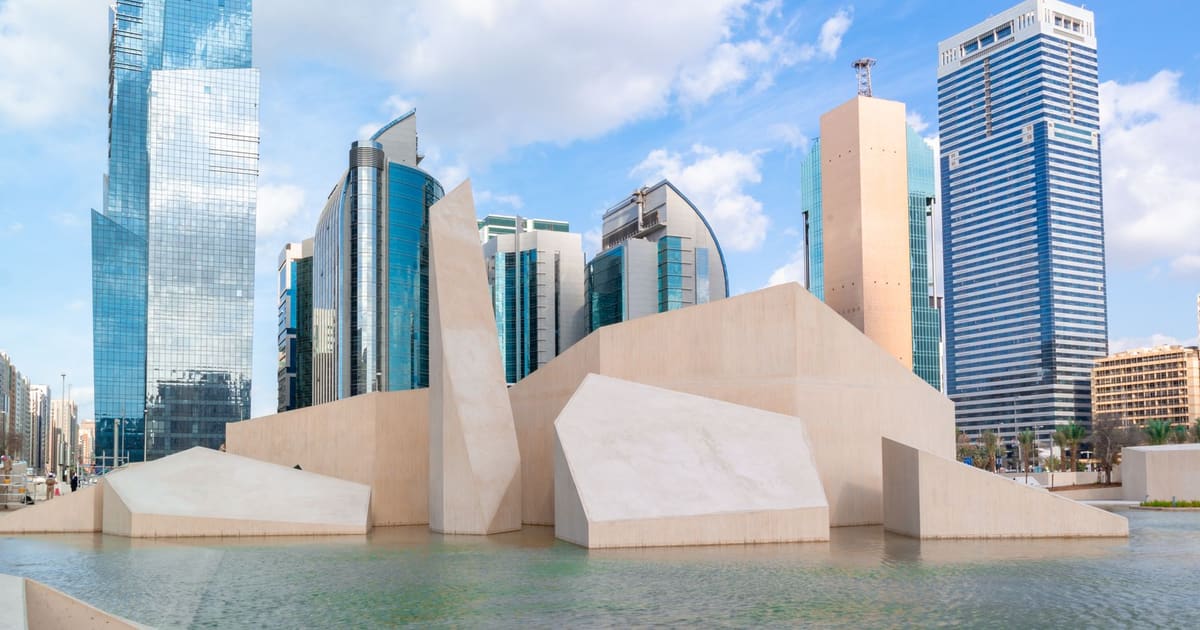
Abu Dhabi went from a fort beside a freshwater well to a capital city of towers in roughly one lifetime, and this walk follows that change through the middle of downtown. It starts at Qasr Al Hosn, the old fort where the city began, crosses to the Cultural Foundation, cuts north through a modern souk at the foot of the World Trade Center towers, and comes out on the Corniche, the long waterfront promenade, before ending in the shade of Capital Garden. It runs about four kilometers, roughly two and a half miles, flat the whole way, and it is one of the easiest self-guided walking tours in the Gulf to fit into a cool morning or a warm evening.
The walking takes about an hour, but give it two to three hours if you want to go inside Qasr Al Hosn and browse the souk. The route is flat, on wide sidewalks, plazas and the Corniche promenade, with a few big road crossings; use the marked crossings and underpasses and wait for the lights, because the traffic here moves fast. Heat decides everything in this city. The good season runs from about November to March, when mornings and evenings are warm and lovely. In October and April, set off early in the morning or after sunset. From May to September the midday heat regularly climbs past 40 degrees Celsius, well over 104 Fahrenheit, and a midday walk is simply not possible; if you are here in summer, go only in the first hour after sunrise or late at night, and keep it short. Wear a hat, carry plenty of water and refill it in the souk. Dress modestly, which here means shoulders and knees covered for men and women alike, especially inside the museum and the Cultural Foundation. Entry to Qasr Al Hosn is ticketed and the opening times of the museum, galleries and shops vary, so check before you go. During Ramadan, be discreet about eating and drinking in public in daylight.
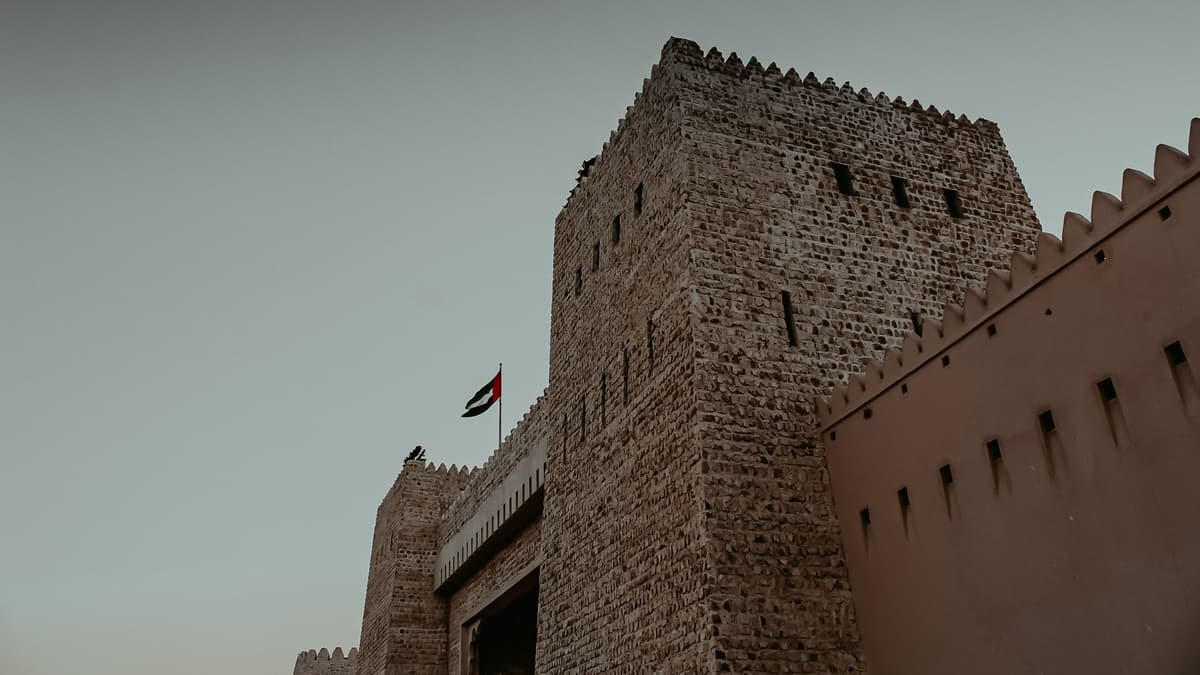
Stand in the open plaza in front of Qasr Al Hosn and take in the fort: thick pale walls, round and square towers, small high windows and notched battlements along the top. This is the oldest stone building in Abu Dhabi, and the whole city grew up around it. The story begins with water. Local tradition says that hunters of the Bani Yas tribe followed a gazelle onto this island in the eighteenth century and found fresh water, and that is said to be how Abu Dhabi, "father of the gazelle," got its name. Around the 1760s a watchtower was built to guard that precious well, and the old tower still stands at the heart of the building in front of you. Toward the end of that century it was enlarged into a fort, and it became the home of the ruling Al Nahyan family and the seat of government. In the 1930s and 1940s an outer palace was built around the old fort. For most of those years the town around it was a small settlement of palm-frond houses whose people lived from pearling, fishing and dates. Look closely at what the walls are made of: coral and stones gathered from the sea, bound with lime mortar and plastered over, which is why the building was long known as the White Fort. The fort remained the ruler's palace into the 1960s, and after a long restoration it reopened as a museum in 2018, telling the story of the city from the inside. When you are ready, walk east across the gardens and plazas of the Al Hosn site to the long white building on its far side. About eight minutes.
 You are now in front of the Cultural Foundation, a long, low modernist building of white walls, arcades and deep shade. It opened in 1981, ten years after the founding of the United Arab Emirates, and it was designed by The Architects Collaborative, the American firm founded by Walter Gropius of the Bauhaus. Look at how the arches and screened walkways borrow from Islamic architecture, and how the inner courtyards are laid out to hold the shade, an old Gulf idea dressed in modern concrete. For the young country it was something new: one home for the national library, exhibition halls and a theater, where people came to see art, hear concerts and read. For a generation it was the place in the city to see a show. By the 2000s the building had grown tired and it closed for years, but it was restored and reopened in 2018, and today it hosts theater, music, exhibitions and art workshops, with a library just for children on the same site. Before you leave, look for the House of Artisans on the site, where the traditional crafts of the Emirates are kept alive, from Al Sadu weaving, with its bold red and black geometric bands, to baskets woven from palm fronds. Turn back toward the fort from the Foundation's arcades for a moment. In a few steps you have crossed from the eighteenth century to the 1980s, the two ends of the city's first great change. From here, head north toward the two tall towers of the World Trade Center, which you can see over the rooftops, crossing busy Hamdan Street at the lights. About thirteen minutes.
Step in from the street and the noise falls away. The World Trade Center Souk is a modern market designed by Foster and Partners, the London studio of the architect Norman Foster, and it stands on the site of the old Central Market, where much of the city came to shop during the boom years. Rather than build another glossy mall, the architects tried to keep the spirit of a traditional souk: narrow lanes, small shops, shaded courtyards and light filtering in through carved wooden screens. Look up at the lattice overhead and on the walls. The pattern recalls the mashrabiya, the wooden window screens that let breezes and light into Arab houses while keeping their rooms private. As the sun moves, the shadows of the lattice slide slowly across the floor. Above you rise the two towers of the World Trade Center, one for offices and one for apartments, the taller among the tallest buildings in the city. Inside you will find carpets, perfumes, spices, dates, handicrafts and cafes. Most shops here have fixed prices, but in the smaller stalls selling carpets and crafts a little polite bargaining is normal: ask the price, offer less with a smile, and settle somewhere in between. It is also a good place to cool down, buy a cold drink and refill your water before the waterfront. When you are done, leave the souk on its north side and keep heading north toward the sea, crossing Khalifa Street and then Corniche Road at the pedestrian crossings or underpasses. About fifteen minutes.
Wat er inbegrepen is
Onze tours zijn bedoeld om meditatief en meeslepend te zijn: je blijft in beweging en luistert gewoon. Samen zijn ze altijd beter, en de app speelt de vertelling synchroon af, zodat jij, je partner en je vrienden elke stop op hetzelfde moment horen.
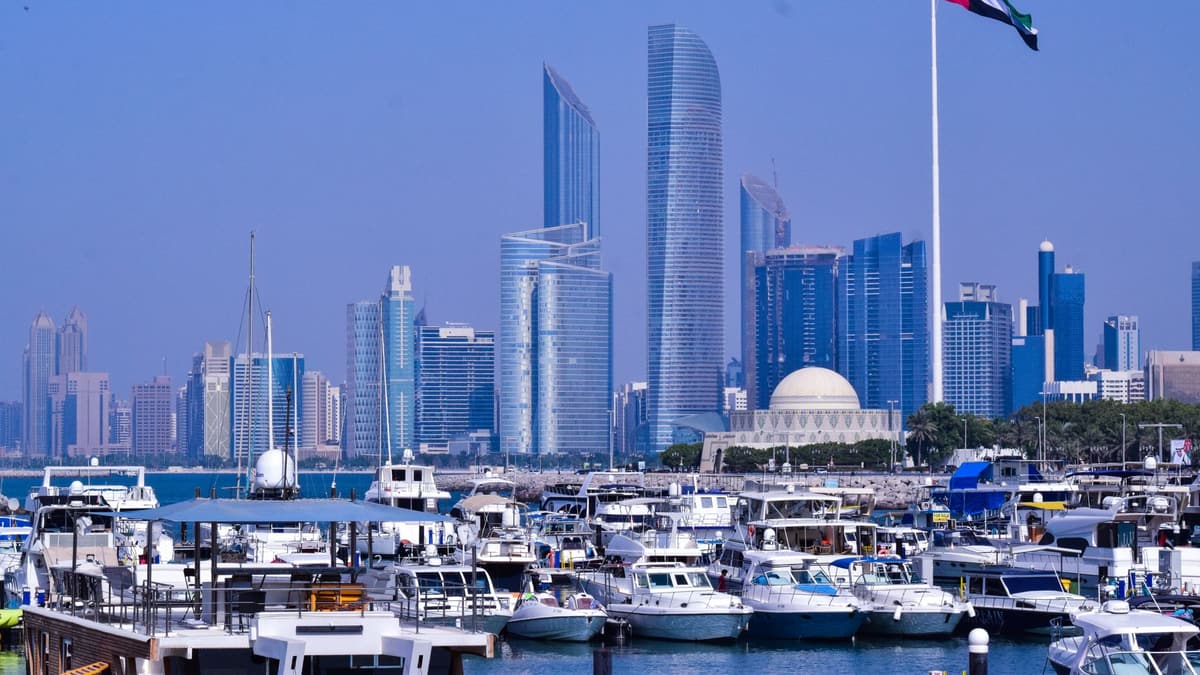
You have reached the Corniche, Abu Dhabi's waterfront promenade, with the sea in front of you and the lawns and trees of Lake Park behind. Stand by the water and look along the shore.
De rest van deze stop zit in de volledige audiotour.
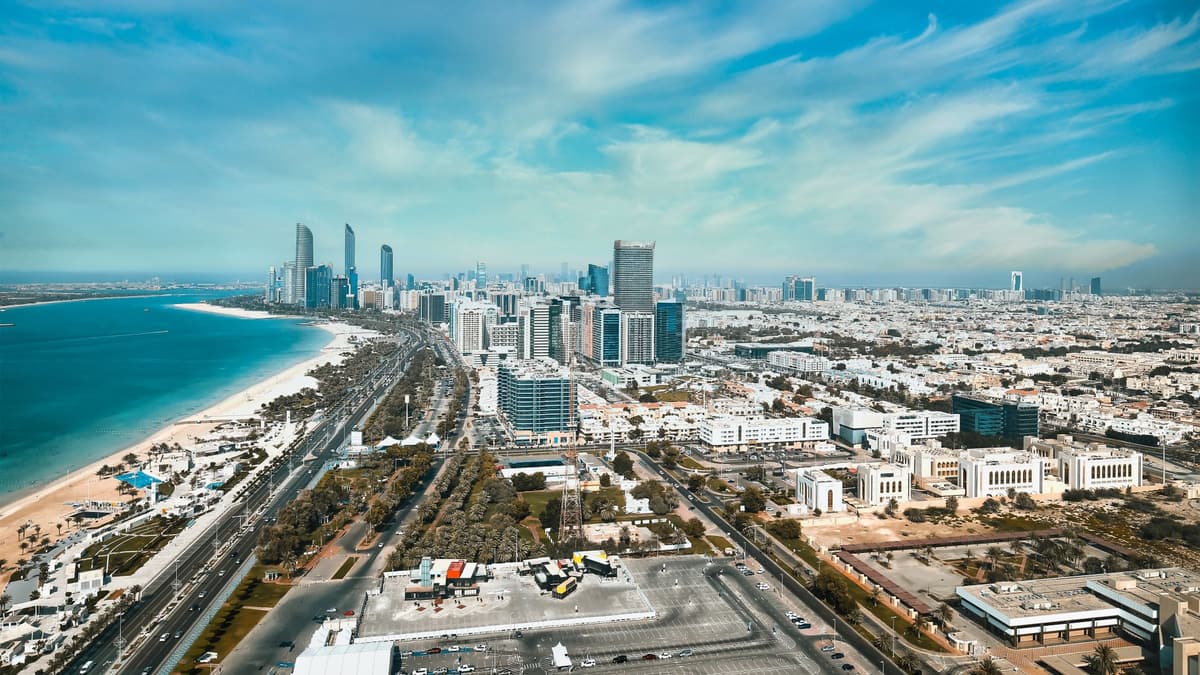
The walk ends in Capital Garden, a public park of lawns, paths and tall shade trees right in the middle of downtown. Find a bench under the trees and notice how much cooler it feels here than out on the open pavement.
De rest van deze stop zit in de volledige audiotour.
Doe deze wandeling samen met anderen tijdens de eerstvolgende geplande tour.
Ongeveer 4 km, circa 57 minuten in een rustig tempo · 5 stops
Vrienden lopen gratis meeOctober 11, 2026 · 9 min read
From the Hollandsche Schouwburg through the old Jewish Quarter, past the Dockworker and the Dam, to the Anne Frank House on the Prinsengracht.
October 11, 2026 · 11 min read
From Van Houten's street by the Vondelpark past Leidseplein, the Rijksmuseum passage and the famous canal bench to the Anne Frank House.

October 11, 2026 · 10 min read
Follow the last days of April and May 1945 from the Anhalter Bahnhof ruin past the Gestapo site and Brandenburg Gate to the Moltke Bridge and the Reichstag.
