
October 11, 2026 · 9 min read
Amsterdam Anne Frank Walking Tour
From the Hollandsche Schouwburg through the old Jewish Quarter, past the Dockworker and the Dam, to the Anne Frank House on the Prinsengracht.
589

October 9, 2026 · 10 min read

 Vrienden lopen gratis mee
Elke tour is ook beschikbaar als een geplande groepswandeling waar je in de app aan kunt deelnemen.
Meer audiotours in Hamburg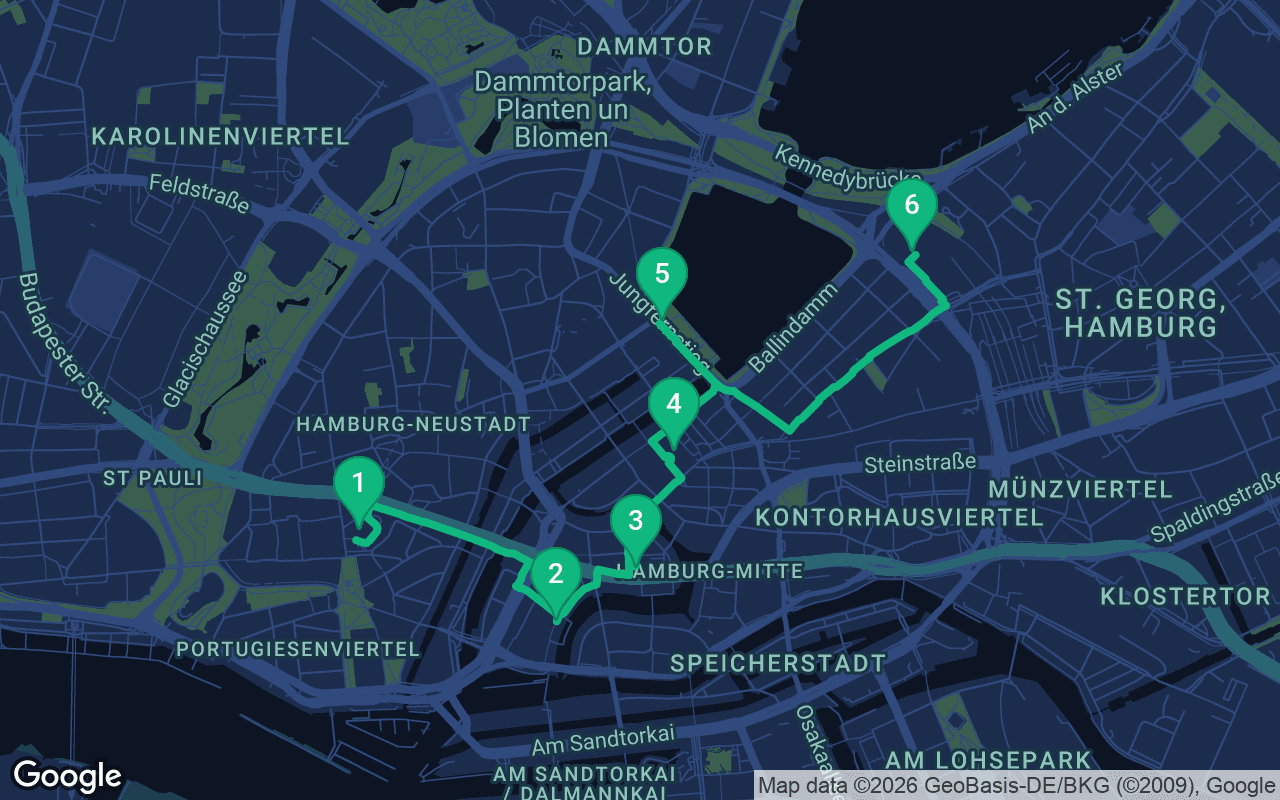
Ongeveer 3,5 km, zo'n 48 minuten op een rustig tempo.
Deze tour is ingesproken
Druk op afspelen bij de eerste 3 stops voor een demo van 30 seconden van de vertelling. In de app zijn de intro en die 3 stops volledig gratis te beluisteren, en bij elke stop klinkt een signaal zodra je aankomt. De hele tour met gids is van jou voor $8.99, een eenmalige aankoop die je voor altijd behoudt.
Werkt met Garmin, Komoot, Strava, OS Maps en elke GPX-app.
Hamburg likes to call itself a free and Hanseatic city, a proud republic of merchants that answered to no prince, and this walk tells its story through the buildings that survived, or rose again after, fire, war and plague. It starts at the great brick church with the copper-green tower that the whole city calls the Michel, drops down to the oldest merchant street in town, pauses at the bombed spire of St. Nikolai, crosses the square in front of the grand City Hall and comes out on the shining lake of the Alster. It ends at one of the finest art museums in Germany. The route is about three and a half kilometers, and it pairs well with our harbor walk among the self-guided walking tours of Hamburg, since together they show both faces of the city.
The walking takes under an hour, but plan on two to three hours, longer if you climb the Michel, ride up St. Nikolai or spend time in the Kunsthalle, which deserves a visit of its own. Opening times change and some sights charge admission, so check before you go. The route is paved and mostly flat, with a gentle downhill from the Michel toward the canals and a few busy roads to cross, so use the lights. Hamburg weather is famously changeable, with wind and showers rolling in from the North Sea, so bring a waterproof layer and something warm outside high summer. A clear morning is the best time to climb a tower for the view, while late afternoon light makes the Alster glow. There are plenty of cafes along the way, and the arcades by City Hall give shelter from a passing shower. Toward the end you are close to the main railway station, which makes it easy to head off afterward.
Stand in the square in front of the church and look up at the tower, rising in stages to a green copper top that has guided sailors home for centuries. This is St. Michael's, the Michel, the most beloved church in Hamburg, and it has had to be built more than once. The first church on this hill was finished in the 1660s and burned after a lightning strike in 1750. Its replacement, the baroque church in front of you, took decades, and the tower was not complete until 1786. Then in 1906 workmen repairing the tower started a fire that burned the church to its walls, and the city simply built it again, faithfully, by 1912. It was damaged again by bombing in the Second World War and restored once more. Step inside if you can. The interior is a bright sweep of white and gold, with curving galleries that hold a congregation of thousands. The composer Carl Philipp Emanuel Bach, son of Johann Sebastian, lies in the crypt, and Johannes Brahms, born in Hamburg, was baptized here. The tower clock is said to be the largest in Germany, and a trumpeter still plays a chorale from the tower to the four points of the compass, an old custom. For the best view of the harbor, take the tower. Then head east, downhill toward the canals, passing beneath the green iron viaduct of the elevated railway, and in about ten minutes you reach Deichstrasse, a narrow street running beside a canal.
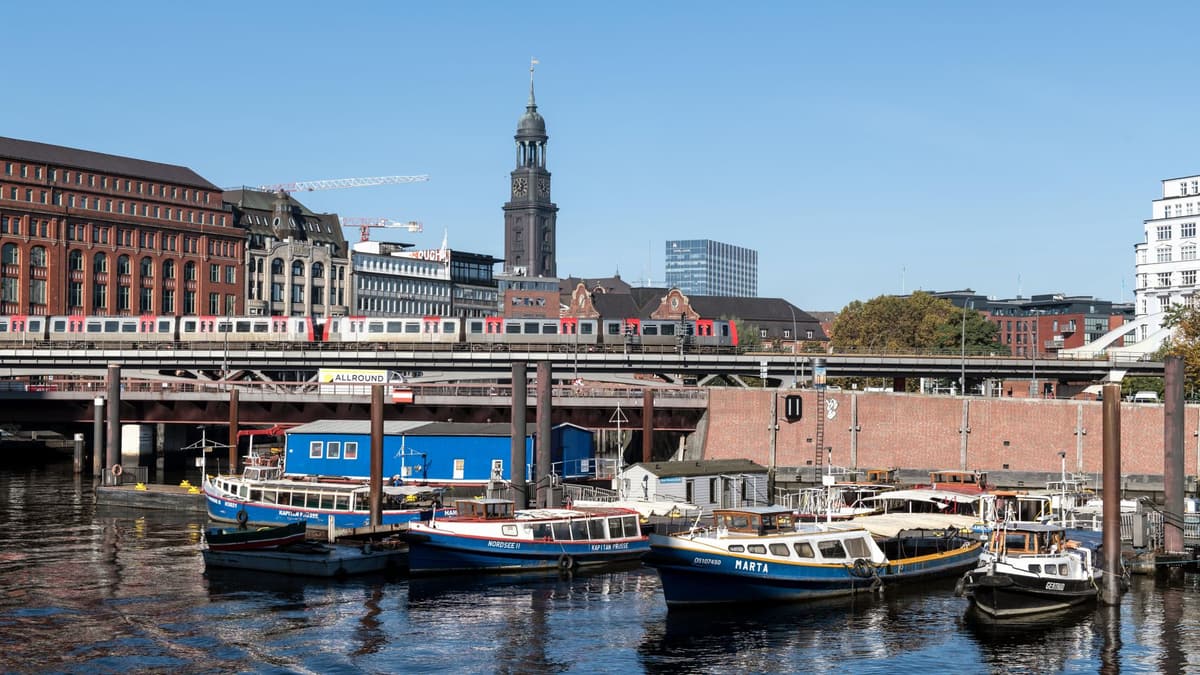 You are in Deichstrasse, and its name tells you how old it is. A Deich is a dike, and this street was first built up along a dike beside the canal in the early fourteenth century. The tall, narrow houses on either side are what Hamburg looked like before the modern city arrived, with steep gables, colored plaster and timber frames, many of them from the seventeenth to the nineteenth centuries. They were merchants' houses that did everything at once. The family lived at the front, the office sat in the middle and the goods were stored at the back, where the houses open straight onto the canal so barges could be unloaded by hoist. If you find a gap between the houses, slip through to the water and look at their back walls, which are often more beautiful than the fronts. On the night of May 5, 1842, a fire broke out in a cigar maker's warehouse on this very street. It burned for three days and destroyed around a quarter of the old city by most counts, including several churches. To stop it, the city even blew up its own town hall to make a firebreak. Around twenty thousand people lost their homes. Oddly, part of Deichstrasse itself survived, which is why you can still walk it. From the north end of the street, turn right along the busy main road, cross the canal, and the dark spire of St. Nikolai stands on your left, about four minutes away.
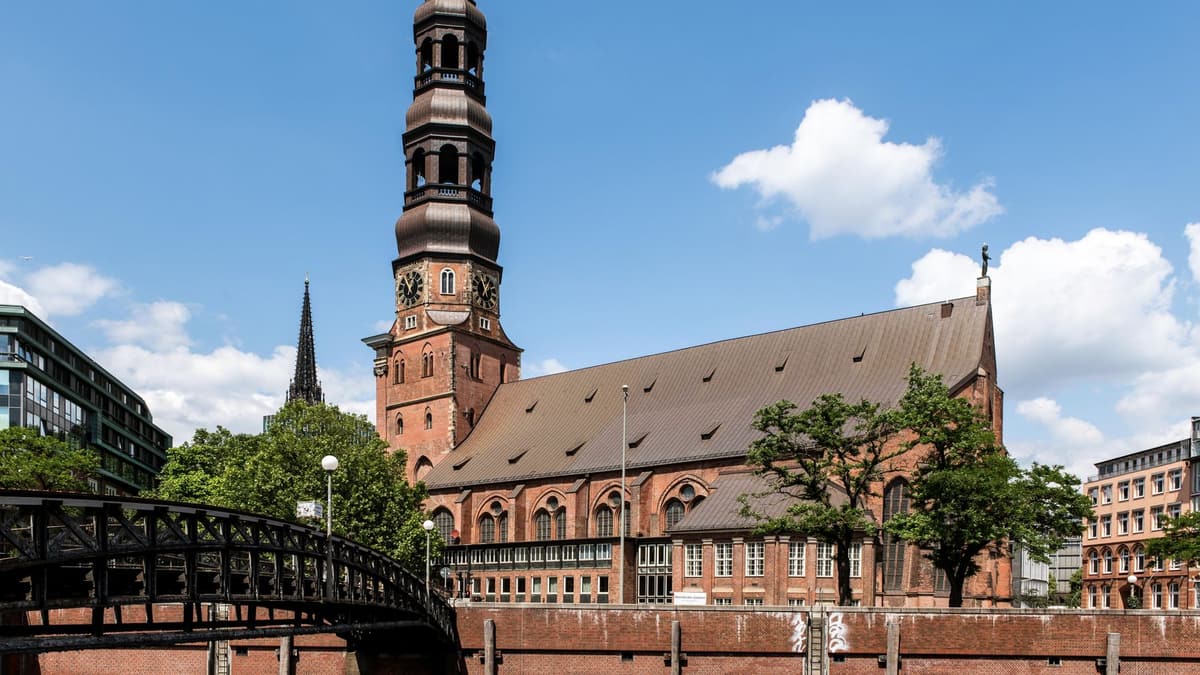
Stand before the tall blackened spire and the ragged walls at its foot. This is all that remains of St. Nikolai, and the city has chosen to keep it this way. The medieval church on this spot was one of those lost in the Great Fire of 1842. Hamburg replaced it with a Gothic Revival church designed by the English architect George Gilbert Scott, and when its tower was completed in 1874, at about 147 meters, it was for a short time the tallest building in the world. In late July 1943, British and American bombers attacked Hamburg in a series of raids known as Operation Gomorrah. On the night of July 27 to 28, hot, dry weather and the concentrated bombing combined into a firestorm, a vortex of flame that pulled in air with the force of a hurricane and burned through the crowded working districts to the east of here. Across the raids, an estimated 35,000 people were killed, most of them civilians, and hundreds of thousands fled the city. St. Nikolai's nave was wrecked and later cleared, but the tower stood. Today it is a memorial to the victims of war and tyranny between 1933 and 1945, and the museum in the crypt places Hamburg's suffering beside the destruction Germany had brought to cities such as Warsaw, Rotterdam and Coventry. A glass lift rises inside the spire to a viewing platform high above the old town. When you are ready, leave the square on its north side and walk north, away from the river, for about five minutes until the streets open onto a vast square and City Hall.
Wat er inbegrepen is
Onze tours zijn bedoeld om meditatief en meeslepend te zijn: je blijft in beweging en luistert gewoon. Samen zijn ze altijd beter, en de app speelt de vertelling synchroon af, zodat jij, je partner en je vrienden elke stop op hetzelfde moment horen.
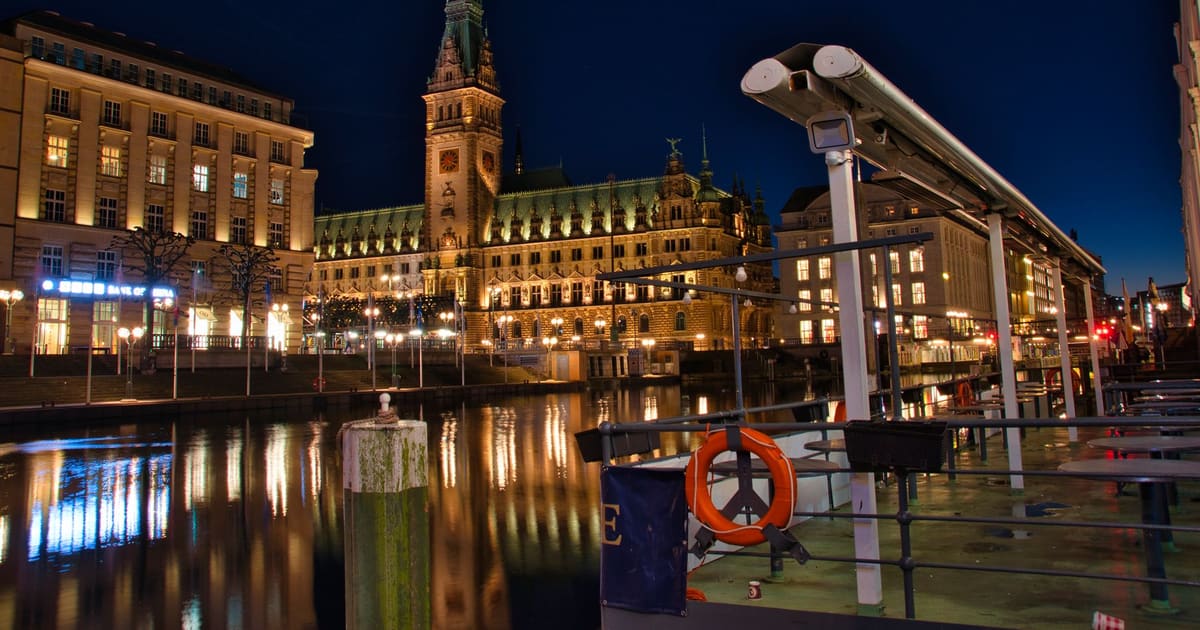
You are on the Rathausmarkt, and the building in front of you is Hamburg City Hall, the Rathaus. Take a few steps back to fit it all in.
De rest van deze stop zit in de volledige audiotour.
In front of you lies the Inner Alster, the Binnenalster, a square lake right in the middle of the city, ringed by grand white buildings and dotted with sailing boats in summer. It is man-made, in a way.
De rest van deze stop zit in de volledige audiotour.
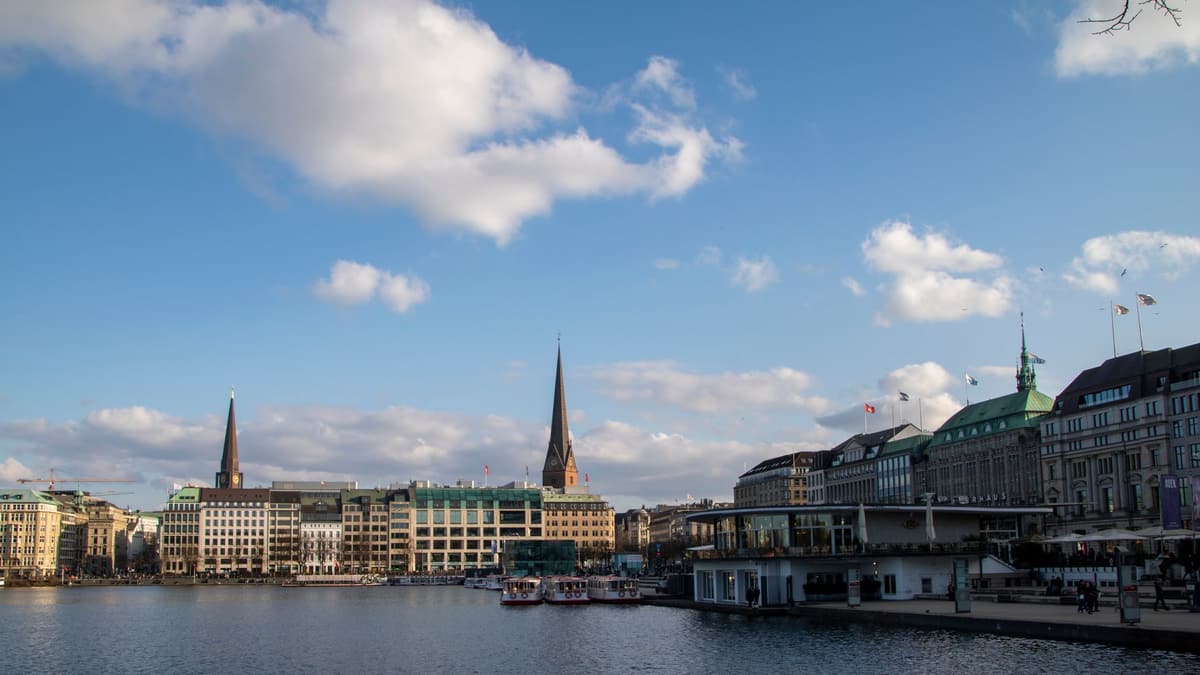
The walk ends at the Hamburger Kunsthalle, the city's great art museum, which is really three buildings joined together.
De rest van deze stop zit in de volledige audiotour.
Doe deze wandeling samen met anderen tijdens de eerstvolgende geplande tour.
Ongeveer 3,5 km, circa 48 minuten in een rustig tempo · 6 stops
Vrienden lopen gratis meeOctober 11, 2026 · 9 min read
From the Hollandsche Schouwburg through the old Jewish Quarter, past the Dockworker and the Dam, to the Anne Frank House on the Prinsengracht.
October 11, 2026 · 11 min read
From Van Houten's street by the Vondelpark past Leidseplein, the Rijksmuseum passage and the famous canal bench to the Anne Frank House.

October 11, 2026 · 10 min read
Follow the last days of April and May 1945 from the Anhalter Bahnhof ruin past the Gestapo site and Brandenburg Gate to the Moltke Bridge and the Reichstag.
