
October 11, 2026 · 9 min read
Amsterdam Anne Frank Walking Tour
From the Hollandsche Schouwburg through the old Jewish Quarter, past the Dockworker and the Dam, to the Anne Frank House on the Prinsengracht.
589

October 9, 2026 · 11 min read

 เพื่อนเดินฟรี
ทุกทัวร์ยังเปิดเป็นการเดินกลุ่มตามเวลาที่กำหนด ซึ่งคุณเข้าร่วมได้ในแอป
ทัวร์เสียงเพิ่มเติมในMunich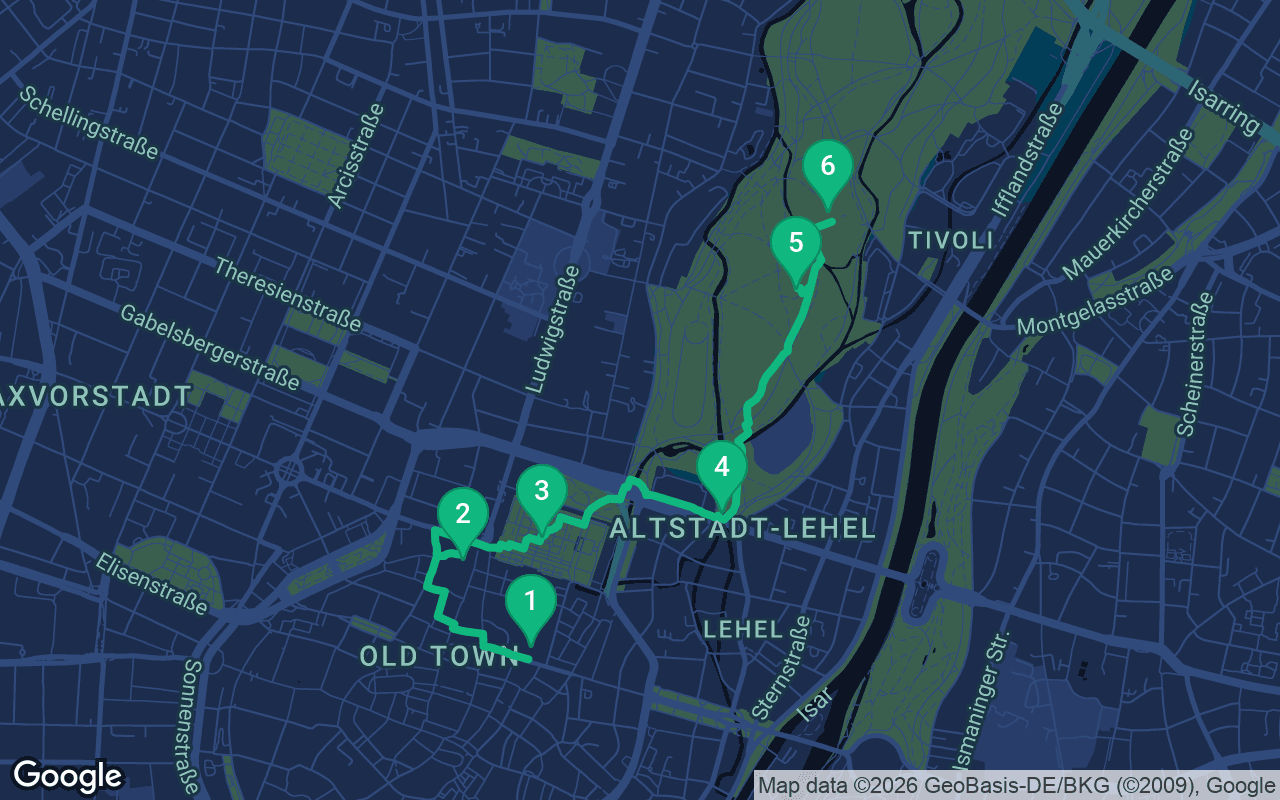
ประมาณ 3.3 กม. ใช้เวลาประมาณ 44 นาทีด้วยจังหวะสบายๆ
ทัวร์นี้มีเสียงบรรยาย
กดเล่นที่ 3 จุดหยุดแรกเพื่อฟังตัวอย่างคำบรรยายความยาว 30 วินาทีได้ที่นี่ ในแอป คุณฟังบทนำและจุดหยุดเหล่านี้แบบเต็มได้ฟรี และทุกจุดหยุดจะมีเสียงแจ้งเตือนเมื่อคุณไปถึง คุณสามารถเป็นเจ้าของทัวร์บรรยายทั้งหมดนี้ได้ในราคาเพียง $8.99 ซึ่งเป็นการซื้อครั้งเดียวและเก็บไว้ใช้ได้ตลอดไป
ใช้งานได้กับ Garmin, Komoot, Strava, OS Maps และแอป GPX ใดก็ตาม
Bavaria's royal family, the Wittelsbachs, lived right here in the middle of Munich, and this walk follows their footsteps from the palace door out into the park they gave the city. You start at the opera house on Max-Joseph-Platz, facing the vast royal palace, and walk past bronze lions to Odeonsplatz, where a golden-yellow church and a stately loggia hide one of the darkest moments in German history. From there you cross the formal palace garden, stop to watch surfers ride a wave in the middle of the city, and wander into the English Garden for a hilltop temple and a pagoda beer garden. It is about two and a half kilometers, flat apart from one short climb, and among the most relaxed self-guided walking tours Munich has to offer. It starts among kings and ends at a beer garden table.
Allow about two hours, longer if you want to tour the palace or settle in at the beer garden at the end, which you probably will. The first half is on paved city squares and streets, and the second half follows wide gravel and earth paths through the English Garden, so comfortable shoes are a good idea. The only real slope is the short climb up the hill to the Monopteros. A sunny afternoon is perfect, since the park is at its liveliest then, though weekends in summer get busy. Much of the walk in the park is shaded by old trees, but the open meadows can be hot. The royal palace, the Residenz, has its own museum and treasury with separate tickets and hours, so check before you go if you want to see inside. At the Eisbach wave you will be watching from the bank or the bridge, never from the water, and the same goes for anyone with you. Bike paths cross the park in many places, and cyclists move fast, so look both ways before you step across.
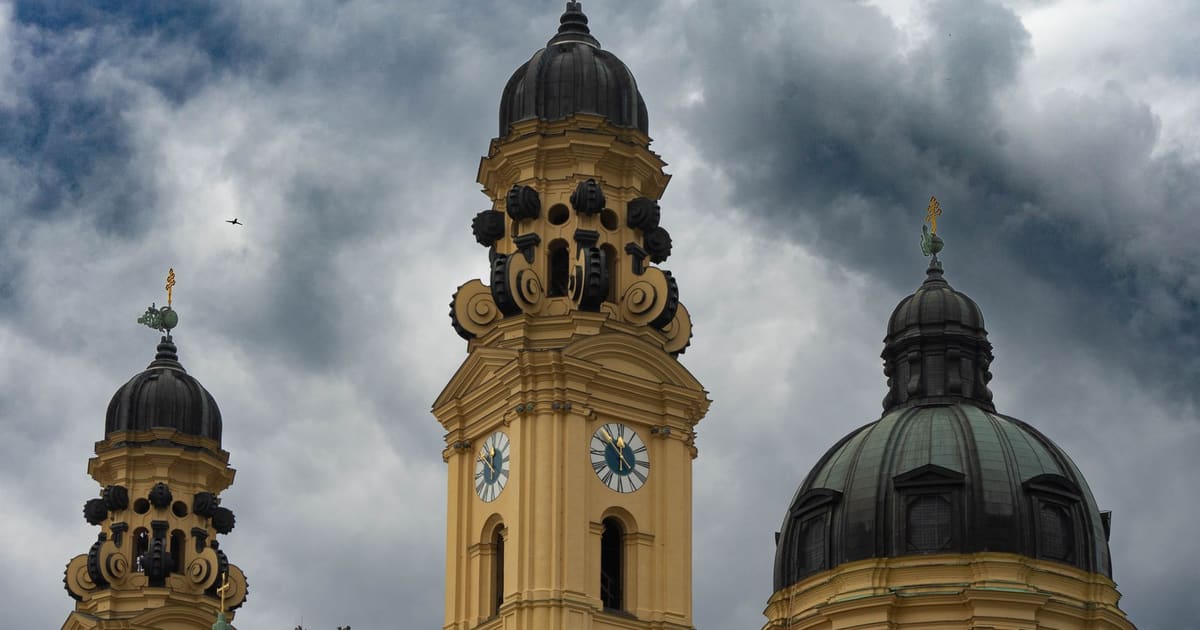
You are standing on Max-Joseph-Platz, and the temple-fronted building with the tall columns is the National Theatre, home of the Bavarian State Opera. Look up at the two triangular gables stacked one above the other, the upper one bright with a mosaic. The first theater here opened in 1818, burned down a few years later and was rebuilt, then bombs destroyed it in the Second World War. Munich rebuilt it faithfully, and it reopened in 1963. This stage holds a special place in music history. In the 1860s the young King Ludwig II, who adored Richard Wagner and paid off his debts, brought the composer to Munich, and several of Wagner's operas had their first performances here, including Tristan and Isolde. In the middle of the square sits a bronze statue of King Maximilian I Joseph, the first King of Bavaria; Bavaria became a kingdom in 1806, thanks to its alliance with Napoleon. Now turn to the long stone palace front on the north side of the square. This is the Königsbau, one wing of the Residenz, the palace where Bavaria's dukes, electors and kings lived and ruled until 1918. The architect Leo von Klenze modeled this facade on the Palazzo Pitti in Florence. The whole palace stretches back for several blocks, around ten courtyards, and holds an exquisite little Rococo theater where Mozart's opera Idomeneo had its premiere. From here, walk north along Residenzstrasse with the palace on your right. Look out for the bronze lions guarding its gateways and the shiny faces on the shields they hold, rubbed by passersby for luck. In about four minutes the street opens onto Odeonsplatz, beside a grand open loggia. Walk to the front of the golden-yellow church on the left-hand side of the square.
 In front of you rises the Theatine Church, its warm yellow facade, two tall towers and green dome making it look as if it had been carried here from Rome. In a sense it was. In 1662, after years of waiting, Elector Ferdinand Maria and his wife, Henriette Adelaide of Savoy, finally had a son and heir, and they built this church in thanks. The princess came from Turin, and she brought in Italian architects and an Italian order of priests, the Theatines, who gave the church its name. The facade was only finished a century later. Step inside to see how different it feels from the outside: brilliant white stucco, swirling with angels and leaves, under a light-filled dome. Now look to your left, across the square, at the open loggia with its broad arches and stone lions. This is the Feldherrnhalle, the Field Marshals' Hall, built in the 1840s for King Ludwig I as a copy of a famous loggia in Florence, to honor Bavaria's generals. On November 9, 1923, Adolf Hitler and his followers marched here in an attempt to seize power, and the Bavarian state police stopped them in a burst of gunfire. Four police officers and sixteen of the marchers died. When the Nazis took power ten years later, they turned this spot into a shrine for their dead, guarded day and night, and passersby were expected to give the Nazi salute. Many people quietly avoided it by slipping through Viscardigasse, the narrow lane just behind the hall. Today a wavy trail of bronze cobblestones in that lane remembers them, and a plaque set into the pavement in front of the hall honors the four police officers who were killed. When you are ready, cross Odeonsplatz to the east and walk through the arched gateway into the palace garden, about two minutes away.
You are in the Hofgarten, the court garden, laid out in the early seventeenth century in the Italian Renaissance style for Elector Maximilian I, whose palace is beside you. It is a calm, geometric place: gravel paths, clipped lawns, rows of trees and flower beds, all arranged around the small domed pavilion in the middle. That pavilion is the Temple of Diana, built at the same time as the garden, with a bronze figure on its roof representing Bavaria. Walk into it, and if you hum or speak, you will hear how its dome carries the sound. On warm evenings musicians and dancers sometimes make use of it, and it is one of the loveliest places in the city to linger. Look along the arcades that frame the garden on the west and north sides. Their walls carry faded paintings of scenes from Bavarian history, and in 1937 the gallery building along the north side housed the notorious Nazi exhibition of so-called degenerate art, which mocked modern painters like Paul Klee and Ernst Ludwig Kirchner. At the eastern end of the garden stands a big modern building of glass and stone built around an old dome; it is the Bavarian State Chancellery, the office of the state's premier. In front of it, a sunken war memorial holds the stone figure of a dead soldier. To continue, leave the garden at its northeast corner, cross the busy ring road at the lights, and walk east along Prinzregentenstrasse. Pass the long colonnaded front of the Haus der Kunst on your left, and just beyond its far end, where the road crosses a fast-flowing stream, look over the railing. It takes about ten minutes.
สิ่งที่รวมอยู่
ทัวร์ของเราออกแบบมาให้เป็นประสบการณ์ที่ผ่อนคลายและดื่มด่ำ คุณเดินไปพร้อมกับฟังไปเรื่อย ๆ และจะดียิ่งขึ้นเมื่อไปด้วยกัน แอปจะเล่นคำบรรยายแบบซิงค์กัน ให้คุณ คนรัก และเพื่อน ๆ ได้ฟังทุกจุดในเวลาเดียวกัน
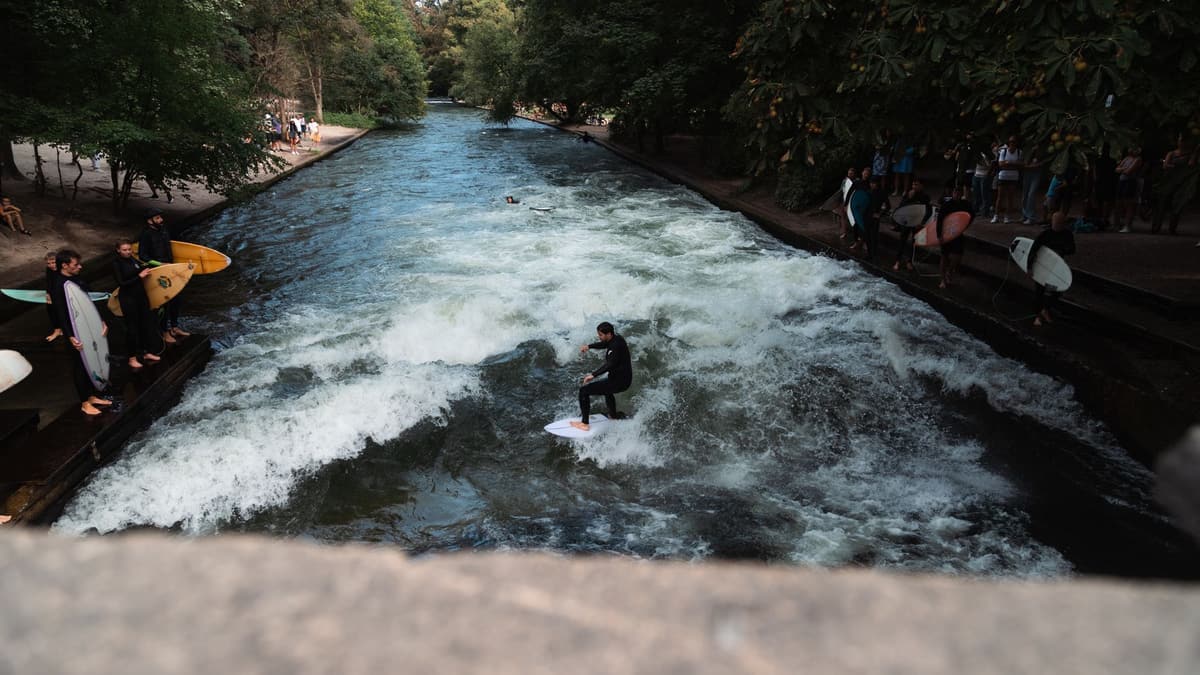
Below you, the Eisbach, a man-made channel of the river Isar, comes rushing out from under the road, and where it hits a step in its concrete bed it rears up into a standing wave about a meter high.
เนื้อหาที่เหลือของจุดนี้อยู่ในทัวร์เสียงฉบับเต็ม
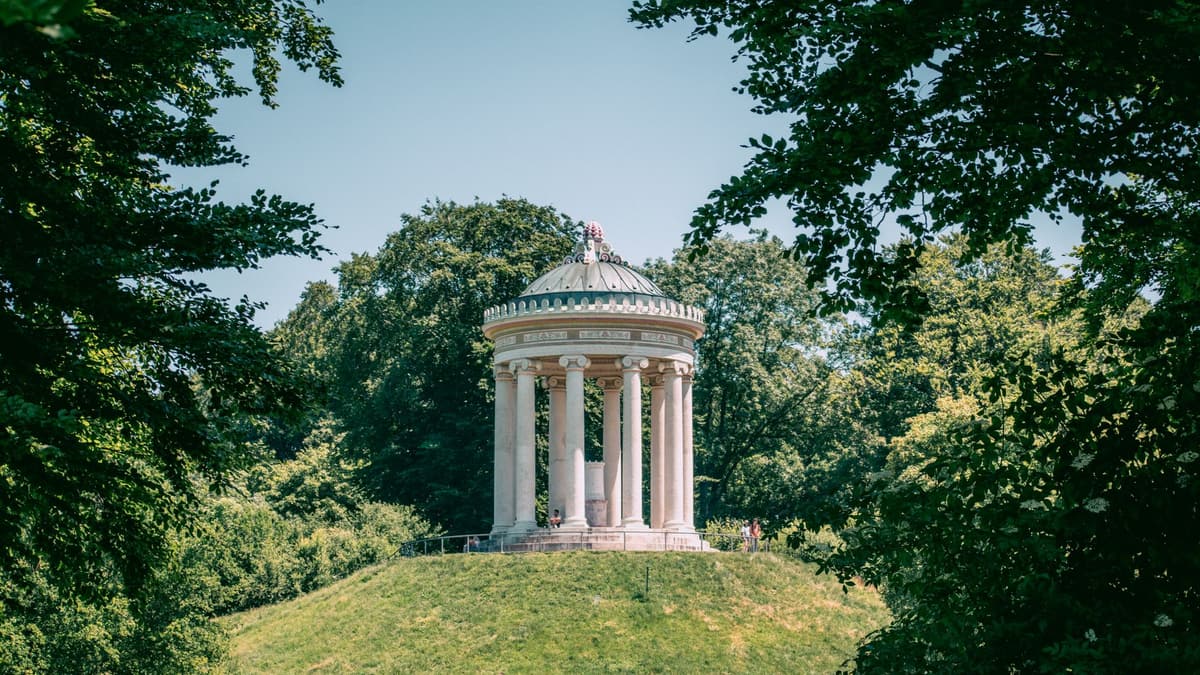
You are standing in the Monopteros, a little round Greek temple of slender columns on top of a hill, and the view is the reward for the climb.
เนื้อหาที่เหลือของจุดนี้อยู่ในทัวร์เสียงฉบับเต็ม
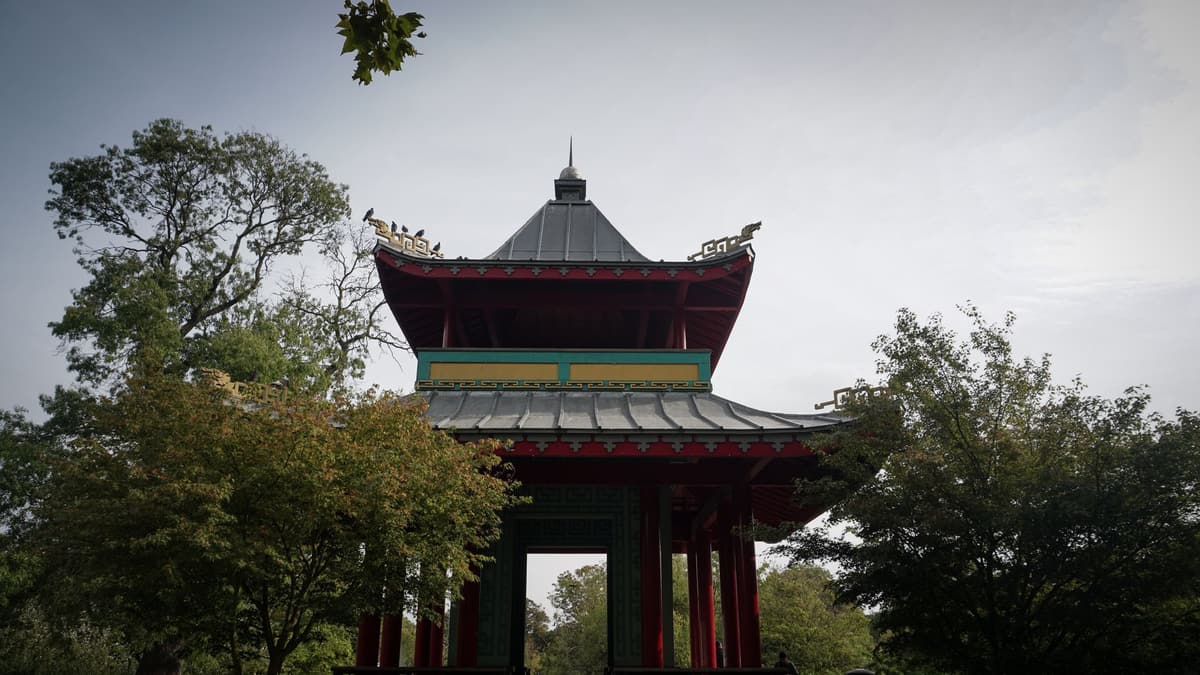
The walk ends at the Chinese Tower, a five-tiered wooden pagoda standing in the middle of a huge beer garden.
เนื้อหาที่เหลือของจุดนี้อยู่ในทัวร์เสียงฉบับเต็ม
เดินไปกับคนอื่นในทัวร์ที่กำหนดเวลาไว้ครั้งต่อไป
ประมาณ 3.3 กม. ใช้เวลาประมาณ 44 นาทีด้วยจังหวะสบายๆ · 6 จุดแวะ
เพื่อนเดินฟรีOctober 11, 2026 · 9 min read
From the Hollandsche Schouwburg through the old Jewish Quarter, past the Dockworker and the Dam, to the Anne Frank House on the Prinsengracht.
October 11, 2026 · 11 min read
From Van Houten's street by the Vondelpark past Leidseplein, the Rijksmuseum passage and the famous canal bench to the Anne Frank House.

October 11, 2026 · 10 min read
Follow the last days of April and May 1945 from the Anhalter Bahnhof ruin past the Gestapo site and Brandenburg Gate to the Moltke Bridge and the Reichstag.
