
October 11, 2026 · 9 min read
Amsterdam Anne Frank Walking Tour
From the Hollandsche Schouwburg through the old Jewish Quarter, past the Dockworker and the Dam, to the Anne Frank House on the Prinsengracht.
589

October 9, 2026 · 10 min read

 Bạn bè đi bộ miễn phí
Mỗi tour cũng được tổ chức như một chuyến đi bộ nhóm theo lịch trình mà bạn có thể tham gia trong ứng dụng.
Thêm tour âm thanh tại Venice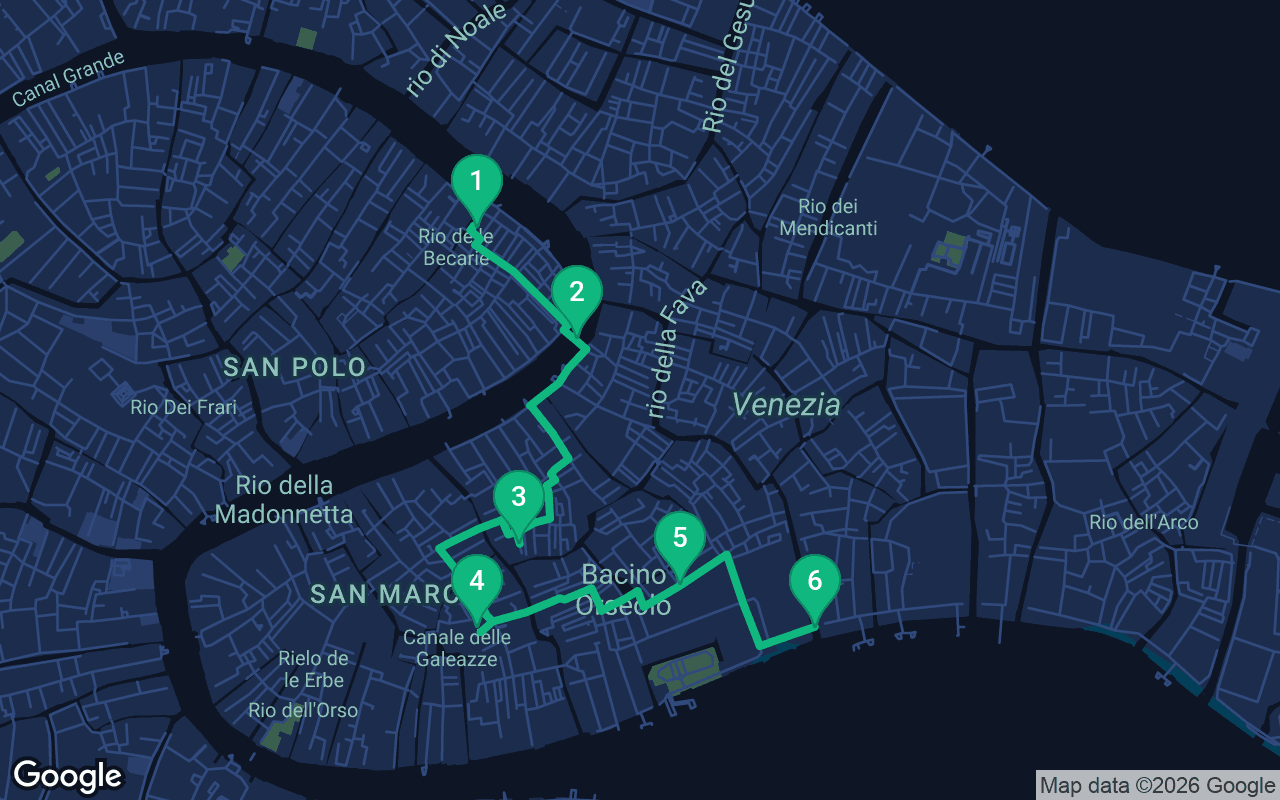
Khoảng 1,9km, mất khoảng 26 phút với nhịp độ thoải mái.
Tour này có thuyết minh âm thanh
Nhấn phát tại 3 điểm dừng đầu tiên để nghe thử 30 giây phần thuyết minh ngay tại đây. Trong ứng dụng, phần giới thiệu và các điểm dừng này được nghe trọn vẹn miễn phí, và mỗi điểm dừng sẽ phát âm báo khi bạn đến nơi. Toàn bộ chuyến tham quan có thuyết minh sẽ là của bạn chỉ với $6.99, mua một lần và sở hữu mãi mãi.
Hoạt động với Garmin, Komoot, Strava, OS Maps và mọi ứng dụng GPX.
This is the walk almost everyone tries to do on their first day in Venice, and the one almost everyone gets lost on. It starts among the fish and vegetable stalls of the Rialto Market, crosses the Grand Canal on the most famous bridge in the city, then threads a maze of lanes to a hidden spiral staircase and the opera house of La Fenice before opening out, all at once, into Piazza San Marco. It finishes on the waterfront, looking at the Bridge of Sighs. The whole line is only about two kilometers, but in Venice distance is the least of it, so think of this as one of those self-guided walking tours where the point is to keep your bearings while the city does its best to charm you off course.
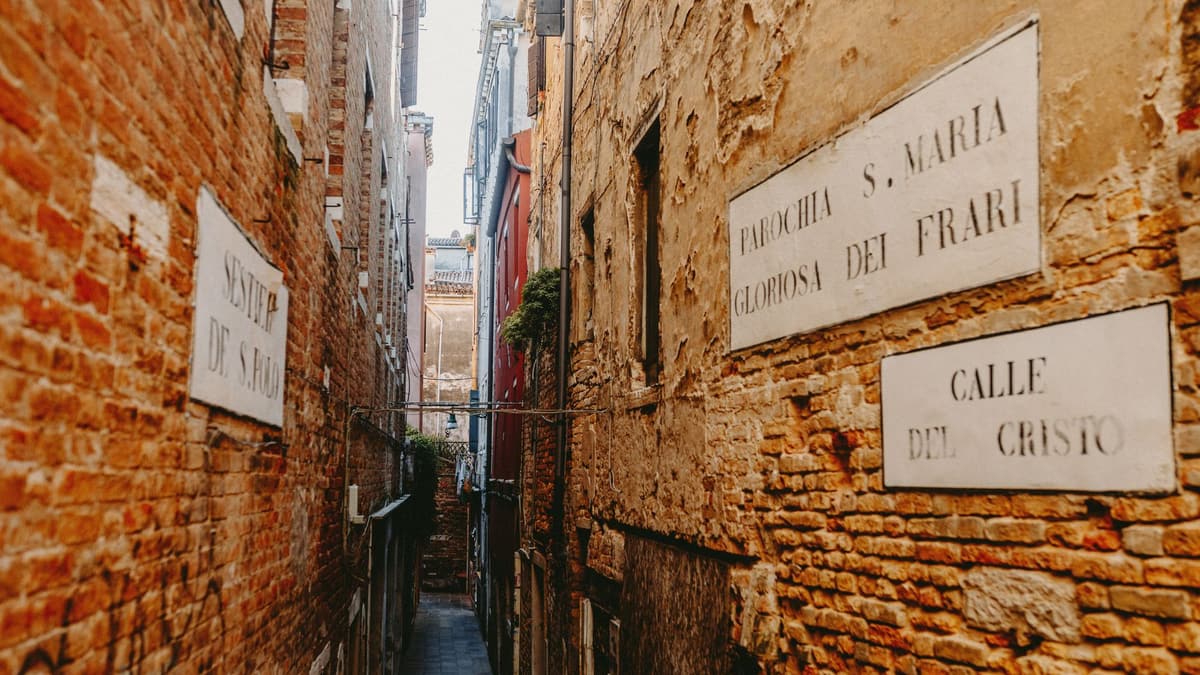
Allow around two hours at a stroll, and much longer if you go inside the basilica or climb the staircase. There are no hills in Venice, but there are bridges, and every one of them has steps, so this is not a smooth route for wheels. Mornings are best. The market is at its liveliest early, before the stalls pack up around lunchtime, and the lanes between Rialto and San Marco fill with people from late morning onward. Venice has no street names you can easily follow on foot, so do what Venetians do and steer by the yellow signs painted on corners, which point "per Rialto" and "per San Marco", and by the little squares, called campi, that you pass through. You will also walk through sottoporteghi, short tunnels under buildings that look private but are public passages. In autumn and winter, very high tides known as acqua alta can flood the lowest ground, Piazza San Marco first of all, so check the tide forecast and pack shoes you do not mind getting wet. Venice has also been charging a day-visitor access fee on certain dates, so check whether it applies on your date before you travel.
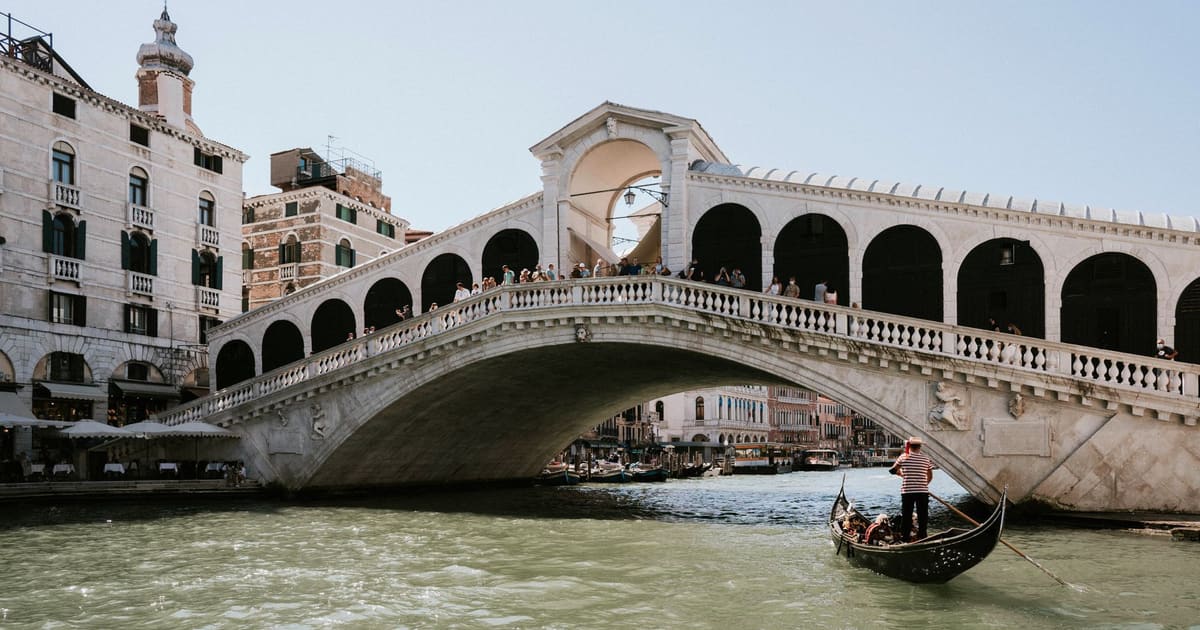
Stand under the open stone arcade of the fish market, the Pescaria, with the Grand Canal at your back, and let your eyes adjust to the glitter of ice and scales. This is the Rialto, the patch of higher ground where Venice really began as a city, and people have been buying and selling food on this spot for close to a thousand years. Merchants from across the Mediterranean once met here to trade spices, silk and gold, and the neighborhood was the money center of the Republic long before San Marco became its showpiece. The arcaded hall above the fish stalls looks medieval but was built in the early twentieth century, in a deliberately old-fashioned Gothic style, so it would sit happily beside its neighbors. Walk along the counters and look at what is on offer: spider crabs, cuttlefish still inky, piles of small lagoon fish, sometimes the tiny soft-shell crabs that are a Venetian specialty in their season. Next to the fish, the fruit and vegetable stalls spill along the canal, with artichokes and radicchio from the lagoon islands. When you are done, walk away from the water along the stalls toward the little square with the church and its big painted clock, and the great white bridge rises on your right, about three minutes away.
Before you climb, step into the small square of San Giacomo di Rialto and look back at the church with the huge clock face. Venetians call it San Giacometto and like to claim it as the oldest church in the city, a story you can enjoy without needing to believe it. Across the square, a stooped stone figure carries a short flight of steps on his back. This is the Gobbo di Rialto, the hunchback of Rialto, and the steps led up to a platform from which the Republic's laws were read out to the crowd. Now climb the bridge. For centuries, a bridge on this spot was the only way to cross the Grand Canal on foot. Earlier bridges here were wooden, and one of them collapsed in the fifteenth century under the weight of a crowd watching a procession pass below. The city held a competition for a stone replacement, and some of the great architects of the day sent designs, but the job went to Antonio da Ponte, whose single bold arch was finished in 1591. Critics are said to have predicted it would fall. It still carries two rows of shops and a constant river of visitors. Stop at the top and look both ways along the canal, then go down the far side into the square with a bronze statue of the playwright Carlo Goldoni. From there, work south and a little west through the lanes, via Campo San Luca, to Campo Manin, where small signs for the Scala Contarini del Bovolo point into a narrow lane, about eight minutes.
Follow the lane into a quiet courtyard, and there it is: a slender tower of brick and white stone arches, winding up the side of a palace like a stick of candy. The Contarini were one of the great noble families of Venice, so numerous that each branch of the family needed a nickname, and this branch was known by its staircase. Bovolo means snail shell in Venetian, and once you see the spiral of arches rising floor by floor, the name needs no explaining. The staircase was built at the end of the fifteenth century, when Venetian palaces usually hid their stairs inside courtyards, and it was a showy way of turning a practical thing into a piece of theatre. Look at how each ring of arches is a little higher than the last, so the whole tower seems to turn as you walk around it. For a long time it was neglected and closed, and its restoration and reopening in recent years gave the city back one of its best views. If it is open, climb to the little belvedere at the top. From there the roofs of Venice spread out around you, a jumble of chimneys, terraces and bell towers, with the Campanile of San Marco standing over all of it. When you come back down, return to Campo Manin and head south through the lanes, over a small bridge, to the square in front of the opera house, about five minutes.
Bao gồm những gì
Các tour của chúng tôi được thiết kế để mang tính thiền định và đắm chìm: bạn vừa đi vừa lắng nghe. Đi cùng nhau luôn tuyệt hơn, và ứng dụng phát thuyết minh đồng bộ để bạn, người thương và bạn bè nghe mỗi điểm dừng cùng một lúc.
You are in Campo San Fantin, a small square that the opera house fills with its pale, columned front. Look for the phoenix, the theatre's emblem, on the facade.
Phần còn lại của điểm dừng này có trong tour âm thanh đầy đủ.
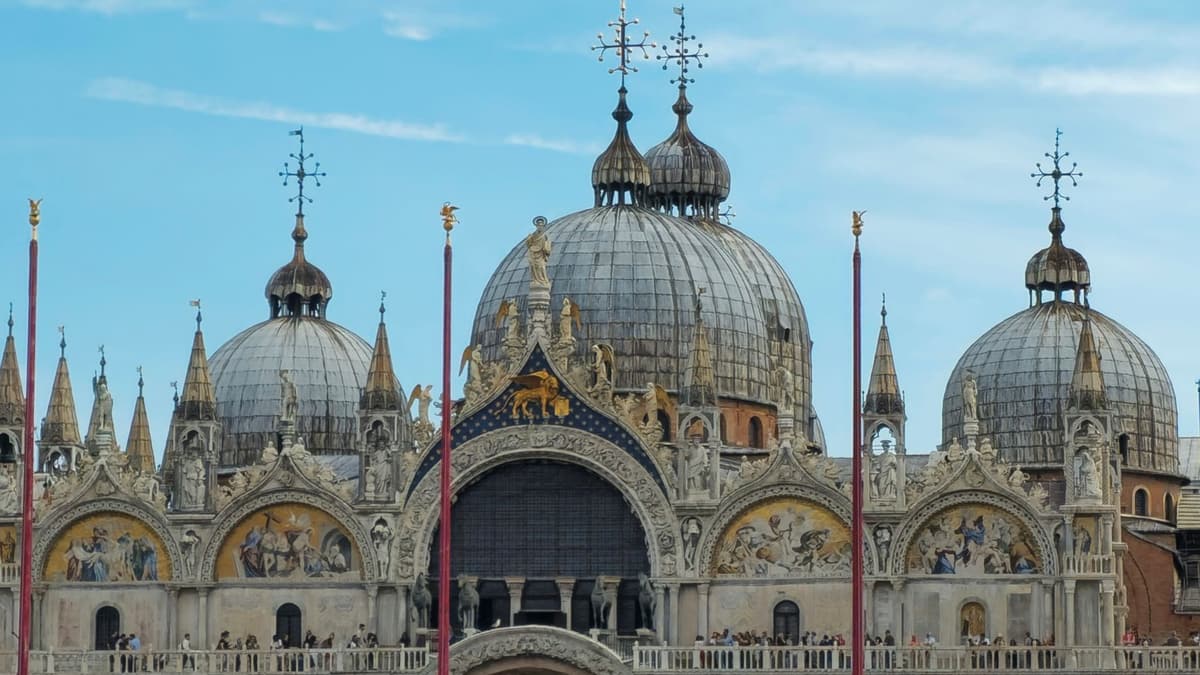
Stop as soon as you step into the open, because this is the best first view of Piazza San Marco: the long square stretching away from you, framed by arcades on both sides, with the domes and golden mosaics of Saint Mark's Basilica at the…
Phần còn lại của điểm dừng này có trong tour âm thanh đầy đủ.
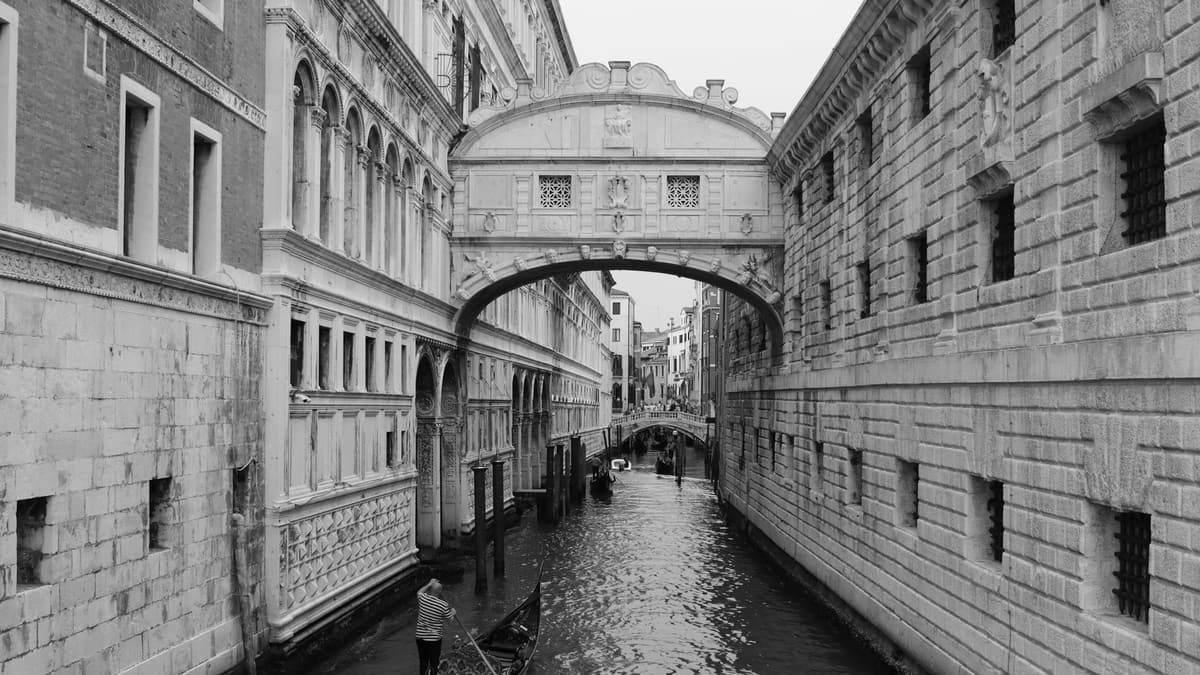
You are on the Ponte della Paglia, the Straw Bridge, said to be named for the boats that once unloaded straw here.
Phần còn lại của điểm dừng này có trong tour âm thanh đầy đủ.
Thực hiện buổi đi bộ này cùng người khác vào tour đã lên lịch tiếp theo.
Khoảng 1,9km, mất khoảng 26 phút với nhịp độ thoải mái · 6 điểm dừng
Bạn bè đi bộ miễn phíOctober 11, 2026 · 9 min read
From the Hollandsche Schouwburg through the old Jewish Quarter, past the Dockworker and the Dam, to the Anne Frank House on the Prinsengracht.
October 11, 2026 · 11 min read
From Van Houten's street by the Vondelpark past Leidseplein, the Rijksmuseum passage and the famous canal bench to the Anne Frank House.

October 11, 2026 · 10 min read
Follow the last days of April and May 1945 from the Anhalter Bahnhof ruin past the Gestapo site and Brandenburg Gate to the Moltke Bridge and the Reichstag.
