
October 11, 2026 · 9 min read
Amsterdam Anne Frank Walking Tour
From the Hollandsche Schouwburg through the old Jewish Quarter, past the Dockworker and the Dam, to the Anne Frank House on the Prinsengracht.
589

October 11, 2026 · 13 min read

 الأصدقاء يسيرون مجاناً
تتوفر كل جولة أيضاً كمشية جماعية مجدولة يمكنك الانضمام إليها في التطبيق.
المزيد من الجولات الصوتية في Paris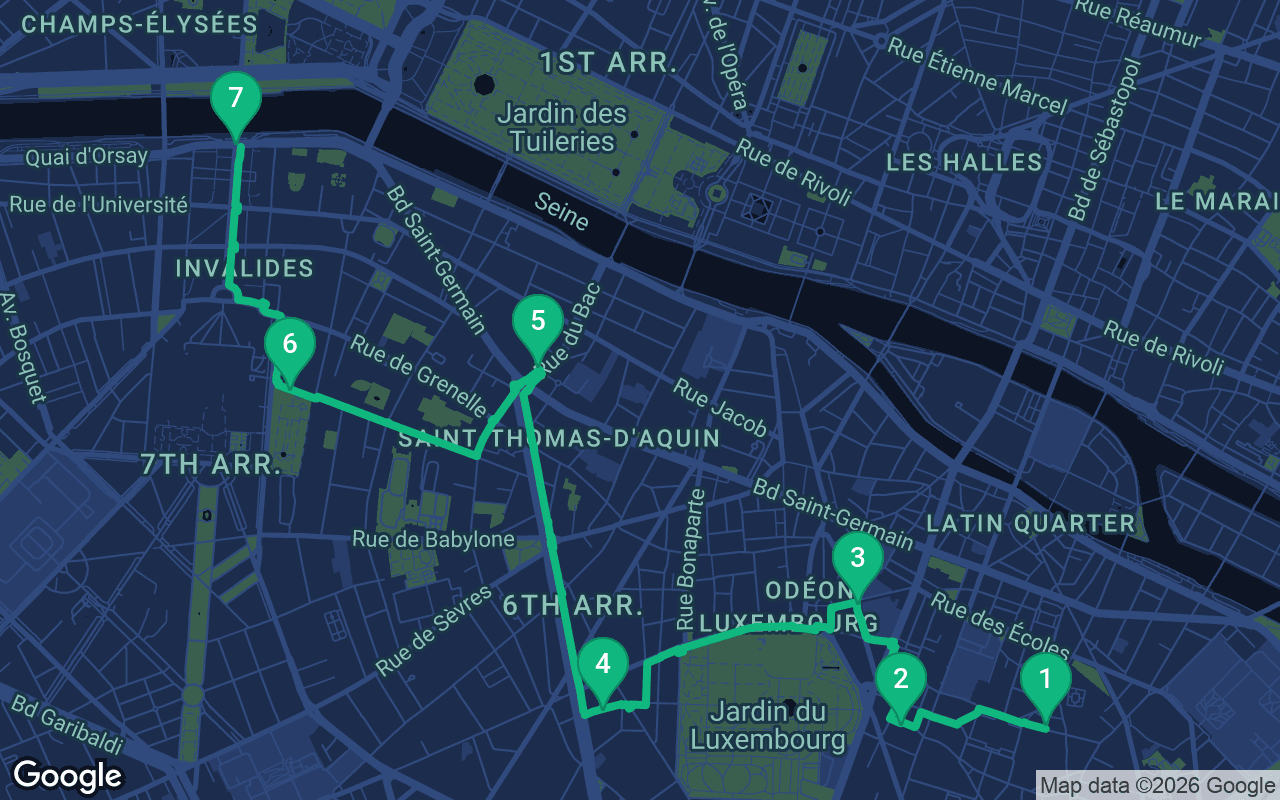
حوالي 5.2 كم، وحوالي 72 دقيقة بسرعة سهلة.
هذه الجولة مصحوبة بتعليق صوتي
اضغط على زر التشغيل في أول 3 من المحطات للاستماع إلى عرض تجريبي مدته 30 ثانية من التعليق الصوتي. في التطبيق، تستمع إلى المقدمة وهذه المحطات كاملةً مجانًا، وتنبّهك كل محطة بإشارة صوتية فور وصولك. والجولة الصوتية بالكامل لك مقابل $16.99، وهي عملية شراء لمرة واحدة تحتفظ بها للأبد.
يعمل مع Garmin وKomoot وStrava وOS Maps وأي تطبيق GPX.
Gil Pender is a Hollywood screenwriter who would rather be a novelist. He's in Paris with his fiancée Inez and her parents, and he's in love with the city, or rather with the city of the 1920s, the Paris of Hemingway, Fitzgerald and Gertrude Stein. Inez would rather spend her time with Paul, a friend who knows everything and says so. Then one night, lost after a wine tasting, Gil sits down on some church steps, a clock strikes midnight, and an old car pulls up and carries him into the decade of his dreams. That's Midnight in Paris, written and directed by Woody Allen and released in 2011, with Owen Wilson as Gil, Rachel McAdams as Inez, Marion Cotillard as Adriana and Michael Sheen as Paul. Filming in Paris began in July 2010. This is an unofficial fan walk, not made with or endorsed by the filmmakers or the studio. We follow Gil's nights first, then step into his daytime world, and finish at the bridge of the final scene. Along the way, each stop separates what was filmed from the real 1920s behind it. Spoilers throughout. It's one of our self-guided walking tours, about 5.2 kilometers from Saint-Étienne-du-Mont to the Pont Alexandre III.
The walking adds up to about 72 minutes, so allow two and a half to three hours with time at each stop. The route is paved and mostly flat, gently downhill from the hill of Sainte-Geneviève toward the river. The longest stretch, about a kilometer and a quarter, runs between stops four and five. The third leg crosses the Jardin du Luxembourg, which is open in the daytime only, so after dark go round it by rue de Vaugirard instead. Two stops are best seen open: Deyrolle, a working shop, and the Musée Rodin, which needs a ticket. Check both before you go. A late afternoon start works well: you see the shop and the museum by day, and reach the river as the light turns golden. Polidor, at stop three, is a working restaurant if you want to eat where Gil met Hemingway. The nearest stations at the start are Cardinal Lemoine on metro line 10 and Luxembourg on the RER B. The walk ends close to Invalides, on metro lines 8 and 13 and the RER C.
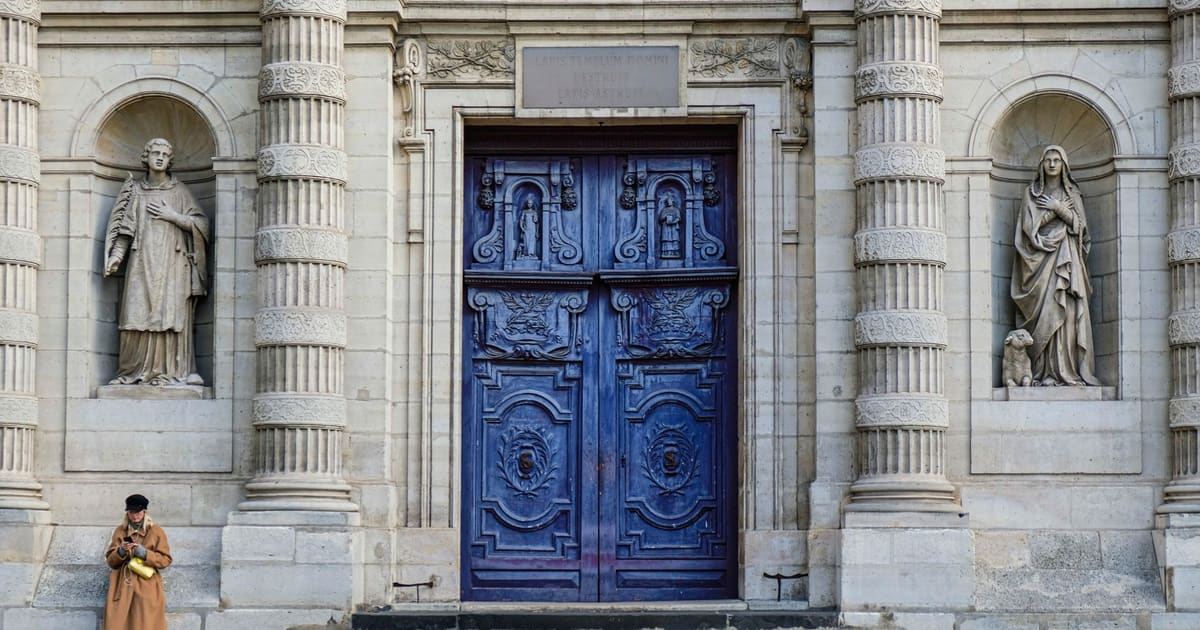
You're beside the church of Saint-Étienne-du-Mont, on the hilltop behind the Panthéon. Don't stand at the grand front of the church. Find the side steps on little Place de l'Abbé-Basset. These are the steps.
This is where the magic starts. Gil has been to a wine tasting, and afterwards he gets lost in these old lanes. He sits down on these steps. A clock strikes midnight. And along rue de la Montagne-Sainte-Geneviève, the lane in front of you, comes an old Peugeot. It stops, and it takes him with it. The car takes him to a party in the 1920s, where he meets Cole Porter and Scott and Zelda Fitzgerald. From then on, this is his pickup point. Night after night, he comes back to these steps and waits for midnight.
The steps haven't changed, and fans still come to sit on them and take photos. One film site calls them a minor tourist attraction.
The church behind you is far older than any of Gil's dreams. It was rebuilt between 1492 and 1626. Inside is something you can't see anywhere else in the city: a rood screen, the carved screen that runs across the church, built in the early 1500s. It's the only one still standing in Paris. Two great writers are buried inside, the mathematician and thinker Blaise Pascal and the playwright Jean Racine. Racine's remains were moved here after the abbey of Port-Royal des Champs, where he first lay, was destroyed. And this is the church of Sainte Geneviève, the patron saint of Paris. Her medieval relics were destroyed in the Revolution, but a chapel built in 1853 keeps surviving stones from her original tomb.
That first party, by the way, was filmed on the Île Saint-Louis, at 53 quai de Bourbon, a detour if you want it. Our next stop is the street that played two of Gil's later destinations. Head west past the Panthéon to rue Saint-Jacques; rue Malebranche opens on the far side. About seven minutes.
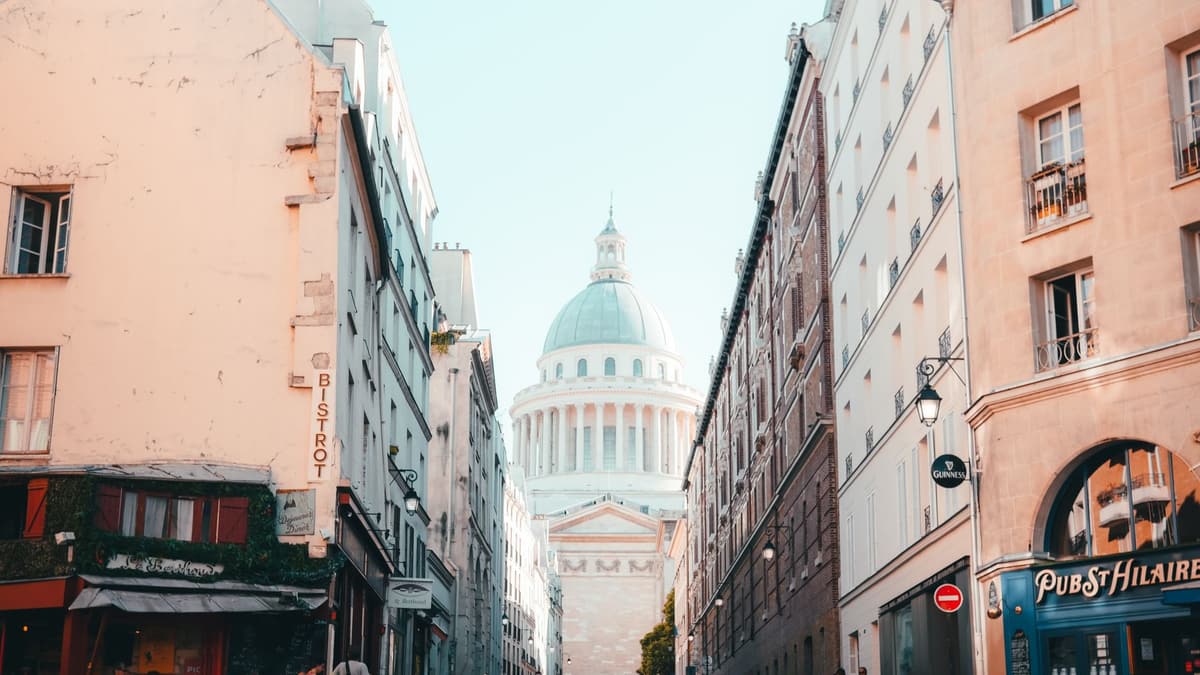
You're on rue Malebranche, a short, ordinary street of apartment buildings a few steps from the Panthéon. Nothing marks it as a film location. Look for number 15, and then number 17 beside it.
These two doors are a jump ahead in Gil's story, and they're the film's two great cheats. Number 15 plays the front door of Gertrude Stein's home, where Hemingway will soon bring Gil and his novel. Number 17 plays the door of Bricktop's, the famous 1920s nightclub. Location guides disagree about where the club's interior was filmed, but the door was filmed right here.
Now the real story. Stein never lived on this street. Her home was on the other side of the Luxembourg garden, and we'll stand at her real door in two stops. And the real Bricktop's was nowhere near the Latin Quarter. It was up in Montmartre, on rue Pigalle.
Its owner was Ada Smith, known to everyone as Bricktop. She arrived in Paris on May 11, 1924, to perform at a club called Le Grand Duc, on rue Pigalle. When she saw how small it was, she cried. The young man who comforted her was the club's busboy, Langston Hughes, the future poet. Bricktop stayed, and by 1926 she had her own club. In 1929 she moved it to 66 rue Pigalle. Cole Porter, Scott Fitzgerald and Ernest Hemingway were all among her customers. So when the film sends Gil to Bricktop's, it's sending him to a real place, full of the real people he admired. It just moved the front door across town.
Stand across from number 15 for a moment. A film crew turned this quiet door into Gertrude Stein's, and then packed up and left it as it was.
To get through that door, Gil first needs an introduction, and he's about to get one from Ernest Hemingway himself. Walk west to the end of the street and on to boulevard Saint-Michel. Cross it and take rue Monsieur-le-Prince, which runs north from the boulevard. Polidor is at number 41. About seven minutes.
You're outside Polidor, at 41 rue Monsieur-le-Prince. Look at the old shopfront. The restaurant opened in 1845 as a crèmerie, a little dairy shop serving simple meals, and it's still serving today. One film location writer describes the dining room as basically unchanged since the late 1800s.
We're back on Gil's first night. After the party, he goes out drinking with the Fitzgeralds, and they bring him here. At a table inside, he meets Ernest Hemingway, played by Corey Stoll. Imagine it from Gil's side. A few hours ago he was a tourist at a wine tasting, and now his literary hero is sitting across the table. Gil tells him about the novel he's been struggling with. Hemingway makes him an offer. He will show it to Gertrude Stein.
From here on, Gil's nights have a purpose. He's no longer just visiting the 1920s. He has a manuscript in the system, and a door to knock on.
Is the Hemingway story here true? The restaurant counts among its past customers Verlaine, Rimbaud, Gide, James Joyce, Hemingway, Antonin Artaud and Jack Kerouac. That's the restaurant's own claim, and a good one, but it's Polidor telling it, so enjoy it in that spirit. What's certain is that it was already old when the Lost Generation arrived, and that it's still here.
If you're hungry, you can eat here. It's open every day, and it's one of the few places on this walk where you can sit inside Gil's Paris.
Next, the real door that Hemingway promised to open. Walk back down rue Monsieur-le-Prince and cross the Jardin du Luxembourg heading west, leaving by its west side onto rue Guynemer. Rue de Fleurus leads off it to the west, and number 27 is a short walk along. About fifteen minutes. After dark, when the garden is shut, go round by rue de Vaugirard.
ما الذي يشمله
جولاتنا مصممة لتكون تأملية وغامرة: تتحرك وتستمع فحسب. وهي أجمل دائمًا برفقة الآخرين، إذ يشغّل التطبيق السرد بشكل متزامن، فتسمع أنت وشريكك وأصدقاؤك كل محطة في اللحظة نفسها.
You're on rue de Fleurus, outside number 27. It's a private building, and the door stays shut, but look for the commemorative plaque that marks it.
بقية هذه المحطة في الجولة الصوتية الكاملة.
You're outside Deyrolle, at 46 rue du Bac. Look in the windows.
بقية هذه المحطة في الجولة الصوتية الكاملة.
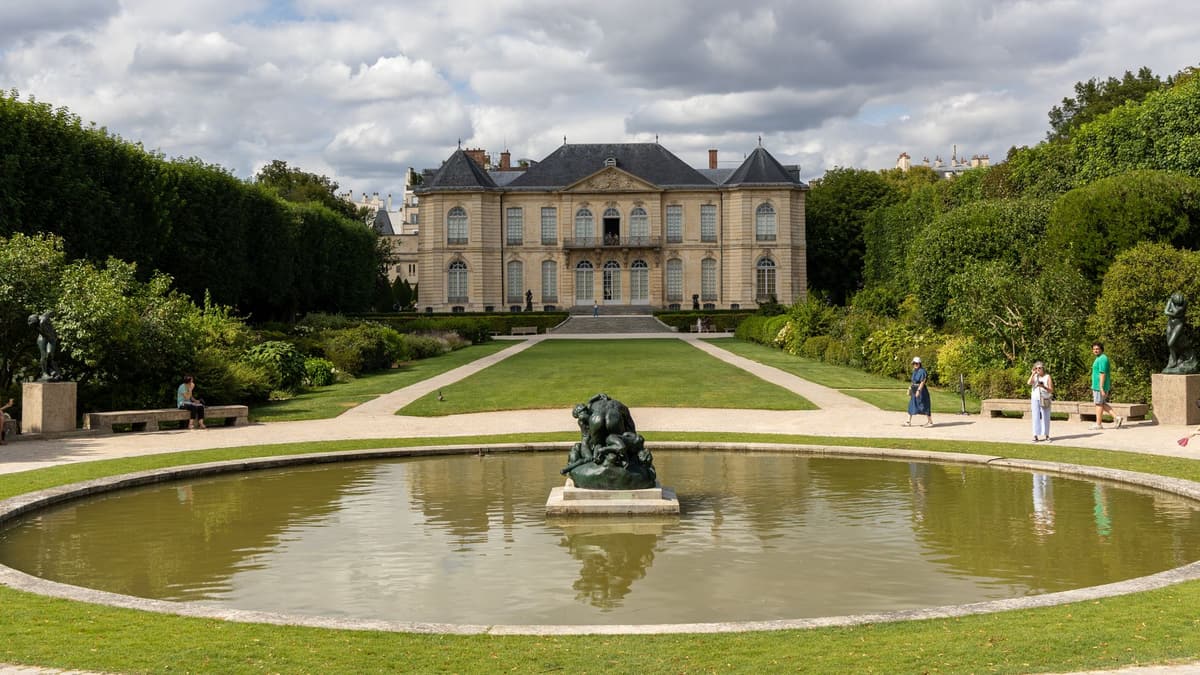
You're outside the Musée Rodin at 77 rue de Varenne, in front of the Hôtel Biron, an elegant mansion with a large garden. Rodin's The Thinker sits out in that garden.
بقية هذه المحطة في الجولة الصوتية الكاملة.
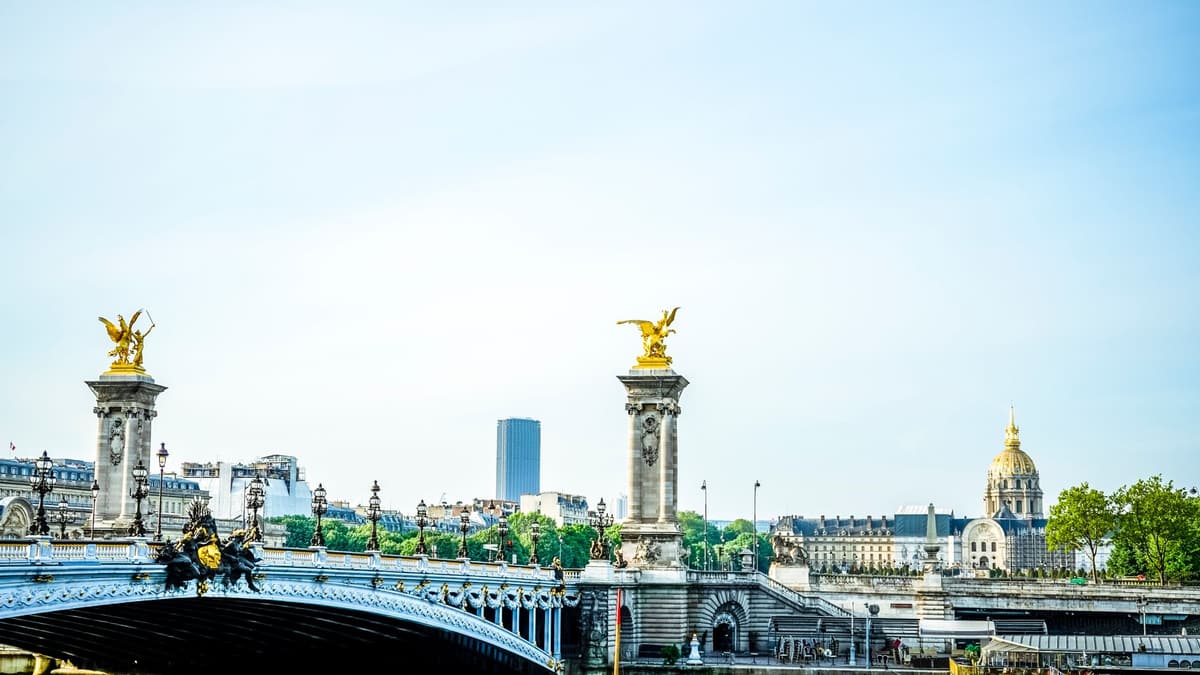
You're at the Left Bank end of the Pont Alexandre III. Look up at the tall pillars and the four gilded winged figures on top of them.
بقية هذه المحطة في الجولة الصوتية الكاملة.
قم بهذا النشاط مع أشخاص آخرين في الجولة المُجدوَلة القادمة.
حوالي 5.2 كم، وحوالي 72 دقيقة بسرعة سهلة · 7 محطات
الأصدقاء يسيرون مجاناًOctober 11, 2026 · 9 min read
From the Hollandsche Schouwburg through the old Jewish Quarter, past the Dockworker and the Dam, to the Anne Frank House on the Prinsengracht.
October 11, 2026 · 11 min read
From Van Houten's street by the Vondelpark past Leidseplein, the Rijksmuseum passage and the famous canal bench to the Anne Frank House.

October 11, 2026 · 10 min read
Follow the last days of April and May 1945 from the Anhalter Bahnhof ruin past the Gestapo site and Brandenburg Gate to the Moltke Bridge and the Reichstag.
