
October 11, 2026 · 9 min read
Amsterdam Anne Frank Walking Tour
From the Hollandsche Schouwburg through the old Jewish Quarter, past the Dockworker and the Dam, to the Anne Frank House on the Prinsengracht.
589

October 9, 2026 · 10 min read

 Vrienden lopen gratis mee
Elke tour is ook beschikbaar als een geplande groepswandeling waar je in de app aan kunt deelnemen.
Meer audiotours in George Town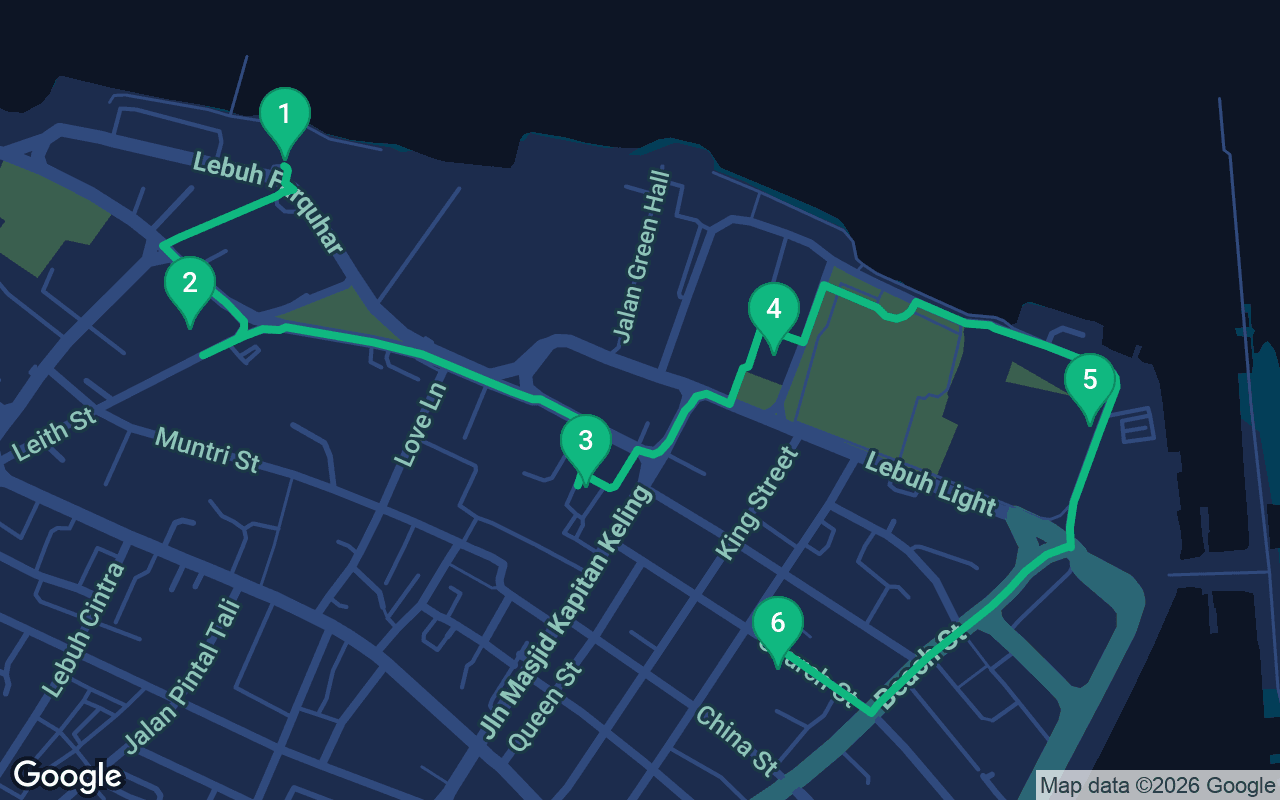
Ongeveer 2,5 km, zo'n 35 minuten op een rustig tempo.
Deze tour is ingesproken
Druk op afspelen bij de eerste 3 stops voor een demo van 30 seconden van de vertelling. In de app zijn de intro en die 3 stops volledig gratis te beluisteren, en bij elke stop klinkt een signaal zodra je aankomt. De hele tour met gids is van jou voor $7.99, een eenmalige aankoop die je voor altijd behoudt.
Werkt met Garmin, Komoot, Strava, OS Maps en elke GPX-app.
George Town began as a bet. In 1786 a British trader named Francis Light stepped ashore on a forested cape at the northeastern tip of Penang, and within a generation a busy free port had grown up behind him, drawing merchants from China, India, the Malay world, Arabia and Armenia. This walk follows the British side of that story and the fortunes made alongside it. It starts at the grand seafront hotel of the 1880s, visits the indigo mansion of a Hakka magnate, the oldest Anglican church in Southeast Asia and the white City Hall on the Esplanade, reaches the fort where it all began, and ends inside the gilded house of a tin tycoon. It is about two and a half kilometers, a mile and a half, and one of the easiest self-guided walking tours in Malaysia to fit into a morning.
The walking itself takes only about 35 minutes, but give yourself two and a half to three hours, because the Blue Mansion, the fort and the Peranakan Mansion each reward time inside. The route is completely flat, on pavements and roadsides, with a few busy junctions where it pays to use the crossings and watch for motorbikes. Penang is hot and humid all year, and the sun on the open Esplanade is fierce by late morning, so start early, wear a hat, drink plenty and duck into the covered walkways along the shophouse fronts whenever you can. Rain comes suddenly and heavily, most often in the afternoon, and usually passes within the hour, so a small umbrella earns its place in your bag. The Blue Mansion is a working hotel that shows visitors around on guided tours at set times, and the fort and the Peranakan Mansion charge for entry, so check times before you go. St George's is a living church; dress modestly if you step inside and keep quiet during services.
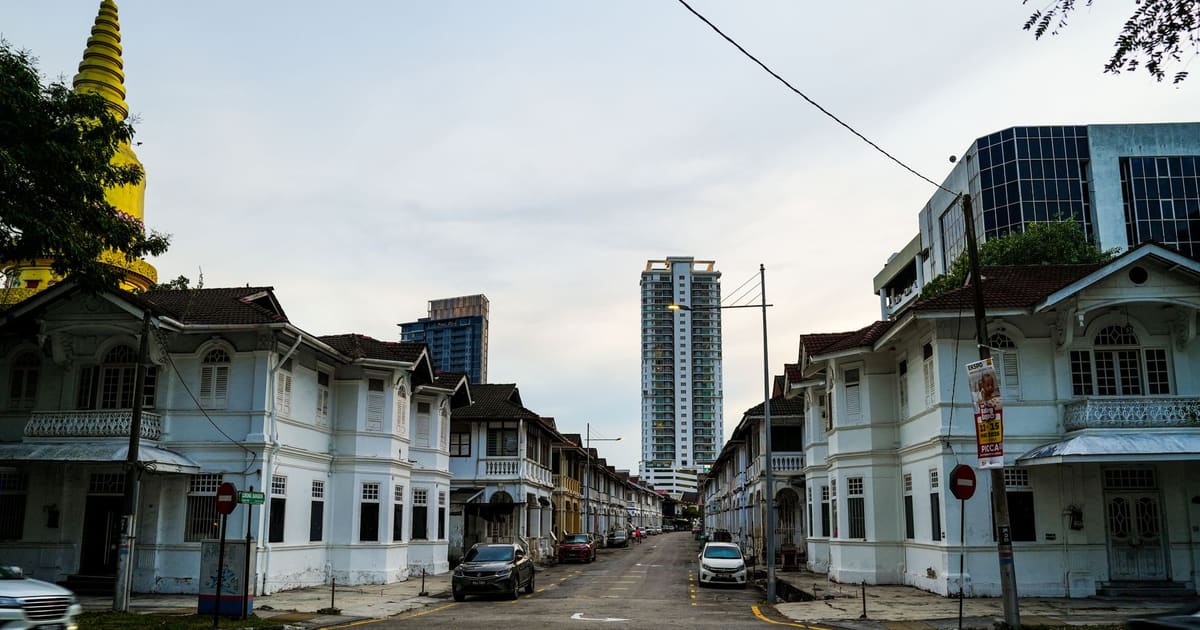
Start in front of the Eastern & Oriental Hotel, the long white building with the pale dome on Farquhar Street, and if you can, walk through to the lawn at the back, where the sea runs right up to the low wall. The E&O was opened in 1885 by the Sarkies brothers, Armenian hoteliers who went on to found Raffles in Singapore, and it became the place where the colonial world came to stay. The hotel lists Somerset Maugham, Rudyard Kipling, Hermann Hesse and Noel Coward among the guests of its golden years, and it is easy to picture Maugham on this lawn, gathering the gossip of planters and officials that turned up in his stories. Look along the seafront in both directions. The road running west from here was Northam Road, once nicknamed Millionaires' Row for the mansions that Chinese and European tycoons built along it, a few of which still stand. The hotel faded badly in the decades after independence, closed in the 1990s, and reopened after a long restoration that brought back the polished halls you see now. Even if you are not staying, the lobby and the lawn give a fine sense of the old seaside town. Leave by the front entrance and head south for a couple of minutes to Leith Street. The mansion stands a short way along it, and its color makes it impossible to miss. Allow about four minutes.
 You cannot miss it. The Cheong Fatt Tze Mansion is painted a deep indigo blue, a lime wash colored with natural dye, and everyone in Penang simply calls it the Blue Mansion. Stand back across the lane to take in the whole front, with its curved roof ridges and its shuttered windows. The man who built it, Cheong Fatt Tze, was a Hakka from southern China who arrived in the Dutch East Indies as a penniless youth and made one of the great fortunes of the region in shipping, plantations and banking, with business across Southeast Asia and in China itself. He also served the Qing court as a diplomat. The house went up around the turn of the twentieth century and follows the rules of feng shui closely, with hills behind it and the sea before it, and open courtyards that catch the rain and, so the thinking goes, keep wealth flowing inward. Inside are 38 rooms, five courtyards and seven staircases, a blend of Chinese layout with Scottish ironwork and English floor tiles. After Cheong died in 1916, his will kept the house in the family, and it slowly decayed into crowded lodgings until conservationists rescued it in the 1990s, work that won a UNESCO heritage award. Walk back up Leith Street to the main road, turn right and follow it east as it becomes Farquhar Street. You pass the Cathedral of the Assumption and the old colonial school building that now houses the state museum, and reach a white church set back on a lawn. About seven minutes.
Stand on the pavement and look at St George's Church across its lawn: a crisp white Georgian building with a columned portico and a slim spire. This is the oldest Anglican church in Southeast Asia, built in 1817 and 1818 by convict labor brought from India, to a design by an army engineer, Captain Robert Smith. The East India Company's chaplain, the Reverend Robert Hutchings, pushed the project through; he had founded the Penang Free School, one of the oldest English schools in the region, the year before. In the grounds, look for the small round pavilion with slender columns, set up in 1886 for the hundredth anniversary of the settlement as a memorial to Francis Light. It stands near the street, so you can see it without going in. The church you see has been patched up many times. It suffered in the Second World War, in 2007 it was named one of Malaysia's national heritage treasures, and it has since been carefully restored. The interior is plain and airy, built for a hot climate, and if the doors are open you are welcome to step in quietly. The church sits on the corner of Jalan Masjid Kapitan Keling, a road that lines up a church, Chinese and Hindu temples and a mosque within a few minutes of each other. To continue, follow that road north from the church toward the sea, then bear right. When the wide green of the Padang opens up, the long white building on its edge is City Hall. About four minutes.
Wat er inbegrepen is
Onze tours zijn bedoeld om meditatief en meeslepend te zijn: je blijft in beweging en luistert gewoon. Samen zijn ze altijd beter, en de app speelt de vertelling synchroon af, zodat jij, je partner en je vrienden elke stop op hetzelfde moment horen.
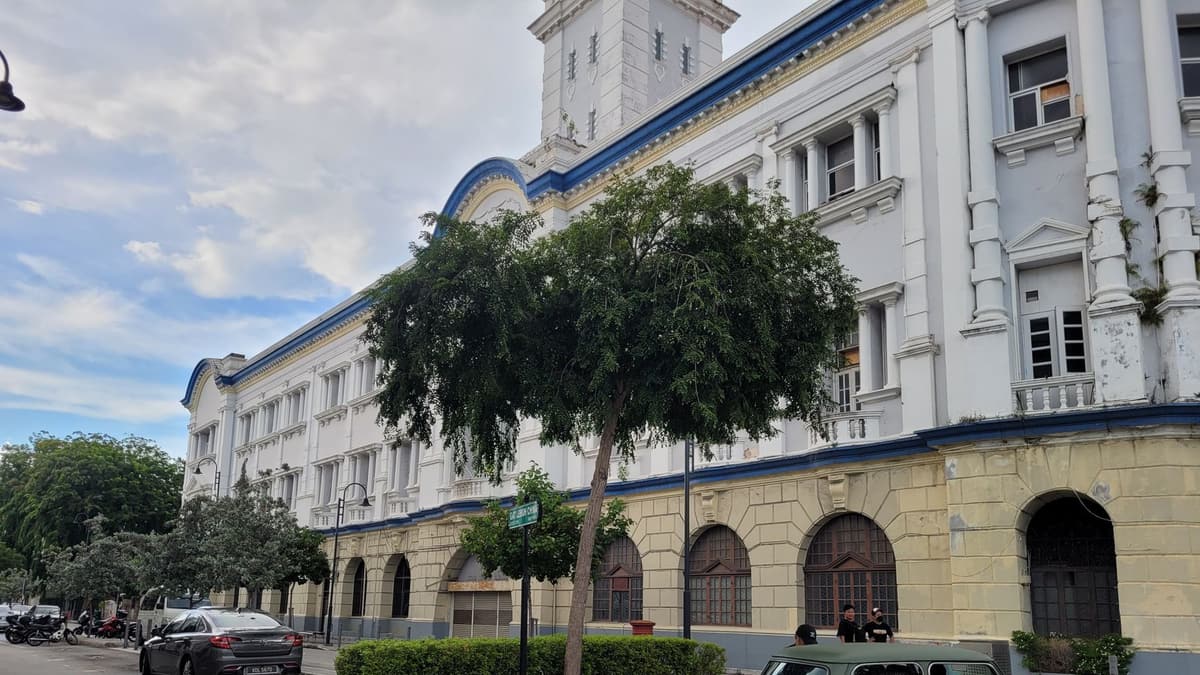
Take a spot on the grass of the Padang, the old parade ground, and look back at the City Hall, a gleaming white building of 1903 with columns, balustrades and a central pediment, in the confident Edwardian style of the high empire.
De rest van deze stop zit in de volledige audiotour.
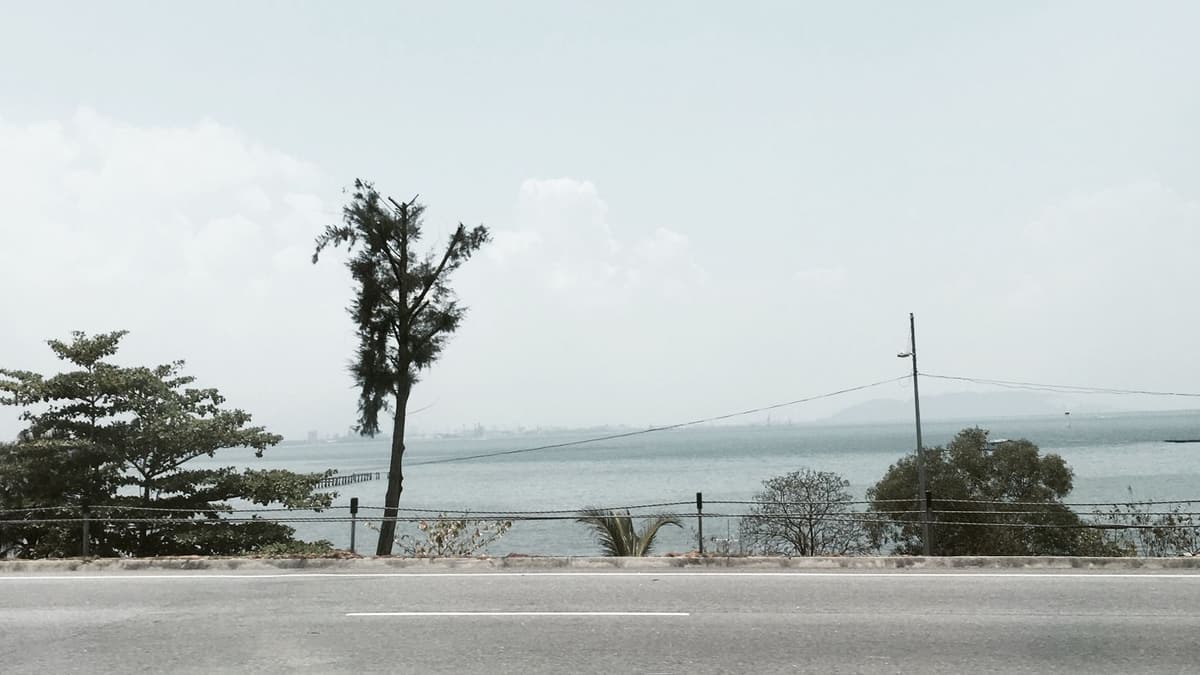
This is where George Town began. Francis Light, a trader who knew the Malay sultans well, landed on this cape in July 1786 and soon raised the British flag, naming the place Prince of Wales Island.
De rest van deze stop zit in de volledige audiotour.
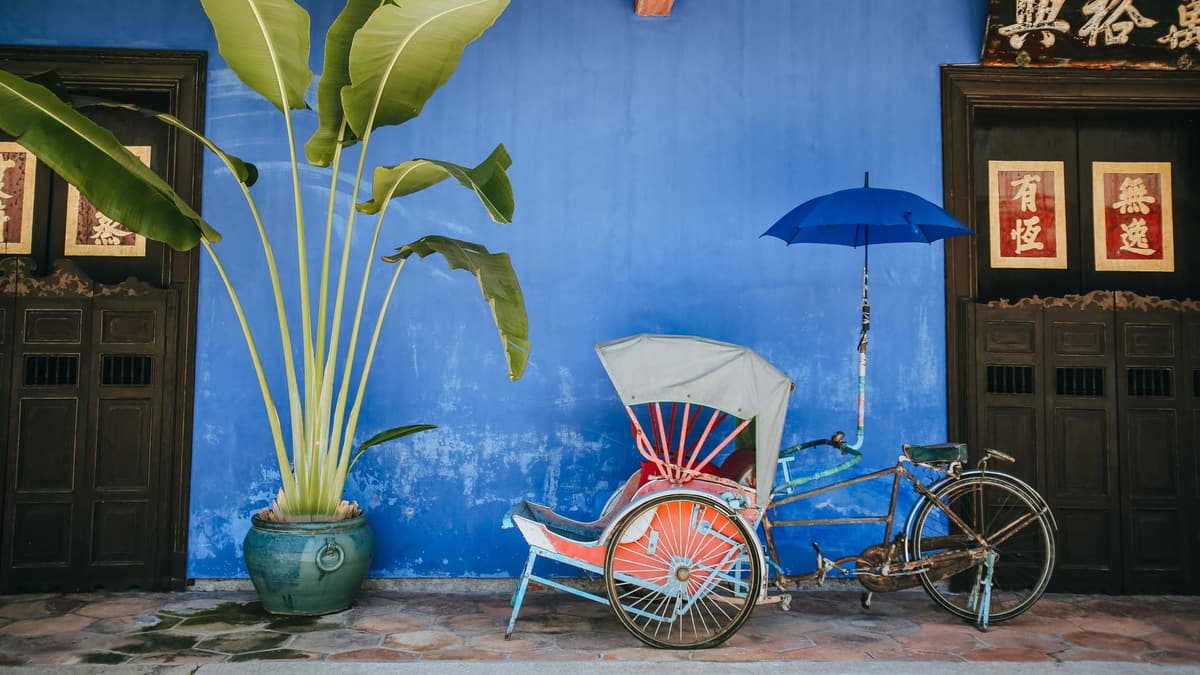
The walk ends at the Pinang Peranakan Mansion, a striking pale green house on Church Street with carved gateways and cast iron balconies.
De rest van deze stop zit in de volledige audiotour.
Doe deze wandeling samen met anderen tijdens de eerstvolgende geplande tour.
Ongeveer 2,5 km, circa 35 minuten in een rustig tempo · 6 stops
Vrienden lopen gratis meeOctober 11, 2026 · 9 min read
From the Hollandsche Schouwburg through the old Jewish Quarter, past the Dockworker and the Dam, to the Anne Frank House on the Prinsengracht.
October 11, 2026 · 11 min read
From Van Houten's street by the Vondelpark past Leidseplein, the Rijksmuseum passage and the famous canal bench to the Anne Frank House.

October 11, 2026 · 10 min read
Follow the last days of April and May 1945 from the Anhalter Bahnhof ruin past the Gestapo site and Brandenburg Gate to the Moltke Bridge and the Reichstag.
