
October 11, 2026 · 9 min read
Amsterdam Anne Frank Walking Tour
From the Hollandsche Schouwburg through the old Jewish Quarter, past the Dockworker and the Dam, to the Anne Frank House on the Prinsengracht.
589

October 9, 2026 · 13 min read

 Os amigos caminham grátis
Cada tour também funciona como uma caminhada em grupo agendada que você pode acessar no app.
Mais passeios de áudio em Delft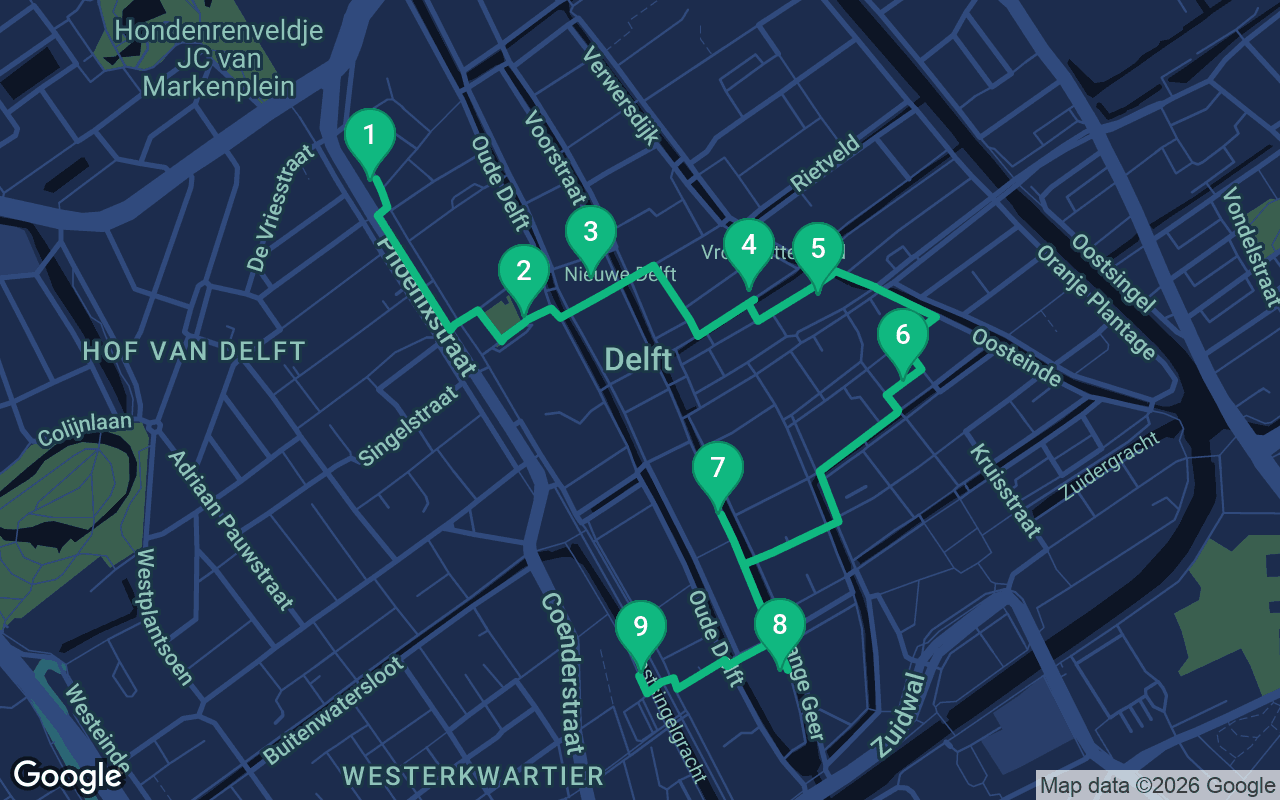
Cerca de 2,4 km, mais ou menos 33 minutos em passo tranquilo.
Este passeio é narrado
Aperte o play nas primeiras 3 paradas para ouvir uma demonstração de 30 segundos da narração. No aplicativo, a introdução e essas 3 paradas tocam completas e de graça, e cada uma avisa com um sinal sonoro quando você chega. Todo o passeio narrado é seu por $7.99, uma compra única que você guarda para sempre.
Funciona com Garmin, Komoot, Strava, OS Maps e qualquer app de GPX.
Delft is the kind of town that slows you down without asking. It is small, flat and ringed with canals, and inside that ring sits a remarkable amount of Dutch history: the house where the father of the nation was shot, the churches where Vermeer was baptized and buried, and the tomb of the royal family under a tower that soars over the market square. This walk starts at a working windmill on the west side of town, crosses the old center to the Markt, then turns south along the canals and finishes at the railway station. It is about two and a half kilometers and flat the whole way, one of the easiest self-guided walking tours in the Netherlands to fit into a morning or a day trip from The Hague or Rotterdam.
The walking itself takes little more than half an hour, but give it two or three hours so you can step inside the churches and the Prinsenhof, and longer if you sit down on a cafe terrace, which Delft makes very hard to resist. The streets are flat and paved, often with bricks or cobbles, so wear comfortable shoes. Two things matter more here than hills. The first is bikes. Delft is a cycling town, and bikes have priority on the bike paths, which are usually paved in red, so stay off the red lanes and look both ways before you step off any curb. The second is water. The canal edges have no railings, so watch small children and your own feet when you stop for a photo. Mornings are the quietest time, and late afternoon light on the brick is lovely. The windmill, the churches and the museums each keep their own hours and charge their own admission, and some close on certain days, so check before you go. Bring a layer and an umbrella, because the weather blowing in off the North Sea changes quickly.
Begin at the foot of Windmill De Roos, the tall brick mill that rises above the rooftops on the west side of the old town. Stand back far enough to see the whole thing: a tapering tower, a wooden gallery wrapped around it partway up, and four great sails turning above. The gallery is there for a practical reason. A mill in a town had to be tall to catch the wind above the surrounding roofs, so the miller needed a platform high up from which to set the sails and turn the cap into the wind. The present mill dates from the eighteenth century, and it is still a working grain mill, grinding flour when the wind is right. Mills like this were once part of daily life in every Dutch town, grinding grain, sawing timber and pumping water out of the low, wet land. When the mill is open you can often climb to the gallery for a view over the roofs toward the church towers you are about to visit, and there is sometimes flour for sale. Opening days vary, so check before you go. From here, walk southeast through the quiet streets for about five minutes to the Oude Delft, the oldest canal in town, and look for the old convent buildings of the Prinsenhof beside it.
You are standing at the Prinsenhof, a cluster of red brick buildings that began life in the fifteenth century as the convent of Saint Agatha. After the Reformation the nuns were gone, and the buildings became the Delft home of the most important man in the revolt against Spain, William of Orange. William led the Dutch Revolt against King Philip II, and Philip wanted him dead badly enough to declare him an outlaw and put a reward on his head. On 10 July 1584 a young Catholic named Balthasar Gérard, who had worked his way into the household under a false name, waited inside and shot him at close range as he came from dinner. William died within minutes. Tradition gives him last words asking God to have mercy on his soul and on his poor people. Inside, the bullet holes can still be seen in the wall by the stairs, now protected behind glass. Gérard was caught and put to death. William is remembered as the Father of the Fatherland, and the Dutch national anthem, the Wilhelmus, is written in his voice. The building is now Museum Prinsenhof Delft, telling the story of William and of the town, so check before you go if you want to see the stairwell. When you come back out to the canal, the tall tower leaning gently beside the water belongs to your next stop. Cross the nearest bridge, a minute or two away.
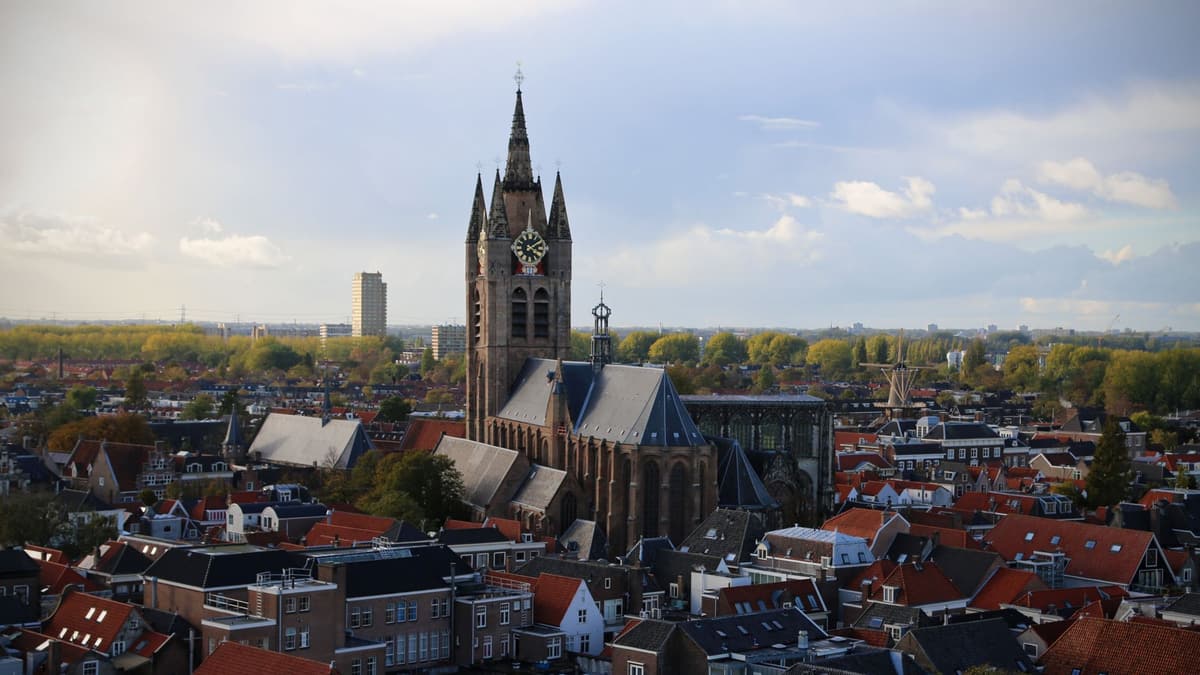 Look up, and you will see why people stop in the middle of the street here with their cameras raised. The brick tower of the Oude Kerk, the Old Church, leans visibly out of true, by roughly two meters at the top. It was built on soft, waterlogged ground right beside the canal, and the ground gave way a little. Locals have long called it Oude Jan, Old John. The church goes back to the thirteenth century, making it the oldest in Delft, and inside, beneath the pale columns and the wooden vaults, lie some of the town's best-known dead. Johannes Vermeer was buried here in December 1675, aged forty-three. A simple memorial stone in the floor marks him today, because the exact place of his grave is not known for certain. Also buried here is Antonie van Leeuwenhoek, a Delft cloth merchant who taught himself to grind tiny lenses and built microscopes powerful enough to make him one of the first people ever to see bacteria. He was born in the same year as Vermeer, 1632, and after the painter died in debt, Leeuwenhoek was the man appointed to settle his estate. The naval heroes Piet Hein and Maarten Tromp have grand tombs here too. Step inside if the church is open. Then head east through the lanes toward the market square, about four minutes, and look for the narrow canal called the Voldersgracht, which runs behind the houses on the north side of the Markt.
O que está incluído
Nossos passeios foram feitos para ser meditativos e imersivos: você caminha e simplesmente escuta. Eles são sempre melhores em companhia, e o aplicativo toca a narração sincronizada, para que você, seu par e seus amigos ouçam cada parada ao mesmo tempo.
On the Voldersgracht stands the Vermeer Centrum, on the spot where the Guild of Saint Luke once had its hall. This was the trade association every Delft painter had to join to sell work in the town, along with glass makers, potters and other craftsmen.
O restante desta parada está no passeio em áudio completo.
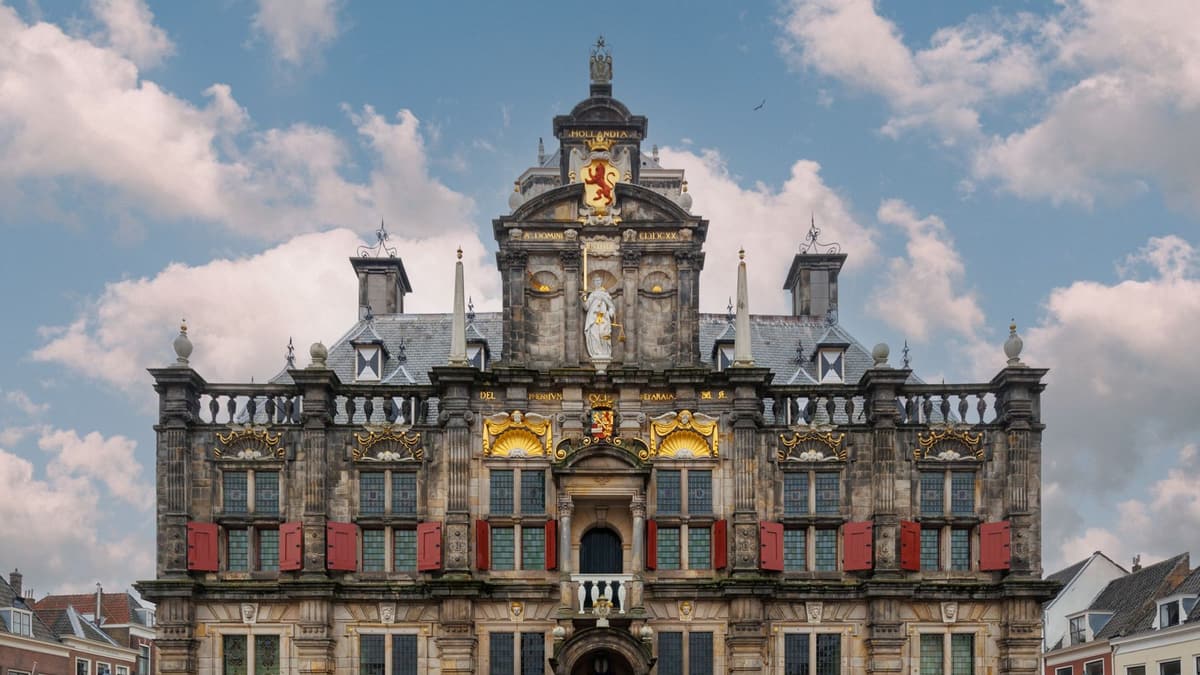
The Markt is the great open heart of Delft, a long cobbled square with the Nieuwe Kerk at one end and the City Hall facing it from the other. Stand in the middle and look both ways.
O restante desta parada está no passeio em áudio completo.
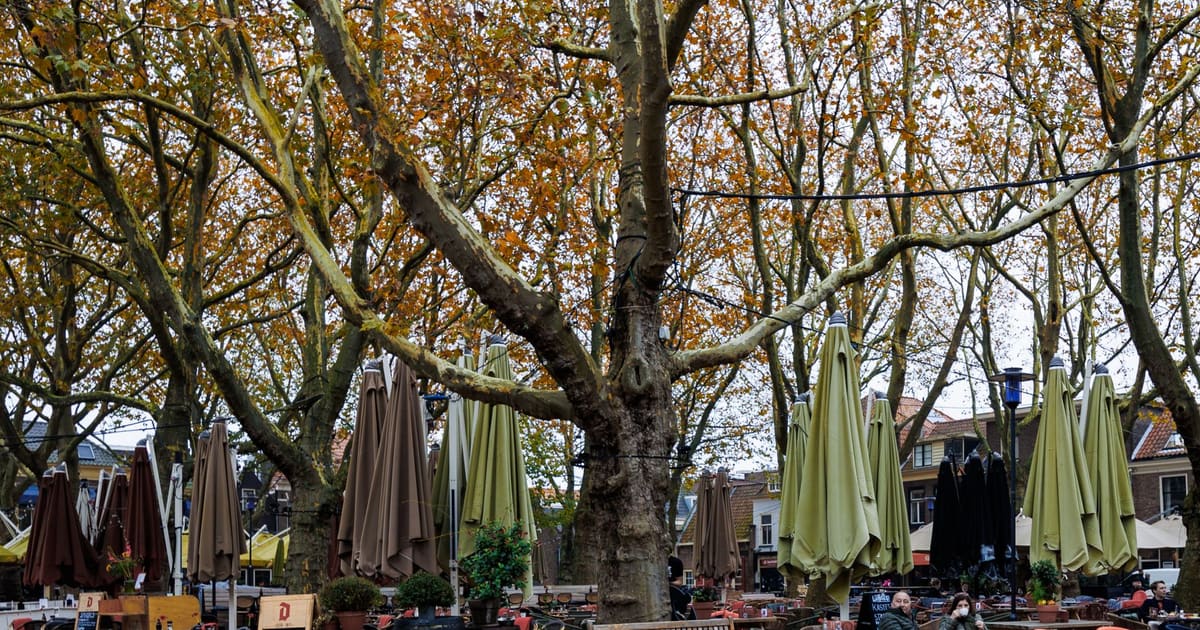
The Beestenmarkt is a broad, open square under tall trees, ringed by gabled houses and, these days, by cafe terraces that spill out across most of it. The name means the beast market.
O restante desta parada está no passeio em áudio completo.
Along the Koornmarkt, the canal where grain was once traded, stands a handsome old canal house that hides one of the most charming small museums in the country.
O restante desta parada está no passeio em áudio completo.
This long, sober brick complex is the Armamentarium, built around the start of the seventeenth century as the arsenal of the States of Holland, the province's weapons store.
O restante desta parada está no passeio em áudio completo.
The walk ends at Delft Station, and it is worth stepping inside before you catch a train.
O restante desta parada está no passeio em áudio completo.
Faça esta caminhada com outras pessoas no próximo passeio agendado.
Cerca de 2,4 km, aproximadamente 33 minutos em ritmo leve · 9 paradas
Os amigos caminham grátisOctober 11, 2026 · 9 min read
From the Hollandsche Schouwburg through the old Jewish Quarter, past the Dockworker and the Dam, to the Anne Frank House on the Prinsengracht.
October 11, 2026 · 11 min read
From Van Houten's street by the Vondelpark past Leidseplein, the Rijksmuseum passage and the famous canal bench to the Anne Frank House.

October 11, 2026 · 10 min read
Follow the last days of April and May 1945 from the Anhalter Bahnhof ruin past the Gestapo site and Brandenburg Gate to the Moltke Bridge and the Reichstag.
