
October 11, 2026 · 9 min read
Amsterdam Anne Frank Walking Tour
From the Hollandsche Schouwburg through the old Jewish Quarter, past the Dockworker and the Dam, to the Anne Frank House on the Prinsengracht.
589

October 9, 2026 · 12 min read

 เพื่อนเดินฟรี
ทุกทัวร์ยังเปิดเป็นการเดินกลุ่มตามเวลาที่กำหนด ซึ่งคุณเข้าร่วมได้ในแอป
ทัวร์เสียงเพิ่มเติมในKuala Lumpur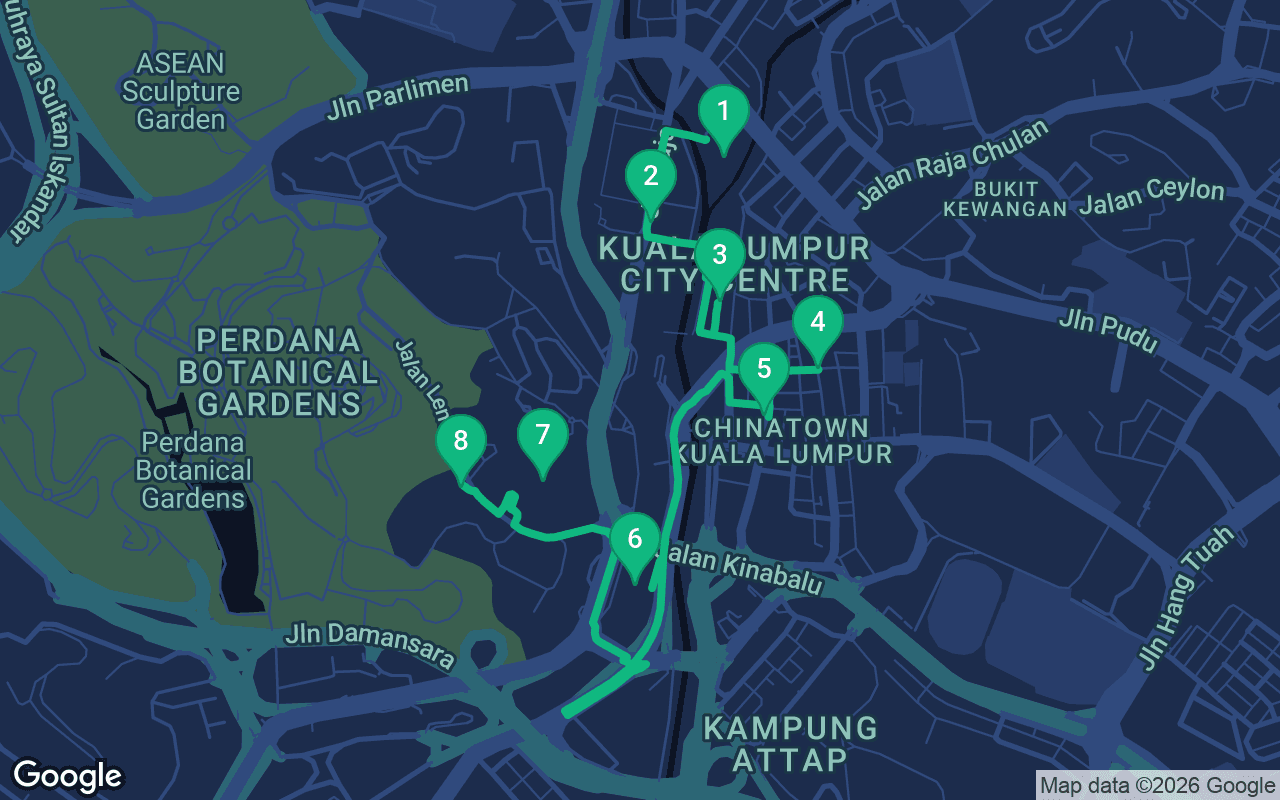
ประมาณ 4 กม. ใช้เวลาประมาณ 56 นาทีด้วยจังหวะสบายๆ
ทัวร์นี้มีเสียงบรรยาย
กดเล่นที่ 3 จุดหยุดแรกเพื่อฟังตัวอย่างคำบรรยายความยาว 30 วินาทีได้ที่นี่ ในแอป คุณฟังบทนำและจุดหยุดเหล่านี้แบบเต็มได้ฟรี และทุกจุดหยุดจะมีเสียงแจ้งเตือนเมื่อคุณไปถึง คุณสามารถเป็นเจ้าของทัวร์บรรยายทั้งหมดนี้ได้ในราคาเพียง $9.99 ซึ่งเป็นการซื้อครั้งเดียวและเก็บไว้ใช้ได้ตลอดไป
ใช้งานได้กับ Garmin, Komoot, Strava, OS Maps และแอป GPX ใดก็ตาม
Kuala Lumpur began as a muddy riverbank where a few boatloads of tin miners pulled ashore, and the whole story of how that camp became a capital still fits inside a single morning on foot. This walk starts at Masjid Jamek, the old mosque standing on the point where two rivers meet, crosses to the green of Merdeka Square where Malaya became independent, and then threads through Chinatown's market lanes to a Hindu temple and a Taoist shrine that face each other across one narrow street. It finishes past the minarets of the old railway station at the National Mosque and the Islamic Arts Museum, on the edge of the Lake Gardens. It is about four kilometers, mostly flat, and among the self-guided walking tours we know, few show so clearly how Malay, Chinese, Indian and British Kuala Lumpur grew up side by side, within a few minutes of one another.
Allow about an hour of walking, and a full morning or more if you go inside the mosques, the temple, Central Market and the museum, which you should. Kuala Lumpur is hot and humid all year, so start early, ideally by eight or nine, when the light is soft and the streets are still waking up. Carry water and a small umbrella, which does double duty as a sunshade. Heavy afternoon downpours are common, often arriving fast after a bright morning, and they usually pass within an hour or so; Central Market and the covered street of Petaling Street make good places to wait one out. The route is flat except for a gentle rise at the end, but the pavements in the old town are uneven and there are some busy roads to cross, so use the signal crossings and footbridges rather than dashing between cars. Three stops are places of worship. Dress modestly, with shoulders and knees covered, and wear shoes you can slip off easily, because you will remove them at the mosques and the temple. The two mosques welcome visitors outside prayer times and lend robes and headscarves at the door, and visiting hours shift around prayers and Fridays, so check before you go. Museum hours change too, so look them up on the day.
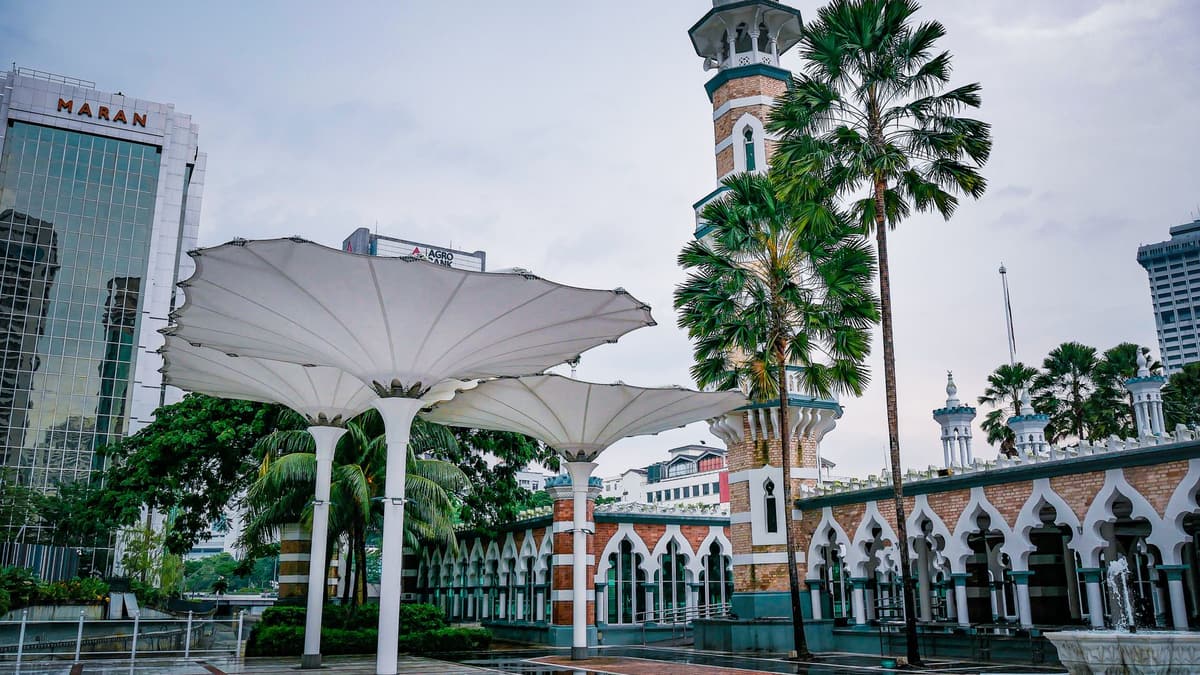
You are standing at the place that gave the city its name. Kuala Lumpur means "muddy confluence," and right here, behind the mosque, the Gombak River runs into the Klang. In 1857 a party of Chinese miners, sent upriver by a Selangor prince to look for tin, came as far as the boats could carry them and stepped ashore at this point. Many of them died of fever in the first months, but the tin was real, and a rough trading town grew on the banks. The mosque came much later. Masjid Jamek was completed in 1909 to designs by Arthur Benison Hubback, a British architect who borrowed freely from Mughal India: rows of pale arches, onion domes, slender minarets and bands of cream stone laid through rosy brick. It was the city's main mosque until the National Mosque opened, and it is still the oldest in Kuala Lumpur. Visitors are welcome outside prayer times; take off your shoes, accept a robe if you are offered one, and walk quietly among the palms to the riverside terrace. Look down at the meeting of the waters, now walled in concrete and lined with walkways, and in the evening washed in blue light and mist. From the mosque gate, head out to Jalan Tun Perak, cross the river heading west, then turn left into Jalan Raja, about five minutes, with copper domes rising ahead.
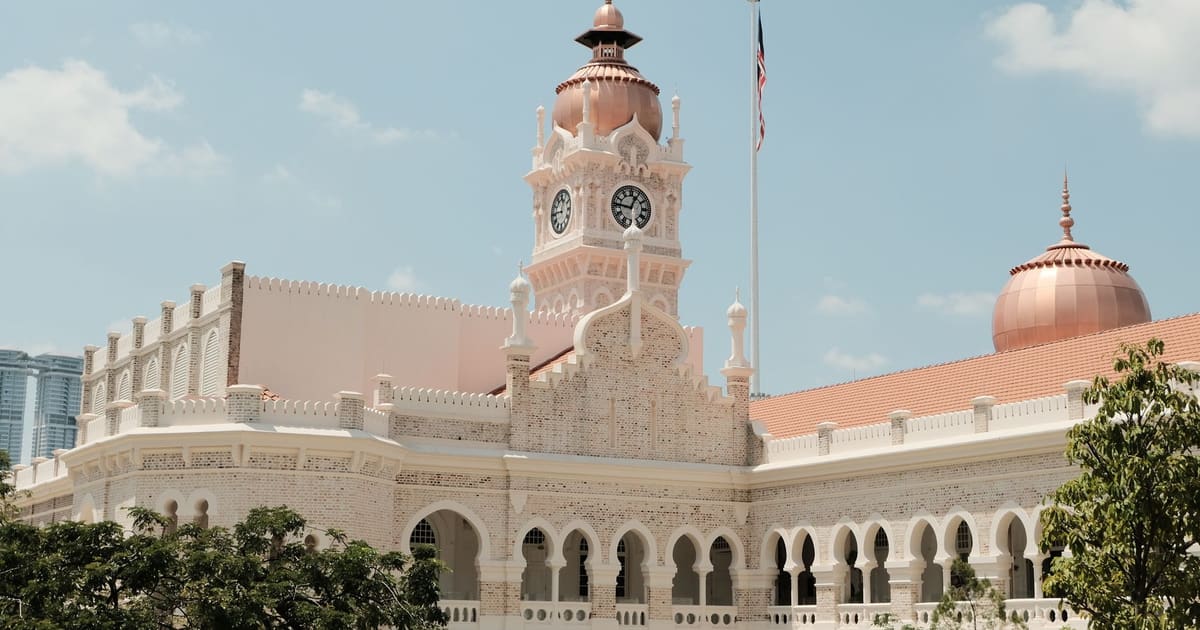
On your right spreads a wide green lawn, and on your left stands one of the most photographed buildings in Malaysia. This is Merdeka Square, signposted as Dataran Merdeka, and merdeka means independence. Under the British it was simply the Padang, the field, where colonial officials played cricket and rugby and watched parades. The long black and white building on its far side is the Royal Selangor Club, the social club of colonial Kuala Lumpur, which locals nicknamed the Spotted Dog, for reasons still argued over. At midnight on the 31st of August 1957, in front of a huge crowd, the Union flag was lowered here for the last time and the flag of the new Federation of Malaya was raised. Prime Minister Tunku Abdul Rahman read the formal proclamation later that morning at the new Merdeka Stadium across town, but this lawn is where people still gather to count down to National Day. The tall flagpole at the southern end is one of the tallest anywhere. Facing the lawn is the Sultan Abdul Samad Building, finished in 1897 for the colonial government, all horseshoe arches, striped brick and gleaming copper domes, with a clock tower at its center. It is named after the Sultan of Selangor who ruled at the time. Walk along the front of the building, then turn left and cross the river by the road bridge, Lebuh Pasar Besar, and turn right onto Jalan Hang Kasturi. Central Market is about five minutes away.
 The long, pale blue building on your right, with its stepped roofline and crisp vertical lines, is Central Market, and it is one of the best Art Deco buildings in Malaysia. A market has stood on this spot since the 1880s, when it was a wet market where the town bought its fish, meat and vegetables. The building you see dates from the 1930s. By the late 1970s it was rundown and slated for demolition, and a campaign by heritage groups saved it. It reopened in the mid 1980s as Pasar Seni, the "art market," which is the name you will see on the nearby train station. Step inside out of the heat. Two floors of stalls sell batik, songket cloth woven with metallic thread, pewter, wood carving and painted kites, and upstairs there are small food stalls and places to sit. If you want to see batik being made, look for the workshops where artists draw in hot wax. Alongside the building runs Kasturi Walk, a covered lane of stalls under a canopy shaped like a traditional Malay kite, the wau, which is handy if the rain arrives. This is the moment to cool down and buy a souvenir from people who make them. When you are ready, come out at the southern end, walk a little farther down Jalan Hang Kasturi and turn left along Jalan Hang Lekir. Petaling Street crosses it about three minutes ahead.
สิ่งที่รวมอยู่
ทัวร์ของเราออกแบบมาให้เป็นประสบการณ์ที่ผ่อนคลายและดื่มด่ำ คุณเดินไปพร้อมกับฟังไปเรื่อย ๆ และจะดียิ่งขึ้นเมื่อไปด้วยกัน แอปจะเล่นคำบรรยายแบบซิงค์กัน ให้คุณ คนรัก และเพื่อน ๆ ได้ฟังทุกจุดในเวลาเดียวกัน
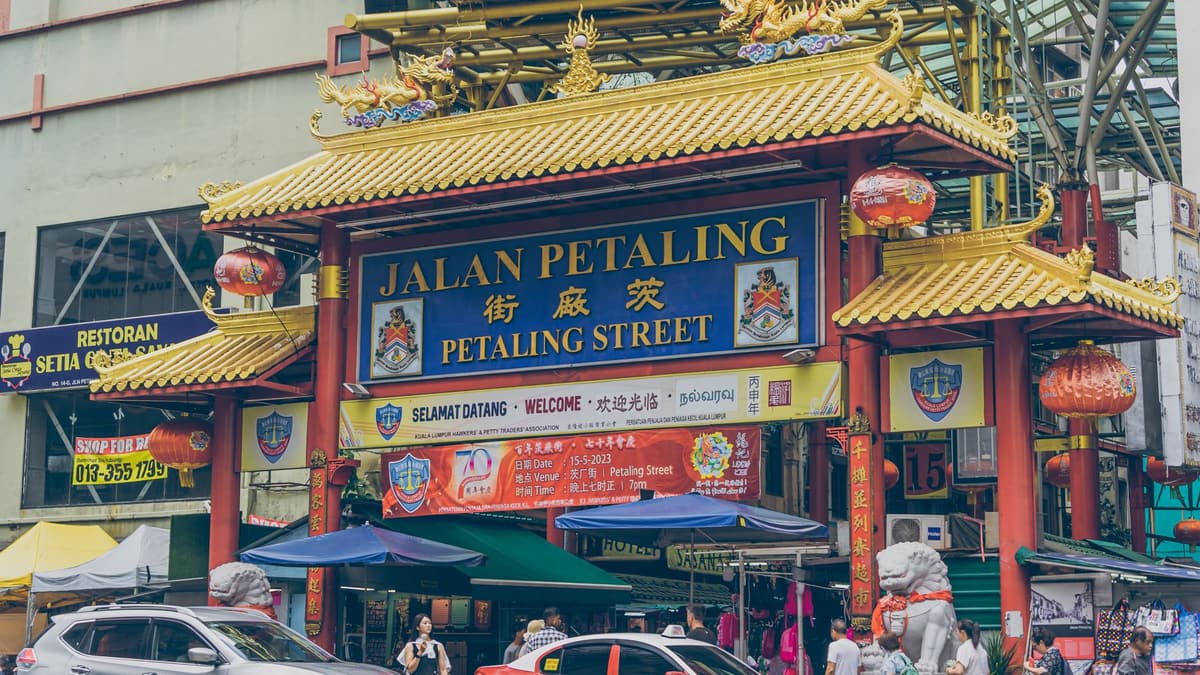
You have reached the heart of Chinatown, a street covered by a long green roof, packed with stalls and lined with old two story shophouses.
เนื้อหาที่เหลือของจุดนี้อยู่ในทัวร์เสียงฉบับเต็ม
Look up at the gateway tower in front of you, a gopuram of five tiers rising over the street, every ledge crowded with brightly painted gods, goddesses, guardians and animals.
เนื้อหาที่เหลือของจุดนี้อยู่ในทัวร์เสียงฉบับเต็ม
This is the old Kuala Lumpur Railway Station, and it looks less like a station than a palace from a storybook, with white walls, pointed arches, domed pavilions and slim towers on the roofline.
เนื้อหาที่เหลือของจุดนี้อยู่ในทัวร์เสียงฉบับเต็ม
After two buildings full of domes, the National Mosque, Masjid Negara, comes as a surprise. It is modern, clean lined and quietly confident, built in the early 1960s and opened in 1965, a few years after independence.
เนื้อหาที่เหลือของจุดนี้อยู่ในทัวร์เสียงฉบับเต็ม
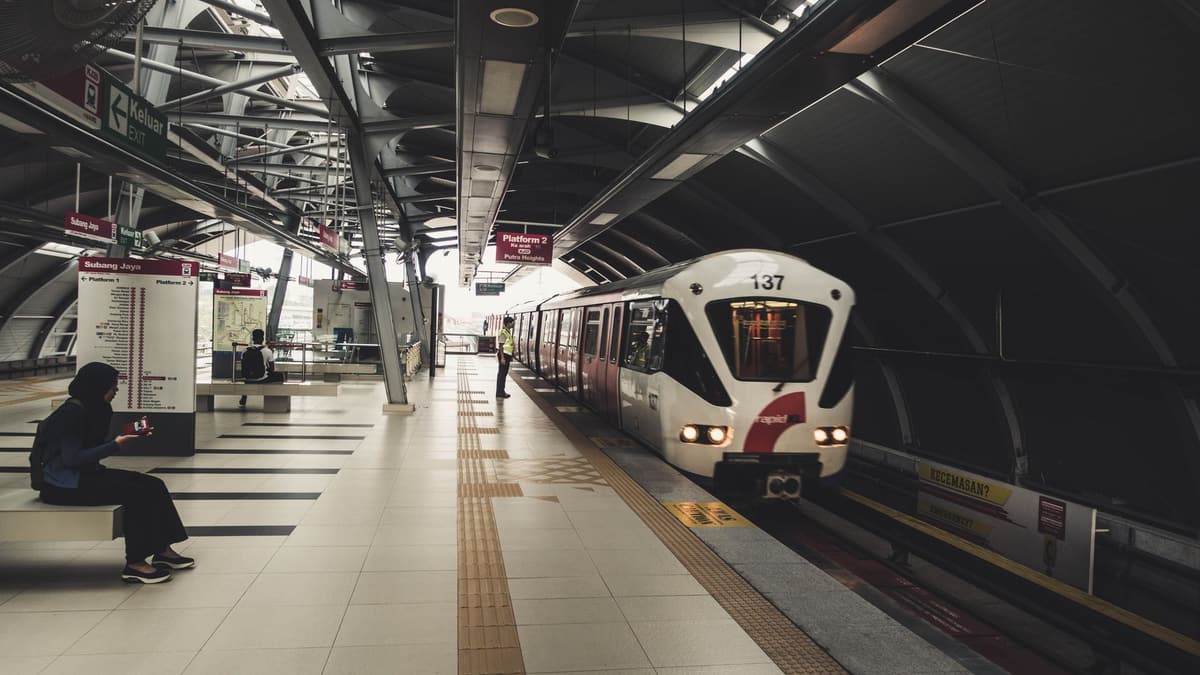
The walk ends at the Islamic Arts Museum Malaysia, a cool white building with a turquoise dome at the edge of the Lake Gardens, the city's big green park.
เนื้อหาที่เหลือของจุดนี้อยู่ในทัวร์เสียงฉบับเต็ม
เดินไปกับคนอื่นในทัวร์ที่กำหนดเวลาไว้ครั้งต่อไป
ประมาณ 4 กม. ใช้เวลาประมาณ 56 นาทีด้วยจังหวะสบายๆ · 8 จุดแวะ
เพื่อนเดินฟรีOctober 11, 2026 · 9 min read
From the Hollandsche Schouwburg through the old Jewish Quarter, past the Dockworker and the Dam, to the Anne Frank House on the Prinsengracht.
October 11, 2026 · 11 min read
From Van Houten's street by the Vondelpark past Leidseplein, the Rijksmuseum passage and the famous canal bench to the Anne Frank House.

October 11, 2026 · 10 min read
Follow the last days of April and May 1945 from the Anhalter Bahnhof ruin past the Gestapo site and Brandenburg Gate to the Moltke Bridge and the Reichstag.
