
October 11, 2026 · 9 min read
Amsterdam Anne Frank Walking Tour
From the Hollandsche Schouwburg through the old Jewish Quarter, past the Dockworker and the Dam, to the Anne Frank House on the Prinsengracht.
589

October 9, 2026 · 10 min read

 Bạn bè đi bộ miễn phí
Mỗi tour cũng được tổ chức như một chuyến đi bộ nhóm theo lịch trình mà bạn có thể tham gia trong ứng dụng.
Thêm tour âm thanh tại Ho Chi Minh City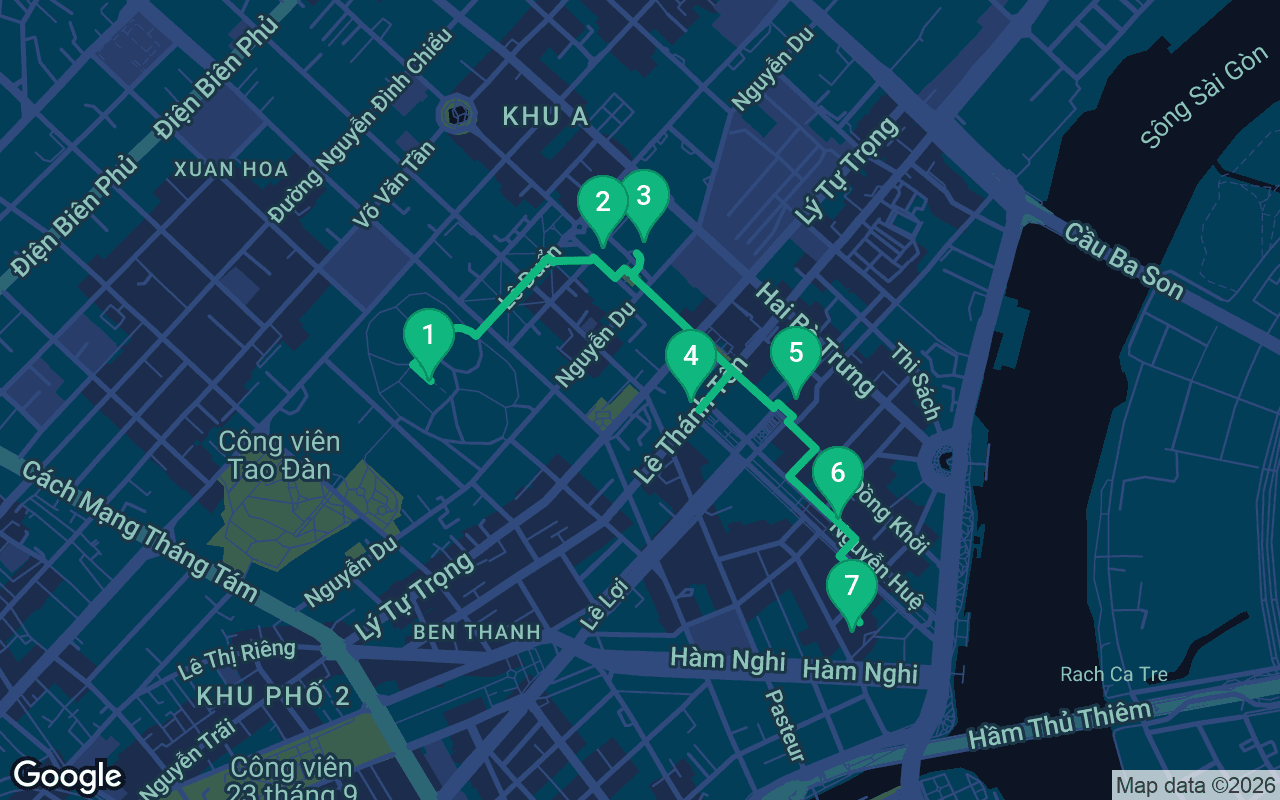
Khoảng 2,3km, mất khoảng 32 phút với nhịp độ thoải mái.
Tour này có thuyết minh âm thanh
Nhấn phát tại 3 điểm dừng đầu tiên để nghe thử 30 giây phần thuyết minh ngay tại đây. Trong ứng dụng, phần giới thiệu và các điểm dừng này được nghe trọn vẹn miễn phí, và mỗi điểm dừng sẽ phát âm báo khi bạn đến nơi. Toàn bộ chuyến tham quan có thuyết minh sẽ là của bạn chỉ với $7.99, mua một lần và sở hữu mãi mãi.
Hoạt động với Garmin, Komoot, Strava, OS Maps và mọi ứng dụng GPX.
Ho Chi Minh City is a restless, fast-growing metropolis, but its center still follows the street plan the French laid out in the nineteenth century, and a short walk through it covers a remarkable sweep of history. This route starts at the palace where the Vietnam War ended in April 1975, then follows the old colonial axis past a red-brick cathedral, a grand post office, the old Hôtel de Ville and the Opera House, before finishing on the pedestrian boulevard of Nguyễn Huệ under the city's most famous skyscraper. It is about two and a half kilometers and completely flat, an easy morning among self-guided walking tours, with history at almost every corner and good coffee in between.
The walking itself takes well under an hour, but allow three, since the palace alone can fill an hour and the post office and the cafés will slow you down. The ground is flat and paved. The real challenge is the climate. Saigon is hot all year, and humid, with a rainy season from roughly May to November that brings short, heavy afternoon downpours, so start early, carry water, wear a hat, and duck into air-conditioned lobbies when you need to. The other challenge is the motorbikes. To cross a street, step out when there is a gap, then walk at a slow, steady pace without stopping or rushing, and riders will curve around you. Use the crossings with lights where you can. The palace and the observation deck at the end charge admission and keep their own hours, and the cathedral has limited access during its restoration, so check before you go. Locals still call the city Saigon, and so do we here. It was renamed after Ho Chi Minh in 1976, and the old name survives in daily speech. In 2025 the city's districts were reorganized into new wards, but everyone still calls this area District 1.
Stand at the tall iron gates and look across the lawn at the long, white, modernist building beyond, with its facade of slender concrete fins. This is Independence Palace, also called Reunification Hall, and it is one of the most charged places in Vietnam. A French governor's palace once stood here. After the French left, it became the residence of the president of South Vietnam, but in 1962 two rebel pilots of the South Vietnamese air force bombed it, and it was torn down. The building you see, designed by the architect Ngô Viết Thụ, was finished in 1966 and has barely changed since, a time capsule of 1960s state rooms, carpets and furniture. In the basement, the bunker still holds the old radio equipment and war maps. On 30 April 1975, North Vietnamese tanks crashed through these gates, and the South's last president, Dương Văn Minh, in office for only two days, surrendered. The war that had cost millions of lives was over, and the country was soon reunified. Two tanks of the same models stand on the lawn today. For some Vietnamese the date is a day of victory, and for many who fled the South it is remembered as the fall of Saigon. Walk out through the front gates and follow the wide boulevard of Lê Duẩn northeast through the park. The twin red spires of the cathedral rise straight ahead, about seven minutes away.
 You arrive in a busy square facing the Notre-Dame Cathedral Basilica, and the first thing to notice is the color. The walls are bare red brick, unplastered, and the story goes that the bricks were shipped from Marseille and have kept their warm color for well over a century. The French built the cathedral between 1877 and 1880, a Romanesque church with Gothic touches, and the two bell towers got their tall iron spires some years later. It was given the rank of a basilica in 1962. In front of it, in the middle of the square, stands a white granite statue of the Virgin, Our Lady of Peace, made in Italy and placed here in 1959. In 2005 crowds gathered after reports that the statue was shedding tears, though the church never confirmed it as a miracle. The cathedral has been under a long restoration in recent years, with scaffolding on the towers and the interior often closed, so you may only be able to admire it from outside. That is still worth it. Stand back near the statue to take in the whole facade and its rose window, and notice the traffic swirling around the square without pause. The next stop is just across the square, on the right as you face the church. It takes one minute.
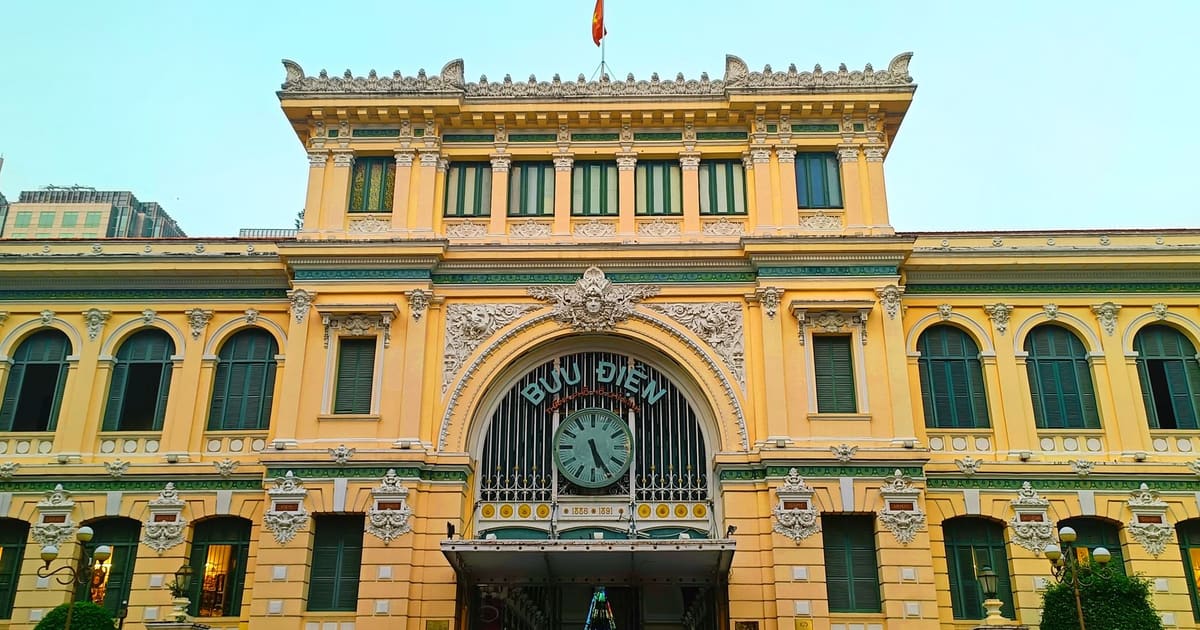
Walk in through the arched doors of the Saigon Central Post Office and look up. The great vaulted hall, built between 1886 and 1891 to a design by the French architect Alfred Foulhoux, has a curved roof on an iron frame and long rows of arched windows, and it feels more like a railway station than a post office. It is sometimes credited to Gustave Eiffel, but there is no good evidence for that. It is still a working post office, so you can buy stamps and send a postcard home, and the old wooden telephone booths still line the walls. Look at the walls near the entrance for two large painted maps, one of Saigon and its surroundings in the 1890s, the other of telegraph lines across southern Vietnam and Cambodia. At the far end of the hall, a large portrait of Ho Chi Minh looks down on the counters. For decades a letter writer named Dương Văn Ngộ sat at a desk in this hall, writing and translating letters for people in French and English, and he became a small legend among visitors. When you come out, the lane alongside the post office is a pedestrian book street, worth a browse. Then walk southeast down Đồng Khởi, the old rue Catinat, for two blocks, and turn right onto Lê Thánh Tôn. City Hall appears on your right after about six minutes.
Bao gồm những gì
Các tour của chúng tôi được thiết kế để mang tính thiền định và đắm chìm: bạn vừa đi vừa lắng nghe. Đi cùng nhau luôn tuyệt hơn, và ứng dụng phát thuyết minh đồng bộ để bạn, người thương và bạn bè nghe mỗi điểm dừng cùng một lúc.
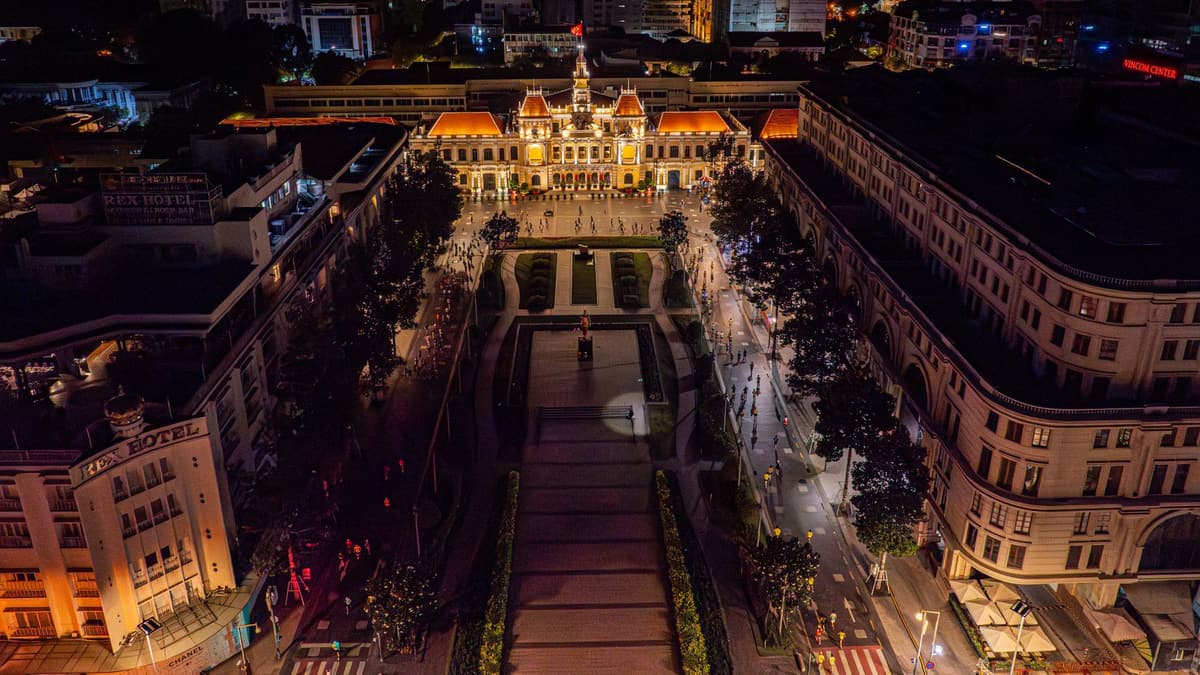
Cross into the plaza in front and stand by the bronze statue of Ho Chi Minh, unveiled here in 2015.
Phần còn lại của điểm dừng này có trong tour âm thanh đầy đủ.
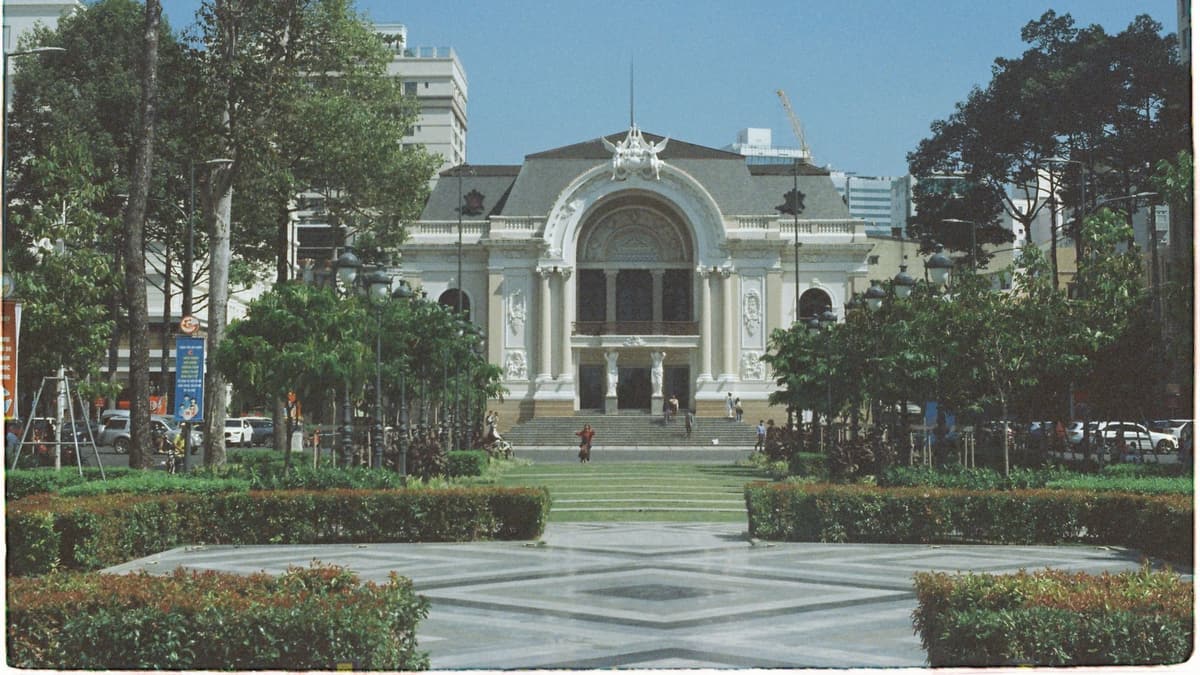
In front of you, at the top of Lê Lợi, stands the Opera House, more formally the Municipal Theatre, with its arched entrance, carved figures and curved roofline.
Phần còn lại của điểm dừng này có trong tour âm thanh đầy đủ.
Look up at the building at number 42 Nguyễn Huệ, and you will see why people stop here to take photos.
Phần còn lại của điểm dừng này có trong tour âm thanh đầy đủ.
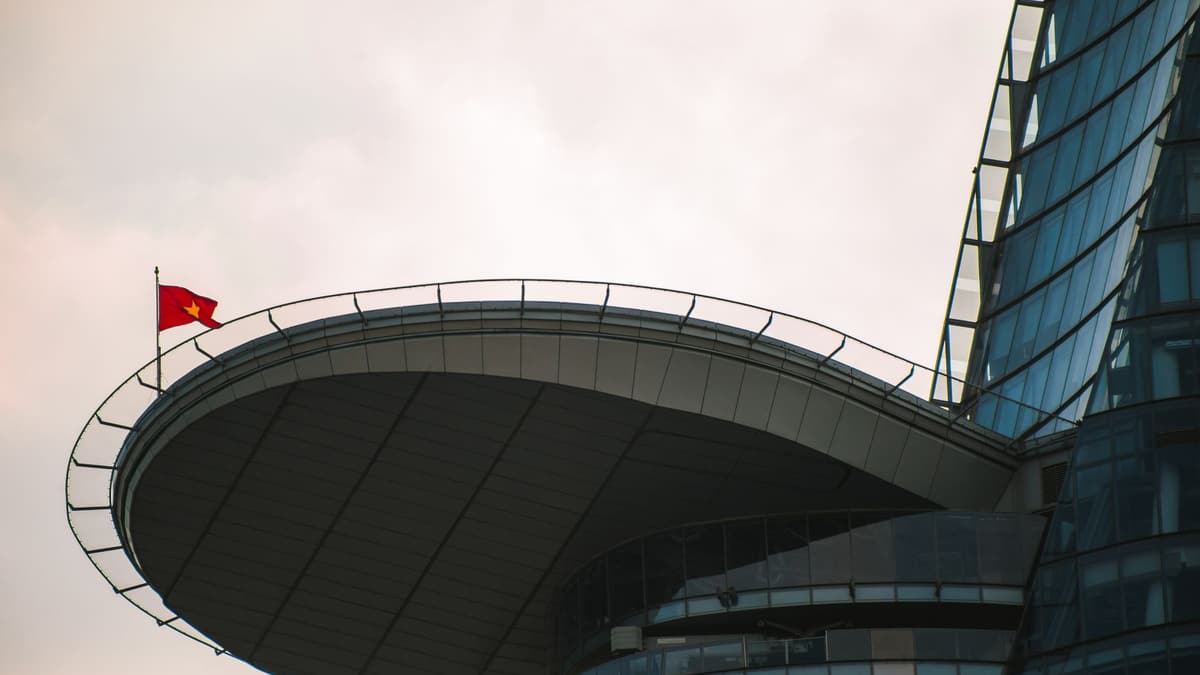
Tip your head back and follow the curve of the Bitexco Financial Tower up into the sky. Finished in 2010, it rises about 260 meters, and it was designed by the architect Carlos Zapata to suggest a lotus bud, Vietnam's national flower, opening upward.
Phần còn lại của điểm dừng này có trong tour âm thanh đầy đủ.
Thực hiện buổi đi bộ này cùng người khác vào tour đã lên lịch tiếp theo.
Khoảng 2,3km, mất khoảng 32 phút với nhịp độ thoải mái · 7 điểm dừng
Bạn bè đi bộ miễn phíOctober 11, 2026 · 9 min read
From the Hollandsche Schouwburg through the old Jewish Quarter, past the Dockworker and the Dam, to the Anne Frank House on the Prinsengracht.
October 11, 2026 · 11 min read
From Van Houten's street by the Vondelpark past Leidseplein, the Rijksmuseum passage and the famous canal bench to the Anne Frank House.

October 11, 2026 · 10 min read
Follow the last days of April and May 1945 from the Anhalter Bahnhof ruin past the Gestapo site and Brandenburg Gate to the Moltke Bridge and the Reichstag.
