
October 11, 2026 · 9 min read
Amsterdam Anne Frank Walking Tour
From the Hollandsche Schouwburg through the old Jewish Quarter, past the Dockworker and the Dam, to the Anne Frank House on the Prinsengracht.
589

October 9, 2026 · 12 min read

 Bạn bè đi bộ miễn phí
Mỗi tour cũng được tổ chức như một chuyến đi bộ nhóm theo lịch trình mà bạn có thể tham gia trong ứng dụng.
Thêm tour âm thanh tại Singapore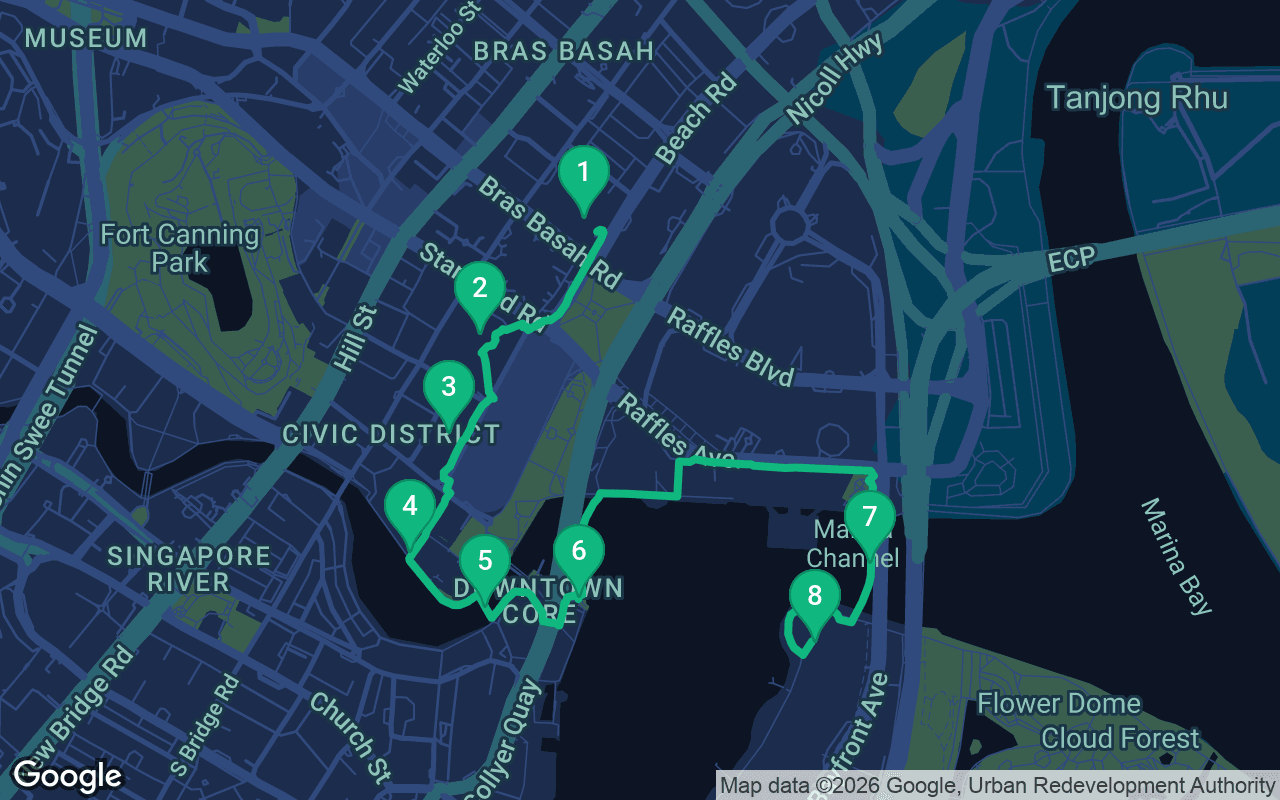
Khoảng 3,5km, mất khoảng 48 phút với nhịp độ thoải mái.
Tour này có thuyết minh âm thanh
Nhấn phát tại 3 điểm dừng đầu tiên để nghe thử 30 giây phần thuyết minh ngay tại đây. Trong ứng dụng, phần giới thiệu và các điểm dừng này được nghe trọn vẹn miễn phí, và mỗi điểm dừng sẽ phát âm báo khi bạn đến nơi. Toàn bộ chuyến tham quan có thuyết minh sẽ là của bạn chỉ với $8.99, mua một lần và sở hữu mãi mãi.
Hoạt động với Garmin, Komoot, Strava, OS Maps và mọi ứng dụng GPX.
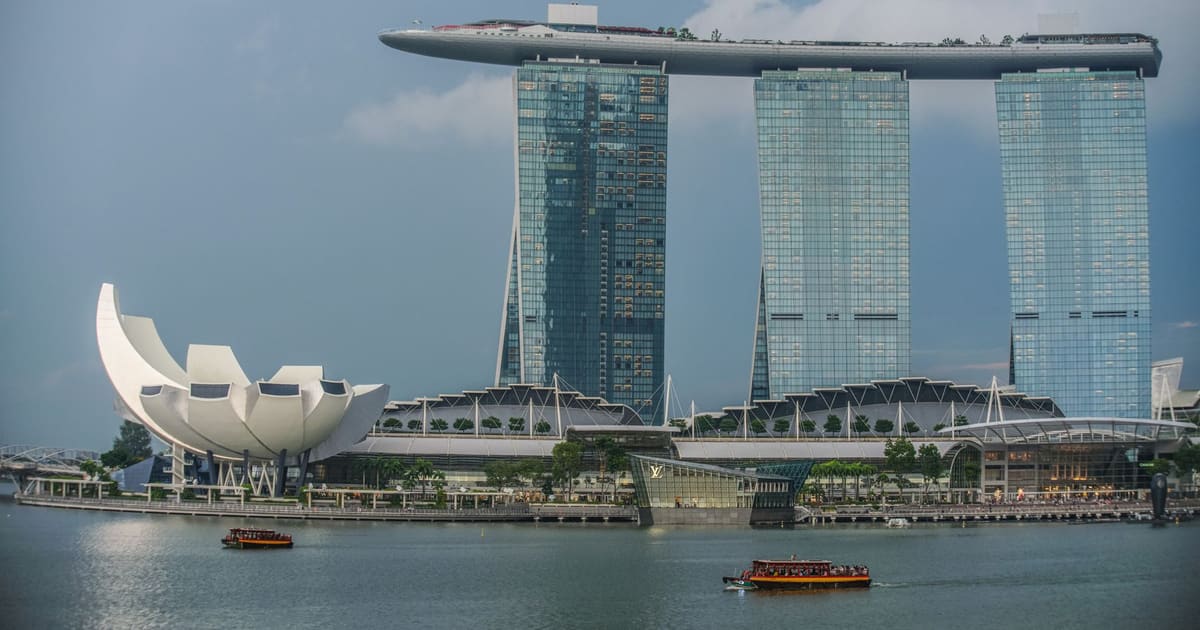
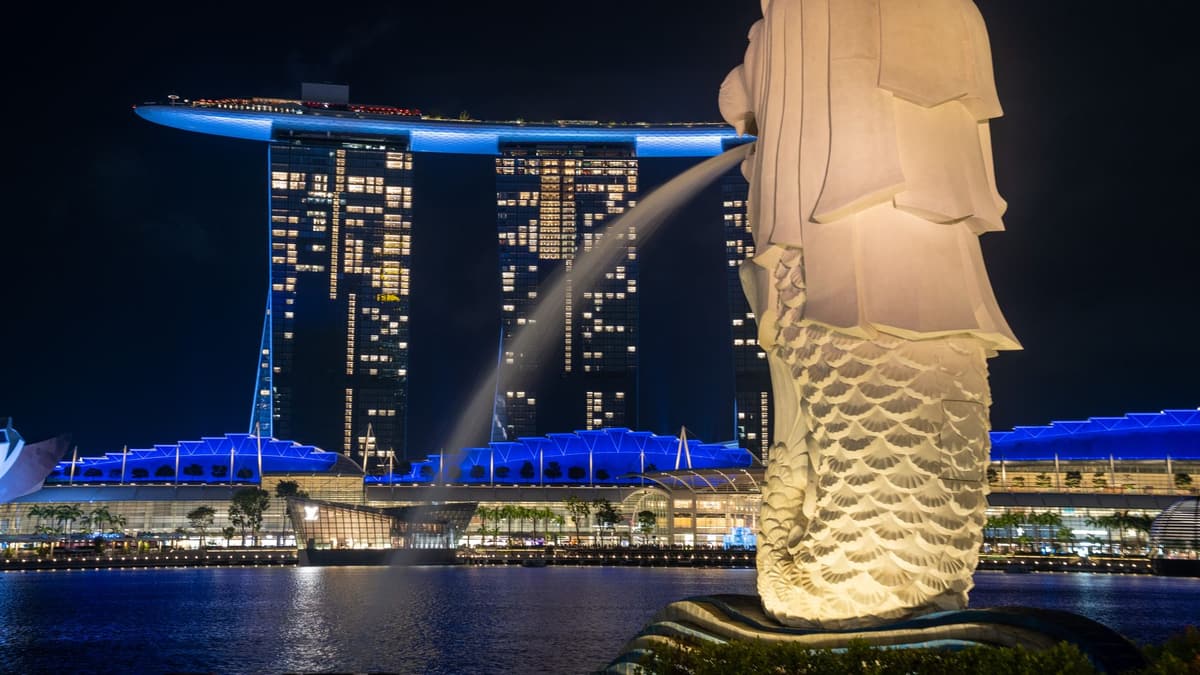
Singapore changes so fast that it can be hard to see where it came from, but this walk lays the whole story out in a single line. You start at Raffles Hotel, cross the old colonial Civic District past a white cathedral and the courts and council chambers of the British era, and come down to the river where the modern city was founded in 1819. Then you follow the water to the Merlion, cross the bay on a footbridge shaped like a strand of DNA, and finish under the three towers of Marina Bay Sands, standing on land that was open sea fifty years ago. It is about three and a half kilometers and almost entirely flat, and of all the self-guided walking tours we know in Asia, few pack two centuries of a city into so short a stroll.
The walking itself takes under an hour, but give it a morning or a long late afternoon if you plan to step inside the cathedral, the gallery or the hotel arcades. Singapore sits almost on the equator, so it is hot and humid every day of the year, and the sun is fierce by late morning. The best plan is to start by eight or nine, or to set off around four and time your finish for dusk, when the bay lights up; sunset comes at about seven all year round. Thunderstorms roll in quickly, most often in the afternoon, and they tend to be heavy and short. Carry a small umbrella, which also works as a sunshade, and wait out a downpour under the covered walkways and arcades the city is full of. Pavements are smooth and the crossings well marked, so sensible shoes are enough. Bring water; there are plenty of places to refill or buy more along the way. The cathedral is a working church and the gallery and the SkyPark keep their own hours and prices, so check before you go.
Stand on Beach Road and look across the drive at the long white building with its deep verandas and tall arched windows. Raffles Hotel opened in 1887, started by the Sarkies brothers, Armenian hoteliers who also ran grand hotels in Penang and Rangoon. It began as a modest bungalow facing what was then the seafront, because in those days the water came almost up to this road, and the main building you see now went up in the 1890s. Writers, planters, film stars and royalty stayed here, among them Rudyard Kipling and Somerset Maugham, and the Sikh doormen in their turbans became as famous as the hotel itself. Upstairs in the Long Bar, a Hainanese bartender named Ngiam Tong Boon is credited with mixing the first Singapore Sling early in the twentieth century, a pink gin cocktail with cherry liqueur and pineapple. The bar keeps up a tradition of letting you drop peanut shells on the floor. The hotel was restored twice, most recently in a long renovation finished in 2019, and it is now a national monument. Parts of it are for guests only, but the arcades and courtyards and the Long Bar are open to everyone. When you are ready, walk along Bras Basah Road beside the hotel and turn left onto North Bridge Road, heading southwest with the Raffles City towers on your left. Cross Stamford Road and the cathedral's lawn opens up on your right, about five minutes away.
In front of you, set back on a wide green lawn, stands a gleaming white Gothic church with a slender spire. St Andrew's is the Anglican cathedral of Singapore and the largest cathedral in the country. An earlier church on this spot was struck by lightning twice in the 1840s and had to come down, and the building you see was put up in the late 1850s and early 1860s. It was designed by a British army engineer, Ronald MacPherson, and built by Indian convict laborers, men transported from British India to work on the public buildings and roads of the colony. Their skill is the reason the walls glow the way they do. The plaster is Madras chunam, a South Indian recipe of shell lime mixed with egg white, sugar and water steeped with coconut husk, polished until it shines almost like porcelain. Walk up close and you can see how smooth it is. Inside, the nave is cool and bright, with memorials and stained glass, and visitors are welcome when there is no service on. Be quiet if one is underway, and dress with a little respect. From the cathedral, walk south down St Andrew's Road and across Coleman Street. The great open field of the Padang is on your left, and the columns of the old City Hall rise on your right, about four minutes on.
 Look up at the row of tall Corinthian columns facing the Padang. This was City Hall, finished in 1929, and the building beyond it with the green dome was the Supreme Court, finished ten years later. Between them they saw some of the biggest days in Singapore's history. On 12 September 1945, in the chamber of what was then the Municipal Building, Japanese commanders formally signed the surrender of their forces in Southeast Asia, ending more than three years of occupation, a time when many thousands of civilians, especially in the Chinese community, were killed. The steps out front later became the stage for rallies and the first National Day parades, with crowds packed onto the Padang below. The courts moved in 2005 to the new Supreme Court building behind, the one wearing a disc on its roof like a flying saucer, and the two old buildings were joined into the National Gallery Singapore, which opened in 2015. It holds one of the largest public collections of modern art from Singapore and Southeast Asia, and the link between the two buildings, under a canopy of metal and glass, is worth seeing on its own. The rooftop terraces give a fine view over the Padang to the bay; access and hours can change, so check before you go. From the gallery, continue south past the old Supreme Court and walk down toward the river, keeping the white Victoria Theatre and Concert Hall, with its clock tower, close by. You will reach the riverside walk in about five minutes.
Bao gồm những gì
Các tour của chúng tôi được thiết kế để mang tính thiền định và đắm chìm: bạn vừa đi vừa lắng nghe. Đi cùng nhau luôn tuyệt hơn, và ứng dụng phát thuyết minh đồng bộ để bạn, người thương và bạn bè nghe mỗi điểm dừng cùng một lúc.
On the riverbank stands a white statue of a man with his arms folded, gazing out over the water. This marks the spot where Stamford Raffles, an official of the British East India Company, is said to have stepped ashore in late January 1819.
Phần còn lại của điểm dừng này có trong tour âm thanh đầy đủ.
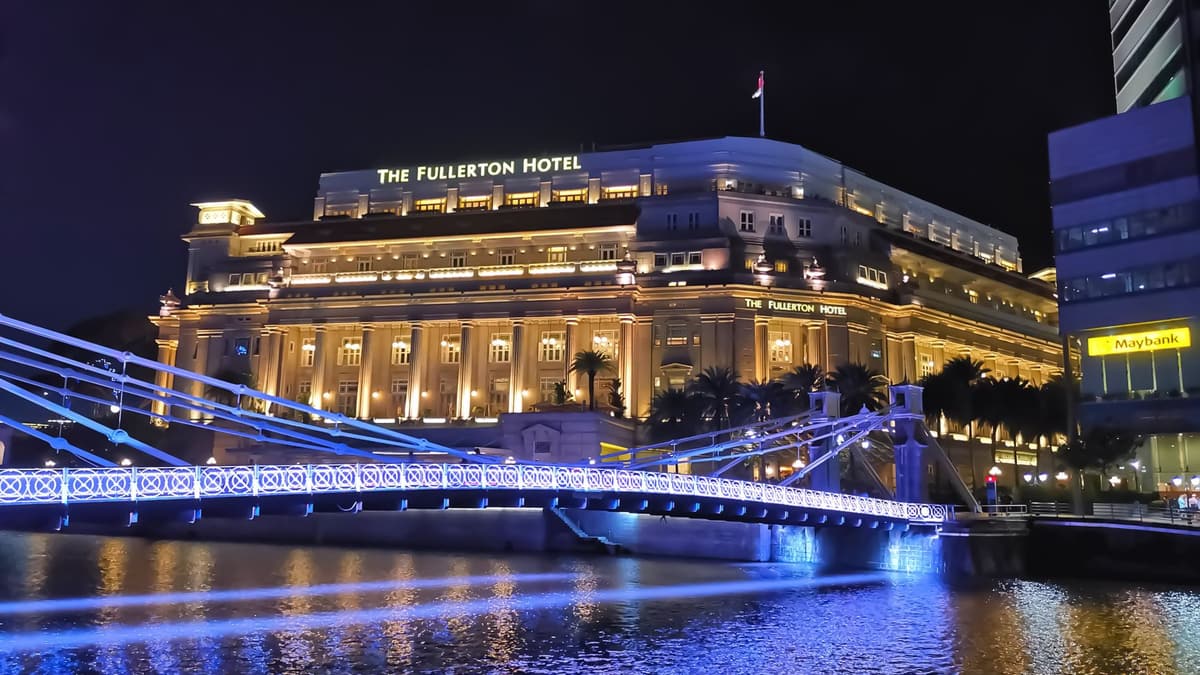
You are crossing Cavenagh Bridge, a suspension bridge of white painted iron opened in 1869 and one of the oldest bridges in Singapore.
Phần còn lại của điểm dừng này có trong tour âm thanh đầy đủ.
Here it is, the city's mascot: a white creature with the head of a lion and the body of a fish, spouting a great arc of water into Marina Bay.
Phần còn lại của điểm dừng này có trong tour âm thanh đầy đủ.
On your way you passed Esplanade, Theatres on the Bay, the arts center that opened in 2002. Its two domes are covered in pointed aluminum sunshades, and almost everyone in Singapore calls it the durian, after the spiky, famously smelly fruit.
Phần còn lại của điểm dừng này có trong tour âm thanh đầy đủ.
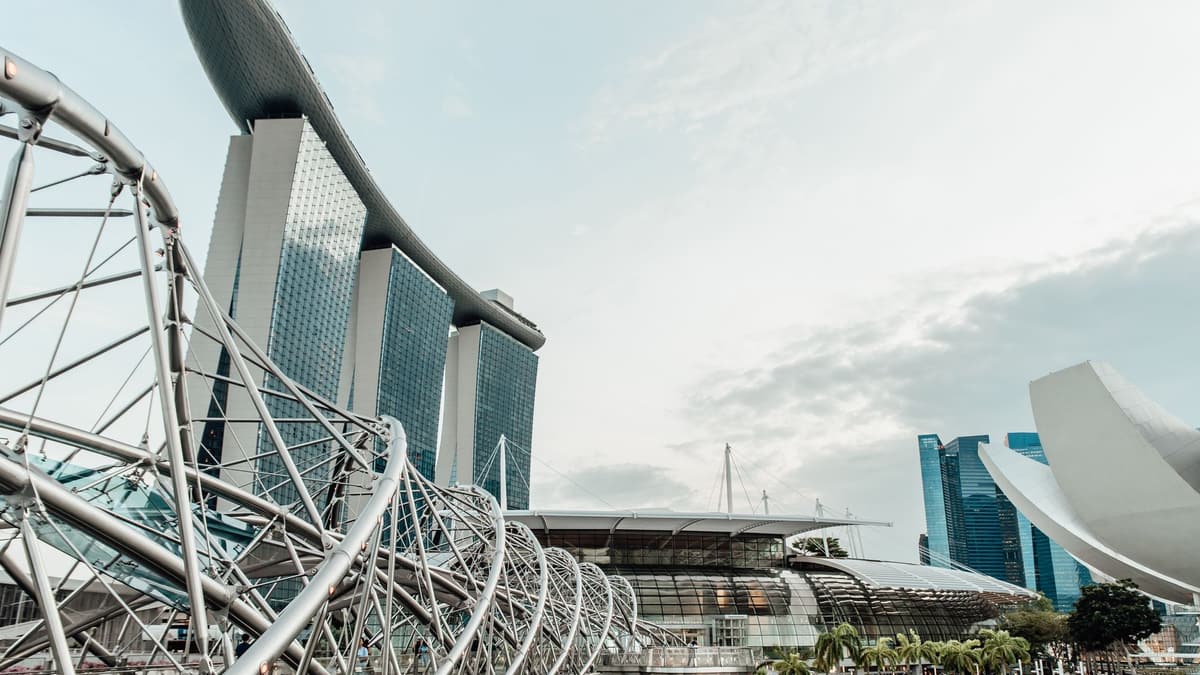
The walk ends at the foot of Marina Bay Sands, three towers fifty-seven stories tall, joined at the top by a long platform shaped like the deck of a ship.
Phần còn lại của điểm dừng này có trong tour âm thanh đầy đủ.
Thực hiện buổi đi bộ này cùng người khác vào tour đã lên lịch tiếp theo.
Khoảng 3,5km, mất khoảng 48 phút với nhịp độ thoải mái · 8 điểm dừng
Bạn bè đi bộ miễn phíOctober 11, 2026 · 9 min read
From the Hollandsche Schouwburg through the old Jewish Quarter, past the Dockworker and the Dam, to the Anne Frank House on the Prinsengracht.
October 11, 2026 · 11 min read
From Van Houten's street by the Vondelpark past Leidseplein, the Rijksmuseum passage and the famous canal bench to the Anne Frank House.

October 11, 2026 · 10 min read
Follow the last days of April and May 1945 from the Anhalter Bahnhof ruin past the Gestapo site and Brandenburg Gate to the Moltke Bridge and the Reichstag.
