
5 tháng 10, 2026 · 7 phút
A Walking Buddy Schedule
Fix one or two days, a time and a meeting place, agree a bad-weather plan and what happens when one of you cancels, and start small.


Meeting a new walking buddy or joining a walking group safely comes down to three things. Before the walk, check who you're meeting and tell one person the details. On the walk, stay in public, in daylight, on a route with people around and a way out, and make your own way there and home. If anything feels wrong, leave, and you don't need a reason. That matches what the Suzy Lamplugh Trust, a UK personal safety charity, advises for meeting anyone you've only known online. None of this needs to make a first walk tense, and each habit takes a minute or two. Below is how to do each part properly, for one person and for a group.
You learn a lot from the messages before a first walk. Someone who wants to walk with you will be happy to agree on a public meeting spot, a time and roughly how long you'll be out, and won't mind if you suggest those yourself. Pressure is the thing to notice: pushing for a quieter place than the one you suggested, an evening slot after you said daytime, offering to pick you up, or asking where you live or work before you've met. Any one of these on its own can be innocent, but together they tell you the other person cares more about their plan than your comfort, and that's a fine reason to say no. Look at their profile too, and check that what they've told you about themselves holds together. The Trust's advice for meeting someone from online is simple on this point: don't give away personal information, such as your home address, on a first meeting. If you haven't found anyone yet, start with our page on finding a walking buddy and come back to this once you have a name.
A walking group is usually the gentler first step, because there are more people around you and nobody is relying on one stranger. It still pays to look before you go. A well-run group has a named organiser, a written meeting point and start time, a rough route and length, and some history: past walks, photos, people who come back. Send the organiser one plain question before your first walk, such as how long the route is or whether a slower walker can keep up. A quick, friendly answer tells you someone is responsible for the walk, and no answer at all tells you something too. On longer walks, ask whether someone walks at the back. Groups spread out as fast walkers pull ahead, and a group that keeps someone at the rear is one that has thought about not leaving people alone.
This is the step people skip because it feels like too much for a walk, and it takes a minute. The Suzy Lamplugh Trust suggests telling someone where you're going and who you're meeting, including the name and the website or app you arranged it through, and checking in with them before, during and after. Make the check-in specific: "I'll message you by 11" works far better than "I'll let you know". Agree what they'll do if 11 comes and goes without a message, which is usually to call you, and then to try again and act if you still don't answer. If your phone can share your live location with a friend, turn it on for the length of the walk, and leave home with a charged battery.
Name an exact meeting spot, a busy one: the main gate of the park, the front of a named café, the exit of a station. For the route, the question to ask is how easily you could leave it. A loop through a city park, along a busy riverside or through streets with shops and bus stops lets you step away at almost any point. A path into woods or along a remote stretch of coast leaves you an hour from anywhere with people you met that morning, which is fine for a group you know and a poor choice for a first walk. Keep the first one short enough that you'd happily do it again, then lengthen it once you know you enjoy each other's company.
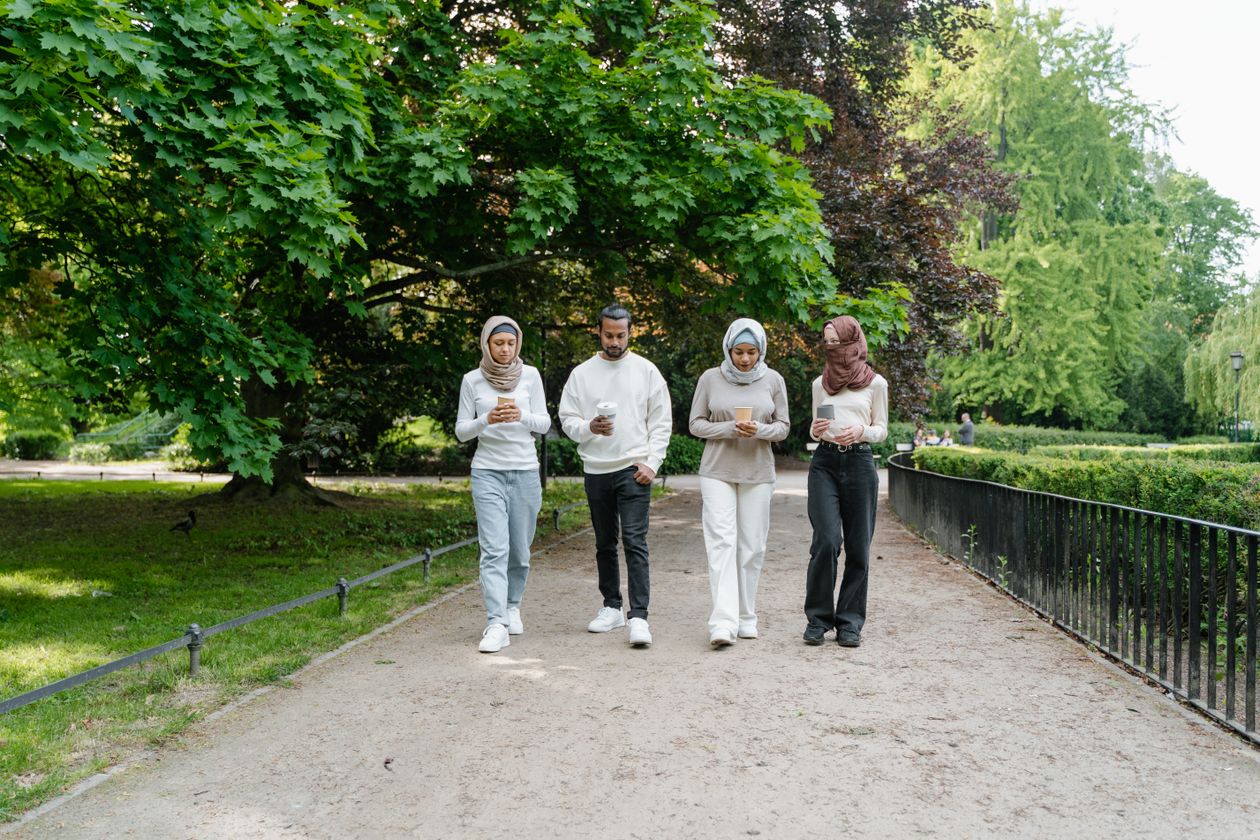 Photo: MART PRODUCTION, Pexels
Daylight helps in two ways. You can see who you're with and where you are, and so can everyone around you. Traffic is the other reason: in the US in 2024, 76% of pedestrians killed in traffic crashes died in the dark, against 20% in daylight, according to the national road safety agency's figures. If a walk might run past sunset, wear something bright or carry a light, and where there's no pavement, walk on the shoulder facing traffic, as the same agency advises. The other half of this is getting home. The Trust's advice is to work out how you'll get home before you go out, down to when the last bus or train leaves. Make your own way to the meeting point and back, and don't accept a lift from someone you've just met, however kindly it's offered. Arriving and leaving on your own means the walk ends when you decide it does.
A first walk is for finding out whether you like walking together, not for swapping life stories. Talk about the route, the area, where else you like to walk. Keep back the things that let someone find you without you: your exact address, where you work, the times you leave the house each day. A good walking partner won't push for those, and if one does, change the subject once. If they push again, that's your answer about a second walk. Keep your phone somewhere you can reach it quickly, and keep your attention on where you are rather than on the screen.
 Photo: Keira Burton, Pexels
You don't need proof to end a walk. If something about a person or a group makes you uneasy, say you need to head off and go. It helps to have a line ready before you set out, something like "I'm going to turn back here, I've got to be somewhere," so you're not inventing one under pressure. Walk towards the busiest part of the route, and message the person you told. A decent walking partner or group will shrug and wish you well, and anyone who argues or follows has shown you that leaving was right. If you think you're being followed, the Trust's advice is to cross the road, turning to see who is behind you, and if they're still there to keep moving, head somewhere busy, tell people what is happening and call the police if you need to. In the UK, if you call 999 and can't speak, cough or tap the phone if you can, then press 55 when prompted, and you'll be put through to the police. Afterwards, tell the group's organiser, and block and report the person on whatever app or site you met them through.
Walk With Me shows walks near you on a map, and you ask to join. By default the host approves every request, and hosts can turn on auto-accept. A walk's pin on the public map is shifted by up to 200 meters (100 m for a live walk), and a host's precise live location goes only to the people they've accepted. The meeting point you write is visible to anyone who can see the walk, so make it a public place. You can make a walk friends only or invite only, and there are Women Only, Men Only and LGBTQ+ Only walks, where the app checks the joiner's self-declared profile gender. Blocking takes one tap, and reports are reviewed within 24 hours. There's more on how the app keeps walks safe. It's free on the App Store and Google Play.
5 tháng 10, 2026 · 7 phút
Fix one or two days, a time and a meeting place, agree a bad-weather plan and what happens when one of you cancels, and start small.
21 tháng 8, 2026 · 7 phút
A regular walking partner keeps older adults walking and seeing people. How to pick one, walk safely, add balance work, and where to find a companion.
29 tháng 7, 2026 · 5 phút
Company keeps you walking; time alone calms you down. What the research says about each, when to go solo, and how to mix the two.
