
October 11, 2026 · 9 min read
Amsterdam Anne Frank Walking Tour
From the Hollandsche Schouwburg through the old Jewish Quarter, past the Dockworker and the Dam, to the Anne Frank House on the Prinsengracht.
589

October 6, 2026 · 11 min read

 Bạn bè đi bộ miễn phí
Mỗi tour cũng được tổ chức như một chuyến đi bộ nhóm theo lịch trình mà bạn có thể tham gia trong ứng dụng.
Thêm tour âm thanh tại Delhi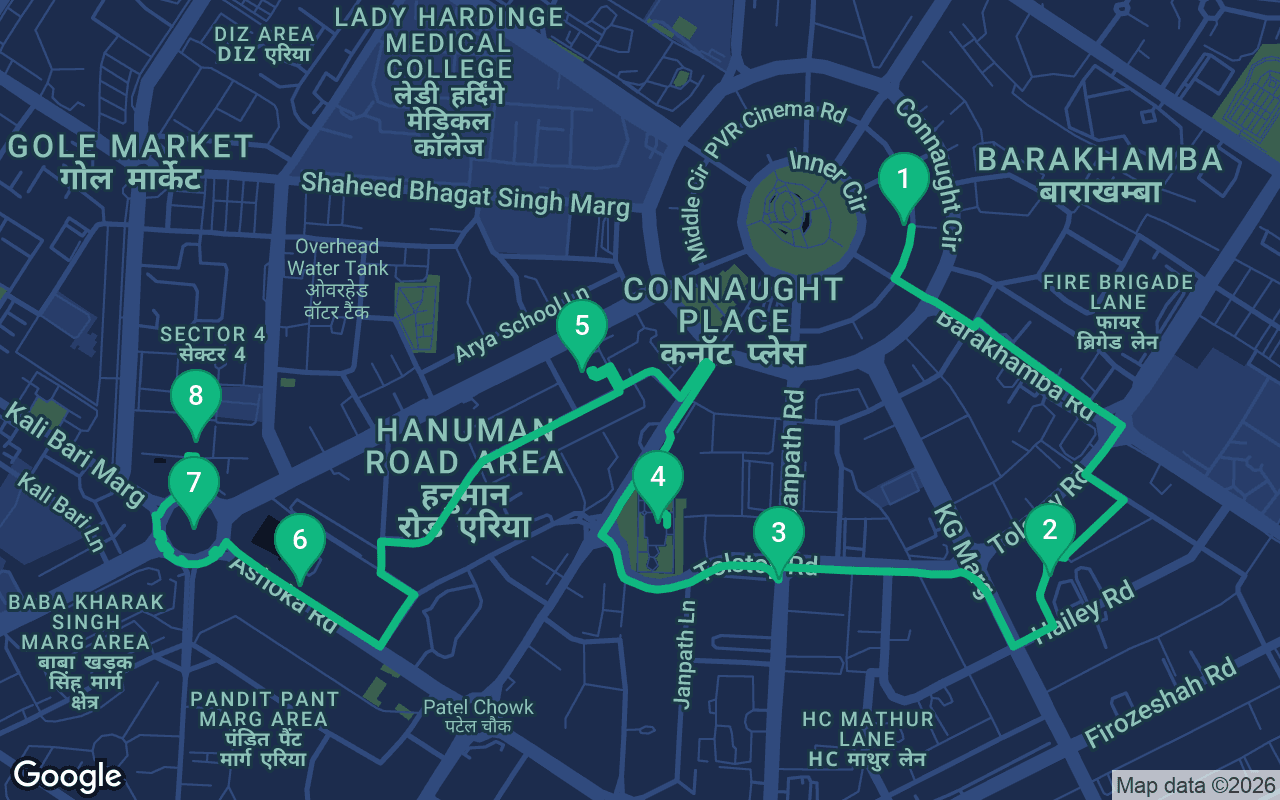
Khoảng 5,4km, mất khoảng 78 phút với nhịp độ thoải mái.
Tour này có thuyết minh âm thanh
Nhấn phát tại 3 điểm dừng đầu tiên để nghe thử 30 giây phần thuyết minh ngay tại đây. Trong ứng dụng, phần giới thiệu và các điểm dừng này được nghe trọn vẹn miễn phí, và mỗi điểm dừng sẽ phát âm báo khi bạn đến nơi. Toàn bộ chuyến tham quan có thuyết minh sẽ là của bạn chỉ với $11.99, mua một lần và sở hữu mãi mãi.
Hoạt động với Garmin, Komoot, Strava, OS Maps và mọi ứng dụng GPX.
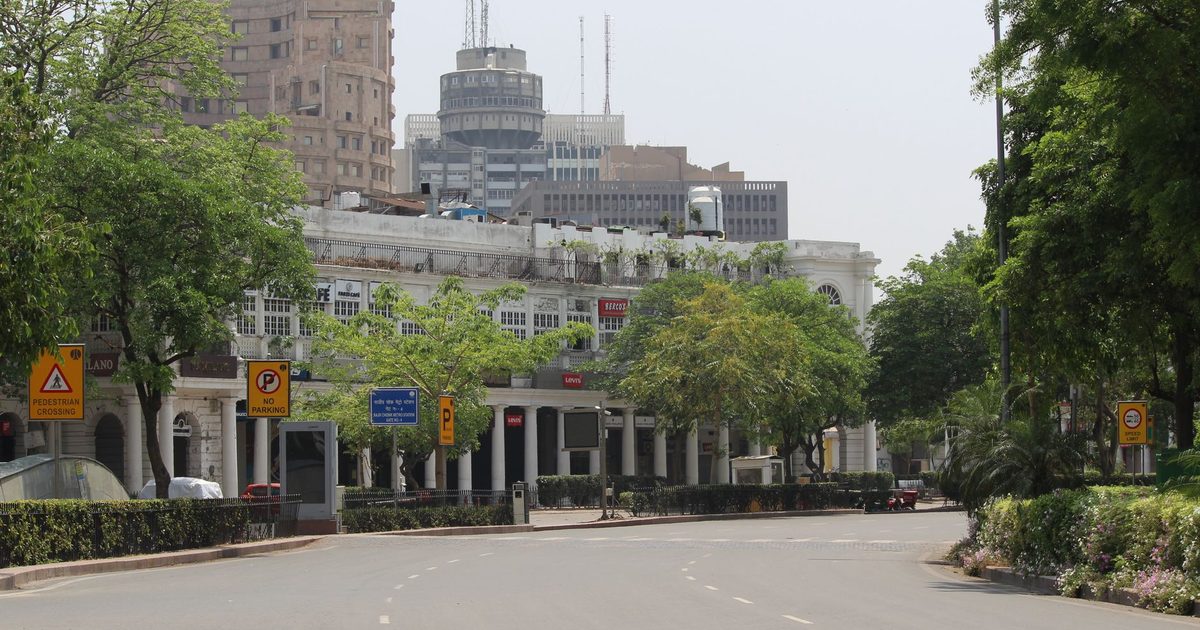
New Delhi was built as a statement. In 1911 the British announced that the capital of India would move here from Calcutta, and over the next twenty years architects led by Edwin Lutyens laid out a new city of wide avenues, roundabouts and white colonnades. Yet tucked between those avenues are places far older and far more alive than the imperial plan: a medieval stepwell, an eighteenth-century observatory, a busy Hindu temple and one of the great Sikh shrines of the world. This walk starts in the white circle of Connaught Place and loops south and west through them all, ending at a quiet cathedral near the Gole Dak Khana roundabout. It covers about four kilometers on flat ground, and it is one of the most surprising self-guided walking tours in India, a few hours in which you cross centuries and several faiths without ever leaving the center of the city.
Plan for about an hour and a half of walking, and three hours or more with stops, especially if you eat at the gurudwara's community kitchen. The ground is flat, but pavements can be uneven and busy, and crossing the big roads takes patience: use the crossings and pedestrian signals, and take your time at the roundabouts. The best season is from October to March, and the best time of day is early morning, when the air is cooler and the streets are calm. From April to June the heat is fierce, and the monsoon brings heavy rain in summer, while winter can bring fog and poor air quality, so check the forecast and the air quality before you set out. Carry water and a scarf or bandana: at Bangla Sahib you must cover your head and remove your shoes, and at Hanuman Mandir you will remove your shoes too. Dress modestly, with shoulders and knees covered, for the places of worship. Jantar Mantar and Agrasen ki Baoli are protected monuments with their own hours, and Jantar Mantar charges for entry, so check before you go.
You are standing in the Inner Circle of Connaught Place, the commercial heart of New Delhi. Look around at the ring of white, two-story buildings, with their tall columns and deep, shady arcades running all the way around. The circle was built between 1929 and 1933 and named after the Duke of Connaught, a son of Queen Victoria. Its architect, Robert Tor Russell, is often said to have taken his inspiration from the curving Georgian terraces of the English city of Bath. The idea was to give the new capital a grand shopping district, and the arcades were designed to keep shoppers out of the sun and the rain. The buildings are divided into blocks, each marked with a letter, which makes it easy to arrange to meet someone here. In the middle of the circle lies Central Park, a green lawn that sits on top of Rajiv Chowk, one of the busiest metro stations in the city, and above it flies an enormous Indian flag. The circle has been officially renamed Rajiv Chowk, but almost everyone still calls it CP. Take a slow walk under the arcades. Then leave the circle on its southeast side, cross the outer ring with care, and head southeast toward Hailey Road, where the stepwell hides among office towers, about twelve minutes.
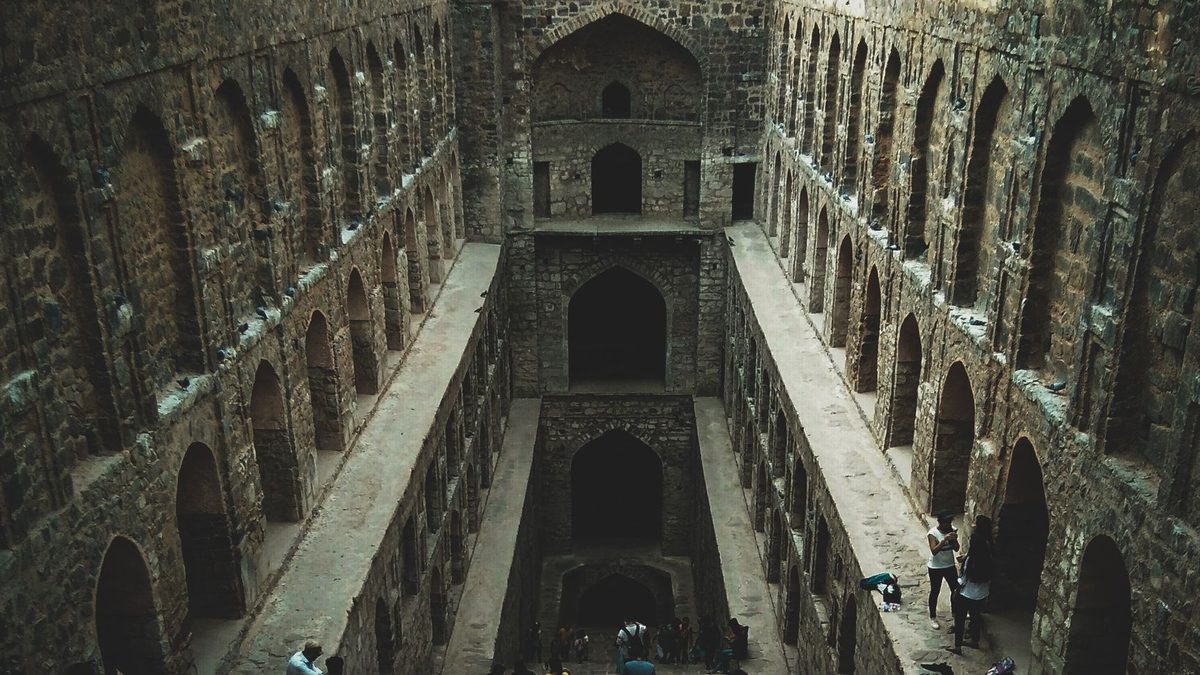
Walk through the gate and stand at the top of the steps, and the city disappears. In front of you, a long, narrow flight of stone steps drops down between high walls, more than a hundred of them, into the earth. This is Agrasen ki Baoli, a stepwell, and it is one of the most startling sights in central Delhi, all the more so because modern office blocks loom right over its walls. Stepwells were built across northern and western India to reach water through the long dry seasons. People walked down to fill their pots, and the deep stone chambers stayed cool even at the height of summer, so they were also places to rest, meet and escape the heat. Look at the walls on either side, lined with rows of arched niches on several levels. Nobody knows exactly when this one was built. Tradition links it to a legendary king called Agrasen, but the structure you see is generally thought to date from the medieval period, perhaps the fourteenth century, and to have been rebuilt over the years. Today the bottom is mostly dry, and pigeons and bats swoop between the arches. Walk down if you like, slowly, and feel the temperature drop. Then head back out and walk west, crossing Kasturba Gandhi Marg, to the broad avenue of Janpath, about ten minutes.
 You have reached Janpath, one of the main avenues of New Delhi. Its name means the People's Path, but under the British it was called Queen's Way, because it crosses the great ceremonial avenue once known as King's Way, which runs from the presidential palace to India Gate. That right-angled meeting of avenues is the backbone of Lutyens's plan, and you are standing on one of its arms. Look at the width of the street, the trees lining its sides and the low buildings set back from the road: this was a city designed to impress, with plenty of space and green. The northern end of Janpath, near Connaught Place, has a very different mood. It is famous for its lively street market, with rows of stalls selling clothes, jewelry, bags, carpets and handicrafts, some of them from Tibet and other Himalayan regions, and bargaining is expected. Along the avenue you will also find some of the city's old landmarks, among them the stately Imperial hotel, built in the 1930s. If you are here early, the stalls may still be shuttered, and you will have the shady footpath almost to yourself. From here, cross Janpath with care and walk west to Sansad Marg, Parliament Street, where the entrance to Jantar Mantar is waiting, about five minutes away.
Bao gồm những gì
Các tour của chúng tôi được thiết kế để mang tính thiền định và đắm chìm: bạn vừa đi vừa lắng nghe. Đi cùng nhau luôn tuyệt hơn, và ứng dụng phát thuyết minh đồng bộ để bạn, người thương và bạn bè nghe mỗi điểm dừng cùng một lúc.
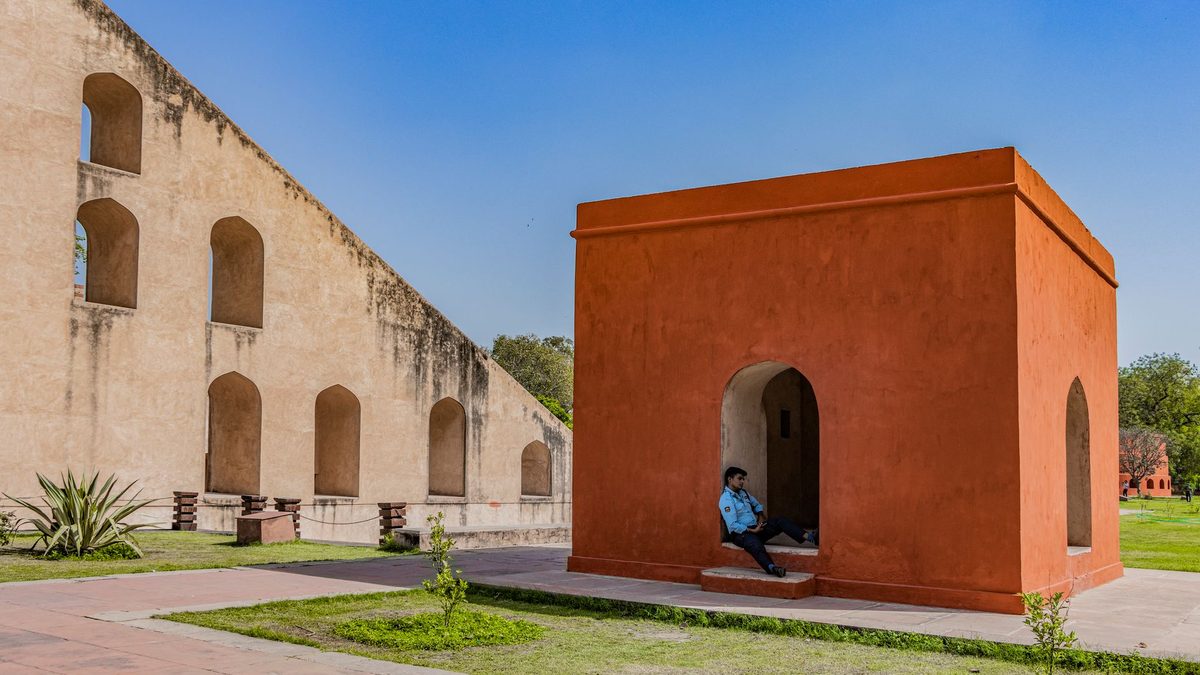
Through the gate, a garden opens up, scattered with huge, strange shapes in rose-red plaster: ramps, curved walls, giant bowls sunk into the ground and a towering triangle with staircases running up its side.
Phần còn lại của điểm dừng này có trong tour âm thanh đầy đủ.
You will hear the Hanuman Mandir before you see it: bells ringing, devotional songs and the hum of a crowd. Then come the colors, saffron flags, garlands of orange marigolds, sweets piled high for offerings, and the smell of incense.
Phần còn lại của điểm dừng này có trong tour âm thanh đầy đủ.
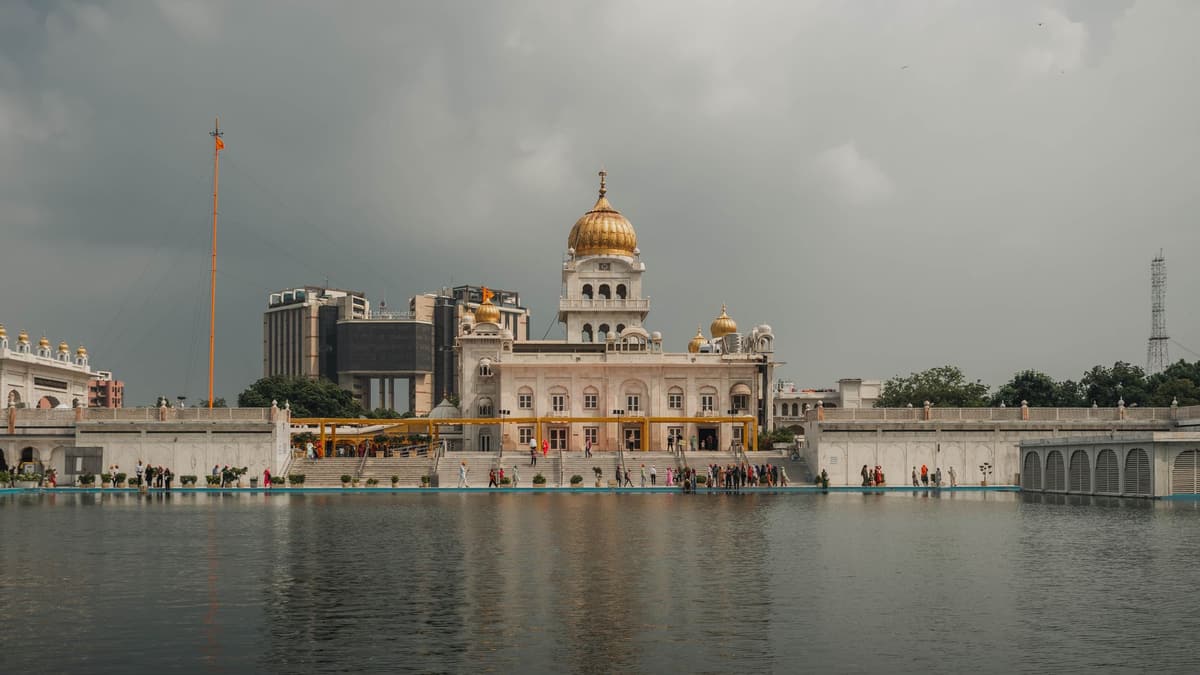
The golden onion dome rising above white marble belongs to Gurudwara Bangla Sahib, one of the most important Sikh houses of worship in Delhi.
Phần còn lại của điểm dừng này có trong tour âm thanh đầy đủ.
You are at Gole Dak Khana, one of the great roundabouts of New Delhi, where several broad avenues meet like the spokes of a wheel.
Phần còn lại của điểm dừng này có trong tour âm thanh đầy đủ.
The walk ends at the Sacred Heart Cathedral, a pale, Italian-style church set behind a lawn and tall trees. Stand at the gate and look at its facade, with its columns and arches, a very different style from the colonnades of Connaught Place.
Phần còn lại của điểm dừng này có trong tour âm thanh đầy đủ.
Thực hiện buổi đi bộ này cùng người khác vào tour đã lên lịch tiếp theo.
Khoảng 5,4km, mất khoảng 78 phút với nhịp độ thoải mái · 8 điểm dừng
Bạn bè đi bộ miễn phíOctober 11, 2026 · 9 min read
From the Hollandsche Schouwburg through the old Jewish Quarter, past the Dockworker and the Dam, to the Anne Frank House on the Prinsengracht.
October 11, 2026 · 11 min read
From Van Houten's street by the Vondelpark past Leidseplein, the Rijksmuseum passage and the famous canal bench to the Anne Frank House.

October 11, 2026 · 10 min read
Follow the last days of April and May 1945 from the Anhalter Bahnhof ruin past the Gestapo site and Brandenburg Gate to the Moltke Bridge and the Reichstag.
