
22 juli 2026 · 6 minuten
How Long Should a Walk Be?
Aim for 150 minutes of brisk walking a week: 30 minutes on five days, or about 20 a day. Short walks count. Here's how to split it up.


A brisk pace is a walk fast enough that you can still talk but couldn't sing, which for most adults works out at about 100 steps a minute, or roughly 2.5 to 3 miles an hour (4 to 5 km/h). That's what health guidelines mean by moderate intensity, the level of effort their weekly targets count, and it's clearly quicker than a stroll without turning into a race. The three measures come from different places and don't always agree for the same person, so here's what each one is based on, how to check yourself in under a minute, and which to trust when they disagree.
The talk test is the measure both the CDC and the NHS give, and it needs no gadget. In the CDC's words, a person doing moderate-intensity activity "can talk, but not sing", while someone working at vigorous intensity "cannot say more than a few words without pausing for a breath". The CDC also offers a 0 to 10 effort scale, where sitting still is 0 and your hardest effort is 10: moderate sits at 5 or 6, and vigorous starts at 7 or 8. What makes the talk test useful is that it measures effort against your own fitness. The same speed can leave a beginner unable to sing a line and feel easy to someone who hikes every weekend, and the test adjusts for both. If you can sing the chorus of a song, speed up. If you're down to a few words between breaths, you've gone past brisk into vigorous, which is fine, it's just harder to keep up for long.
 Photo: Nataliya Vaitkevich, Pexels
The CDC lists "walking briskly (2.5 miles per hour or faster)" as moderate activity, while the NHS says "a brisk walk is about 3 miles an hour". That's 4 km/h and 4.8 km/h. Put as pace, which is what most phones and watches show, 3 miles an hour is a mile in 20 minutes or a kilometre in about 12.5, and 2.5 miles an hour is a mile in 24 minutes or a kilometre in 15. So if a mile takes you between about 20 and 24 minutes, or a kilometre between 12 and 15, you're in the range both bodies call brisk, and anything faster still counts until you're too breathless to talk. These are averages across lots of people, though. A tall walker covers more ground with each step, and someone getting back on their feet after an illness may be working hard at 2 miles an hour. If your app shows pace in a different unit from the one you think in, the walking pace calculator converts between minutes per kilometre, minutes per mile and speed.
The steps figure comes from a series of US lab studies by the same research team. In the first, published in 2019, 76 healthy adults aged 21 to 40 walked on a treadmill at speeds that went up every five minutes, while the researchers counted their steps and measured how much oxygen they used. Around 100 steps a minute was where walking reached moderate intensity, defined as three times the energy you burn sitting still, and around 130 steps a minute was where it became vigorous. The team then repeated the study with 80 adults aged 41 to 60 and found the same two thresholds. With 98 adults aged 61 to 85, 100 steps a minute still marked moderate intensity, but only 6 of the 98 reached vigorous intensity at all, so the researchers didn't set a vigorous threshold for that age group. The limits are worth knowing: these were healthy volunteers on a flat treadmill in a lab, and on a hill or rough ground the same step rate takes more effort. As a rule of thumb, though, 100 steps a minute holds from your twenties to your eighties, and if you're older there's no need to chase 130.
The CDC makes a distinction that explains most of the confusion here. Speed and step rate measure absolute intensity, the energy any average person would use at that pace. The talk test and the 0 to 10 scale measure relative intensity, how hard it is for you. A fit 30-year-old at 3 miles an hour may still be able to sing, which means that by their own effort it's a light walk and they should speed up. Someone who's older or just starting out may be at a 6 out of 10 at 2.3 miles an hour, which is moderate effort for them, even though it's under the official speed. Neither is doing it wrong. For everyday walks I'd go by the talk test, because it moves with you as you get fitter: the pace that left you puffing in spring will feel easy by autumn, and the test is what tells you to pick it up. The step rate is more useful when you want a fixed number to aim for, or a way to compare one walk with another.
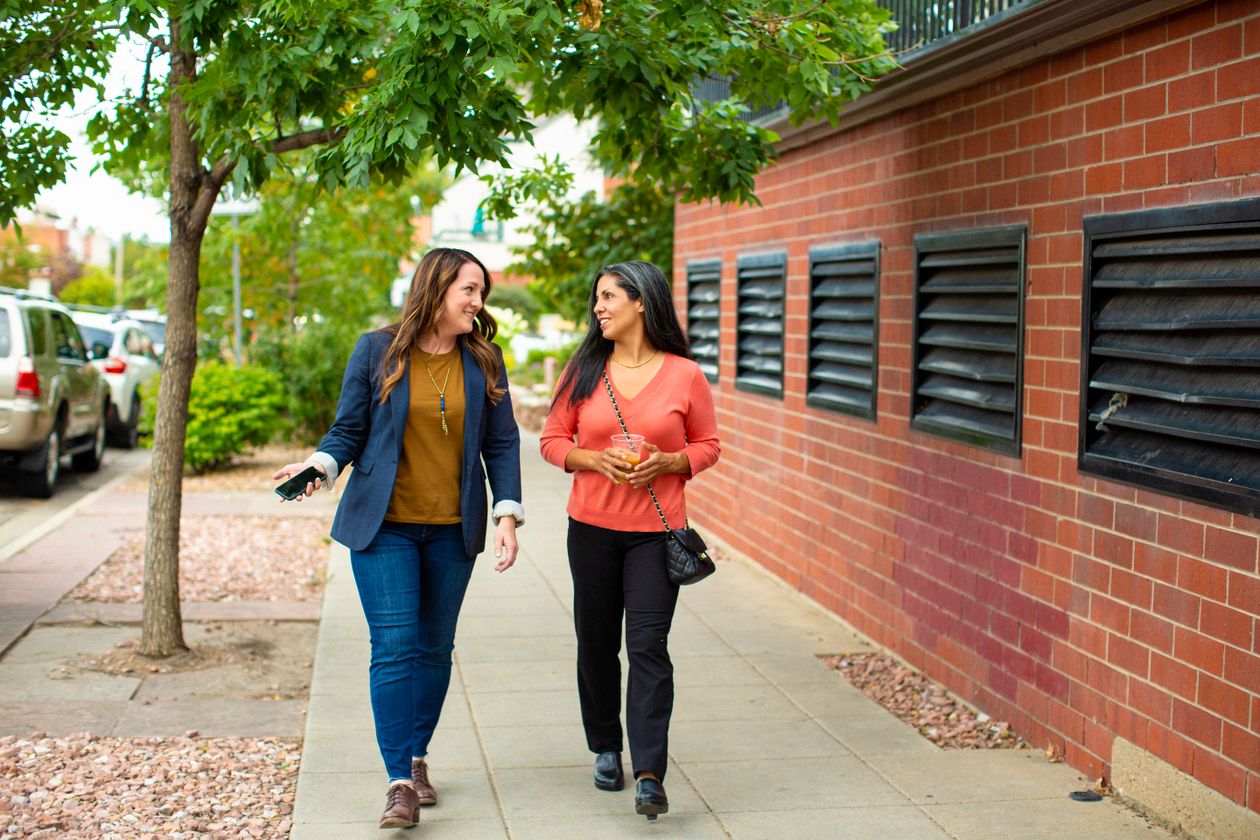 Photo: LinkedIn Sales Navigator, Pexels
Since the research threshold is about how many steps you take, the simplest way to get from a stroll to a brisk walk is to take quicker steps rather than stretching each one longer. Give yourself a few minutes to warm up first, and if you have a heart or lung condition, or you've been told to take it easy, check with your doctor before you push the pace. Then check where you are on a flat stretch:
Brisk walking is the CDC's own example of moderate-intensity activity, and moderate intensity is what the weekly targets are built on. The NHS recommends 150 minutes a week of it for adults, and it notes that a brisk 10-minute daily walk counts towards those 150 minutes. For most people a gentle amble, well under 100 steps a minute and easy enough to sing through, is light activity rather than moderate, so it doesn't fill that target in the same way, though moving at any pace still beats sitting. That's the practical reason to know your brisk pace: it's the difference between a walk the guidelines would count and one they'd call light activity.
A brisk walk is easier to keep up with someone beside you, as long as they're going at the same speed. Walk With Me is a free walking app that shows walks near you on a map, and hosts describe each walk in its title and description, so you can see whether it's a brisk fitness walk before you ask to join, or set up your own and say how fast you plan to go. It's free on the App Store and Google Play.
22 juli 2026 · 6 minuten
Aim for 150 minutes of brisk walking a week: 30 minutes on five days, or about 20 a day. Short walks count. Here's how to split it up.
17 oktober 2026 · 7 minuten
VoiceMap bouwde de beste bibliotheek van verhalenverteller-geleide audiotochten overal. Hier is wat het echt goed doet en waar Walk With Me hetzelfde idee ergens anders brengt.
15 oktober 2026 · 8 minuten
Wat er gebeurt tussen het tikken op Kopen en voor een kathedraal staan met een verhaal in je oren: demo's, gratis stops en offline audio.