
October 11, 2026 · 9 min read
Amsterdam Anne Frank Walking Tour
From the Hollandsche Schouwburg through the old Jewish Quarter, past the Dockworker and the Dam, to the Anne Frank House on the Prinsengracht.
589

October 11, 2026 · 14 min read

 Friends walk free
Every tour also runs as a scheduled group walk you can join in the app.
More audio tours in Kyoto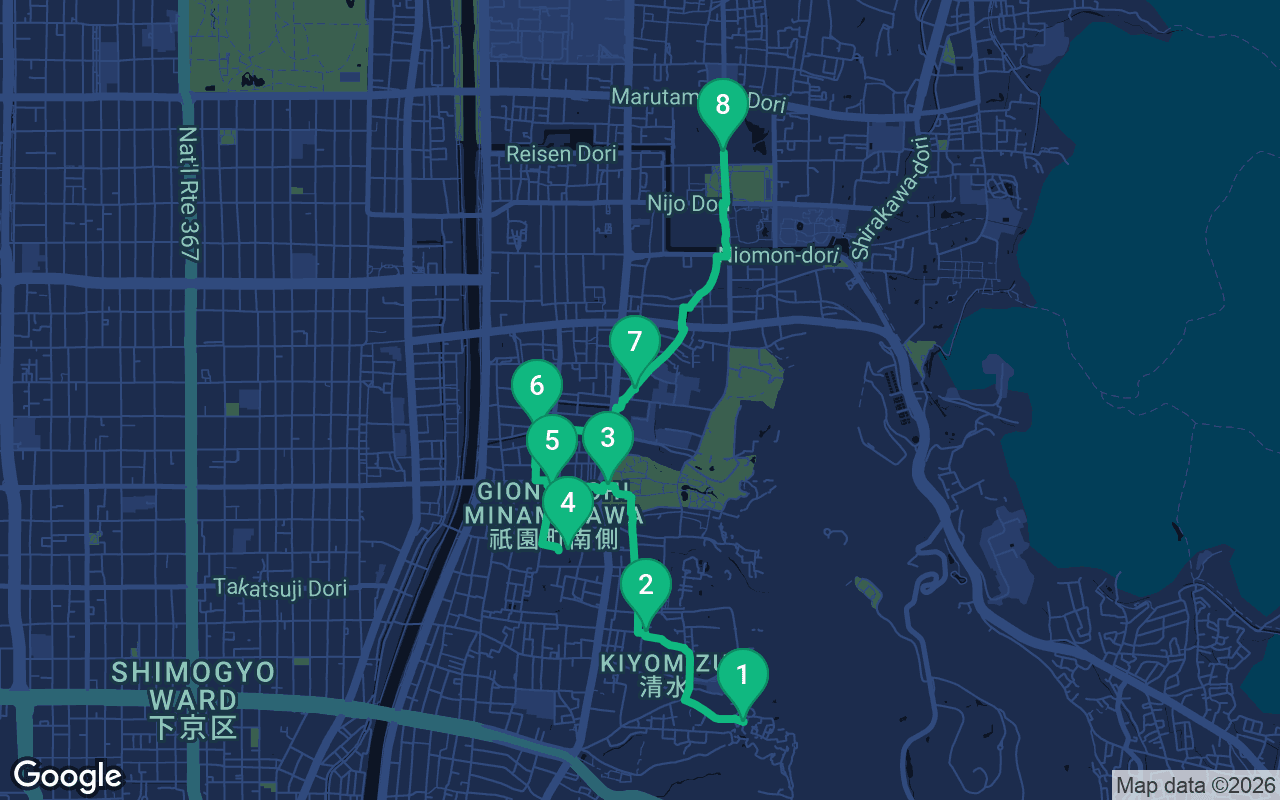
About 4.1 km, roughly 58 minutes at an easy pace.
This tour is narrated
Press play on the first 3 stops for a 30-second demo of the narration. In the app, the intro and those 3 stops play in full for free, each one chiming as you arrive. The whole narrated tour is yours for $15.99, a one-time purchase you keep for good.
Works with Garmin, Komoot, Strava, OS Maps and any GPX app.
In 1929, a nine-year-old girl from a fishing village is taken from her home and brought to Kyoto, to a geisha house in Gion. She will work as a servant, endure a cruel rival, meet a kind stranger by a stream, and spend her life trying to find her way back to him. That's Memoirs of a Geisha, the 1997 novel by Arthur Golden, and the 2005 film by Rob Marshall, with Zhang Ziyi as Sayuri, Ken Watanabe as the Chairman, Michelle Yeoh as Mameha and Gong Li as Hatsumomo. This walk tells Sayuri's story in order, through the real Kyoto behind it. We'll be honest along the way: the book is fiction, most of the film was shot in California, and the real geisha world, and one real geisha in particular, had a lot to say about both. This is an unofficial fan walk, not made with or endorsed by the author, the filmmakers or the studio. It's one of our self-guided walking tours, about 4.1 kilometers from the gate of Kiyomizu-dera down through Gion to Heian Shrine.
Allow two to two and a half hours, with about an hour of walking. The start is the steepest part: Kiyomizu-dera sits at the top of crowded, sloping lanes with stone steps, and from Keihan Kiyomizu-Gojo station it's roughly a 20-minute uphill walk. City buses stop on Higashioji-dori below the temple, so check current routes. After that the walk runs mostly downhill and then flat, ending about ten minutes from Higashiyama subway station. Go early in the morning if you can, before the lanes fill. The temple's main hall and the garden at Heian Shrine charge entry, so check before you go. Most important of all: Gion is a working neighborhood, and the geiko and maiko you may see, Kyoto's words for geisha and their apprentices, are working women, many of them in their teens. Since 2019, photography has been banned on Gion's private lanes, with signs warning of a 10,000 yen fine, and since April 2024 one district has asked visitors not to enter its private alleys at all. This walk keeps to public streets. Never chase, block or photograph a geiko or maiko.
You're at the Niomon, the bright vermilion main gate of Kiyomizu-dera, at the top of the lane called Kiyomizu-zaka. Turn around and look back down the slope, over the rooftops of the old city. Somewhere down there is Gion, where our story lives.
Before the story, a confession, because this walk is about the real Kyoto. Most of Memoirs of a Geisha was not filmed in Japan. The production built an entire geisha district, with streets and even a river, on a ranch in Ventura County, California, and shot much of the rest on soundstages in Los Angeles, at the Sony lot in Culver City. Filming ran from the autumn of 2004 into early 2005. The production said Japan's real geisha districts had too many modern elements for the period.
But the crew did come to Kyoto, for real temples, and this was one of them. Kiyomizu-dera is a temple to Kannon, the Buddhist figure of compassion, on the slopes of Mount Otowa. It was founded more than 1,250 years ago, and its main buildings were rebuilt in 1633. Look for the three-story pagoda here. In the film it shows up only in brief shots, between scenes, to mark the passing of a day or a season.
The film had its world premiere in Tokyo on the 29th of November, 2005, and the reaction in Japan was mixed. Keep that in mind as we go. This is a famous story about Kyoto, told mostly from outside it.
Now let's bring a little girl to the city. Walk back down Kiyomizu-zaka, follow the signs down the stone steps of Sannenzaka, and keep going downhill to Yasaka-dori and the tall wooden pagoda. About ten minutes.
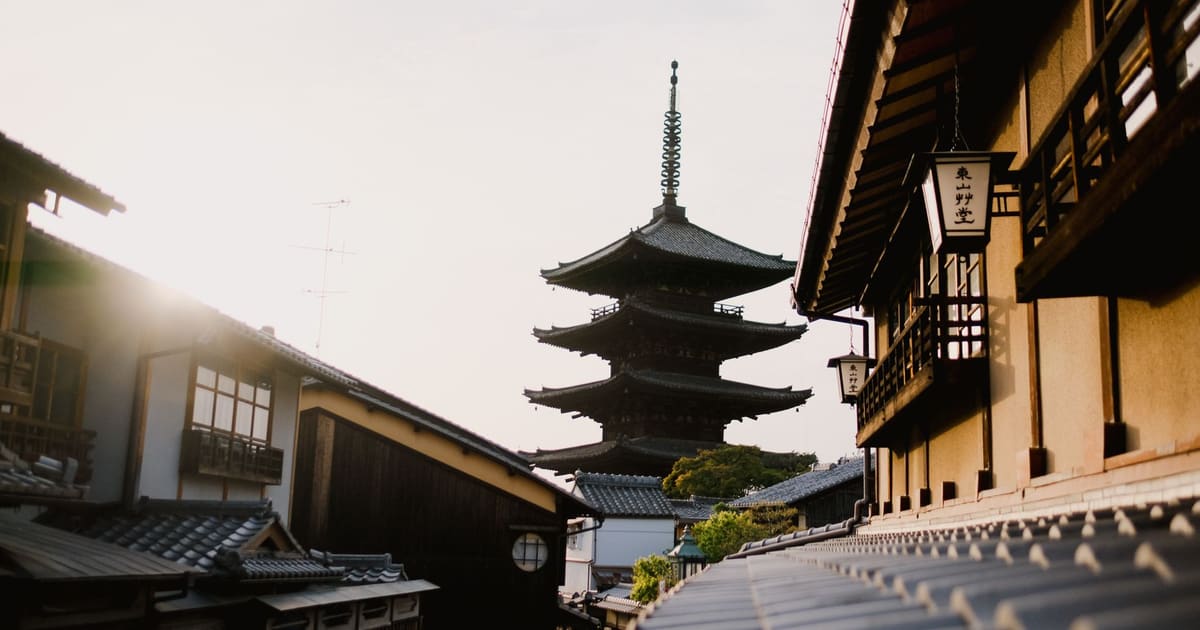
You're looking at the Yasaka Pagoda, five stories of wood rising about 46 meters above the lanes. Find the spot on Yasaka-dori where the street slopes up toward it, and the pagoda fills the end of the view. That's the picture the film keeps coming back to.
Kyoto City's own guide to film locations lists Yasaka-dori and this pagoda for Memoirs of a Geisha, saying it appears again and again in the film as a Kyoto scene. It's one of five places in the city that Kyoto names for the film: this street, the Heian Shrine garden where we end, the bamboo grove of Sagano, where Sayuri rides by car to a cherry-blossom party, and two more far from this walk, which you'll hear about at the next stop.
This is where our story begins. In 1929, nine-year-old Chiyo Sakamoto is taken from Yoroido, a fishing village by the sea, and brought to Kyoto. She and her sister are sold away from home, and the sisters are separated. Chiyo is taken to an okiya, a geisha house, in Gion, where she'll work as a servant. She arrives knowing no one. Picture a child seeing a city like this for the first time, all slopes and tiled roofs and wooden towers.
The pagoda was already old when Chiyo's story was set. It's part of a temple called Hokan-ji, and it was rebuilt in 1440 by the shogun Ashikaga Yoshinori. Today it's an Important Cultural Property, one of Kyoto's best-known silhouettes.
In the okiya, Chiyo's life is hard. The house's star geisha, Hatsumomo, is beautiful and vicious, and she torments the new girl. Chiyo is a servant, at the bottom of the house.
Then, one day, a stranger is kind to her. Head down Yasaka-dori to Higashioji-dori, then walk north to the Shijo crossing, where the shrine's vermilion west gate looks down Shijo-dori. About ten minutes.
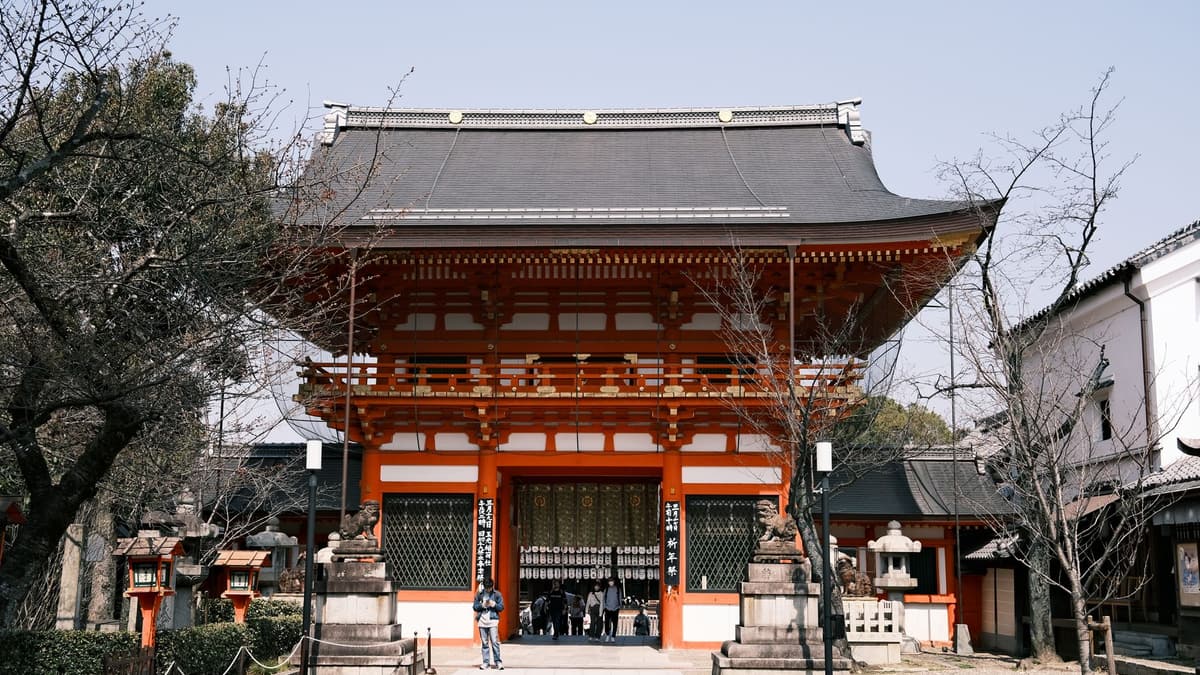
You're at the west gate of Yasaka Shrine, the vermilion gate looking down the length of Shijo-dori. This is Gion's own shrine. In fact, the district grew up around it.
The shrine used to be called Gion-sha, the Gion Shrine. It was renamed Yasaka in 1868, under the order that separated Shinto from Buddhism. Its famous summer festival, the Gion Matsuri, goes back to a ritual held in 869 to ward off an epidemic. And the pleasure quarter of Gion grew up to serve the shrine's pilgrims. Its main hall has been a National Treasure since 2020.
Now the turning point of Chiyo's life. In the novel, she's crying by the Shirakawa, a little stream in Gion. You'll stand by that stream later on this walk. A man stops, and he's kind to her. In the film he buys her a shaved ice, and he gives her his handkerchief, with some coins. In the story he's called the Chairman.
That small kindness changes everything. Chiyo makes a vow: she'll become a geisha, so that one day she can enter his world and see him again. In the film, she prays at a shrine, then runs through a long tunnel of red torii gates.
Here's the honest part. Those scenes weren't filmed here. Kyoto City says the prayer was shot at Yoshimine-dera, a temple in the western hills, and the run through the gates at Fushimi Inari Taisha, in the south of the city. Those are two more of Kyoto's five film locations, and both make good trips for another day.
Next, the training that turns Chiyo into Sayuri. Cross Higashioji-dori and walk west along Shijo-dori to Hanamikoji, then turn left and follow Hanamikoji south to the wooden theater near its end. Keep to the main street. About six minutes.
What's included
Our tours are made to be meditative and immersive: you keep moving and simply listen. They're always better together, and the app plays the narration in sync, so you, your partner and your friends hear every stop at the same moment.
You're at the Gion Kobu Kaburenjo, the wooden theater at the southern end of Hanamikoji. Look at its long wooden front.
The rest of this stop is in the full audio tour.
You're at the Ichiriki, the red-walled teahouse on the corner of Shijo-dori and Hanamikoji. You can only see it from outside.
The rest of this stop is in the full audio tour.
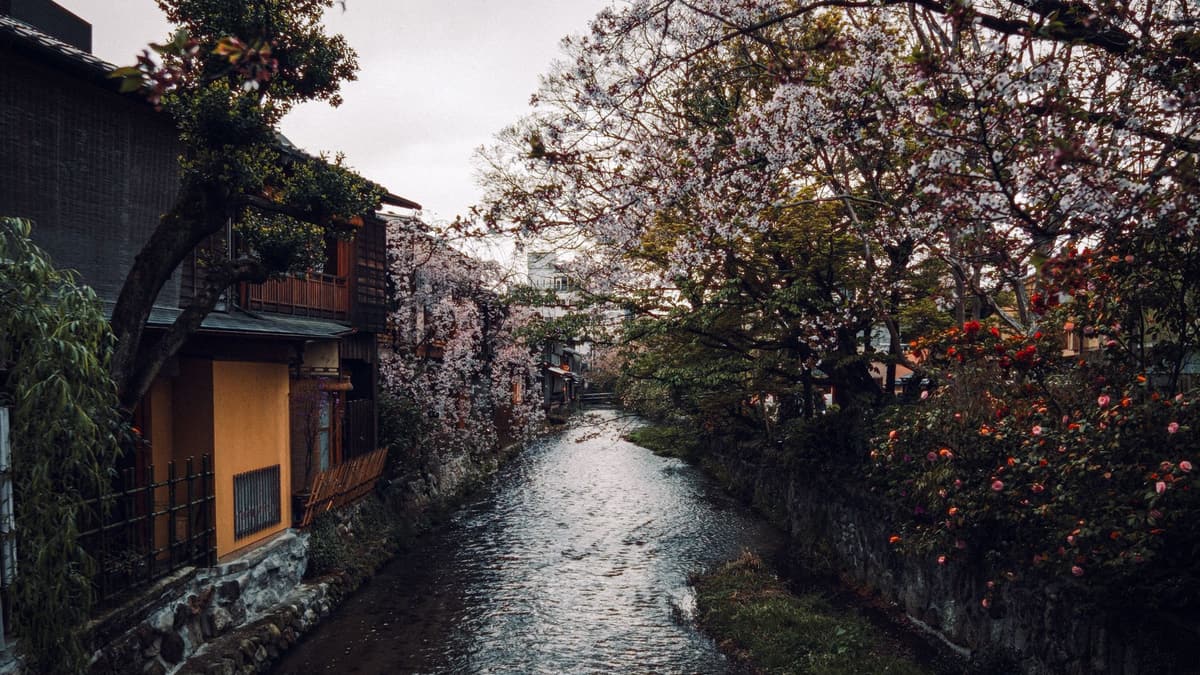
You're at Tatsumi Bridge, a small bridge over the Shirakawa canal, beside the little Tatsumi Daimyojin shrine, a shrine that neighborhood geisha are known to visit. Look along the water at the willows and the stone paving.
The rest of this stop is in the full audio tour.
You're at Gyoja-bashi, also called Ippon-bashi, a bridge of narrow granite slabs across the Shirakawa. It's only about 60 centimeters wide and nearly 12 meters long, with no handrails, built in 1907.
The rest of this stop is in the full audio tour.
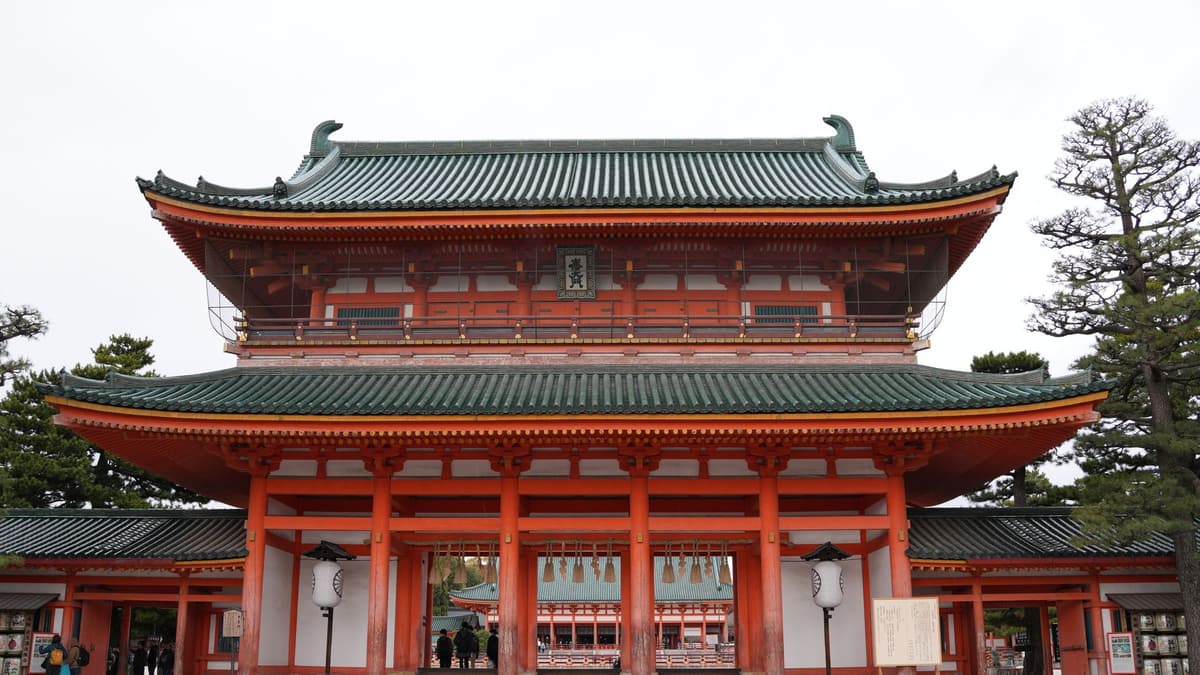
You're at the Otenmon, the vermilion main gate of Heian Shrine. The shrine was founded in 1895, and its grounds are free.
The rest of this stop is in the full audio tour.
Do this walk with other people on the next scheduled tour.
About 4.1 km, roughly 58 minutes at an easy pace · 8 stops
Friends walk freeOctober 11, 2026 · 9 min read
From the Hollandsche Schouwburg through the old Jewish Quarter, past the Dockworker and the Dam, to the Anne Frank House on the Prinsengracht.
October 11, 2026 · 11 min read
From Van Houten's street by the Vondelpark past Leidseplein, the Rijksmuseum passage and the famous canal bench to the Anne Frank House.

October 11, 2026 · 10 min read
Follow the last days of April and May 1945 from the Anhalter Bahnhof ruin past the Gestapo site and Brandenburg Gate to the Moltke Bridge and the Reichstag.
