
October 11, 2026 · 9 min read
Amsterdam Anne Frank Walking Tour
From the Hollandsche Schouwburg through the old Jewish Quarter, past the Dockworker and the Dam, to the Anne Frank House on the Prinsengracht.
589

October 11, 2026 · 14 min read

 Friends walk free
Every tour also runs as a scheduled group walk you can join in the app.
More audio tours in New York City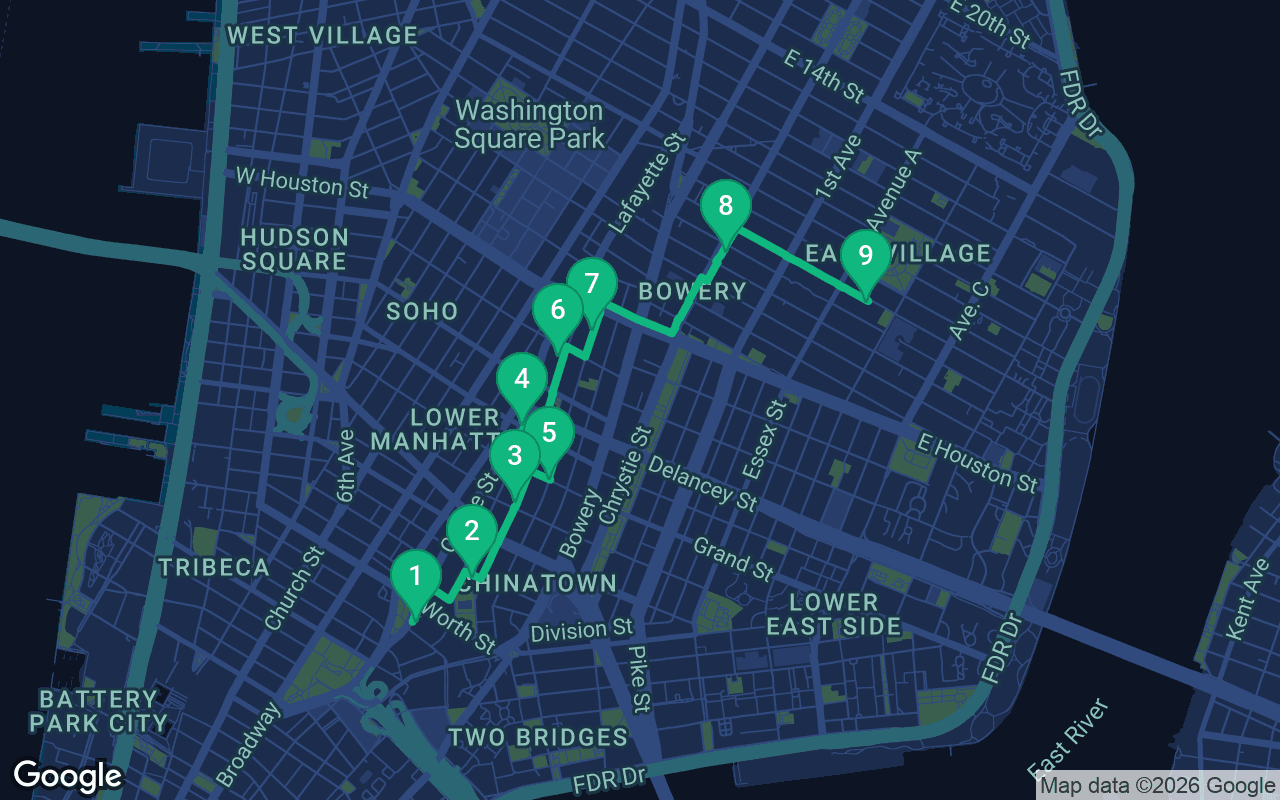
About 3.5 km, roughly 49 minutes at an easy pace.
This tour is narrated
Press play on the first 3 stops for a 30-second demo of the narration. In the app, the intro and those 3 stops play in full for free, each one chiming as you arrive. The whole narrated tour is yours for $15.99, a one-time purchase you keep for good.
Works with Garmin, Komoot, Strava, OS Maps and any GPX app.
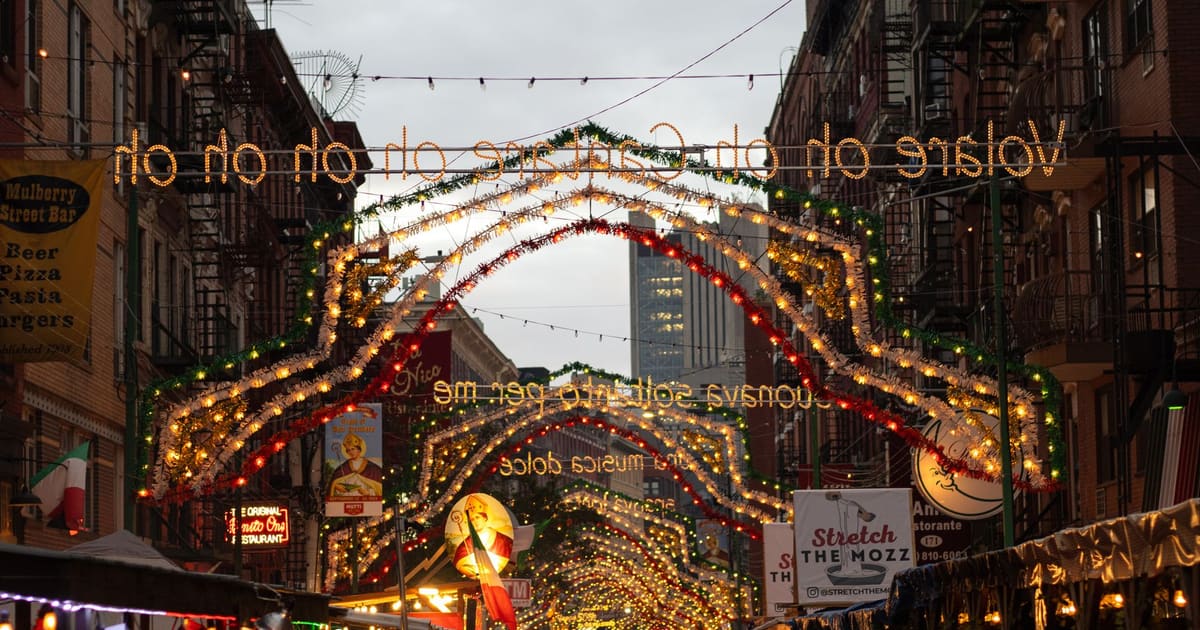
A man walks down a flight of courthouse steps, and a gunman is waiting. Across the city, at the same moment, a baby is being baptized, and the child's godfather, Michael Corleone, is standing at the font promising to renounce Satan while his men kill his rivals. That's the climax of The Godfather, and it starts right where you're standing. This walk sets Francis Ford Coppola's two Godfather films, from 1972 and 1974, against the real history of Little Italy, a few blocks to the north. We begin with that flash-forward, then step back to the 1890s slum where Italian Mulberry Street began, and move forward through the real crimes of the twentieth century, told plainly, with their victims named. Halfway through, we reach the church where Michael stood at the font. And like Part II, we end in the past, on an East Village block dressed as Little Italy in 1917. This is an unofficial walk, not made with or endorsed by the filmmakers or the studio. It's one of our self-guided walking tours, about 3.5 kilometers from Foley Square to East 6th Street.
Allow about an hour and a quarter, with around 50 minutes of walking. The route is flat city sidewalk all the way. The nearest subways to the start are Brooklyn Bridge-City Hall on the 4, 5 and 6, and Chambers Street on the J and Z, both at Foley Square. At the end, the 2 Av station on the F line is about five minutes west. Mulberry Street is lined with restaurants, and in September the Feast of San Gennaro fills it for 11 days, so pick your time according to whether you want the crowds. Old St. Patrick's is a working church, so check its opening times before you go and be quiet inside if there's a service. A word on tone. This walk talks about real murders, and real families who lived with them. They're told soberly here. The great majority of the people of Little Italy were never criminals, and it's their neighborhood we're walking through.
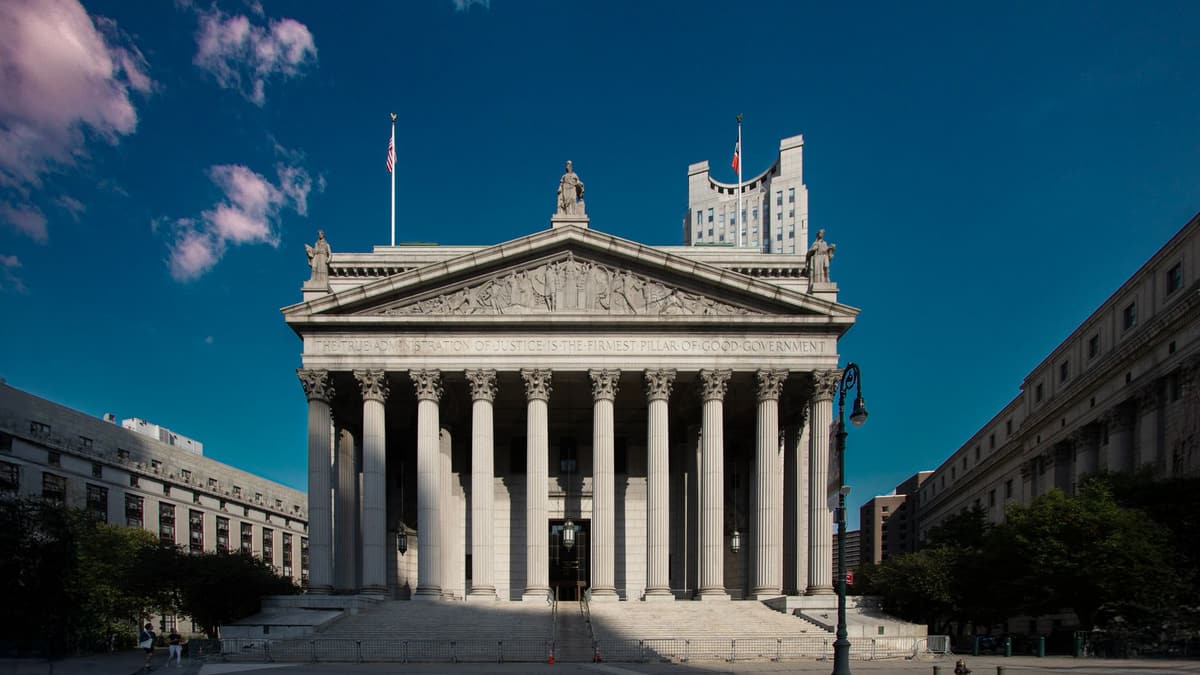
You're at Foley Square, facing the New York County Courthouse. It's the six-sided building by the architect Guy Lowell, opened in 1927, and it's now the New York State Supreme Court. Look at the wide steps and the columned portico facing the square.
In the film, this is the flash-forward we started with. During the baptism, Michael's men take out the heads of the rival families, one after another, while the ceremony goes on. One of them, Barzini, is shot here, on these courthouse steps.
The Godfather premiered in New York on the 14th of March, 1972, and opened in theaters here the next day. It's worth knowing something about how it was made. After protests from Italian-American groups, the producer, Albert Ruddy, announced in March 1971 that the words Mafia and Cosa Nostra would be removed from the script. Watch the film again and you won't hear either word.
That's a useful thing to carry into Little Italy. The film is fiction. The neighborhood is real, and so were the people who lived there, most of whom were never criminals.
Hold on to the baptism. We'll reach the church where it was filmed later on. First, the walk goes back more than a century, to where Italian Mulberry Street began. With your back to the steps, walk north along Centre Street to Worth Street, then turn right and head east along Worth. Columbus Park opens on your left. About four minutes.
You're in Columbus Park, today the busiest park in Chinatown. On a good day you'll see people practicing tai chi, playing Chinese chess and making music. It's the neighborhood's living room.
Now step back to the late 1800s. This was the Mulberry Bend, part of the old Five Points, a slum of tenements where the bend in Mulberry Street ran. The Bend's earlier residents had been Irish. Over time, Italian immigrants replaced them.
Jacob Riis campaigned against the Bend, and the city finally tore the tenements down in the 1890s. In 1897 Mulberry Bend Park opened here, designed by Calvert Vaux. In 1911 it was renamed Columbus Park.
So the park where you're standing is a kind of ending. A slum was cleared to make it. But the Italian community didn't vanish. It moved up the street. Look north from the park's eastern edge, along Mulberry Street. That's the street this walk follows, and it's where Italian New York grew.
It grew into a neighborhood with its own church, bakeries and festival. It also had its criminals. The next stops tell both stories, and it's worth remembering that the first was much bigger than the second.
Today, the neighborhood has changed again. In 2011, a Census survey reported by the New York Times found that only about 5 percent of the area's 8,600 residents were Italian-American, against nearly half in 1950, and it found no residents born in Italy at all. You'll often hear that Chinatown took over Little Italy. That's not really what happened. Most Italian families moved out over the years, as they did better, sold up and later faced rising rents.
Walk north up Mulberry Street, past Bayard Street and Canal Street, to the corner of Hester Street. Stop at number 129, on the corner. About five minutes.
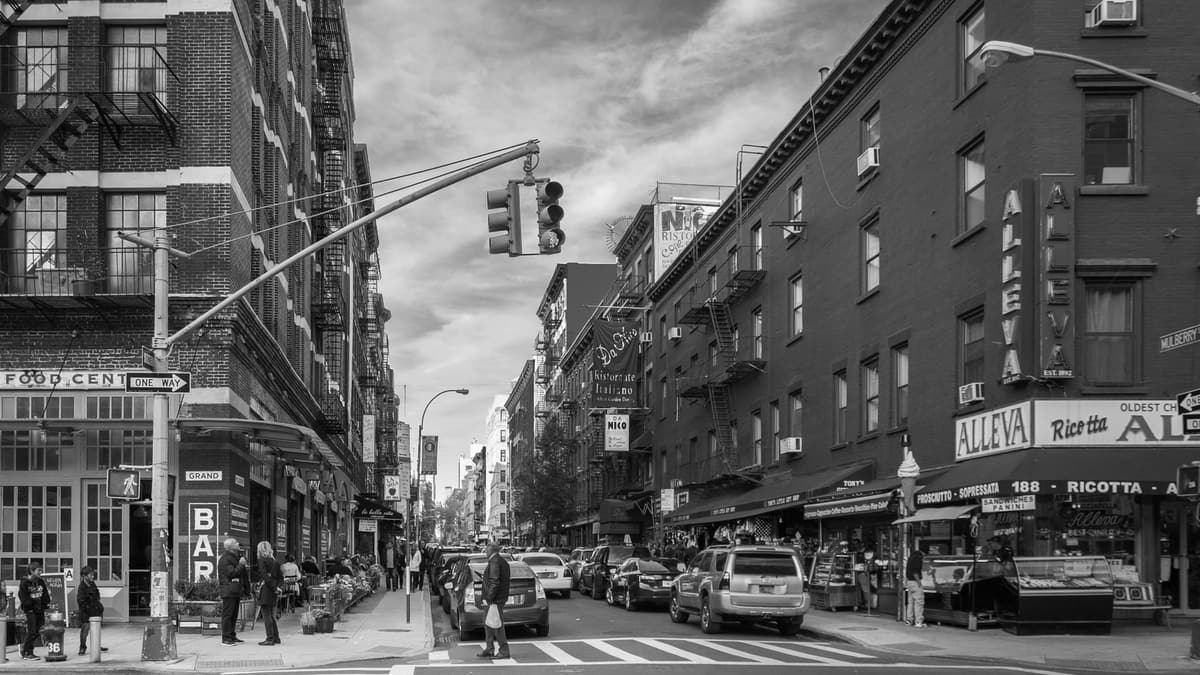
You're at the corner of Mulberry and Hester, at number 129. This is the heart of what's left of Little Italy. Every September, this street fills for the Feast of San Gennaro. It began in 1926 as a one-day street party held by immigrants from Naples, and today it runs for 11 days along Mulberry Street from Canal to Houston.
Now to April 1972. In those days, Umberto's Clam House stood here, at 129. On the 7th of April, the gangster Joey Gallo was here celebrating his 43rd birthday with his family. His wife and stepdaughter were with him at the table. A gunman opened fire. Gallo was hit, and he died in the street outside.
It was three weeks after The Godfather opened in theaters. A film about gangsters was still new on the screens when a real killing happened on this corner.
No one was ever charged. Nicholas Gage, a reporter for the New York Times, later named a suspect in his reporting, and Gallo's bodyguard backed that view. But it never went to court. You may have heard the claim, told in The Irishman, that Frank Sheeran was the killer. That claim isn't proven. Witnesses described a short, stocky gunman, and Sheeran was about six foot four. The Times reporter who covered the killing called the story fabricated.
You'll also hear that Gallo was shot across the street, at Umberto's current address. That's another mistake. Umberto's moved several times after 1972, and it's been at 132 Mulberry, opposite, since 2010. The shooting happened here, at 129, which is now home to a different restaurant.
Take a moment, then walk west along Hester Street to Centre Street, and turn right, north, up Centre Street. The big building with the gilded dome, between Grand and Broome Streets, is your next stop. About five minutes.
What's included
Our tours are made to be meditative and immersive: you keep moving and simply listen. They're always better together, and the app plays the narration in sync, so you, your partner and your friends hear every stop at the same moment.
You're at 240 Centre Street. Look up at the gilded dome.
The rest of this stop is in the full audio tour.
You're on Mott Street, just south of Grand. Look for number 128, the Mietz Building.
The rest of this stop is in the full audio tour.
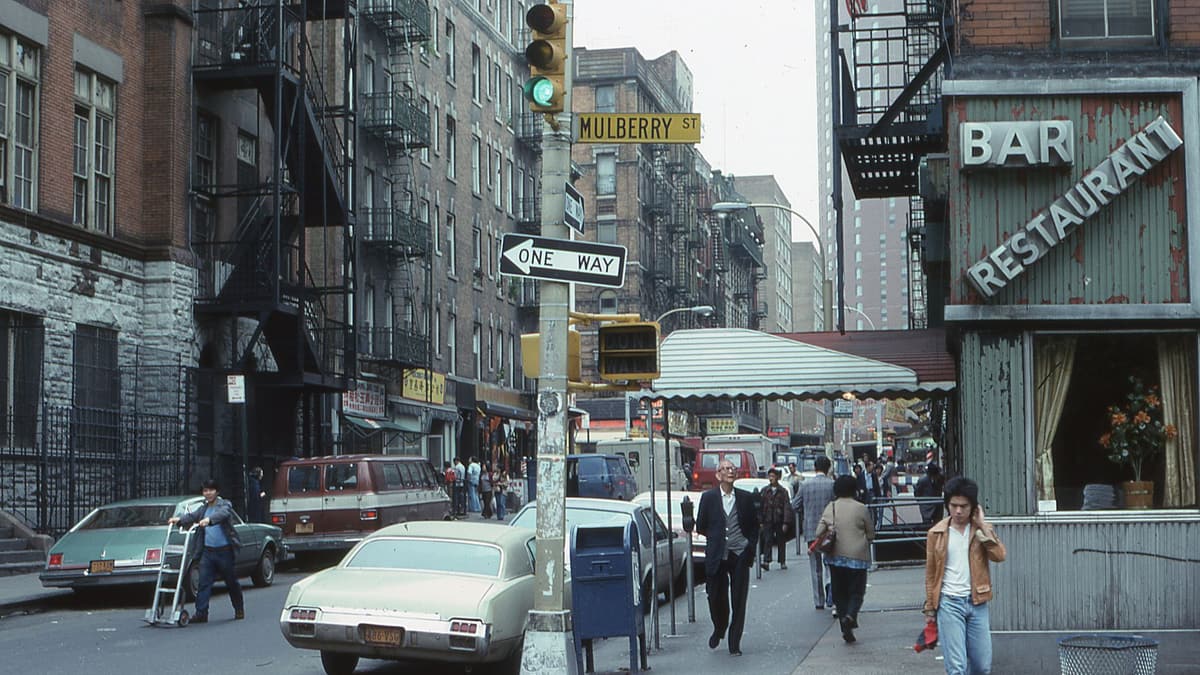
You're at 247 Mulberry Street. Today it's an ordinary shop, with no sign of its past.
The rest of this stop is in the full audio tour.
Stand on Mott Street, in front of the main entrance. This is Old St. Patrick's, the first Catholic cathedral in New York.
The rest of this stop is in the full audio tour.
You're on Second Avenue at East 5th Street, in the East Village. Look for number 80 Second Avenue, just here.
The rest of this stop is in the full audio tour.
You're on East 6th Street, between Avenues A and B. Look for the old tenements at numbers 519 to 531.
The rest of this stop is in the full audio tour.
Do this walk with other people on the next scheduled tour.
About 3.5 km, roughly 49 minutes at an easy pace · 9 stops
Friends walk freeOctober 11, 2026 · 9 min read
From the Hollandsche Schouwburg through the old Jewish Quarter, past the Dockworker and the Dam, to the Anne Frank House on the Prinsengracht.
October 11, 2026 · 11 min read
From Van Houten's street by the Vondelpark past Leidseplein, the Rijksmuseum passage and the famous canal bench to the Anne Frank House.

October 11, 2026 · 10 min read
Follow the last days of April and May 1945 from the Anhalter Bahnhof ruin past the Gestapo site and Brandenburg Gate to the Moltke Bridge and the Reichstag.
