
October 11, 2026 · 9 min read
Amsterdam Anne Frank Walking Tour
From the Hollandsche Schouwburg through the old Jewish Quarter, past the Dockworker and the Dam, to the Anne Frank House on the Prinsengracht.
589

October 10, 2026 · 10 min read

 Friends walk free
Every tour also runs as a scheduled group walk you can join in the app.
See the Pompeii audio tour page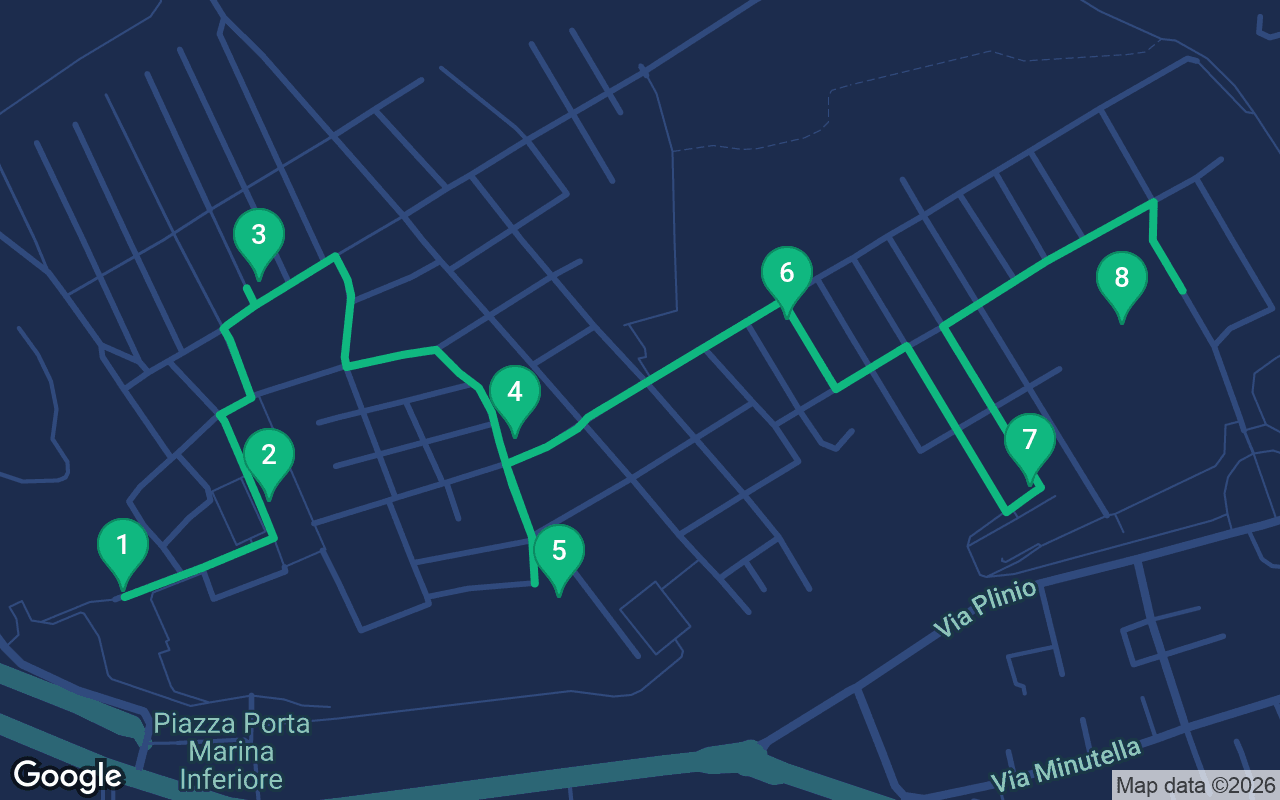
About 2.2 km, roughly 30 minutes at an easy pace.
This tour is narrated
Press play on the first 3 stops for a 30-second demo of the narration. In the app, the intro and those 3 stops play in full for free, each one chiming as you arrive. The whole narrated tour is yours for $14.99, a one-time purchase you keep for good.
Works with Garmin, Komoot, Strava, OS Maps and any GPX app.
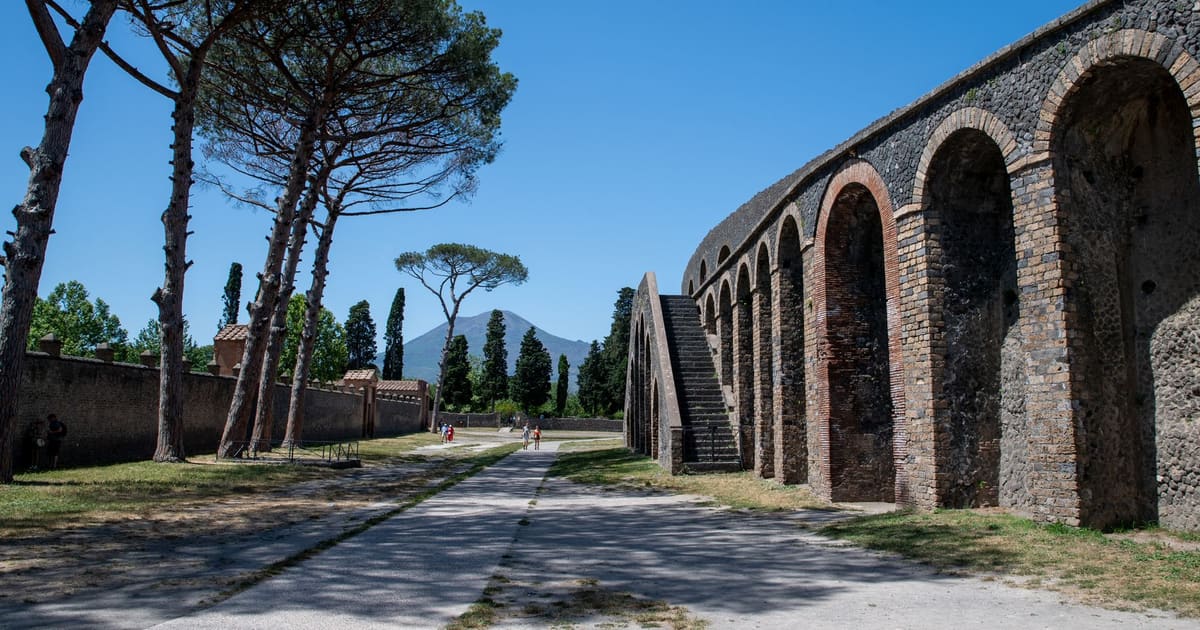
This walk tells one story, in the order it happened: the last two days of Pompeii. You start on an ordinary morning at the western gate, Porta Marina, and cross the Forum. Then a strange cloud rises, stone falls through a long night, and on the second morning something deadlier sweeps the streets. You finish in the Large Palaestra by the amphitheatre, where casts of the victims are kept today as a memorial. Unlike most self-guided walking tours, this one lies entirely inside the excavated Roman city, about 2.2 kilometers on the map. These were real people, and we will tell their story plainly.
The whole walk is inside the Archaeological Park of Pompeii, which is ticketed. Tickets and opening hours change by season, so check before you go. Allow two to three hours. Start at the Porta Marina entrance, by the Pompei Scavi Villa dei Misteri stop on the Circumvesuviana's Naples to Sorrento line. You finish at the Piazza Anfiteatro exit, served by the Pompei Santuario stop on its Naples to Poggiomarino line. Wear sturdy shoes: the Roman paving is uneven, and the climb from the gate is steep. Shade is scarce, so bring water and a hat. Buildings open and close for works, so check the Park's list of open buildings on the day.
You're at the western gate of Pompeii, climbing up from the modern entrance. Look at the two barrel-vaulted passages: the larger one for horses and pack animals, the smaller one for people on foot. The gate in its present form dates to around 80 BC, when Rome settled a colony here. Pompeii sits on a plateau about 30 meters above the sea, and the plateau itself is an old flow of lava from Vesuvius.
In 79 this was a busy town, still under repair. Seventeen years earlier, in AD 62, a severe earthquake had shaken it, and buildings all over the city were still being repaired.
So what day did it all end? No one knows for sure. The oldest manuscripts of a letter by Pliny the Younger, who watched the eruption from across the bay, give a date that works out to the 24th of August. Then in 2018, archaeologists found a charcoal note on a wall here dated the 17th of October, and autumn fruits in the ruins also point to a later date. Many people now say the 24th of October. But in 2024 the Park's own study found that date has no documentary basis, and that there is not enough evidence to rule out August. The question is open, so we will simply say day one and day two.
Walk up through the gate and follow the road uphill, east, into the town. The Forum is about two minutes ahead.
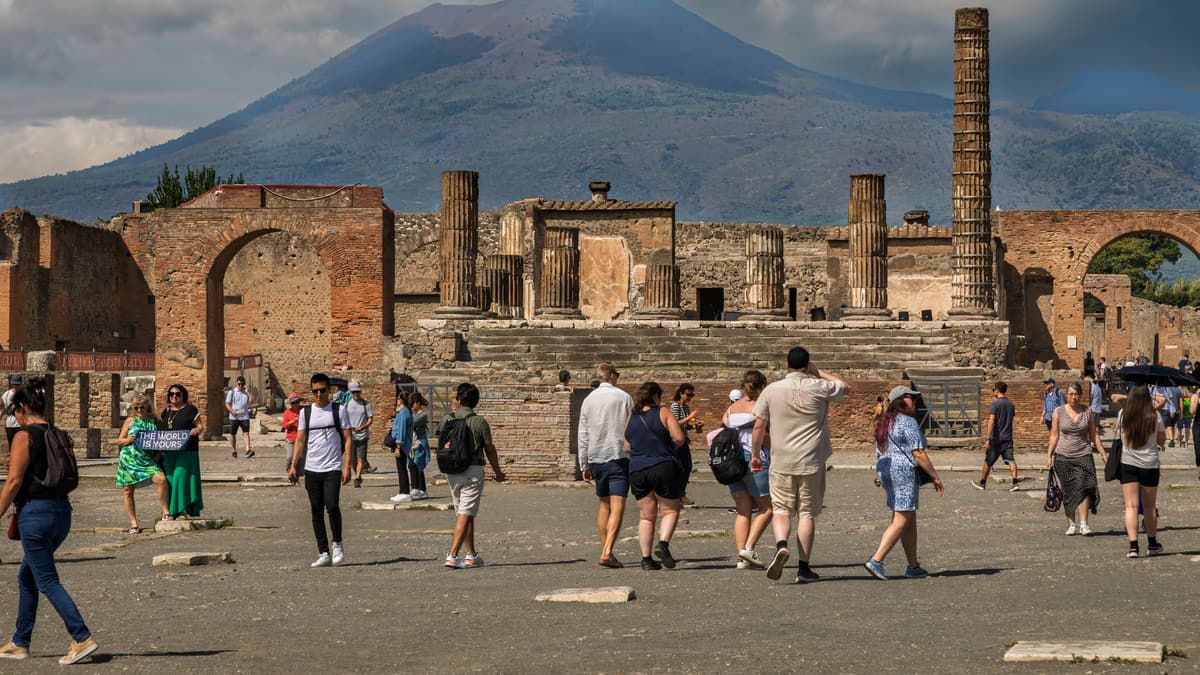
You're in the long open square at the heart of Pompeii. Face north. On its high podium at the far end stands the Temple of Jupiter, and behind it, framed between the columns, rises Vesuvius. After 80 BC this became the town's Capitolium, a temple to three gods together, Jupiter, Juno and Minerva.
Picture it on a working morning, with the mountain standing over it as it always had.
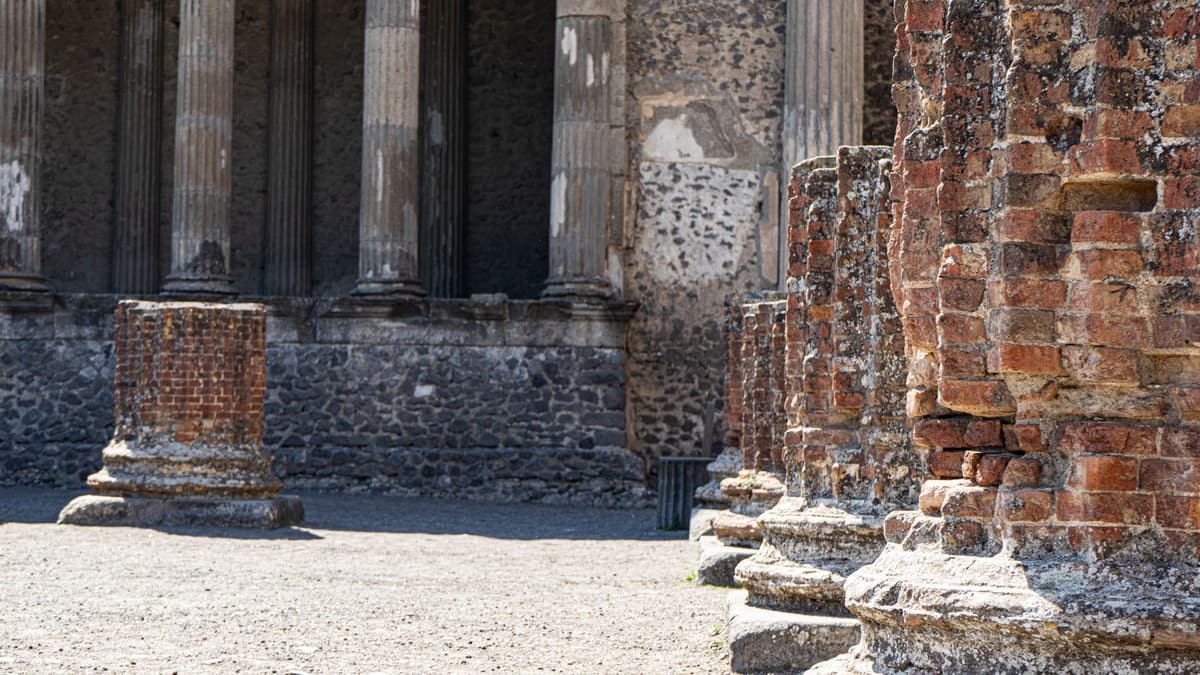
Along the west side, to your left as you face the temple, are the Forum Granaries. They were built after the earthquake of 62 and may not have been finished by 79. Today they are the city's main archaeological storeroom, holding more than nine thousand finds, among them casts of victims and the cast of a dog. At the time of writing, though, the Granaries are closed to view while they are refitted, so you may not see inside.
Walk north past the temple, out of the square, and follow the signs to the House of the Faun, about three minutes away.
 You're at the door of one of the largest houses in Pompeii. Look down: set into the pavement is the Latin greeting HAVE, welcome. The house fills an entire city block, about three thousand square meters, laid out in the second century BC. In the pool of the main atrium stands a copy of the dancing faun that named the house. The original, and the great mosaic of Alexander the Great whose copy lies deeper inside, are in the National Archaeological Museum in Naples.
Now the story turns. On day one, across the bay at Misenum, was Pliny the Elder, commander of the Roman fleet. His nephew, Pliny the Younger, later described the moment in a letter. At about the seventh hour, early in the afternoon, his mother pointed out a cloud of unusual size and shape. It looked most like a pine tree, he wrote, rising on a long trunk and spreading out into branches. Neither Pliny was in these streets that day. What happened here, we know from what the ground has kept.
Leave the house and head south-east, following the signs to the Stabian Baths on Via dell'Abbondanza. It's about four minutes.
What's included
Our tours are made to be meditative and immersive: you keep moving and simply listen. They're always better together, and the app plays the narration in sync, so you, your partner and your friends hear every stop at the same moment.
You're at the Stabian Baths, on Via dell'Abbondanza, the town's main street. Inside are an exercise courtyard, a pool, and the men's changing, cold, warm and hot rooms.
The rest of this stop is in the full audio tour.
You're on one of the oldest sacred sites in Pompeii, the Triangular Forum, on a ridge of lava above the Sarno valley. The worn remains in front of you belong to a Doric temple of the sixth century BC.
The rest of this stop is in the full audio tour.
You're at a Roman street counter, with big storage jars set into its masonry. This was a thermopolium, serving hot food and drink.
The rest of this stop is in the full audio tour.
You're in a walled garden. Before the eruption this plot held houses, later turned into a vineyard.
The rest of this stop is in the full audio tour.
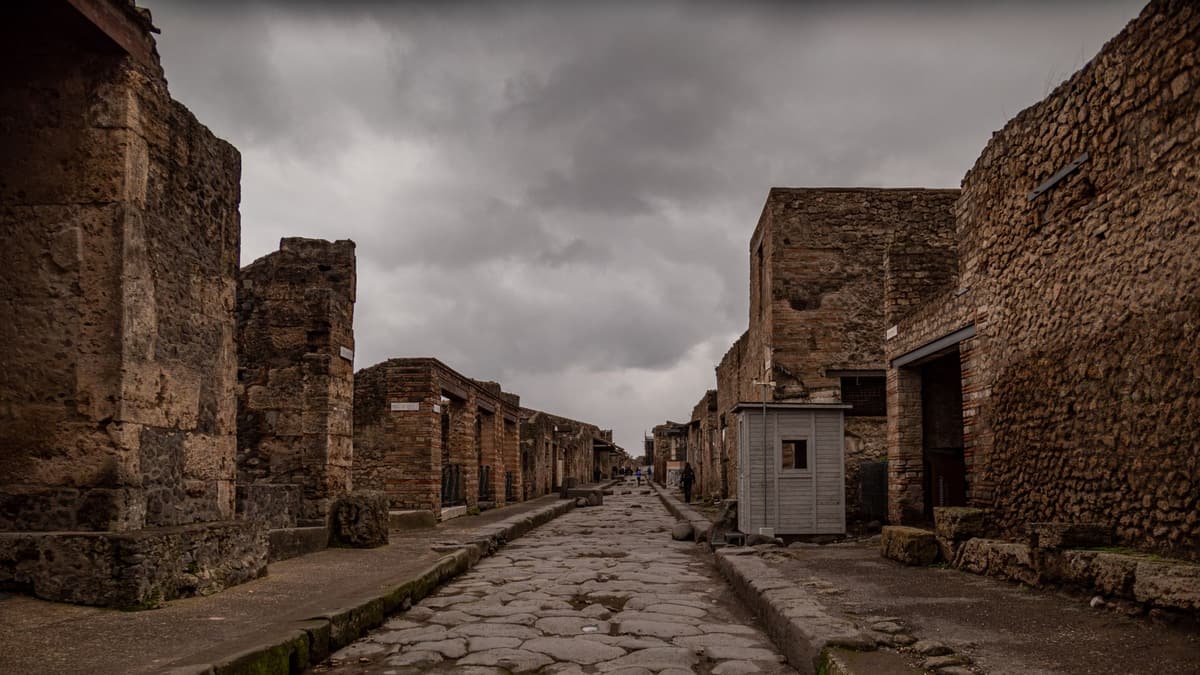
You're at the Large Palaestra, opposite the amphitheatre: a huge exercise ground about 140 meters long, with colonnades on three sides, battlemented walls, and a pool in the middle. It was built under the emperor Augustus for the training of young citizens.
The rest of this stop is in the full audio tour.
Do this walk with other people on the next scheduled tour.
About 2.2 km, roughly 30 minutes at an easy pace · 8 stops
Friends walk freeOctober 11, 2026 · 9 min read
From the Hollandsche Schouwburg through the old Jewish Quarter, past the Dockworker and the Dam, to the Anne Frank House on the Prinsengracht.
October 11, 2026 · 11 min read
From Van Houten's street by the Vondelpark past Leidseplein, the Rijksmuseum passage and the famous canal bench to the Anne Frank House.

October 11, 2026 · 10 min read
Follow the last days of April and May 1945 from the Anhalter Bahnhof ruin past the Gestapo site and Brandenburg Gate to the Moltke Bridge and the Reichstag.
