
October 11, 2026 · 9 min read
Amsterdam Anne Frank Walking Tour
From the Hollandsche Schouwburg through the old Jewish Quarter, past the Dockworker and the Dam, to the Anne Frank House on the Prinsengracht.
589

October 11, 2026 · 13 min read

 Friends walk free
Every tour also runs as a scheduled group walk you can join in the app.
More audio tours in Rome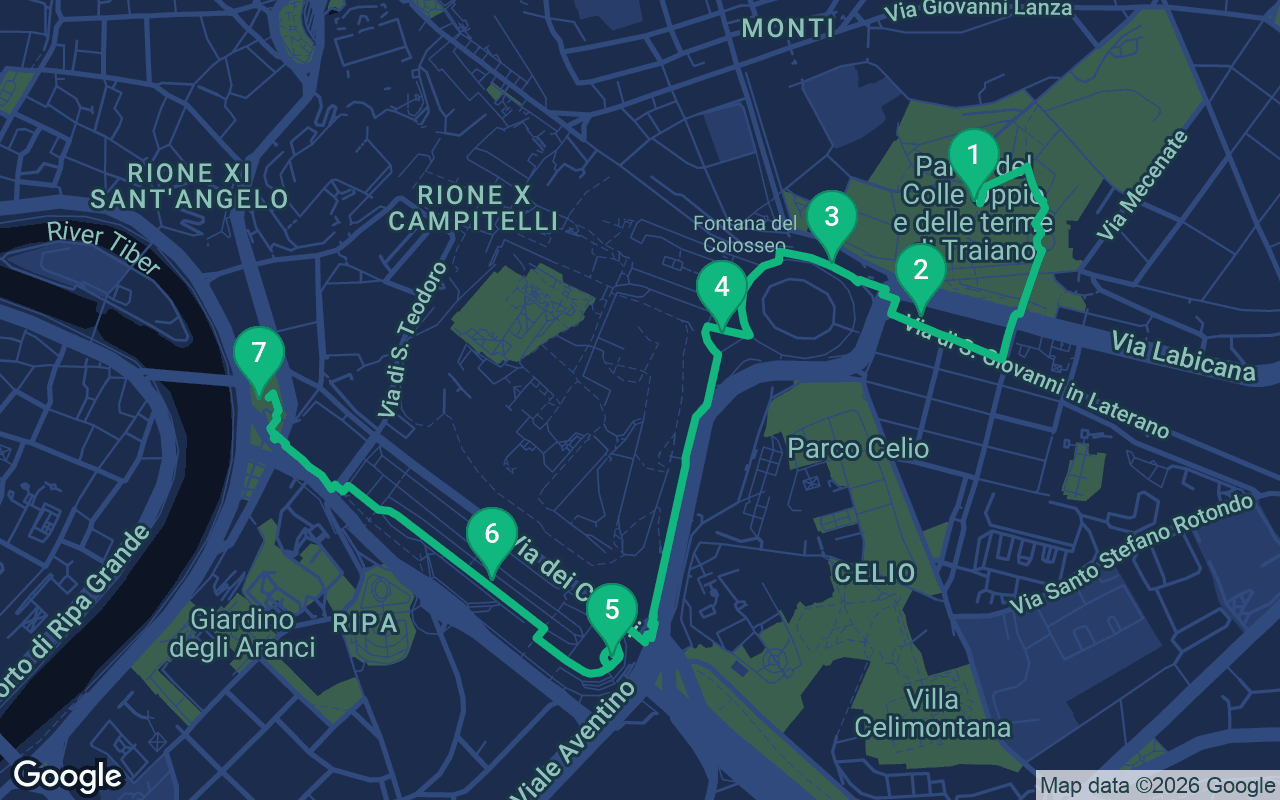
About 3.1 km, roughly 42 minutes at an easy pace.
This tour is narrated
Press play on the first 3 stops for a 30-second demo of the narration. In the app, the intro and those 3 stops play in full for free, each one chiming as you arrive. The whole narrated tour is yours for $14.99, a one-time purchase you keep for good.
Works with Garmin, Komoot, Strava, OS Maps and any GPX app.
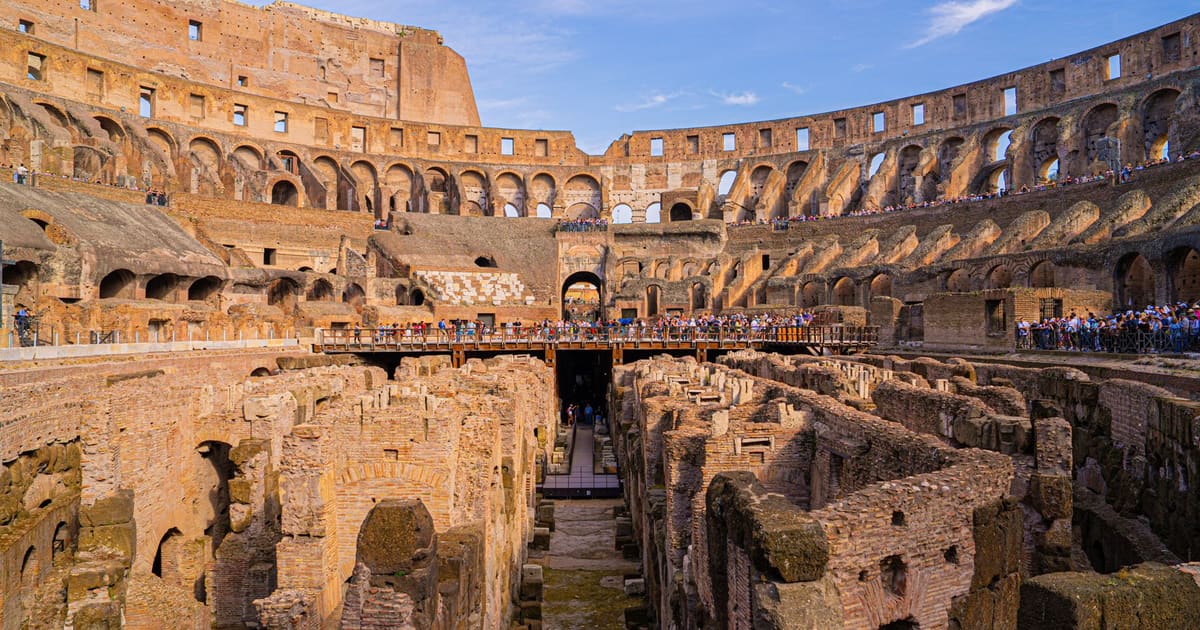
A general turned slave, a jealous young emperor, and a showdown on the sand of the Colosseum. That's the story Ridley Scott told in Gladiator in 2000, and again in Gladiator II in 2024. Here's the twist: neither film was shot in Rome. Both arenas were partial sets built at Fort Ricasoli, on Malta. The real arena is right here, and the real emperor behind the villain is stranger than the films made him. This walk tells the true story the films borrowed, in the order it happened. You'll start with Nero, whose palace lake once filled the valley below the first stop. Then come the emperors who drained it and built the Colosseum, then Commodus, the emperor who really did fight as a gladiator, and then his father, Marcus Aurelius, still carved in stone on a later emperor's arch. You'll learn how Commodus really died, and you'll finish with a jump back in time, to the cattle market where Rome's first gladiator fight was staged. This is an unofficial walk, not made with or endorsed by the filmmakers or the studios. It's one of our self-guided walking tours, about 3.1 kilometers from the Oppian Hill to the Forum Boarium.
The walking itself takes about 42 minutes. With time to stand and look at each stop, allow an hour and a half, or longer if you go inside anything. The nearest Metro to the start is Colosseo, on Line B, about 300 meters away. The walk ends at Piazza della Bocca della Verità, which has buses, and Circo Massimo Metro, also on Line B, is about a kilometer from there.
The route starts on a hill and runs mostly downhill and flat after that. Expect old paving, uneven paths and big crowds around the Colosseum. The Circus Maximus is a wide open field, so in summer go early or late and carry water.
Everything on this walk can be seen from outside, for free. If you want to go in, plan ahead. Colosseum tickets are timed and carry your name, and the arena floor and the underground need special tickets. Visits inside Nero's Golden House run only Friday to Sunday, in timed slots booked online. Prices and hours change, so check before you go.
You're in the park on the Oppian Hill, the Colle Oppio. It looks like an ordinary city park. But under your feet lie the buried rooms of Nero's vast palace. This is the Domus Aurea, Nero's Golden House.
The story the Gladiator films borrowed starts here, with a fire. In the year 64, a great fire burned through Rome. Afterward, Nero's architects, two men named Severus and Celer, built him a new palace, with gardens, woods and vineyards. And down in the valley below this hill, where the Colosseum stands today, they made an artificial lake. In the palace's entrance hall stood a colossal statue of Nero himself, as the Sun god. Hold on to that statue. It comes back later in this story, with a different head.
After Nero, the emperors who followed him filled its rooms with earth and used them as foundations for new buildings. That's why the rooms survive at all, underground and in the dark, beneath the grass of this park.
So when you watch the films' Rome, all marble and crowds, remember what it was built on. The arena where the gladiators fought stands on the bed of Nero's lake.
Next, you'll meet the men who fought there, and where they trained. Leave the park on its southern side, heading downhill toward Via Labicana, and walk to the railings near the spot where Via Labicana and Via di San Giovanni in Laterano split. About four minutes.
You're at the street railings, looking down into an excavation. Below you is the northern half of the Ludus Magnus, the Great School. The other half still lies under the buildings around you. Look for the curved line of a small arena and, around it, rows of identical rooms. Since August 2024 the site has been closed to visits for restoration, so this view from the street is the view everyone gets.
This was the largest gladiator school in Rome. It was built by the emperor Domitian, who ruled from 81 to 96. Most of what you see today is a later rebuilding under the emperor Trajan. The training arena down there had seats for up to 3,000 people, so even training had an audience. Those rows of identical rooms are read as the gladiators' quarters, where the fighters lived. And an underground passage linked the school to the amphitheatre. Nobody knew any of this was here until 1937, when it was found by chance.
The films give their hero a school too, but Maximus is invented. There was no general who became a gladiator and took revenge on an emperor. But the emperor himself was real, and he had his own plans for gladiators' quarters like these. The historian Cassius Dio, a senator who saw Commodus with his own eyes, says that Commodus planned to step out on New Year's Day of the year 193 from the quarters of the gladiators, as both consul and secutor, a type of gladiator. Dio doesn't say which barracks he meant. Perhaps it was this one.
He never got there. To find out why, you first need to see where he fought. Walk west along the street toward the Colosseum, which fills the view ahead, and stop on the north-east side of the square. About three minutes.
You're on the north-east side of Piazza del Colosseo. Take a moment and look up. This is the Flavian Amphitheatre, the building we call the Colosseum. Work on it began under the emperor Vespasian around the year 72, right on top of Nero's lake and gardens, and Titus opened it in the year 80 with 100 days of games. Historians usually estimate it held around 50,000 people.
Even its name probably goes back to Nero. It most likely comes from the Colossus, that giant gilded statue of Nero that ended up standing outside. Its base is gone now, but its outline was marked in the paving across the square.
Now jump forward about a hundred years, to the reign of Commodus. Gladiator makes him the villain. The real man, as Cassius Dio describes him, was stranger still. He did fight in this amphitheatre. And he paid himself for it, drawing a million sesterces a day from the fund for the gladiator shows. Dio was there, among the senators. One day Commodus killed an ostrich, then held up its head and his bloody sword toward the senators, grinning. Dio says that he and others chewed laurel leaves to hide their laughter.
Commodus also went after Nero's Colossus. He had its head cut off and replaced with his own, and gave the statue a club and a lion, so it became Commodus as Hercules. He even ordered Rome itself renamed Commodiana.
As for the films, the 2000 arena at Fort Ricasoli on Malta was about one-third the real size and about 52 feet tall, with the upper tiers added digitally. Gladiator II rebuilt it there. Two famous film details need correcting. No ancient source mentions sharks in this arena. Dio does say Titus staged a sea battle here in the year 80, but some engineers and historians doubt the arena could ever have been flooded. And the thumbs-down signal for death is uncertain. The modern picture of it comes largely from a painting, Jean-Léon Gérôme's Pollice Verso of 1872, the same image Ridley Scott has said hooked him on the project.
Next, Commodus's father. Walk around the south side of the Colosseum to the great triple arch just beyond it, to the south-west. About four minutes.
What's included
Our tours are made to be meditative and immersive: you keep moving and simply listen. They're always better together, and the app plays the narration in sync, so you, your partner and your friends hear every stop at the same moment.
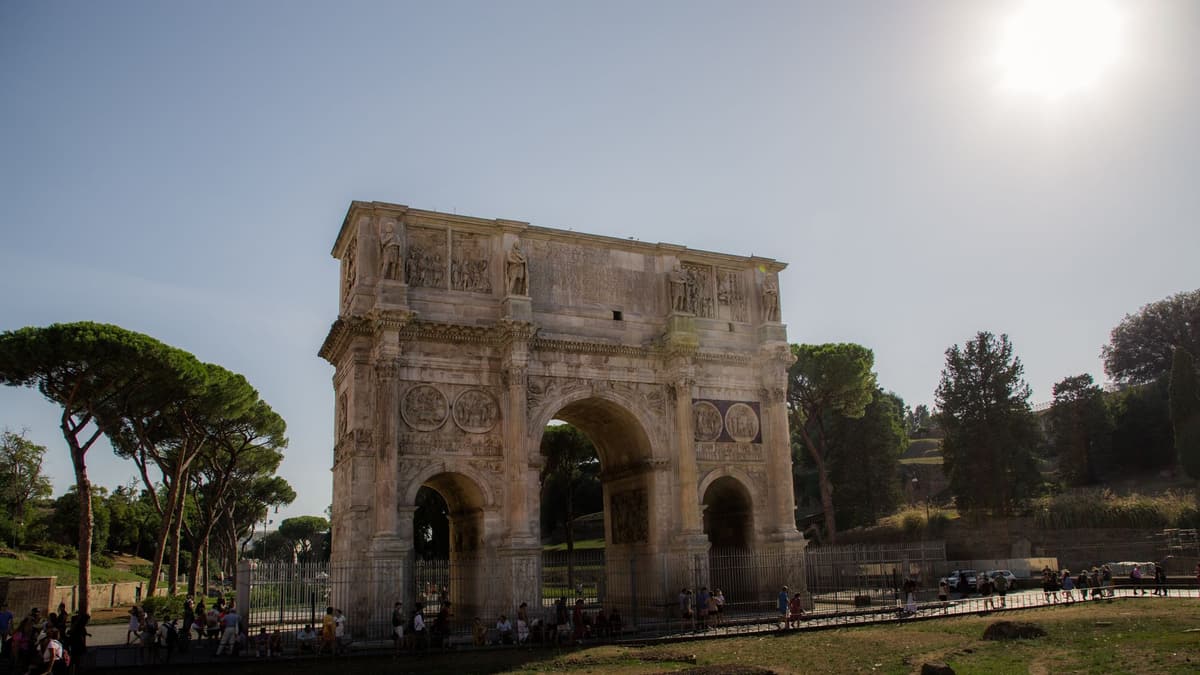
You're at the Arch of Constantine. It's fenced off, but you can walk all the way around it.
The rest of this stop is in the full audio tour.
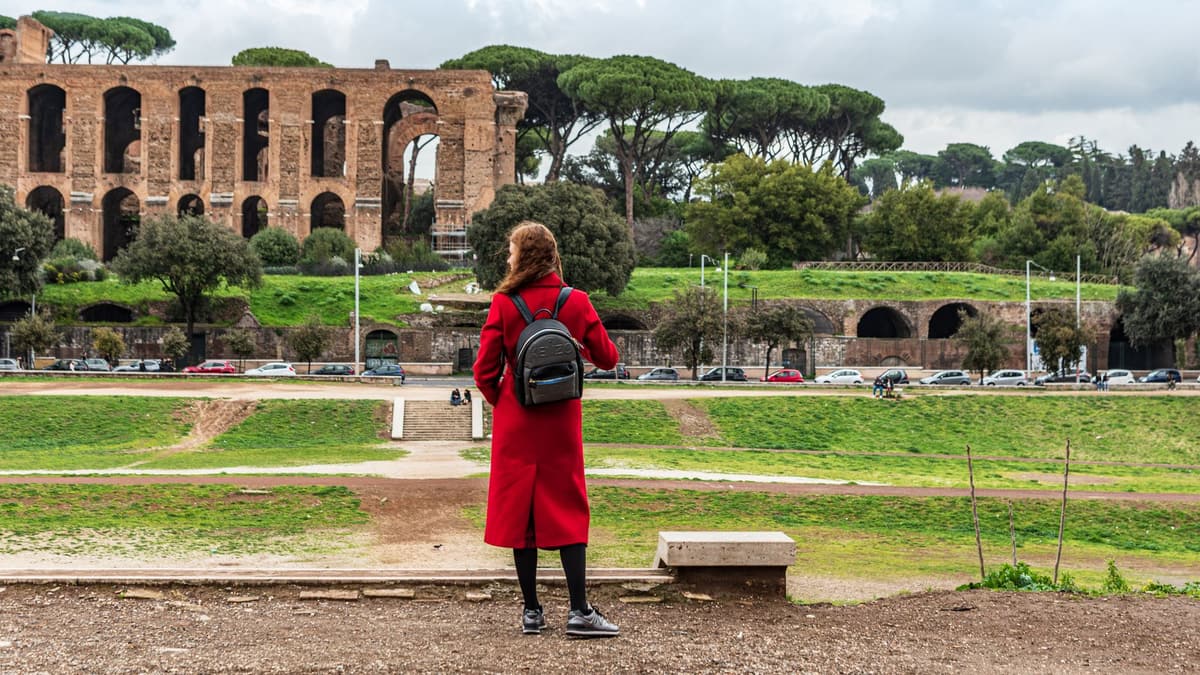
You're at the curved eastern end of the Circus Maximus.
The rest of this stop is in the full audio tour.
You're standing on the old track. Look up at the Palatine Hill.
The rest of this stop is in the full audio tour.
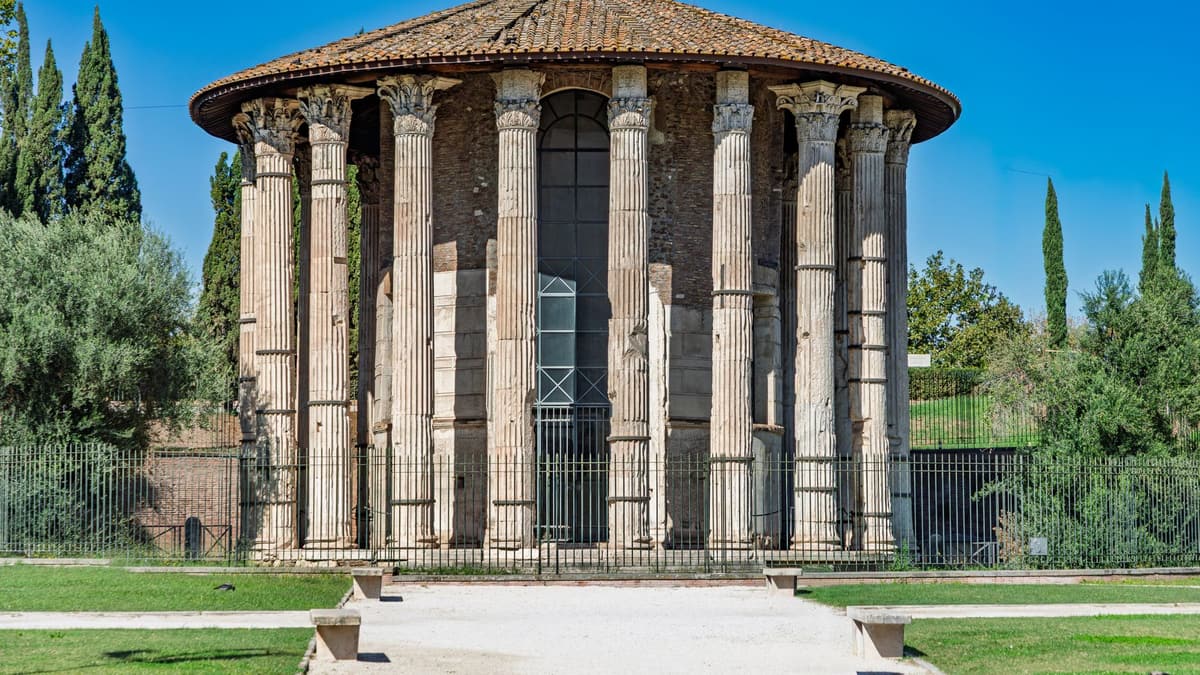
You're in Piazza della Bocca della Verità, in the area the Romans called the Forum Boarium, the cattle market. In front of you stand two ancient temples in the open air.
The rest of this stop is in the full audio tour.
Do this walk with other people on the next scheduled tour.
About 3.1 km, roughly 42 minutes at an easy pace · 7 stops
Friends walk freeOctober 11, 2026 · 9 min read
From the Hollandsche Schouwburg through the old Jewish Quarter, past the Dockworker and the Dam, to the Anne Frank House on the Prinsengracht.
October 11, 2026 · 11 min read
From Van Houten's street by the Vondelpark past Leidseplein, the Rijksmuseum passage and the famous canal bench to the Anne Frank House.

October 11, 2026 · 10 min read
Follow the last days of April and May 1945 from the Anhalter Bahnhof ruin past the Gestapo site and Brandenburg Gate to the Moltke Bridge and the Reichstag.
